
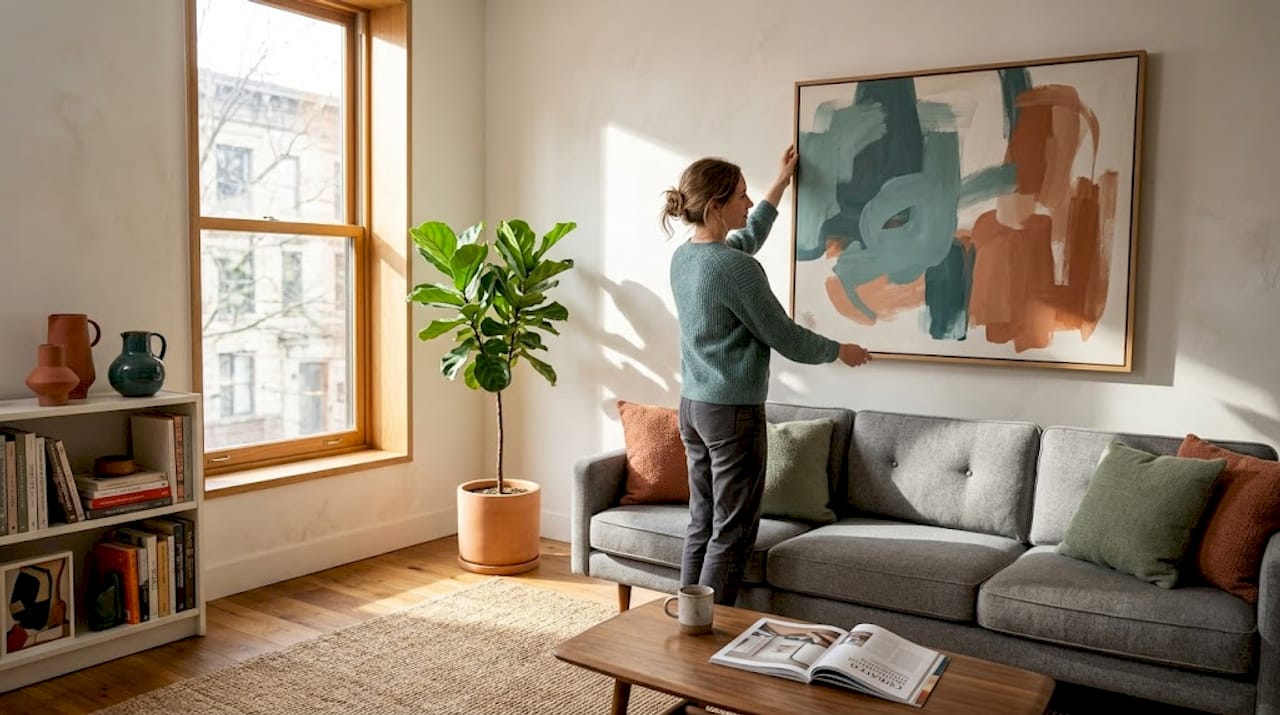
TL;DR:
- Wall art is a crucial but often overlooked element in effective property staging that enhances a space’s warmth, perceived value, and emotional appeal. Properly selected and strategically placed art guides buyers’ attention, creates visual cohesion, and makes listing photographs more engaging, ultimately boosting sale results. Using restrained, proportionate, and broadly appealing pieces ensures a polished, intentional look that helps buyers imagine living in the space.
Wall art is one of the most underestimated tools in a property stager’s arsenal. Most homeowners and interior designers focus on furniture arrangement, neutral paint colours, and decluttering, yet the walls themselves often go under-considered. The result is a space that feels incomplete, slightly cold, or oddly forgettable to buyers walking through the door. Get the art right, and a room shifts from a collection of furniture into a place where someone can genuinely picture their life unfolding. This guide explains exactly why art belongs in your staging strategy, how to choose it wisely, and how to place it for maximum impact at viewings and in listing photographs.
Table of Contents
- The role of art in effective property staging
- How the right art drives buyer connection and sale results
- Selecting art that works: principles and pitfalls
- Applying art for maximum impact: practical staging tips
- What most articles miss about art for staging
- Elevate your staging with unique wall art solutions
- Frequently asked questions
Key Takeaways
| Point | Details |
|---|---|
| Art completes the room | Thoughtful artwork acts as a finishing layer, guiding buyers’ attention and increasing a home’s appeal. |
| Boosts buyer connection | Effective staging art helps buyers visualise living in the space, which can lead to stronger offers. |
| Neutral art widens appeal | Choosing non-personal, broadly appealing pieces reduces friction and attracts more potential buyers. |
| Perfect placement is key | Proper scale, composition, and lighting make staged art look intentional and inviting, both in real life and photos. |
The role of art in effective property staging
Think of a fully furnished room without any art on the walls. The furniture may be beautiful, the flooring pristine, and the lighting warm. Yet something is missing. That something is what staging professionals call the finishing layer, the element that completes a room’s composition and gives the eye a clear place to rest. Art does not compete with the architecture or the furnishings. Instead, it ties them together and signals to a buyer that the space has been thoughtfully considered from floor to ceiling.
Art performs several specific jobs in a staged room. Understanding these functions helps you make deliberate choices rather than simply hanging something that looks nice.
- It creates a focal point. Buyers navigate a room visually before they navigate it physically. A well-placed piece of art draws the eye to the strongest feature of the room, whether that is a chimney breast, a statement wall, or the far end of an open-plan space.
- It adds perceived value. Quality art signals quality taste. Buyers often cannot articulate why a room feels more expensive, but the presence of considered, proportionate wall art is frequently part of the answer.
- It establishes warmth and emotional connection. Bare walls read as vacant and transient. Art introduces life, character, and a sense of permanence that invites buyers to imagine themselves staying.
- It anchors the colour palette. A print or painting that picks up tones from soft furnishings and upholstery creates visual cohesion, making the room feel curated rather than assembled.
You can read more about the staging art impact in the UK show home market, where developers have long understood that art is not decoration for its own sake; it is a conversion tool.
“Art in staging is not about taste. It is about creating the emotional conditions in which a buyer says yes.”
That reframe is important. When you remove personal preference from the equation and focus on the buyer’s psychological response, every decision about art becomes more strategic and more effective.
How the right art drives buyer connection and sale results
With art’s unique function in mind, let us explore the tangible results it delivers. The numbers are worth taking seriously. Staging effectiveness is rooted in helping buyers emotionally connect with a property and visualise it as a future home. Art is one of the most direct and cost-effective ways to trigger that response.
The National Association of Realtors’ staging data provides useful benchmarks, even in a UK context. Staging correlates with stronger sale outcomes in both time on market and offer price, reinforcing the value of every presentation detail, including the artwork on your walls.
| Staging factor | Buyer impact | Staging outcome |
|---|---|---|
| Emotionally neutral art | Reduces friction, widens appeal | More buyers can connect with the space |
| Proportionate wall art | Improves perceived room scale | Rooms feel more considered and balanced |
| Cohesive colour palette | Creates visual harmony | Rooms photograph more attractively |
| Absence of personal art | Removes buyer distraction | Focus stays on the property’s features |
Consider the role art plays in listing photographs. A room with thoughtfully placed art looks more complete on screen, which matters enormously because most buyers form their first impressions online. A wall that reads as bare or unfinished in a photograph signals an unfinished, unloved space, even if the rest of the room is immaculate.
Buyers do not just look at a staged room; they feel it. When the walls are working alongside the furniture and lighting, the overall experience shifts from viewing a house to imagining a home. Explore the types of staging art that work best for different property styles, from minimalist prints for modern flats to more textured, organic works for period homes.
It is also worth noting the custom wall art benefits when staging a high-value or distinctive property. A bespoke piece, scaled precisely to the wall and matched to the interior palette, communicates a level of attention to detail that buyers in the premium market actively respond to.
Selecting art that works: principles and pitfalls
Now let us clarify how to sidestep common staging art mistakes and make selections that elevate any space. The foundational principle is simple: art for staging is not art for self-expression. It is art for broad appeal.
Neutral, broadly appealing art consistently outperforms personal or controversial pieces in staging contexts. This means landscapes, abstracts in muted or complementary tones, botanical prints, and architectural photography tend to work well. Portraits, political works, highly stylised religious imagery, and anything with strong personal narrative associations do not.
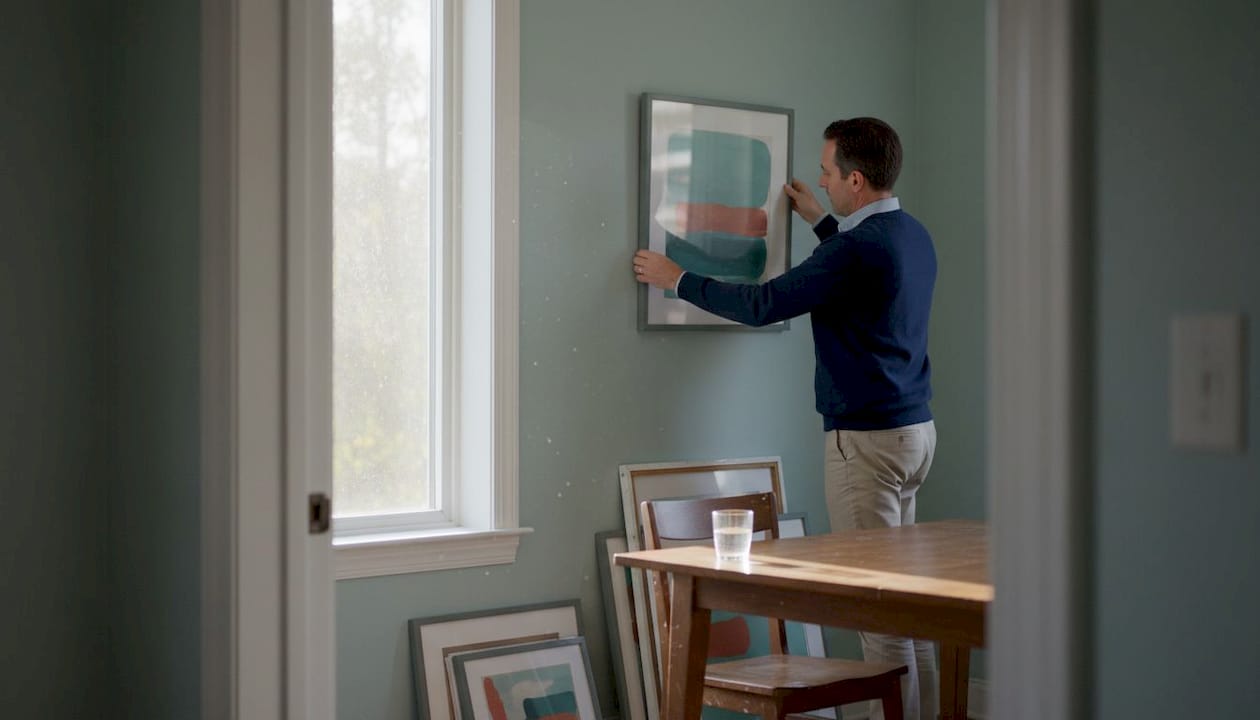
Proportion is the other critical factor. Art should be proportionate to the wall and the furniture beneath it, hung at an appropriate eye level, and coordinated with the room’s existing colour palette. A small print on a vast wall looks lost. An oversized canvas above a narrow console table overwhelms the space. Neither outcome serves the buyer’s perception of the room.
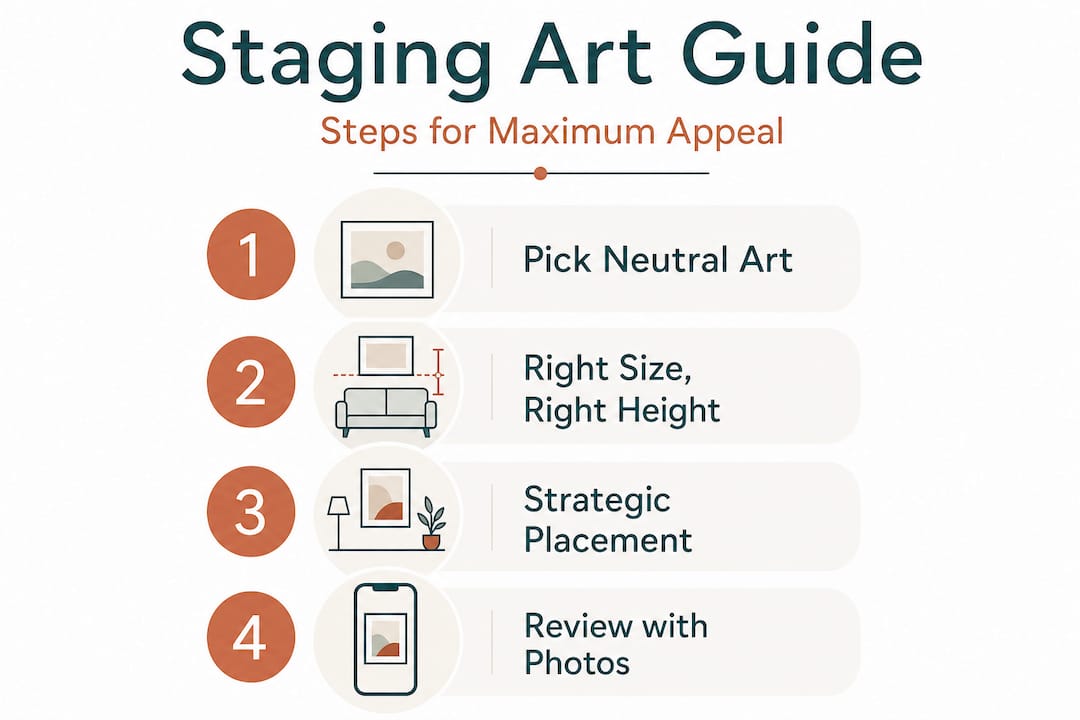
Here is a numbered checklist for selecting and placing staging art:
- Measure before you choose. The artwork should span roughly two thirds of the width of the furniture it sits above. For a 180 cm sofa, aim for art between 110 and 130 cm wide, whether as a single piece or a grouped arrangement.
- Hang at eye level. The centre of the artwork should sit approximately 145 to 150 cm from the floor. In rooms with very high ceilings, you can hang slightly higher to draw the eye upward, but avoid going too far above sight lines.
- Limit focal points. One strong statement per room is almost always more effective than multiple competing pieces. A gallery wall can work but requires careful curation to avoid visual noise.
- Match the mood, not just the palette. A calm, airy abstract suits a bedroom. A bold, energetic print suits a home office or kitchen. The emotional register of the art should support the intended use of the room.
- Check for glare. Glazed frames can create distracting reflections in photographs and under strong artificial lighting. For staging, unglazed prints or matte-finish frames are often the better choice.
Pro Tip: Before committing to art placement, photograph the room with a smartphone from the doorway. This mimics how listing images are taken and immediately reveals whether the art is working, or whether it is creating glare, looking too small, or drawing the eye in the wrong direction.
You can find focused guidance on art selection tips as well as staging art expert tips from professionals who work across residential and commercial projects. For anyone working with a specific interior scheme, the guidance on matching art with interiors is particularly practical.
| Common staging art mistake | Why it undermines the space | The better approach |
|---|---|---|
| Hanging art too high | Creates disconnect between wall and furniture | Centre at 145 to 150 cm from floor |
| Choosing art that is too small | Makes room feel sparse and unresolved | Follow the two-thirds furniture width rule |
| Using personal or sentimental pieces | Distracts buyers and reduces identification | Choose neutral, broadly appealing works |
| Overcrowding with multiple pieces | Creates visual noise and cognitive overwhelm | One strong focal point per room |
| Ignoring glare from glazing | Ruins listing photographs | Use unglazed or matte-finish prints for staging |
Applying art for maximum impact: practical staging tips
Having covered what makes art work in theory, here is how to put these principles into action in real spaces. Whether you are preparing a property for sale yourself or working as a professional stager, these practical steps will help you achieve polished, photograph-ready results.
For in-person viewings:
- Hang art before viewings and step back to assess it from the doorway. First impressions happen in seconds.
- Use art to guide a buyer’s path through the home. A striking piece at the end of a hallway draws people forward. Art positioned to face the main entrance of a room creates an immediate welcome.
- Keep the number of pieces restrained. In an average-sized living room, one or two pieces are usually sufficient. Adding more rarely improves the result and often creates the feeling of a cluttered home rather than a considered one.
- Ensure art does not compete with the home’s best architectural features. If there is a beautiful bay window or period fireplace, let it breathe. Art placed nearby should complement, not distract.
For listing photographs:
Strong listing photographs are one of the most valued elements by buyers’ agents, and wall art directly affects how a room reads on camera. A bare or poorly dressed wall in a photograph signals an unfinished space. A well-chosen print or canvas immediately communicates that the room is complete, well-proportioned, and worth visiting.
- Remove anything with glass if it creates strong reflections. Even a beautiful piece can ruin a photograph if it reflects the camera or the window opposite.
- Adjust lighting to eliminate shadows cast by frames. Side lighting often creates distracting dark shapes on walls.
- Use art to add a point of colour interest in otherwise neutral rooms. A single print with a considered accent colour can bring the room to life on screen without making the space feel personalised.
Pro Tip: Print art in advance rather than relying on digital placeholders during staging. Buyers viewing a property with placeholder frames will notice, and the effect is the opposite of what you want. A real, high-quality print at the correct size always delivers more than a printed sheet in a cheap frame.
“Staging is the art of helping someone fall in love with a place they have never been before. The walls are not background. They are part of the story.”
You will find useful context on art’s role in interior design and how it can function as an art as a design anchor that holds the rest of the room’s composition together.
What most articles miss about art for staging
Here is an uncomfortable truth that most guides will not tell you: more art does not equal better staging. The instinct when a room feels flat is to add things. A print here, a canvas there, a gallery wall because it worked well in someone else’s living room. This instinct is usually wrong.
The most effective staging we see consistently involves restraint. One powerful piece in the right place beats three mediocre ones distributed around the room. Negative space, the area of the wall that is deliberately left bare, is not emptiness. It is breathing room. It gives the eye somewhere to rest and makes the art that is present feel intentional and significant.
Professional stagers who work on high-value properties will often remove art rather than add it. When a room already has strong architectural features, statement furniture, or exceptional natural light, additional art competes for attention and dilutes the room’s impact. Knowing when to stop is a skill that takes practice to develop, but the instinct to keep adding is one of the most common mistakes in amateur staging.
There is also the question of scale. A room that has been staged with one oversized, beautifully proportioned canvas will almost always outperform a room with three or four smaller prints, even if those prints are individually attractive. Hierarchy matters. The eye needs a clear leader, a single dominant visual element that everything else supports. When you have multiple pieces competing for that position, the room feels busy rather than resolved.
The rules of art for staging can be broken, but only when you understand them well enough to know why. A deliberately eclectic gallery wall can work in a creative home or a property aimed at a particular buyer demographic. Personalising with art has its place in the right context. The key is that every decision should be deliberate, not accidental.
Elevate your staging with unique wall art solutions
As you consider these best practices, sourcing the right art for staging has never been more straightforward. At Frametheworld, we offer curated collections and a fully personalised approach to finding or creating art that serves your staging goals precisely. Browse our Wabi Sabi wall art collection for organic, broadly appealing pieces that bring warmth without personal narrative, ideal for living rooms, bedrooms, and hallways. If you need something truly tailored to a specific wall dimension, colour palette, or interior scheme, our custom print service lets you work directly with us to create bespoke staging pieces. For spaces that need a more vibrant lift, our colourful wall art collection offers bold prints that still read as broadly appealing in the right staging context. Whether you are a homeowner preparing for sale or a professional staging multiple properties, we have the range and the flexibility to support you.
Frequently asked questions
Is it better to have blank walls or use art when staging?
Art generally improves staging results, but leaving walls bare is the right choice when a room is already balanced and adding art would create visual noise rather than resolve the composition.
What type of art is best for home staging?
Neutral, broadly appealing art in muted or complementary tones works best, as it helps buyers imagine themselves in the space without being distracted by personal or polarising imagery.
Does art placement affect how a property feels in listing photos?
Yes, because well-placed art makes rooms look finished and well-proportioned on screen, directly improving how the listing performs with online buyers.
Can staging with art increase a home’s sale price?
Staged homes consistently perform better in terms of both sale price and time on market, and art is one of the most cost-effective staging elements available to homeowners and professionals alike.


Leave a comment
This site is protected by hCaptcha and the hCaptcha Privacy Policy and Terms of Service apply.