

TL;DR:
- Choosing wall art should reflect your room’s purpose and emotional mood.
- Correct scale and placement are crucial for visual harmony and aesthetic balance.
- Personal, imperfect art selections create a more memorable and authentic home environment.
Choosing wall art should feel exciting, yet for many homeowners it becomes one of the most paralysing decisions in a room refresh. With thousands of styles, sizes, and formats available, it is easy to second-guess every choice. The right piece does far more than fill a blank wall. It sets a mood, tells a story, and pulls a room together in a way that no cushion or rug can replicate. This guide walks you through a practical, design-conscious approach to selecting art that genuinely suits your space, your personality, and the atmosphere you want to create.
Table of Contents
- Define your purpose and style vision
- Choose artwork scale and placement
- Work with colour, contrast and cohesion
- Select art styles and create balanced arrangements
- Compare methods: Single statement vs gallery wall
- Why the best art selection is driven by personality, not perfection
- Curate your home effortlessly with bespoke art
- Frequently asked questions
Key Takeaways
| Point | Details |
|---|---|
| Prioritise personal connection | Art that resonates with you adds character and warmth to any room. |
| Balance scale and placement | Choose artwork that fits the space and position it at eye-level for the best effect. |
| Use colour for impact | Draw from accent colours or create contrast to unify or enliven your decor. |
| Mix and match styles | Combining different types of art brings depth and a curated feel to your interiors. |
Define your purpose and style vision
Before you browse a single print, ask yourself one honest question: what do you want this artwork to do? That might sound abstract, but it shapes every decision that follows. Some people want art that sparks conversation when guests arrive. Others want something calming for a bedroom, or a bold focal point that ties together a living room’s colour palette. Knowing your intent saves you from buying something that looks right in isolation but feels wrong on the wall.
Think about the emotional register of the room. A home office benefits from something energising or thought-provoking. A hallway can handle something dramatic. A bedroom calls for pieces that feel restful or personally meaningful. Once you have that emotional brief, narrowing down styles becomes much easier.
Here are some common style directions to consider:
- Modern abstract: Bold shapes, expressive brushwork, and non-representational forms that suit contemporary interiors
- Botanical and nature prints: Timeless, versatile, and calming across most room types
- Photography: Adds realism and narrative, works especially well in monochrome or muted tones
- Sentimental and personal pieces: Family portraits, children’s artwork, or pieces collected on travels
- Classic and figurative art: Portraits, landscapes, and still life works that bring depth and history
As you explore personalising with art choices, remember that no single style is more valid than another. A personal love for art is as valid as investment value, and mixing thrift finds, children’s drawings, or blue-chip prints creates genuine individuality.
“The most interesting walls are rarely curated by a single rule. They are built over time, with intention and feeling.”
Pro Tip: Write down three words that describe how you want the room to feel before you start shopping. Use those words as a filter when you are unsure between two pieces.
Choose artwork scale and placement
Once you know your style goals, focus on the logistics of scale and placement. Getting the size wrong is the single most common art mistake in home decorating, and it is surprisingly easy to fix with a little preparation.
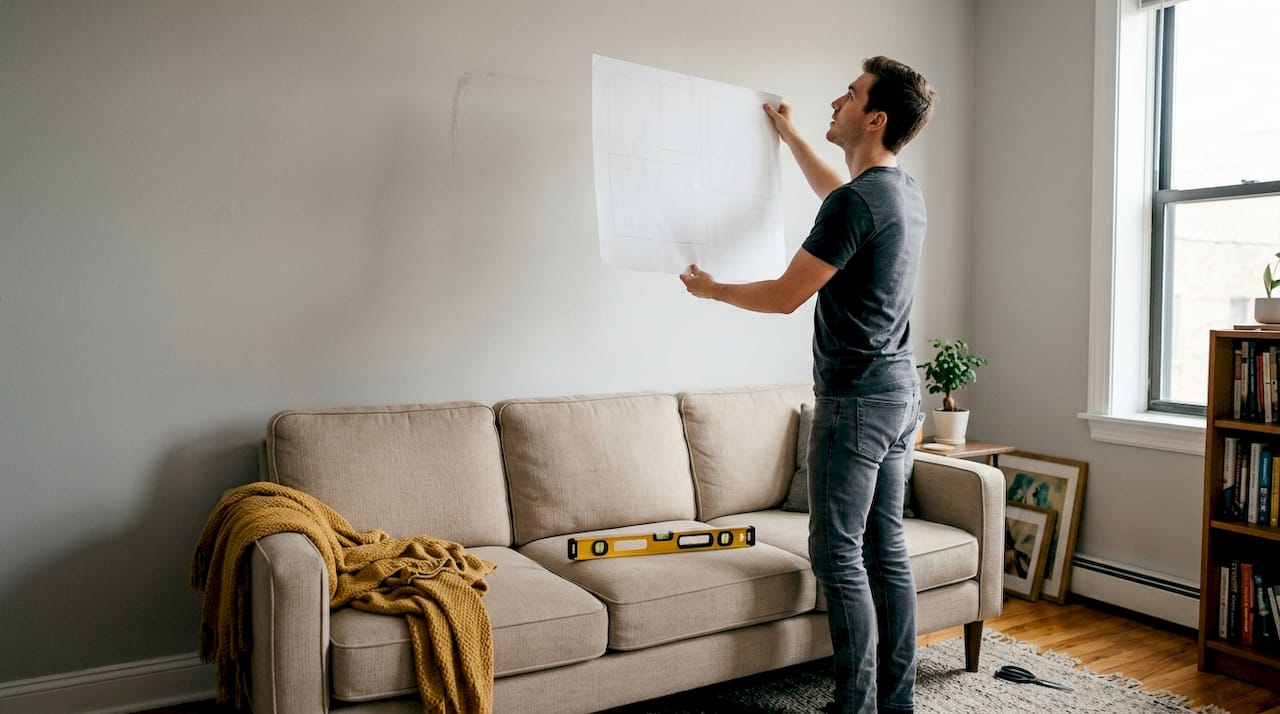
The general rule is that artwork above a sofa should span roughly two-thirds to three-quarters of the sofa’s width. Above a bed, a single piece or grouped arrangement should not exceed the width of the headboard. Above a mantelpiece, the artwork should sit comfortably within the mantel’s frame without overhanging the edges.
| Placement location | Recommended art width | Hanging height (centre) |
|---|---|---|
| Above sofa | 60 to 75% of sofa width | 145 to 150 cm from floor |
| Above bed | Up to headboard width | 15 to 20 cm above headboard |
| Above mantel | Within mantel width | 10 to 15 cm above shelf |
| Standalone wall | 50 to 75% of wall width | 145 to 150 cm from floor |
For art sizing guidance, always measure your wall and the furniture below before ordering. A visual size guide can help you visualise proportions before committing.
Key placement tips:
- Use painter’s tape on the wall to mock up the artwork’s footprint before hanging
- In narrow hallways or art in small spaces, vertical formats draw the eye upward and make ceilings feel higher
- Avoid hanging art too high, which is the most frequent error in residential spaces
Oversized art anchors large rooms, while gallery walls use 6 to 8 inch spacing with the largest piece positioned first to establish the visual anchor.
Pro Tip: Cut out paper templates in your chosen art dimensions and stick them to the wall with low-tack tape. Live with the layout for a day before making any holes.
Work with colour, contrast and cohesion
With size and placement decided, consider colour harmony for maximum impact. Colour is where many people either overthink or underthink their art choices, and both extremes lead to rooms that feel slightly off.
The most effective approach is to pull accent colours from existing elements in the room, such as cushions, rugs, or curtains, and look for artwork that echoes or gently contrasts those tones. You are not trying to match; you are trying to converse.
| Approach | Effect | Best used when |
|---|---|---|
| Tonal harmony | Calm, cohesive, sophisticated | Room already has strong pattern or texture |
| Complementary contrast | Energetic, eye-catching, dynamic | Room is neutral or monochrome |
| Accent pull | Balanced, intentional, grounded | You want art to feel part of the scheme |
| Bold statement | Dramatic, transformative | Art is the clear focal point of the room |
Colour tips to keep in mind:
- Avoid matching artwork directly to sofa upholstery or wall paint; it flattens both
- In rooms with busy wallpaper or patterned textiles, choose calmer, more restrained artwork
- A single bold colour in the artwork can tie together an otherwise disparate scheme
For more on matching art with interiors, consider how light changes throughout the day and how that affects the perceived colour of both your walls and your artwork. Natural and artificial light shift colour temperature significantly. A colour selection guide can help you navigate those nuances with confidence.
Subtly pulling from accent colours while avoiding overpowering or blending in too much creates the most enduring results.
Select art styles and create balanced arrangements
Once you have established colour cohesion, look at how style and arrangement elevate the final look. A single well-chosen piece can be transformative, but a thoughtfully arranged group of works creates something richer and more personal.
For a cohesive gallery wall, follow these steps:
- Choose a unifying element, whether that is colour, frame finish, subject matter, or mood
- Lay all pieces on the floor first and experiment with arrangements before touching the wall
- Start with the largest piece first as the anchor, then build outward with 6 to 8 inch gaps between frames
- Mix orientations, portrait and landscape, to create visual rhythm
- Include at least one unexpected element, such as a mirror, a sculptural object, or a piece in a contrasting style
- Step back frequently and assess the arrangement from the room’s natural viewing distance
“A gallery wall is not a collection of individual pieces. It is a single composition made of many voices.”
Mixing modern and classic styles within one arrangement works well when you maintain consistency in frame colour or material. Black frames unify wildly different art styles. Natural wood frames soften and warm a contemporary grouping.
For deeper inspiration on gallery wall advice and the benefits of gallery walls, consider how essential art styles can be layered to reflect your evolving taste.
Pro Tip: Photograph your floor layout before hanging. It gives you a reference point if pieces shift during installation.
Compare methods: Single statement vs gallery wall
To help you decide, compare the two main arrangement philosophies. Both have genuine merit, and the right choice depends on your room, your personality, and the story you want to tell.
| Factor | Single statement piece | Gallery wall |
|---|---|---|
| Room size | Best in large or open-plan spaces | Works in any size, especially smaller rooms |
| Visual impact | Immediate, focused, dramatic | Layered, narrative, evolving |
| Flexibility | Harder to change without redecorating | Easy to add, swap, or rotate pieces |
| Personal expression | Strong singular statement | Rich, multi-layered storytelling |
| Installation effort | Simple and quick | Requires planning and patience |
A single oversized artwork is powerful in a large living room or above a wide dining table. It creates a clear focal point and prevents visual clutter in rooms that already have strong architectural features. Oversized art anchors large rooms in a way that no collection of smaller pieces can replicate.
A gallery wall, by contrast, suits rooms where you want warmth, personality, and a sense of accumulated life. It is ideal for:
- Staircases and hallways where you pass through rather than sit
- Home offices where inspiration and personality matter
- Bedrooms where personal meaning outweighs design formality
- Smaller rooms where multiple smaller pieces create more visual interest than one large work
Neither approach is universally superior. The most honest question is: does this room need a full stop or a conversation?
Why the best art selection is driven by personality, not perfection
Here is something the design world does not say loudly enough: the most memorable rooms are rarely the most perfectly coordinated ones. They are the rooms that feel inhabited, where the art has a story and the choices reflect a real person rather than a mood board.
There is a tendency, especially when decorating from scratch, to reach for safe, coordinated sets of prints that match effortlessly. The result is often a room that looks finished but feels empty. A piece with genuine personal meaning brings life to spaces more than exact matching ever can.
We would encourage you to include at least one piece that breaks the rules. A vintage find that clashes slightly with everything else. A child’s drawing in a proper frame. A print from a place that changed you. These are the pieces guests remember and the ones that make a house feel like a home.
As you work through how to choose perfect art, resist the urge to over-coordinate. Imperfection, when it is intentional, is always more interesting than a flawless but soulless scheme.
Curate your home effortlessly with bespoke art
At Frametheworld.co.uk, we make it straightforward to bring your art vision to life, whether you know exactly what you want or are still exploring. Browse our curated collections to find pieces that suit every aesthetic, from the quiet restraint of Wabi Sabi wall art to the vibrancy of colourful paintings that transform a neutral room instantly. If you have a specific vision in mind, you can commission a custom print tailored to your exact dimensions, colour palette, and style. We serve both private homeowners and professional interior designers, so whether you are styling one room or an entire project, we have the range and flexibility to support you.
Frequently asked questions
How do I choose the right art size for my wall?
Measure your wall and the furniture beneath it, then use an art print sizing guide to ensure the artwork spans roughly two-thirds to three-quarters of the item below it for visual balance.
Should my art match my sofa or room decor exactly?
Avoiding exact matches is advisable. It is far more effective to pick art that complements or contrasts your room’s palette subtly, as precise matching tends to flatten both the artwork and the furnishings around it.
Can I mix modern, classical and personal art in one room?
Absolutely. Blending different styles creates a layered, authentic look, and personalising spaces authentically through mixed selections gives a room genuine character as long as colour, scale, or theme provides a connecting thread.
What’s the best height to hang art?
Hang artwork so its centre sits at roughly 145 to 150 cm from the floor. A visual guide to artwork sizing can help you confirm the right position for specific furniture arrangements.
Is one large artwork or a gallery wall better for my space?
A single large piece suits wide, open spaces and creates a clear focal point, while a gallery arrangement works beautifully in smaller rooms or wherever you want to tell a richer, more personal visual story.


Leave a comment
This site is protected by hCaptcha and the hCaptcha Privacy Policy and Terms of Service apply.