

TL;DR:
- Choosing decorative prints intentionally early in the design process creates cohesive and personalized spaces.
- Gallery wall layouts include grid, salon-style, and asymmetrical arrangements, each suited for different settings.
- 2026 trends feature large abstracts, botanicals, minimalist text art, and sustainable, custom mural prints.
Choosing decorative prints should feel exciting, yet most people find themselves paralysed by the sheer volume of options available. Walk into any interiors shop or browse online, and you are immediately confronted with thousands of styles, sizes, formats, and colour palettes. The result? Many homeowners and designers either play it safe with generic choices or delay the decision entirely. This article cuts through that noise. We will walk you through a practical selection framework, showcase the gallery wall arrangements that work best in real spaces, highlight the decorative print genres defining 2026, and give you room-by-room guidance so every print you hang feels deliberate and right.
Table of Contents
- How to select the perfect decorative prints
- Gallery walls: Arrangements and examples
- Trending types of decorative prints in 2026
- How to match prints to your space and purpose
- Our perspective: Why decorative prints deserve intentional planning
- Find your perfect decorative prints with Frametheworld
- Frequently asked questions
Key Takeaways
| Point | Details |
|---|---|
| Use a selection framework | Decide purpose, scale and style for each decorative print before you buy. |
| Experiment with gallery walls | Grid, salon or asymmetrical arrangements creatively enhance any room’s visual appeal. |
| Follow 2026 print trends | Opt for abstract, botanical, or text-based prints to keep your décor fresh and contemporary. |
| Match prints to space | Tailor print type and size to each space’s function, whether it’s homely or professional. |
| Plan prints early | Select main decor prints before finalising furnishings to anchor your aesthetic vision. |
How to select the perfect decorative prints
Selecting decorative prints is not about picking what looks pretty in isolation. It is about understanding what a print needs to do in a given space before you even start browsing. A structured approach saves time, money, and the frustration of buying something that never quite fits.
Start with these three criteria:
- Purpose. Is this print for personal expression in a home, or does it need to reinforce a brand identity in a commercial setting? A bold abstract may energise a living room, but a reception area might need something that communicates professionalism and calm.
- Size and layout. A print that is too small for a wall disappears. One that is too large overwhelms. Measure your wall space first, then work backwards to find the right format. Consider whether you want a single statement piece or a grouped arrangement.
- Cohesion with existing decor. Look at your dominant colours, textures, and furniture style. Your print does not need to match everything, but it should belong. A raw linen sofa pairs beautifully with earthy botanical prints; a sleek, modern kitchen suits geometric abstracts.
When it comes to choosing wall art, it helps to understand what is resonating in the wider market. Current wall art styles show that 2026 trends feature large abstracts and botanicals, minimalist text art, and sustainable materials. These are not passing fads. They reflect a broader cultural shift towards nature, intentionality, and considered consumption. Keeping an eye on wall art trends 2026 helps you choose prints that feel current without dating quickly.
Customisation is increasingly popular, and for good reason. A bespoke print lets you control scale, palette, and subject matter to suit your exact space. Mix-and-match approaches, combining different styles within a unified colour story, are particularly effective for creating spaces that feel curated rather than catalogue-bought.
Pro Tip: Before you commit to hanging anything, cut paper templates to the exact dimensions of your intended prints and tape them to the wall. Live with them for a day. You will immediately see whether the scale and positioning feel right, saving you unnecessary holes and disappointment.
Gallery walls: Arrangements and examples
Once you have your selection criteria in place, gallery walls offer one of the most versatile and visually compelling ways to display decorative prints. Whether you are working with a residential living room or a commercial corridor, the arrangement you choose shapes the entire mood of the space.
There are three primary gallery wall layouts to consider:
- Grid arrangements use uniform frames and equal spacing to create a clean, ordered look. Ideal for contemporary interiors and commercial environments where consistency signals professionalism.
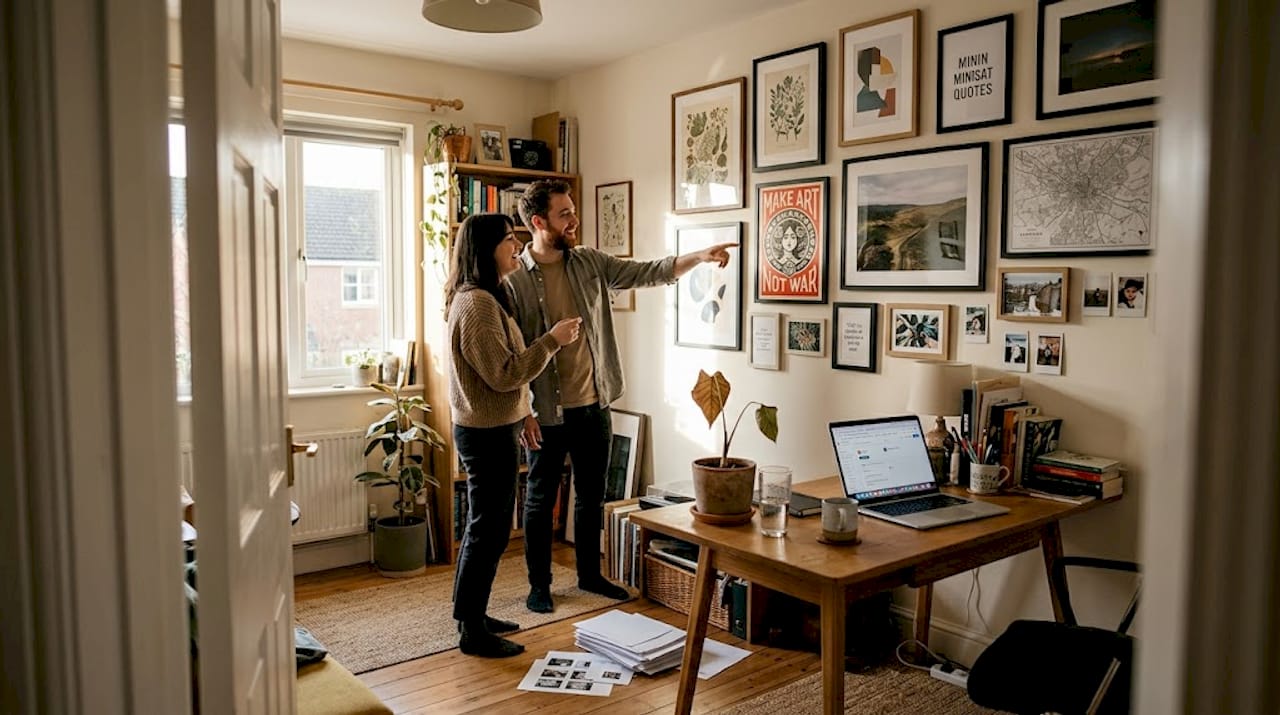
- Salon-style arrangements stack and cluster frames of varying sizes in a dense, layered composition. This approach suits traditional or eclectic homes and creates a sense of richness and personality.
- Asymmetrical arrangements balance different frame sizes and shapes without strict rules. They feel relaxed and modern, working particularly well in open-plan living spaces.
For living room wall decor, the salon style is often the most rewarding choice because it allows you to mix prints across different genres, from botanicals to abstract, without the composition feeling chaotic.
Layout data matters more than most people realise. According to a gallery wall guide, spacing frames 2-3 inches apart, keeping the overall width roughly two-thirds of the furniture below, and hanging at eye level between 57 and 60 inches produces the most balanced results. Deviate significantly from these proportions and even beautiful prints can look awkward.
| Layout type | Best setting | Frame style | Mood created |
|---|---|---|---|
| Grid | Commercial, modern home | Uniform, matching | Ordered, professional |
| Salon-style | Traditional, eclectic home | Mixed sizes and finishes | Rich, personal, layered |
| Asymmetrical | Open-plan, contemporary | Varied but cohesive | Relaxed, curated |
The most common mistake people make is hanging prints too high. Eye level is the golden rule, and it applies whether you are standing in a hallway or seated in a dining room. A second frequent error is choosing frames that compete rather than complement. Mixing too many different frame finishes across a single wall fragments the composition and draws the eye away from the prints themselves.
“A gallery wall is only as strong as its weakest compositional decision. Get the spacing, scale, and hanging height right, and almost any combination of prints can work together.”
Trending types of decorative prints in 2026
With display methodology covered, it is worth focusing on the specific print genres that are shaping interiors right now. The 2026 wall art market is defined by large-scale abstracts, botanicals, text-based art, and rising demand for generative and custom mural prints. Each genre has its own strengths and ideal settings.
| Print type | Ideal setting | Key characteristic | Longevity |
|---|---|---|---|
| Large-scale abstract | Above sofa, open-plan living | Bold colour, gestural marks | High |
| Botanical | Kitchen, bathroom, bedroom | Nature-led, calming | Very high |
| Minimalist text art | Home office, hallway | Typographic, motivational | Medium |
| Generative/custom mural | Feature walls, commercial | Unique, bespoke | Very high |
| Sustainable material prints | Any room | Eco-conscious, textured | High |
Here is how each type performs in practice:
- Large-scale abstracts work brilliantly above sofas or as a single focal point in an open-plan space. Their gestural quality adds energy without demanding a specific narrative.
- Botanical prints are among the most enduring choices available. They bring the outdoors in, suit almost every colour palette, and age gracefully. Place them in kitchens, bathrooms, or bedrooms for maximum effect.
- Minimalist text art has found a strong home in home offices and hallways. A well-chosen phrase or typographic composition adds personality without visual clutter.
- Generative and custom mural prints are the most exciting development in the market. These are prints created using algorithms or bespoke design briefs, making each piece genuinely unique.
- Sustainable material prints printed on recycled or responsibly sourced substrates are growing rapidly as buyers become more conscious of environmental impact.
For a deeper look at what is shaping interiors, explore wall art trends and consider the impact of colour when selecting your palette.
Pro Tip: If you want a trending print that will not feel dated in three years, choose one where the subject is timeless even if the style is current. A botanical rendered in a contemporary palette will outlast a purely trend-driven graphic by years.
How to match prints to your space and purpose
Knowing what is trending is only useful if you can match those options to your specific context. The same print that elevates a bedroom can feel out of place in a reception area, and vice versa. Intentional placement is what separates a beautifully designed space from a room that simply has art on the walls.
Here is a practical room-by-room guide:
- Living room. Choose a large statement piece or a salon-style gallery wall. Abstracts and botanicals both work well. Aim for prints that reflect your personality rather than simply filling space.
- Bedroom. Calm, considered prints work best here. Soft botanicals, muted abstracts, or intimate photography create a restful atmosphere. Avoid anything too visually demanding above the bed.
- Home office. Minimalist text art or structured geometric prints support focus and motivation. Keep the palette neutral to avoid distraction.
- Hallway. This is an underused opportunity. A confident, vertical print or a tight grid of small frames creates a strong first impression without overwhelming a narrow space.
- Commercial reception. Residential decor prioritises eclectic mixes while commercial spaces focus on brand consistency and durable materials. Choose abstracts in brand-aligned colours and invest in quality framing.
Scale is the single most misunderstood element in print selection. A print that looks correct in a photograph may be entirely wrong for your wall once you account for ceiling height, furniture scale, and natural light. Always consider the focal point of the room first, then size your print to anchor or complement it.
For anyone still questioning whether decorative prints are worth the investment, why invest in decorative prints makes a compelling case for treating wall art as a foundational design element rather than a finishing touch.
Pro Tip: Consider scale relative to your focal point. If your sofa is the room’s anchor, your print should be roughly two-thirds of its width to feel proportionate and grounded.
Our perspective: Why decorative prints deserve intentional planning
Here is something most interiors advice will not tell you. Decorative prints are almost universally treated as an afterthought. Furniture arrives, paint goes on the walls, and then someone thinks about art. This sequence is the single biggest reason so many rooms feel almost right but never quite finished.
When prints are chosen early in the design process, something different happens. The print becomes a reference point. Its colours inform the cushion selection. Its mood shapes the lighting choices. Its scale determines furniture placement. A hero print, chosen deliberately and early, unifies a space in ways that no amount of accessorising can replicate after the fact.
Our view, shaped by working with both homeowners and commercial designers, is that you should build your colour and texture palette around a print you love, not the other way round. Start with the art. Everything else follows more naturally than you might expect. Explore design art trends to find a starting point that genuinely excites you, then let that choice lead your wider design decisions.
Find your perfect decorative prints with Frametheworld
At Frametheworld, we have built our collections around exactly the principles covered in this article. Whether you are drawn to the organic calm of Wabi Sabi wall art, the vibrancy of colourful canvas art, or something entirely your own, our platform makes it straightforward to browse by style, size, and format. If you have a specific vision in mind, you can create a custom print tailored to your exact space and brief. We work with both private customers and professional designers, so whether you are decorating a single bedroom or fitting out an entire commercial project, we are here to help you get it right.
Frequently asked questions
What are the most popular decorative prints in 2026?
Large-scale abstracts, botanicals, minimalist text-based designs, and sustainable materials are 2026’s biggest decorative print trends, reflecting a broader shift towards nature and intentional design.
How do I arrange decorative prints for a gallery wall?
Use grid, salon-style, or asymmetrical layouts; space frames 2-3 inches apart and hang at eye level between 57 and 60 inches for the most balanced result.
What’s the difference between prints for homes and businesses?
Residential spaces favour personal, eclectic mixes, while commercial environments prioritise brand-consistent abstracts and durable, high-quality materials that withstand heavy footfall and varied lighting.
How can I ensure my decorative prints look cohesive?
Match prints by colour palette and frame style, and always consider scale and placement relative to the room’s focal point for a unified visual flow.


Leave a comment
This site is protected by hCaptcha and the hCaptcha Privacy Policy and Terms of Service apply.