

TL;DR:
- Multi-panel art, or polyptychs, originated from religious altarpieces and now enhance interior decor.
- Proper arrangement and spacing of panels create movement, depth, and flexibility in large wall art.
- This format allows storytelling, customization, and versatile display options for personal and modern interiors.
Walk into any contemporary home and you might spot a set of three canvases hanging side by side, each one a fragment of a larger image. Many people assume this is simply a modern design trick, yet the idea stretches back centuries to the altarpieces of medieval Europe. Multi-panel art sits at a fascinating crossroads between history and interior design, and understanding it properly changes how you see your own walls. This guide explains what multi-panel art is, where it came from, how it benefits your living space, and how to display it well.
Table of Contents
- Defining multi-panel art: the polyptych explained
- A journey from tradition to modern interiors
- How multi-panel art transforms your living space
- Key considerations: display, arrangement, and common pitfalls
- A new perspective on multi-panel art: beyond aesthetics
- Find the perfect multi-panel art for your home
- Frequently asked questions
Key Takeaways
| Point | Details |
|---|---|
| Multi-panel art origin | Polyptych art has a rich history rooted in religious altarpieces and is now popular in modern homes. |
| Decor impact | Multi-panel pieces enhance wall spaces by adding movement, depth, and a striking focal point. |
| Practical flexibility | Arranging panels offers versatility for different spaces and is easier to install and move than large single canvases. |
| Successful installation tips | Proper spacing, alignment, and wall coverage are essential for an impressive display. |
Defining multi-panel art: the polyptych explained
The term most people reach for is simply “split-canvas art” or “panel set,” but the correct word is polyptych. A polyptych is a painting or artwork divided into multiple panels or sections, typically more than three, derived from the Greek words poly (many) and ptychē (fold). It is a precise term with a long history, and knowing it immediately gives you a richer framework for choosing and discussing art.
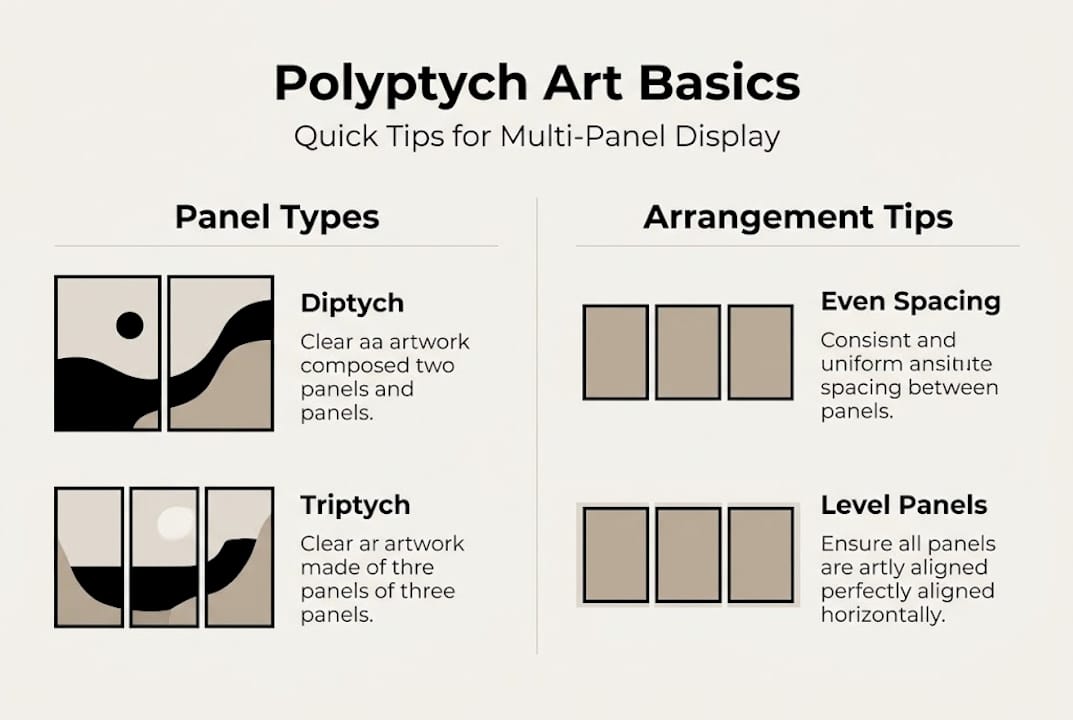
The broader family of multi-panel works includes:
- Diptych: Two panels, often mirrored or contrasting in composition
- Triptych: Three panels, the most popular format in both historical and modern contexts
- Polyptych: Four or more panels, offering the greatest visual scope and storytelling potential
Each format carries a different visual weight. A diptych feels intimate and balanced. A triptych creates a natural focal point in the centre. A polyptych, when well composed, can fill an entire wall with narrative energy.
Historically, multi-panel works were sacred objects. Think of the polyptych altarpiece anatomy found in great European churches, where hinged wooden panels folded open to reveal scenes from scripture. The structure was functional as much as decorative, protecting the painted surface and allowing the altarpiece to be closed during certain liturgical seasons.
Modern decorative polyptychs share the same visual logic but serve an entirely different purpose. Rather than wood panels with gold leaf, you are more likely to encounter canvas prints or acrylic panels. Rather than religious iconography, you might find an abstract seascape or a botanical photograph split across three frames.
| Format | Number of panels | Common use |
|---|---|---|
| Diptych | 2 | Paired portraits, contrasting themes |
| Triptych | 3 | Landscapes, abstracts, focal-point walls |
| Polyptych | 4 or more | Large feature walls, narrative sequences |
Understanding these distinctions helps you make a more deliberate choice. If you are curious about how scale affects the impact of wall art, the large scale art benefits are worth exploring before you commit to a format.
A journey from tradition to modern interiors
Having defined multi-panel art, it is essential to see how the concept has shifted from its religious origins to the heart of today’s interior design.
Traditional polyptychs feature a large central panel with smaller side panels or wings, often hinged for folding, painted on wood with religious themes as altarpieces. The craftsmanship was extraordinary. Artists ground their own pigments, applied gold leaf by hand, and built up layers of tempera over weeks or months. These were not decorative objects in the modern sense. They were theological statements.
The Beaune Altarpiece, painted by Rogier van der Weyden in the fifteenth century, is a perfect example. Its fifteen panels unfold to reveal the Last Judgement in breathtaking detail. The composition only makes sense as a whole, yet each panel stands as a complete work of art in its own right. That tension between the individual and the collective is precisely what makes polyptychs so compelling.
Fast forward to the present day, and modern multi-panel art splits a single image across non-hinged canvas panels, hung with 1 to 3 inch gaps. The shift in materials and mounting reflects a shift in intent. Where historical polyptychs were built to last centuries inside stone buildings, contemporary versions are designed to be moved, rearranged, and replaced as your taste evolves.
Key changes across the centuries:
- Materials: Wood and tempera replaced by canvas, acrylic, and inkjet printing
- Themes: Religious iconography replaced by landscapes, abstracts, and photography
- Structure: Hinged, foldable panels replaced by independent, wall-mounted frames
- Purpose: Liturgical function replaced by personal expression and interior design
- Audience: Clergy and nobility replaced by homeowners and art enthusiasts
“The polyptych format survived because it solves a visual problem that never goes away: how do you fill a large space with meaning without overwhelming it?”
For practical guidance on decorating living room walls with this kind of impact, or for ideas on styling large wall art in different room proportions, these resources will help you bridge the historical and the practical.
How multi-panel art transforms your living space
With historical context in mind, let us explore why multi-panel art is so well suited for personal living spaces.
The most immediate benefit is scale. A single canvas large enough to fill a substantial wall can be cumbersome to transport, expensive to frame, and difficult to hang alone. A triptych or polyptych solves all three problems at once. Each panel is manageable in size, lighter to carry, and straightforward to position with a second pair of hands.

Beyond practicality, multi-panel art enhances living spaces by filling large walls with 60 to 75 percent coverage, adding depth and movement, and offering versatile arrangements whether horizontal, vertical, spaced, or corner-mounted. That coverage figure matters. Too little art on a large wall feels sparse. Too much feels cluttered. The 60 to 75 percent rule gives you a reliable starting point.
Here is what multi-panel art does that a single piece simply cannot:
- Creates movement: The eye travels across the panels, following the composition from left to right or top to bottom
- Adds perceived depth: Gaps between panels introduce shadow and dimension, making a flat wall feel layered
- Offers arrangement flexibility: Panels can be hung in a row, stacked, or arranged asymmetrically to suit the room’s shape
- Suits awkward spaces: A narrow corridor, a wide chimney breast, or an L-shaped wall can all be addressed with creative panel arrangements
- Allows phased investment: You can begin with a diptych and add panels over time as your budget allows
For rooms with unusually large or high walls, the advice on art for large spaces is particularly relevant. And if you want something truly unique, the custom wall art benefits of commissioning a bespoke polyptych are considerable.
Pro Tip: Before purchasing, cut paper templates to the exact panel sizes and tape them to your wall. This takes five minutes and saves you from a costly mistake.
You can also explore multi-panel wall ideas for inspiration on how other homeowners have used this format creatively.
Key considerations: display, arrangement, and common pitfalls
Once you have chosen your multi-panel piece, it is crucial to display it for maximum effect. Here is how to avoid the most common mistakes.
Modern split-canvas arrangements are hung with 1 to 3 inch gaps, usually covering 60 to 75 percent of wall width. That gap is not arbitrary. Too small, and the panels merge visually into a single awkward shape. Too large, and the composition fragments and loses coherence.
Follow these steps for a confident installation:
- Measure your wall first: Calculate 60 to 75 percent of the wall width to find your target display area
- Mark the centre point: Work outward from the centre of the wall, not from one edge
- Use a spirit level: Even a slight tilt on one panel throws the entire arrangement off
- Set consistent gaps: Cut a small card spacer to your chosen gap width and use it between every panel
- Hang at eye level: The midpoint of the arrangement should sit roughly 145 to 150 centimetres from the floor
- Step back frequently: Check alignment from across the room, not just up close
The most common pitfalls are misaligned panels, choosing a piece that is too small for the wall, and hanging the arrangement too high. Many people instinctively hang art at picture-rail height, which leaves an uncomfortable gap between the art and the furniture below.
Pro Tip: If you are hanging a triptych above a sofa, the bottom edge of the panels should sit roughly 15 to 20 centimetres above the sofa back. This anchors the art to the furniture and creates a cohesive zone.
For a deeper understanding of framing and mounting options, the wall art framing process covers everything from fixings to finishes. If you want broader guidance, expert interior design art tips offer a room-by-room approach. You can also consult this guide on what is a polyptych for further terminology and display context.
A new perspective on multi-panel art: beyond aesthetics
Most conversations about multi-panel art stop at the visual. Does it fill the wall? Does it match the sofa? These are reasonable questions, but they miss the more interesting point.
A polyptych tells a story in sequence. The panels create a beginning, a middle, and an end. When you choose a multi-panel piece thoughtfully, you are not just decorating a wall. You are curating a narrative that visitors read without realising it. That is a form of self-expression that a single canvas rarely achieves.
There is also an underappreciated flexibility in the format. Unlike a single large canvas, individual panels can be rotated seasonally, replaced one at a time, or rearranged to suit a room refresh. This makes a polyptych a living part of your home rather than a fixed fixture.
We think the most overlooked quality is the way a well-chosen polyptych turns a wall into a conversation catalyst. Guests ask about it. They walk closer. They notice the gaps, the sequence, the way the image breathes across the panels. If you want to plan large scale art with this kind of intention, start with the story you want the room to tell.
Find the perfect multi-panel art for your home
If you feel inspired to update your décor, here is how you can bring the timeless power of multi-panel art to your own walls. At Frametheworld, we offer curated collections and bespoke options designed to suit every space and style. Whether you are drawn to the quiet elegance of Wabi Sabi wall art or the energy of colourful canvas art, there is a multi-panel format to match your vision. For something entirely your own, our custom print service lets you split any image across panels in the size and format that fits your wall perfectly. Great art should feel made for your home, because with us, it can be.
Frequently asked questions
What is the difference between a diptych, triptych, and polyptych?
A diptych is two panels and a triptych is three. A polyptych refers to any artwork with more than three panels, making it the broadest category in multi-panel art.
How should I space multi-panel art on my wall?
Panels are typically spaced 1 to 3 inches apart, which preserves the visual connection between panels while allowing each one to breathe independently.
Can multi-panel art fit in small rooms?
Yes. A diptych or compact triptych scaled to 60 percent of the wall width works well in smaller spaces, provided the panels are positioned at the correct height and not overcrowded by furniture.
Is multi-panel art a new trend?
Far from it. Multi-panel art has roots in Renaissance altarpieces and medieval religious painting, but it is enjoying a strong modern revival in canvas and acrylic prints for home interiors.
What types of images work best for multi-panel art?
Landscapes, abstracts, and large-scale photography suit split-panel arrangements especially well, as their continuous compositions translate naturally across multiple canvases without losing coherence.


Leave a comment
This site is protected by hCaptcha and the hCaptcha Privacy Policy and Terms of Service apply.