

TL;DR:
- Art plays a crucial role in shaping emotional connections, establishing visual hierarchy, and enhancing client satisfaction in interior design. Deliberately integrating artwork from the project’s outset ensures spaces feel cohesive, personalized, and memorable, influencing mood, perception, and purchase intent. Prioritizing art early in the process transforms it from an afterthought to a central design element that elevates the entire environment.
Art is routinely treated as an afterthought in design projects, something chosen once the walls are painted and the furniture is arranged. This assumption is fundamentally mistaken. Thoughtfully selected artwork shapes how clients feel the moment they step into a space, influences their emotional connection to it, and can even determine whether they choose to buy, stay, or return. This guide draws on current research and practical experience to show homeowners and interior designers how to harness art as a primary tool for delivering exceptional, memorable client experiences in both residential and commercial environments.
Table of Contents
- Why art matters in shaping client experience
- Art, emotion, and the power of first impressions
- The business case: Art’s impact on satisfaction and purchase intention
- Public and commercial spaces: Art as a tool for engagement
- Personalising art choices for unforgettable client experiences
- A designer’s perspective: Why memorable spaces always start with art
- Bring your vision to life with curated and custom art
- Frequently asked questions
Key Takeaways
| Point | Details |
|---|---|
| Art defines client experience | Intentional art selection is central to creating spaces that delight and satisfy clients in every setting. |
| Strategic art boosts outcomes | Art can increase emotional engagement, purchase intention, and satisfaction for both residential and commercial spaces. |
| Personalisation is key | Custom or curated art choices reflecting client values produce the most memorable environments. |
| Plan art early | Choosing art at the beginning of a project leads to more cohesive, impactful designs. |
Why art matters in shaping client experience
Most clients cannot articulate exactly why one room feels welcoming and another feels cold. The difference is often art. As a design element, art operates on multiple levels simultaneously: it introduces colour, establishes scale, communicates personality, and anchors the eye. When chosen with intention, it transforms a merely functional space into one that feels curated, considered, and alive.
The impact of art in interior design goes well beyond surface appeal. Art pieces serve as conversation starters, cultural signals, and emotional anchors. A large abstract painting in a hotel lobby communicates creative ambition. A series of botanical prints in a family home communicates calm and connection to nature. These are not accidental effects; they are the direct result of deliberate choices.
“Art shapes mood, provides focal points, and ties together design elements in residential and commercial interiors, enhancing emotional resonance and personalization for clients.” The Role of Art in Interior Design
Here is why art deserves to sit at the centre of any client experience strategy:
- It creates an immediate visual focal point that guides attention and establishes hierarchy in a room
- It reinforces the values and identity of the homeowner or brand occupying the space
- It adds layers of meaning that furniture and finishes alone cannot provide
- It gives clients something to respond to emotionally, making a space feel personal rather than generic
- The way art shapes mood means it can be used deliberately to calm, energise, inspire, or reassure depending on context
When designers and homeowners treat art as decoration applied at the end of a project, they miss the opportunity to let it inform colour palettes, furniture selection, and spatial flow from the very beginning. The result is spaces that feel assembled rather than designed.
Art, emotion, and the power of first impressions
Clients form judgements about a space within seconds of entering it. This is not speculation; it reflects how the human brain processes environments. Art placed strategically in entrance areas, reception zones, and key transitional spaces plays an outsized role in shaping these snap judgements.
Consider two entrance hallways. The first has neutral walls, a console table, and a mirror. The second has all of the above, plus a striking original print that reflects the homeowner’s aesthetic values. Visitors to the second space immediately understand something meaningful about who lives there and how they think about beauty. The experience feels warm and intentional rather than simply adequate.
Personalising spaces through art is one of the most effective ways to convert a neutral environment into a distinctive one. The emotional resonance created by art that aligns with a client’s taste signals care, investment, and confidence. Clients in commercial settings interpret this as professionalism. Clients in residential settings interpret it as belonging.

| Space type | Without curated art | With curated art |
|---|---|---|
| Residential entrance | Functional but forgettable | Warm, personal, and memorable |
| Hotel lobby | Clinical or bland | Distinctive, brand-aligned, inviting |
| Office reception | Corporate and cold | Creative, trustworthy, engaging |
| Retail floor | Transactional | Experiential and immersive |
| Show home | Empty feeling | Aspirational and emotionally resonant |
Colour, style, and scale all carry emotional weight. Warm tones in large format prints create energy and intimacy. Cool, abstract works in restrained palettes convey sophistication and calm. Oversized pieces make a bold statement, while smaller grouped artworks invite closer inspection and reward curious clients with detail. Discovering the right combination is both a science and a deeply personal practice. Looking at bespoke artwork examples can help designers and homeowners identify what resonates before committing to a direction.
Pro Tip: When selecting art for client-facing spaces, always test how the piece reads from a distance of three to four metres. First impressions are formed from across the room, not up close. A work that is beautiful in detail but visually weak at distance will not carry the emotional impact you are hoping for.
The business case: Art’s impact on satisfaction and purchase intention
For property developers, hospitality businesses, and commercial clients, the question is often straightforward: does investing in art deliver measurable returns? The evidence says yes, and the data is compelling.
Research into housing display design found that artistic elements elevate the perceived sense of style in a space and directly mediate purchase intention among millennial buyers, based on an empirical study drawing on 491 responses. This is not a minor effect. Millennials now represent one of the largest buyer demographics, and their purchasing decisions are strongly influenced by aesthetic alignment and emotional connection to a space.
| Outcome | Without strategic art | With strategic art |
|---|---|---|
| Perceived property value | Standard | Elevated |
| Emotional connection to space | Weak | Strong |
| Time spent viewing a space | Shorter | Longer |
| Purchase intention (millennials) | Moderate | Significantly higher |
| Client satisfaction post-purchase | Average | Above average |
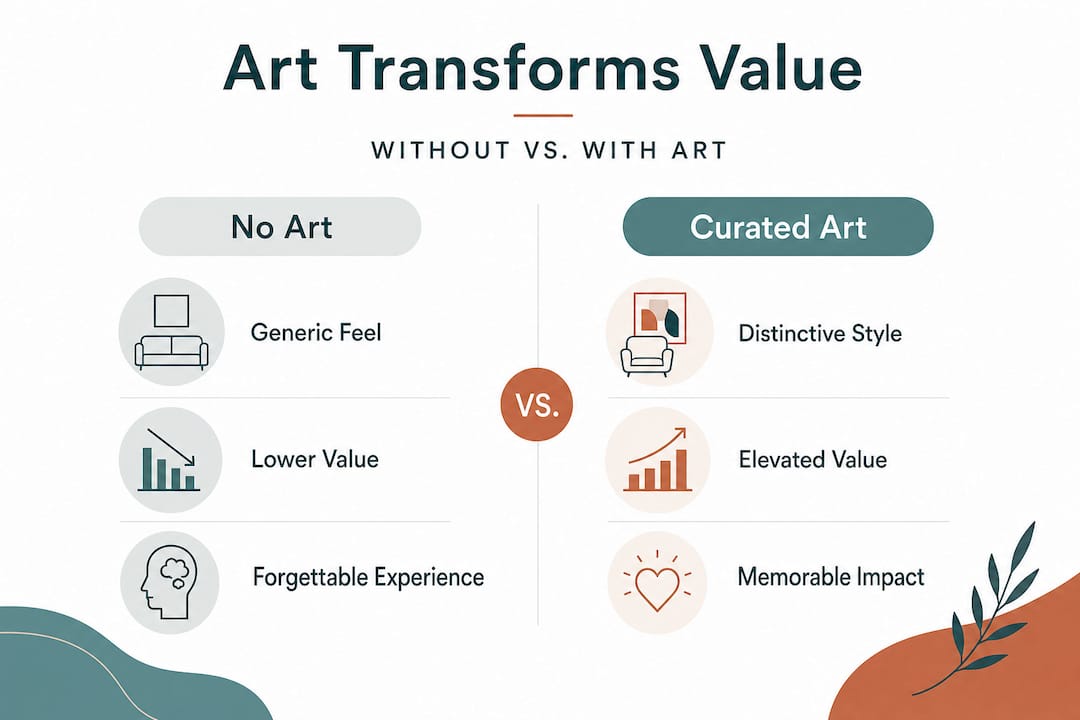
The implications extend beyond property sales. In hospitality, clients who feel emotionally connected to the aesthetic of a hotel or restaurant are more likely to leave positive reviews, return, and recommend the venue. In retail, art and considered visual display increase dwell time and, with it, the likelihood of purchase. The strategic use of wall art for property developers is no longer a niche consideration; it is a measurable competitive advantage.
Understanding how to choose wall art with these commercial goals in mind requires thinking beyond personal taste. Scale, cohesion with the wider design scheme, and alignment with the target buyer or visitor profile all play a role. A developer targeting young professional buyers will make entirely different art choices from one targeting established families or downsizers.
Public and commercial spaces: Art as a tool for engagement
The evidence for art’s impact becomes even more striking when you look at public and large-scale commercial environments. Art installations in shopping streets, corporate campuses, and public walkways are not merely decorative gestures. They are strategic investments in visitor experience.
“Public art interventions substantially enhance perceived restorativeness in commercial pedestrian streets,” according to recent published research examining how art shapes urban and commercial environments.
Restorativeness is the sense of relief and renewal a person feels when they move from a stressful environment into one that feels calming or uplifting. In commercial contexts, this matters enormously. A visitor who feels restored by their environment is more likely to stay longer, engage more fully, and associate those positive feelings with the brand or place responsible for them.
Practical examples of this principle at work are everywhere once you start looking:
- A thoughtfully commissioned mural in a café gives guests a reason to photograph and share their visit
- Rotating art exhibitions in a corporate lobby communicate innovation and attract press attention
- Sculptural works in a hotel courtyard create landmark moments that guests remember and mention in reviews
- Seasonal installations in retail spaces generate repeat visits from regulars curious to see what has changed
- Art curation in a clinic or wellness centre reduces perceived waiting time and lowers client anxiety
Understanding how art transforms commercial spaces for better client engagement is increasingly a skill that interior designers are expected to bring to commercial briefs. Brands that lead in this area consistently outperform competitors on measures of customer loyalty and perceived quality.
Personalising art choices for unforgettable client experiences
Knowing that art matters is only the beginning. The real skill lies in translating this understanding into specific choices that feel genuinely right for each client and project. Here is a practical process for getting this right.
- Start with a client values conversation. Before looking at any artwork, ask your client what emotions they want to feel in the space and what impression they want to make on others. Words like “calm”, “energised”, “sophisticated”, or “playful” give you an emotional brief to work from.
- Audit the existing environment. Look at the light quality, wall dimensions, existing colour palette, and architectural features. These factors define the parameters within which art will be selected. Art that ignores the space it inhabits rarely succeeds.
- Identify one or two statement pieces first. Rather than filling all available wall space, commit to one or two anchor works per room. These should be chosen to reflect the client’s personality and the desired mood, as art shapes mood, provides focal points, and ties together design elements in ways that scattered small pieces simply cannot.
- Layer supporting pieces around the anchors. Once the statement works are selected, choose smaller or more subtle pieces that echo their palette or theme without competing for attention.
- Consider commissioning bespoke artwork. For clients with very specific visions, a custom art guide can help navigate the process of commissioning something truly unique. Bespoke pieces deliver an unmatched sense of ownership and pride.
- Review at installation. Always stand in the room with the artwork in position before making a final decision. What works in a mood board does not always translate perfectly to a three-dimensional space filled with light, furniture, and texture.
Pro Tip: The most common mistake when selecting art is choosing pieces that are too small for the wall. Art that is dwarfed by its surroundings looks uncertain and diminishes the room. When in doubt, go larger. A single oversized piece will always feel more intentional than a cluster of undersized works. Understanding why personalising wall art matters also helps clients invest more confidently in pieces they have shaped themselves.
For more structured guidance on the creative process, tips on creating personalised artwork offer practical steps for both homeowners and designers working on spaces that require a genuinely individual touch.
A designer’s perspective: Why memorable spaces always start with art
Here is an uncomfortable truth that many in the industry are slow to admit: treating art as a finishing touch is not just limiting, it is a design error. When art comes last, it is chosen to fit what already exists. The result is spaces that are coordinated but rarely inspired.
The most memorable interiors we encounter are almost always organised around a central artwork, or at the very least, a clear artistic intention. The art does not fill the room; the room grows around the art. This inversion of the conventional process changes everything. Furniture choices become more purposeful. Colour decisions become more anchored. The overall scheme gains a point of reference that every subsequent decision can be measured against.
We have seen this play out repeatedly. A designer who commits to art as a design foundation at the outset of a project ends up with a scheme that feels coherent and confident. The clients understand it intuitively, even if they cannot explain why. The spaces feel like they were meant to exist in exactly the way they do.
This is not about spending more money on art. It is about repositioning it in the hierarchy of decisions. Even a carefully chosen print from an accessible collection can anchor a room if it is selected thoughtfully and given genuine prominence. The philosophy matters more than the price tag.
Bring your vision to life with curated and custom art
Selecting the right artwork is the most powerful move you can make in any design project, and you do not have to navigate it alone. At Frame the World, you can browse ready-made collections spanning styles from Wabi Sabi and Pop Art through to vibrant Colourful Paintings, all filterable by size, format, and theme. Whether you are dressing a single room or sourcing art for an entire commercial development, the catalogue is built to make the process intuitive. Where a standard collection does not quite fit, bespoke customisation options allow you to work towards a piece that is genuinely designed around your client’s vision and the specific demands of your space.
Frequently asked questions
How does art affect the mood of a room or commercial space?
Art shapes mood, provides focal points, and unifies design elements across a space, which means it has a direct and measurable effect on how clients feel when they enter and move through an environment.
Does investing in art for a property actually boost sales or satisfaction?
Yes. Research shows that artistic elements mediate purchase intention among millennial buyers and elevate the perceived sense of style in display properties, making art a practical commercial investment rather than a luxury.
What role does public art play in commercial environments?
Public art interventions enhance perceived restorativeness in commercial pedestrian zones, meaning visitors feel more at ease, stay longer, and associate positive feelings with the brand or location responsible for the artwork.
How can I personalise art for my home or business clients?
Begin with a conversation about values and desired atmosphere, then select or commission artwork that reflects those qualities specifically, rather than defaulting to what is simply popular or on trend.
Is there an ideal time to choose art in a design project?
Selecting key artworks early, ideally at the brief stage rather than the end, allows the entire design scheme to develop around a clear artistic intention, producing more cohesive and emotionally satisfying results.


Leave a comment
This site is protected by hCaptcha and the hCaptcha Privacy Policy and Terms of Service apply.