

TL;DR:
- Art in the workplace significantly boosts employee well-being and organizational culture.
- Effective art curation involves understanding space function, company values, and proper placement.
- Blended styles and scalable models enhance engagement, flexibility, and long-term impact.
Art in the workplace is rarely treated as the strategic asset it actually is. Most organisations approach it as a finishing touch, something to fill blank walls once the “real” design decisions have been made. Yet organisational aesthetics transmit between 11 and 18% of the total effect of leadership, emotional intelligence, and support on employee well-being. That is not a decorative footnote. This guide is written for interior designers and corporate clients who are ready to treat art as a genuine design lever: one that shapes culture, drives engagement, and delivers measurable returns on investment.
Table of Contents
- Why art matters in the workplace
- Curating art: The process and pitfalls
- Maximalism, minimalism, and meaning: Choosing the right style
- Innovative art solutions: Flexibility, engagement, and scalability
- What most approaches miss about art in workplace design
- Bring your workplace to life with curated art
- Frequently asked questions
Key Takeaways
| Point | Details |
|---|---|
| Art drives well-being | Workplace art can directly improve staff well-being, motivation, and company culture. |
| Curation is critical | Selecting the right art requires understanding space function and user needs. |
| Style impacts experience | Both maximalist and minimalist approaches offer value if balanced thoughtfully. |
| Innovative solutions scale | Hybrid curation models and functional art support flexible, modern workspace design. |
Why art matters in the workplace
The instinct to hang a few prints and call it done is understandable. Budgets are tight, timelines are demanding, and art often lands at the bottom of the priority list. But the evidence tells a different story, and it is compelling enough to change how you brief, specify, and implement art in any commercial environment.
At its most fundamental level, art reduces psychological stress. Exposure to carefully chosen visual stimuli lowers cortisol levels, slows the physiological stress response, and gives the brain a moment of what researchers call “soft fascination,” the gentle, effortless attention you give to something beautiful rather than something demanding. In open-plan offices, where cognitive load is already high, this relief matters enormously. Staff who work in aesthetically considered environments report feeling more valued, more connected to their organisation, and more motivated to perform.
The numbers back this up clearly. Workplace aesthetics measurably transmit 11 to 18% of the total well-being effects typically attributed to leadership quality and organisational support. In practical terms, this means that the physical environment, including the art on the walls, is doing nearly a fifth of the emotional heavy lifting that managers are often assumed to carry alone.
Beyond individual well-being, art shapes the collective mood and identity of a workplace. A curated collection signals that the organisation takes culture seriously. It creates talking points, sparks informal conversation, and reinforces brand values without a word of copy. When employees feel proud of their environment, that pride transfers directly to their sense of belonging and their commitment to the organisation’s goals.
“Art is not a luxury in the workplace; it is infrastructure for human performance.”
You can also make a straightforward business case for investment in art. Consider the data below:
| Outcome | Impact of considered art placement |
|---|---|
| Employee well-being | Up to 18% of total effect transmitted via aesthetics |
| Reported sense of belonging | Significantly higher in aesthetically enriched offices |
| Creative output | Increased in environments with varied visual stimuli |
| Staff retention signals | Positive correlation with pride in physical environment |
The key benefits of workplace art include:
- Stress reduction through passive exposure to calming or engaging imagery
- Cultural alignment by reflecting company values and identity visually
- Sense of community built through shared aesthetic experiences
- Creative stimulation in zones designed for ideation and collaboration
- Brand differentiation for client-facing areas and reception spaces
Explore more about art’s effect on workplace culture and the research-backed case for boosting productivity with art to deepen your approach before you move to the curation stage.
Curating art: The process and pitfalls
Knowing that art matters is one thing. Knowing how to select and position it effectively is another. Too many well-intentioned workplace art programmes fall apart because they skip the curation process and jump straight to purchasing. The result is a collection that feels disconnected, arbitrary, or worse, actively counterproductive.
The right process starts with listening. Effective art curation begins with understanding the client’s story: what the organisation values, how it wants staff and visitors to feel, and what different spaces are functionally designed to achieve. A curation brief that ignores these foundations will almost certainly miss the mark, regardless of the quality of the individual artworks selected.
Here is a practical step-by-step approach:
- Conduct stakeholder dialogue. Speak to facilities managers, HR leads, and ideally a representative sample of staff. Understand what people currently feel about the space and what they want it to feel like. This is not a suggestion; it is the most cost-effective research you can do.
- Map spaces by function. Break the office into zones: focused work, collaborative ideation, social and informal, client-facing, and transit or circulation. Each zone has different emotional requirements.
- Match art to function. Calming, low-stimulation works (soft colour palettes, natural motifs, abstract forms) suit focused work zones. Bold, energising pieces (vivid colour, dynamic composition, figurative or narrative content) support collaboration areas and creative studios.
- Assess scale, placement, and lighting. A beautiful artwork placed at the wrong height, in poor light, or at an awkward angle relative to how people move through the space will fail to land. Scale matters: an undersized piece on a large wall reads as an afterthought.
- Consider technical requirements. Wall construction, fixings, frame weight, and proximity to HVAC systems all affect installation choices. These are not afterthoughts; address them during specification.
- Plan for rotation and evolution. A static collection dates quickly. Build a programme, not a one-time purchase.
The most common errors are instructive. Ignoring user preferences produces art that staff feel no connection to. Visual clutter, too many pieces competing for attention in a single zone, fragments the experience rather than enhancing it. And mismatched or poorly placed art in inappropriate spaces can yield null or even negative effects on staff well-being and productivity.
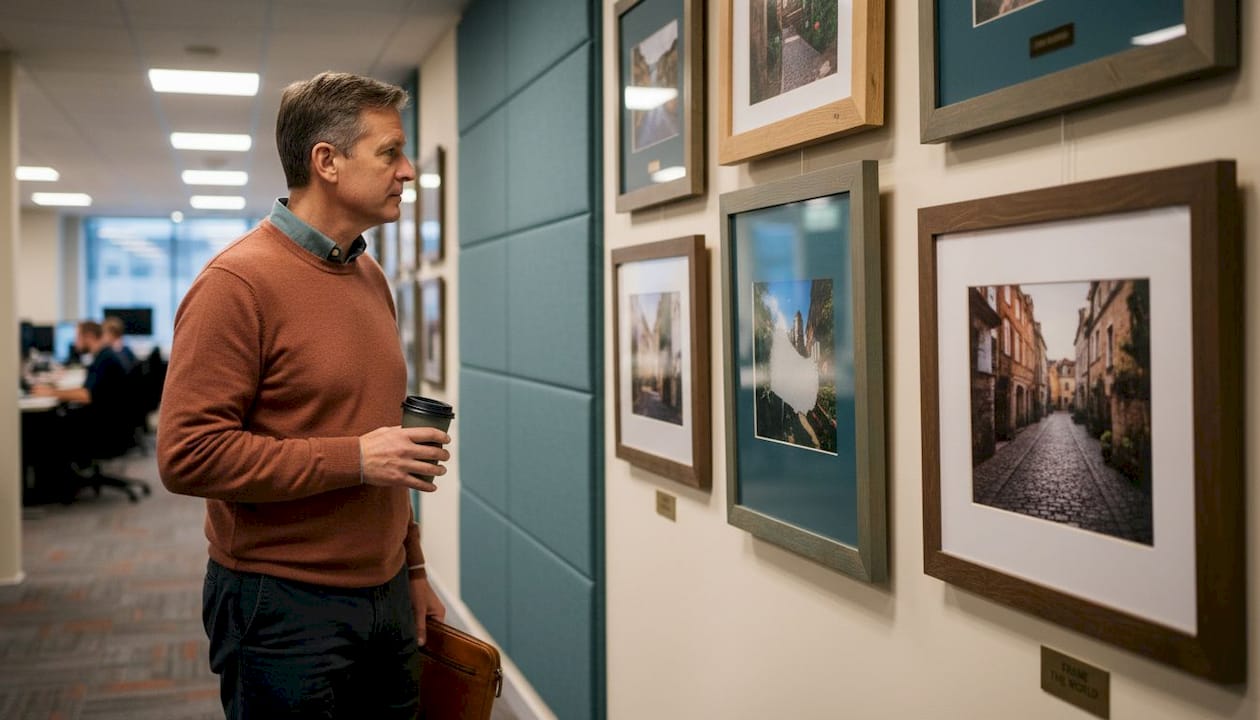
Pro Tip: Treat the curation brief like an interior design brief. Include mood boards, colour palette restrictions, subject matter guidance, and clear notes on what each space needs to achieve emotionally before you approach any supplier or artist.
The story-based approach to curation is particularly powerful. When each artwork can be connected to something real about the organisation, its founding story, its markets, its values, its people, it becomes more than decoration. It becomes part of the fabric of the place. Staff remember why a piece is there, and that meaning compounds over time. Consider personalising spaces with art and reviewing essential art selection tips for a structured starting point.
Maximalism, minimalism, and meaning: Choosing the right style
Once the curation framework is in place, the question of style becomes genuinely interesting. The prevailing assumption in corporate environments has been that minimalism is the “safe” choice: clean lines, neutral tones, unobtrusive. And minimalism certainly has its place, particularly in environments where focused, calm work is the priority.
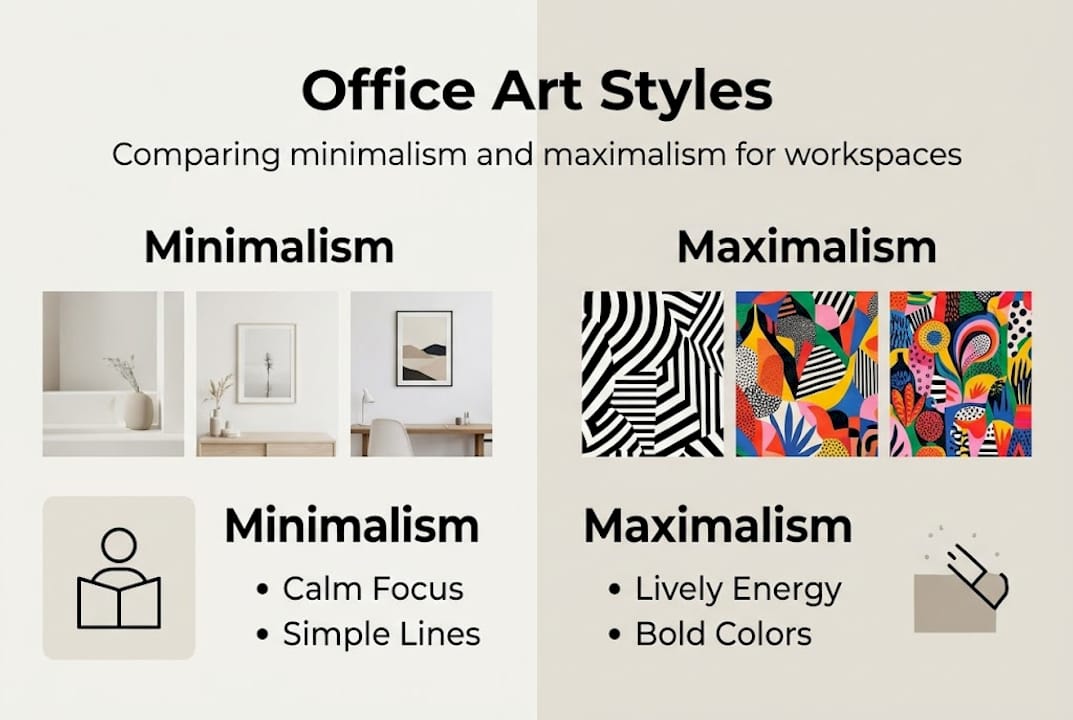
But minimalism taken too far produces sterility. Blank walls and sanitised palettes can communicate something unintentional: that the organisation is cold, risk-averse, or uninterested in human expression. It can make a space feel like a waiting room rather than a community.
Maximalism offers a powerful counter-argument. Maximalist art layers patterns, textures, and colour to create environments that feel abundant, celebratory, and inclusive. When thoughtfully applied, it can serve as a visual metaphor for diversity and equity, making spaces feel genuinely welcoming to a wider range of people and perspectives. The risk, of course, is visual chaos. Maximalism without editorial control becomes overwhelming and fatiguing rather than stimulating.
“The best workplace art programmes are neither maximalist nor minimalist. They are intentional, and intention is the only aesthetic standard that holds up over time.”
| Style | Strengths | Risks | Best suited for |
|---|---|---|---|
| Minimalism | Calm, focused, timeless | Sterile, cold, unwelcoming | Deep focus zones, executive spaces |
| Maximalism | Inclusive, energising, expressive | Overwhelming, cluttered | Collaboration spaces, social areas |
| Blended approach | Layered, adaptable, human | Requires careful editorial control | Mixed-use or full-floor environments |
The most effective workplace art programmes blend both approaches deliberately. A focused work zone might feature a single large-format abstract print with a restricted palette, while the adjacent collaboration hub features a curated wall of varied works with more dynamic colour and content. The contrast itself communicates something meaningful about how the organisation thinks about work.
Style also communicates values. A collection that features exclusively Western European landscape prints tells a different story to one that includes global, contemporary, and community-sourced works. For organisations that are actively building inclusive cultures, the art programme is an opportunity to make that commitment visible without it feeling performative.
Pro Tip: Use the blended approach by anchoring each zone with one dominant art “voice” and then allowing secondary pieces to provide contrast and texture. Variety within a framework always outperforms variety without one.
Browse art styles for commercial spaces and consider how minimalist wall art could anchor your focus zones before layering in bolder pieces elsewhere.
Innovative art solutions: Flexibility, engagement, and scalability
The art world has changed significantly in how it serves commercial environments. The model of commissioning a consultant to select a fixed collection, install it, and walk away is increasingly being replaced by more flexible, participatory, and scalable approaches. For organisations managing multiple sites, hybrid workforces, or rapid growth, this evolution is genuinely useful.
Hybrid curation models, including subscription services and employee-driven selection within defined brand guidelines, are making scalable art programmes accessible to organisations that previously lacked the budget or internal expertise to approach art strategically. The subscription model, in particular, allows collections to rotate regularly, keeping environments feeling fresh and giving staff repeated opportunities to engage with new works.
Employee-driven selection is one of the most underused tools available to HR and facilities teams. When staff have a voice in choosing art for their own spaces, within agreed visual and thematic parameters, the results are notable. Ownership of the environment increases. Conversations about the art become conversations about values. And the risk of alienating employees with art that feels imposed or irrelevant is dramatically reduced.
Functional art is another emerging category worth serious attention:
- Acoustic art panels combine sound absorption with visual interest, addressing two significant workplace challenges simultaneously. In open-plan offices where noise is a constant productivity drain, these panels are genuinely transformative.
- Wayfinding art uses curated imagery to guide people through large floorplates intuitively, reducing the need for signage while adding aesthetic richness.
- Biophilic art featuring botanical, landscape, and natural imagery supports the well-being benefits associated with nature connection, even in environments where introducing real plants is impractical.
- Digital and rotating displays allow a single installation to serve multiple curatorial purposes depending on the time of day, the audience, or the season.
| Solution type | Key benefit | Ideal for |
|---|---|---|
| Subscription art rotation | Keeps spaces fresh, reduces capital outlay | Growing organisations, multi-site businesses |
| Employee choice programmes | Increases ownership and belonging | People-first cultures, hybrid teams |
| Acoustic art panels | Dual function: sound and visual | Open-plan, high-noise environments |
| Biophilic art collections | Well-being, nature connection | Any environment, especially urban offices |
For large organisations, scalability is critical. A programme that works beautifully in one flagship office but cannot be replicated across regional sites is a missed opportunity. The goal is a framework that preserves enough brand consistency to feel coherent while allowing local variation that makes each space feel specific and considered. Explore how art contributes to value and well-being when implemented at scale, including the return on investment evidence that makes the business case straightforward.
What most approaches miss about art in workplace design
Most workplace art programmes fail quietly. They do not fail dramatically; they simply never quite land. The collection gets installed, nobody complains, and nobody is particularly moved either. That quiet failure is worth interrogating, because it reveals something important about how organisations typically approach this decision.
The root problem is almost always short-termism combined with trend-chasing. Someone selects art based on what looked good in a design magazine that year, or what a competitor recently installed, and the collection arrives without any meaningful connection to the organisation’s actual story or its people’s lived experience.
What genuinely works is different. The best programmes we observe start from a place of authentic enquiry. What does this company believe? Who are the people who work here? What do they need to feel at their best? The art that flows from those answers will almost always outperform art selected on purely aesthetic grounds, because it carries meaning that compounds over time.
The other critical insight is that art programmes need to evolve. Organisations change. Teams grow or contract. Values mature. An art collection that felt right in 2022 may be telling entirely the wrong story in 2026. Building in a review cycle, at minimum every two to three years, is not optional if you want the programme to remain effective.
Art’s deeper role in interior design is precisely this: it is a living expression of organisational identity, not a fixed finish.
Bring your workplace to life with curated art
Implementing an effective workplace art programme is far more straightforward when you have the right creative partner. At Frametheworld, we work with interior designers and corporate clients to source, customise, and deliver art that is genuinely fit for purpose, whether that means a single statement piece for a reception space or a scaled collection across an entire office campus.
Our custom print services allow you to brief us on your project’s specific requirements, from dimensions and format to colour palette and thematic direction, ensuring that every piece works within your design framework rather than against it. For clients seeking something with a quieter, more considered aesthetic, our Wabi Sabi wall art collection offers beautifully crafted works that balance calm with character. Get in touch to discuss your project and discover how we can support every stage of the curation process.
Frequently asked questions
How does art specifically impact employee well-being?
Art improves mental well-being by reducing stress, increasing positive emotions, and creating a sense of connection among staff; organisational aesthetics transmit up to 18% of the total well-being effect associated with good leadership and support.
What is a common mistake when adding art to a workspace?
Mismatched or poorly placed art can produce null or even negative effects on staff well-being and productivity, making the curation and placement process just as important as the artwork itself.
How do you select art for different office spaces?
Match art to space function by choosing calming, low-stimulation pieces for focused work zones and energising, visually dynamic works for collaboration and social areas.
Can art support hybrid or flexible workplace models?
Yes; hybrid curation models including subscription rotation and employee-driven selection within brand guidelines make scalable, adaptable art programmes entirely achievable for modern, flexible organisations.


Leave a comment
This site is protected by hCaptcha and the hCaptcha Privacy Policy and Terms of Service apply.