

TL;DR:
- Art personalisation goes far beyond surface details like names or colors, creating meaningful connections with space and inhabitants. Properly personalized artwork reflects a person’s story and values while integrating technically to enhance the room’s design, often serving as an architectural anchor. Bringing art to life involves careful selection, collaboration, and strategic placement to craft interiors that feel authentic and emotionally resonant.
Most people assume personalising art means slapping a name on a print or picking something in the right shade of blue. That assumption undersells one of the most powerful tools available to homeowners and interior designers. Art personalisation, done properly, goes far deeper than surface adjustments. It connects a space to the people who inhabit it, creates narrative anchors that no off-the-shelf piece can replicate, and influences the entire design language of a room. This guide unpacks what art personalisation truly means, how it works in practice, and how you can use it to create interiors that feel genuinely alive.
Table of Contents
- Defining art personalisation: more than a name or colour
- How art personalisation works: mechanics and methods
- Setting expectations: the art and artist’s interpretation
- Practical tips: applying art personalisation in your space
- Why real connection trumps perfect match: a designer’s view
- Bring your space to life with personalised art
- Frequently asked questions
Key Takeaways
| Point | Details |
|---|---|
| Beyond surface customisation | True art personalisation is about meaning, narrative, and emotional fit, not just colour or naming. |
| Multiple personalisation methods | Commissioning, curation, and AI-driven tools offer different routes to a unique visual statement. |
| Expect artistic interpretation | Even personalised commissions reflect the artist’s style—perfection is less important than authentic connection. |
| Design around the art | Interiors stand out when art leads the room’s design, guiding every element from lighting to texture. |
Defining art personalisation: more than a name or colour
The most common misunderstanding is treating personalisation as cosmetic. A monogram on a canvas or a colour-matched print is customisation, not personalisation. The distinction matters enormously in practice.
Art personalisation is the practice of creating or selecting artwork so it reflects a specific individual’s or organisation’s preferences, story, identity, and the space it will live in. That definition puts identity and story at the centre, not aesthetics alone. Aesthetics follow, but they are never the starting point.
There are two dimensions to proper art personalisation, and both matter:
- Narrative fit: Does the artwork carry meaning for the people in the space? Does it reference a personal history, cultural heritage, a shared memory, or a set of values?
- Technical integration: Does the piece work at the right scale, placement, and palette to anchor the room without competing with other design elements?
Both dimensions must align for personalisation to succeed. A deeply meaningful piece hung at the wrong height, in the wrong light, in a room with clashing materials, will underperform. Equally, a technically perfect placement of a meaningless print leaves a room feeling curated but hollow.
“The most compelling interiors are not those with the most expensive art, but those where the art clearly belongs to the people living there.”
Interior designers who understand this principle often build rooms around a chosen artwork rather than adding art as an afterthought. The piece becomes an architectural anchor. Furnishings, textiles, lighting, and even wall finishes are selected in response to what the art demands. You can explore why personalising artwork matters for a deeper look at this design-first thinking.
The emotional and technical aspects of art personalisation reinforce each other. When a room is built around a piece with genuine personal meaning, the technical integration often feels more natural because you are designing with purpose rather than trying to fill space.
How art personalisation works: mechanics and methods
Understanding the concept is one thing. Knowing how to bring it to life is another. There are three broad approaches, each with different levels of involvement, cost, and creative control.
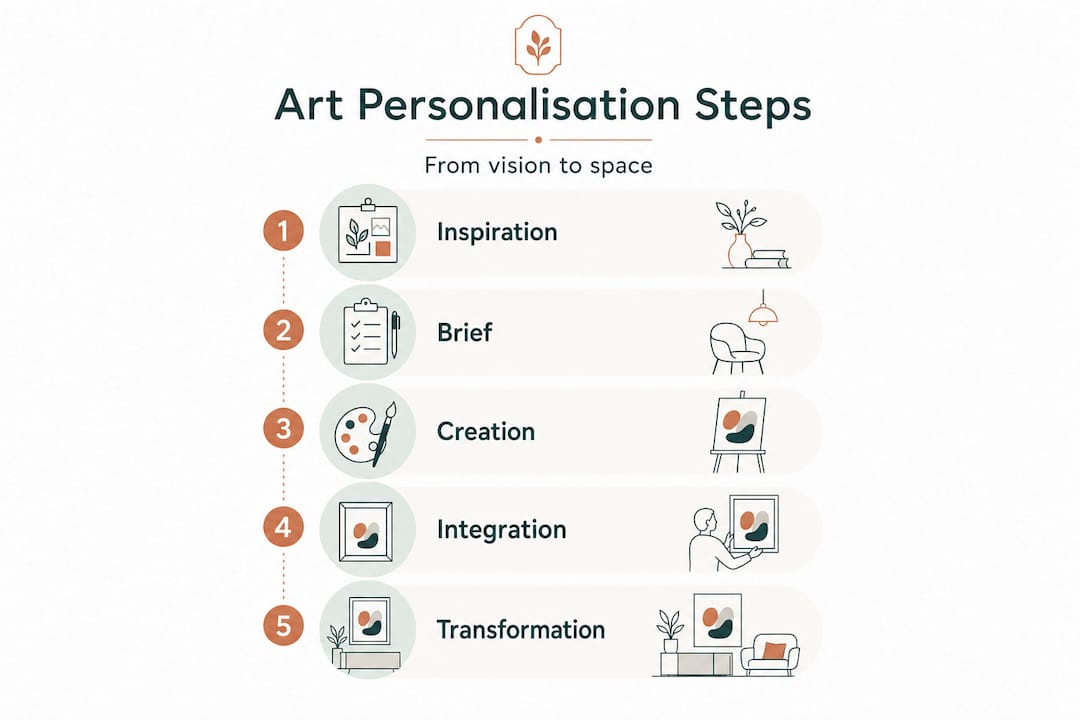
The typical client-to-art flow looks like this:
- Identify the story. What memory, value, landscape, or identity marker should the artwork reflect? Be specific. “Something calm” is less useful than “the light on the water near where we got married.”
- Choose your method. Will you commission an original work, collaborate with an artist on an existing style, use a curated selection service, or use template-based AI customisation?
- Brief thoroughly. Provide reference images, mood descriptions, colour preferences, and size constraints. The richer the brief, the better the outcome.
- Review and refine. Most commissions involve at least one revision stage. Use it to redirect rather than prescribe.
- Plan placement before delivery. Decide exactly where the piece will hang, at what height, and under what lighting conditions before it arrives.
In home staging and high-end residential projects, art personalisation through curation often means selecting a centrepiece artwork first, then designing surrounding room elements to respond to it. A chandelier height might be set to frame the piece. A rug colour might echo a secondary tone in the painting. Furniture placement might open sightlines to draw the eye.
AI-enabled personalisation is increasingly used to let consumers generate or customise art elements quickly, offering a faster and more affordable route to something that feels tailored. It does not replace deep personalisation, but it democratises the process for those working within tighter budgets or timelines.
| Method | Creative control | Typical cost | Time required | Best for |
|---|---|---|---|---|
| Traditional artist commission | High | Higher | Weeks to months | Unique, story-driven pieces |
| Designer-led curation | Medium | Variable | Days to weeks | Full room integration |
| AI/template-based customisation | Medium | Lower | Hours to days | Budget-conscious personalisation |
Pro Tip: When working with tailored artwork services, prepare a written mood brief alongside visual references. Words and images together give any artist or algorithm far more to work with than either alone.
You can read more about the practical process in our guide to creating personalised artwork, and if you want inspiration before you brief anyone, our bespoke artwork examples show a range of what is achievable at different budget levels.
Setting expectations: the art and artist’s interpretation
One of the most common sources of disappointment in commissioned art is unrealistic expectations. Clients arrive with a precise vision in their mind and expect the artist to reproduce it faithfully. That is not how art works, and it is not even how you want it to work.
“Personalised art does not always mean perfectly exact. Even with a clear brief, artists interpret client direction through their own lens.”
That interpretive layer is not a flaw. It is often where the magic happens. An artist brings craft, intuition, and an external perspective that transforms your raw idea into something you could not have produced yourself. The goal is not replication. It is resonance.
Here is a practical comparison of how different methods handle the gap between your idea and the final piece:
| Method | How close to brief? | Artist interpretation | Revision flexibility |
|---|---|---|---|
| Traditional commission | Close but not exact | High, enriches the work | Usually 1 to 2 rounds |
| Collaborative session | Very close | Moderate, shaped by dialogue | Ongoing |
| AI/template-based | Exact to parameters | Minimal | Instant iteration |
| Curated selection | Approximate | None, you choose | Browse and replace |

Each approach has legitimate uses. Traditional commissions suit those who want a genuinely original piece with lasting value. Collaborative sessions work well when you have a strong sense of direction but want a skilled hand to realise it. AI and template tools serve those who need speed, volume, or a lower financial commitment.
Pro Tip: When briefing an artist, describe the feeling you want someone to experience when they stand in front of the piece. “I want them to feel calm and slightly nostalgic” is far more useful guidance than a list of colours or subjects. This emotional target helps the artist make creative decisions that align with your ultimate goal.
Managing custom art expectations honestly from the start also protects the relationship between client and creator. Agree upfront on revision rounds, approximate style direction, and which elements are fixed versus flexible.
Practical tips: applying art personalisation in your space
Having a great piece of personalised art is only half the challenge. Integration is the other half, and it is where many otherwise excellent projects fall flat. Here is how to get it right.
Steps for integrating personalised art effectively:
- Choose the art first, then furnish around it. This reverses the instinct most homeowners have, but it produces more cohesive results.
- Consider scale seriously. A piece that feels significant in a gallery might look timid in a high-ceilinged living room. Measure your wall, then add 20 percent to what feels comfortable.
- Map the palette relationship. The art does not need to match your furnishings exactly, but it should share at least one colour reference point with the room, even a subtle one.
- Plan your lighting before installation. Directional picture lighting or warm spotlights can transform a piece. Flat, overhead lighting flattens art visually and emotionally.
- Give the piece space to breathe. Resist the urge to surround a statement artwork with competing objects. Negative space amplifies impact.
The most enduring design principle here is that art should drive the room’s design rather than be fitted into it after the fact. Designers who treat art as an architectural driver, and use placement and interplay with materials to unify the space, consistently produce more memorable results than those who treat it as a final accessory.
Common mistakes to avoid:
- Hanging art too high, a near-universal error. Eye level is roughly 145 to 150 centimetres from the floor to the centre of the piece.
- Choosing art purely by colour match and ignoring subject or emotional tone.
- Grouping too many pieces of similar size and weight, which creates visual static rather than hierarchy.
- Ignoring the visual customisation opportunities that come from combining art with architectural features like shelving, panelling, or textured surfaces.
Pro Tip: A single piece of textured art, whether oil on canvas, mixed media, or hand-applied print, creates more visual warmth than several flat digital prints. Texture responds to natural light throughout the day and keeps the wall feeling alive across different times and seasons.
For commercial environments, the stakes are higher and the brief more complex. Our guide to curating art for commercial spaces covers how to think about brand narrative, client-facing impressions, and the particular challenges of shared or high-traffic spaces. And for a solid foundation on the practical side of selection, our wall art selection guide walks through sizing, framing, and placement in detail.
Why real connection trumps perfect match: a designer’s view
Here is an uncomfortable truth that many interior projects sidestep: the safest-looking rooms are often the least interesting ones. When designers prioritise palette-matching above everything else, they produce spaces that photograph well but feel oddly lifeless to the people who actually live or work in them.
The most memorable interiors we encounter share one quality. The art in them is clearly chosen, not coordinated. There is a piece that carries a story, perhaps a large abstract commission that the homeowner cannot fully articulate but feels deeply connected to, or a vintage print from a place that shaped their character. These rooms feel inhabited in a way that perfectly curated, trend-led spaces rarely do.
The instinct to chase a “seamless look” is understandable. It feels safer. But safety in design often trades long-term satisfaction for short-term visual comfort. The rooms people return to, the ones they describe to others, the ones that photograph differently every time because the light catches the texture differently, are built around meaning.
Customising wall art is not just about adjusting a product. It is about making a design decision that will outlast every other object in the room. Sofas get replaced. Paint colours change. But a piece of art with genuine personal resonance tends to stay, and it keeps rewarding attention in ways that matched accessories never do.
Our position is this: prioritise the story, then solve the technical problems. If a piece does not fit the current palette, repaint. If it dominates the room, strip back the furnishings and let it. Design challenges are solvable. Meaning is not something you can retrofit.
Bring your space to life with personalised art
Everything in this guide points to the same conclusion. Art that means something to you transforms a room in ways that no other design element can replicate. At Frametheworld.co.uk, you can explore curated collections built around distinct moods and narratives, commission bespoke pieces that carry your own story, or personalise existing works to suit your space precisely. Browse the Wabi Sabi wall art collection for pieces that bring quiet, grounded character to any interior, or explore colourful hand-painted art if you want something that anchors a room with energy and warmth. Whatever direction you take, start with the story.
Frequently asked questions
Is personalised art only about adding names or favourite colours?
No. Art personalisation focuses on reflecting identity, story, and intentional design choices, meaning that surface-level adjustments like names or colour matching represent only a very small part of what true personalisation involves.
Can I achieve art personalisation on a limited budget?
Yes. AI-enabled personalisation and template-based options have made meaningful art customisation accessible at significantly lower price points than traditional commissions, and curated selections can deliver strong personal resonance at no customisation cost at all.
How precise will my commissioned artwork be to my brief?
Most artists interpret briefs through their own creative lens, so expect close alignment with the emotional and thematic direction of your brief, but not literal replication of every detail. That interpretive quality is usually what makes the result feel like art rather than a reproduction.
Should the room match the art, or the art match the room?
Experts consistently recommend that you design the room around the art that resonates most personally, using the piece as a narrative and visual anchor rather than fitting art into a pre-existing scheme. This approach produces more cohesive and emotionally satisfying interiors.


Leave a comment
This site is protected by hCaptcha and the hCaptcha Privacy Policy and Terms of Service apply.