
TL;DR:
- Quality prints use pigment inks and archival materials for greater longevity and vibrancy.
- They evoke emotional depth and enhance a space’s atmosphere better than mass-market posters.
- Investing in high-quality prints offers long-term value and personalized options for interior cohesion.
Most people assume a print is just a print. You pick something from a shelf, stick it in a frame, and call it done. But that assumption quietly ruins more interiors than any poor sofa choice ever could. The difference between a cheap poster and a genuinely high-quality print is vast, and it shows immediately in any room. Quality prints bring vibrancy, emotional depth, and durability that mass-market alternatives simply cannot replicate. This guide explains exactly what separates them, why it matters for your space, and how choosing well now pays dividends for years to come.
Table of Contents
- What makes a print ‘quality’?
- The aesthetic and emotional impact of quality prints
- Value and longevity: Why paying more pays off
- Personalisation and fit: Creating spaces that reflect identity
- Why most people overlook quality prints—and what truly matters
- Explore premium print collections for your next project
- Frequently asked questions
Key Takeaways
| Point | Details |
|---|---|
| Superior visual impact | Quality prints display sharper detail, richer colours, and texture that mass-market posters cannot match. |
| Investment in longevity | Archival-quality prints resist fading and can last decades, offering exceptional value over time. |
| Personalised for any space | Premium prints can be tailored in size, style, and finish to perfectly complement any interior. |
| Emotional and aesthetic uplift | Carefully chosen prints create a unique atmosphere and can positively affect mood and well-being. |
What makes a print ‘quality’?
The word “quality” gets thrown around so freely in retail that it has almost lost its meaning. When it comes to art prints, though, quality has a very specific and measurable definition rooted in materials, process, and longevity.
The gold standard for fine art reproduction is giclée printing. Giclée (pronounced zhee-clay) simply means using a professional-grade inkjet process with pigment-based inks at extremely high resolution, typically between 1,440 and 2,880 dots per inch. These prints are produced on archival-grade substrates such as 100% cotton rag paper, fine art canvas, or acid-free board. As fine art print overview explains, these distinctions in process and materials fundamentally alter the outcome.
Compare that with the average mass-market poster. Those are usually printed with dye-based inks on thin, wood-pulp paper using standard commercial presses. Dye-based inks are water-soluble and bond loosely to the paper surface. They look passable in a shop display, but they fade noticeably within a few years, particularly when exposed to sunlight or humidity.
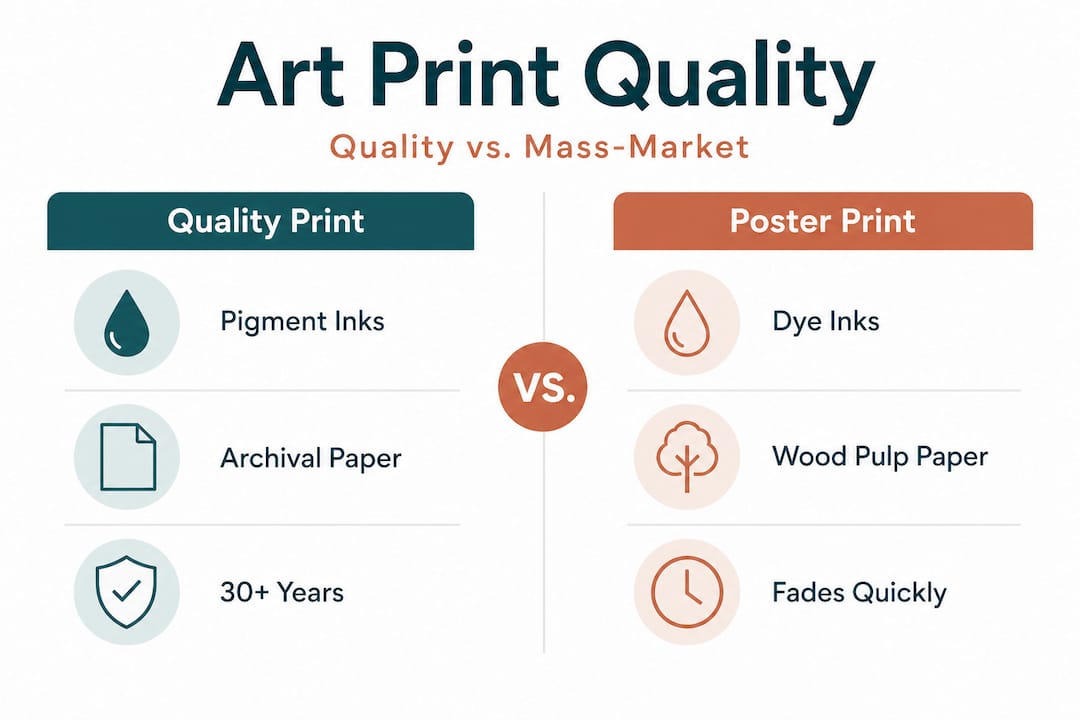
Giclée prints use pigment inks and archival papers like 100% cotton rag, delivering superior sharpness, colour depth, and texture compared to mass-produced posters printed with dye-based inks on thin paper. This isn’t just technical trivia; it directly translates into how striking and rich your wall looks over time.
| Feature | Quality print | Mass-market poster |
|---|---|---|
| Ink type | Pigment-based | Dye-based |
| Resolution | 1,440 to 2,880 DPI | 300 to 720 DPI |
| Paper stock | Archival, acid-free, cotton rag | Standard wood-pulp paper |
| Colour depth | Rich, nuanced, layered | Flat and often oversaturated |
| Lifespan | Decades with proper care | 3 to 5 years before visible fade |
| Texture | Fine art feel | Smooth, glossy, uniform |
“The materials behind a print are as important as the image itself. Without archival-grade paper and pigment inks, even the most beautiful image degrades into something forgettable within a few years.”
Colour depth in particular is worth dwelling on. Pigment inks contain multiple densities of each colour, creating smooth gradients and subtle tonal shifts that dye inks simply cannot achieve. When you stand in front of a quality print, you notice dimension and warmth. A poster, by contrast, tends to look a little flat and oddly bright, like a screenshotted image rather than a considered artwork.
The aesthetic and emotional impact of quality prints
Understanding the technical side is useful, but the real reason most people seek out better prints is simpler: they want their space to feel genuinely beautiful and meaningful rather than just furnished.
Print sharpness and colour accuracy have a direct effect on how a room reads emotionally. A landscape print with true-to-life blues and greens creates a sense of calm and space, particularly in smaller rooms. An abstract with deep blacks and layered pigments brings drama and focus to a minimal interior. These are not accidents; they are outcomes that only accurate, high-resolution printing can deliver. Choosing art that genuinely supports your interior vision is exactly why standout interiors with prints has become such a relevant conversation for homeowners and designers alike.
Quality prints contribute meaningfully to everyday well-being. Research consistently shows that tidy and well-curated homes positively affect mood, happiness, and general well-being. Art is central to curation; it provides focal points, introduces colour palettes, and tells a story about who lives or works in the space.
Here are the core emotional benefits that quality prints consistently deliver:
- Pride of ownership: A well-made print feels like something you chose deliberately, not just filled a wall with.
- Calm and relaxation: Carefully selected imagery and colour reduce visual noise and create restful environments.
- Conversation and connection: Distinctive artwork sparks dialogue, whether in a home living room or a client-facing commercial space.
- Sense of identity: Art reflects taste and values in ways that furniture alone cannot.
- Positive daily atmosphere: Quality art holds up visually over time, so the initial lift to your mood does not fade the way a poster does.
Knowing how to use prints in design to elevate space comes down to treating art as a structural element of the room rather than a finishing afterthought. Quality is what makes that possible.
Value and longevity: Why paying more pays off
Cost is the most common objection to choosing quality prints over cheaper alternatives. The upfront price is higher, and for someone decorating on a budget, that gap matters. But the comparison changes entirely when you account for lifespan.
Quality prints last for decades thanks to pigment inks and archival papers, unlike standard posters, which can fade visibly within just a few years. Let’s make that concrete.
| Print type | Average cost | Lifespan | Cost per year |
|---|---|---|---|
| Mass-market poster | £15 | 3 years | £5.00 per year |
| Quality giclée print | £90 | 30+ years | £3.00 per year |
| Limited edition print | £200 | 50+ years | £4.00 per year |
The numbers tell a clear story. A quality print is not only more beautiful; it is genuinely more economical over any meaningful time horizon. You also avoid the frustration of re-buying and re-framing artwork every few years as it yellows, bleaches, or simply looks tired.
Limited edition prints add another dimension to this value equation. When an artist or publisher releases a print in a numbered run, often accompanied by a signed certificate of authenticity, the piece carries rarity value. Small edition sizes mean fewer prints exist, which can increase desirability and, in some cases, monetary value over time. Understanding limited edition print value is particularly useful for anyone approaching art as both decor and a long-term investment.
For interior designers working across multiple client projects, the value argument is equally strong. Recommending quality prints protects your reputation. Clients who see their carefully chosen artwork fading or curling two years post-installation will remember who suggested it. Quality prints age gracefully and reflect well on everyone involved in the decision.
Pro Tip: When buying a limited edition print, always check the edition size. A print numbered 3/500 is far more common than one numbered 3/25. Smaller editions generally carry more long-term value, both emotionally and in terms of potential resale.
Personalisation and fit: Creating spaces that reflect identity
The strongest interiors are not just visually cohesive; they feel personal. Generic art, however technically well-printed, cannot achieve this on its own. Personalisation is where quality printing truly separates itself from mass-market alternatives, because the same archival process can be applied to custom imagery, specific sizes, and bespoke colour treatments.
Personalising your home art means making choices that go beyond picking from a standard catalogue. It might mean commissioning a custom abstract in a specific colourway to complement your existing furnishings, or selecting a particular scale to anchor a double-height wall. It might mean printing a personal photograph or a bespoke illustration to archival standard, ensuring it holds up as long as a purchased artwork would.
The personalisation options available through quality print providers include:
- Size: From small framed pieces to large-format statement prints across entire wall sections.
- Theme and subject: Landscapes, abstracts, botanicals, portraiture, geometric pattern, and beyond.
- Colour palette: Prints can be adjusted to work within warm, cool, neutral, or bold interiors.
- Material: Paper, canvas, aluminium, acrylic, and specialist substrates each change how light interacts with the image.
- Framing: The right frame completes the artwork and ties it to the space.
Exploring custom art prints for interiors reveals just how broad the possibilities are, particularly for clients with specific spatial or tonal requirements.
There is also a widely shared practice among professional interior designers that most homeowners are unaware of. Designers add art last after all furniture, textiles, and lighting have been placed, choosing and positioning artwork to create perfect cohesion and personality across the finished interior. This approach ensures the art fits the room as it actually exists, not as it was imagined at the planning stage.
This is an important insight. If you are mid-way through a redesign, resist buying art too early. Let the room take shape, then select prints that respond to it. The result will feel far more considered and intentional. When you are ready to start creating personalised artwork for a specific space, that final-step approach will serve you extremely well.
Pro Tip: If you are gifting or investing in a limited edition print, always request the certificate of authenticity and keep it safely stored. The certificate confirms the edition number, artist details, and print specifications, adding context and provable value to the piece. A framed print for decor without its certificate is missing part of its story.
Why most people overlook quality prints—and what truly matters
Here is something worth saying plainly: the interior design world spent decades convincing people that only original paintings matter. Reproductions were seen as a lesser choice, something for those who could not afford the real thing. That view is outdated and, frankly, limiting.
A beautifully produced giclée print of a contemporary artwork, printed to archival standard on cotton rag, is not a compromise. It is a considered object in its own right. The image is rendered with extraordinary fidelity. The paper holds the ink with precision and warmth. The result, hung on a well-lit wall, is genuinely moving in the way that good art should be.
Designers often add art as the final touch, ensuring perfect cohesion and personality across interiors. This approach reflects something deeper: art is not decoration in the way a cushion is decoration. It carries meaning, establishes mood, and gives a room its character. That function is not diminished by the method of reproduction. It is enhanced when the reproduction is done well.
The other myth worth challenging is that quality prints are inaccessible. The price gap between a basic poster and a genuine giclée print has narrowed significantly as archival printing technology has become more widespread. You can find flexible art print décor at a wide range of price points without sacrificing the materials that make longevity possible. Accessibility and quality are no longer opposites.
What truly matters, in our experience, is intention. Choosing a print because it moves you, because it fits the room you have actually built, because it is made to last and worthy of lasting. That intention is what turns a wall into something worth looking at every single day.
Explore premium print collections for your next project
The insights in this guide point in one direction: investing in quality prints is one of the most rewarding decisions you can make for any interior. At Frametheworld, we make that decision easy by offering a broad range of high-quality wall art printed to archival standards, alongside fully bespoke options for clients who need something specific.
Browse our Wabi Sabi wall art collection for serene, texture-rich pieces that bring warmth and quiet sophistication to any room. If your project calls for something vibrant and bold, our colourful wall art range offers striking options across a variety of themes and scales. For homeowners or designers with precise requirements, our custom print options allow you to specify size, material, subject, and finish to create something perfectly suited to your space.
Frequently asked questions
How do high-quality prints differ from posters?
High-quality prints use pigment inks and archival paper, delivering superior sharpness, colour depth, and durability, while standard posters rely on dye-based inks on thin paper that fade within a few years.
Do quality prints really last for decades?
Yes. Prints produced with pigment inks at high DPI on archival substrates can remain vibrant and sharp for thirty years or more, while standard poster dye inks typically fade within three to five years.
Why are limited edition prints considered more valuable?
Limited edition prints are produced in small, numbered runs and come with certificates of authenticity, which confirm rarity and add context, increasing both their collectability and long-term value.
Is it worth personalising wall art for my home?
Absolutely. Personalising quality prints to suit your room’s size, palette, and mood ensures your décor feels genuinely intentional and unique rather than generic.
Can investing in quality prints improve my home’s atmosphere?
Yes. Well-curated home environments are directly linked to improved mood and well-being, and quality art prints are one of the most effective ways to create that sense of curation throughout a space.


Leave a comment
This site is protected by hCaptcha and the hCaptcha Privacy Policy and Terms of Service apply.