

TL;DR:
- Bespoke art can increase home value by 5 to 20 percent and create emotional connections.
- Custom artwork enhances personal well-being and complements interior design through precise sizing and color matching.
- The commissioning process involves defining a clear brief, researching artists, and collaborating to create meaningful, unique pieces.
Most homeowners treat art as the finishing touch, something chosen after the furniture arrives and the walls are painted. Yet property values can rise by 5 to 20% when art installations are part of the interior strategy, with murals alone delivering a 12 to 18% uplift according to recent research. That single statistic reframes the entire conversation. Bespoke artwork is not merely an aesthetic indulgence. It is a considered decision with measurable financial consequences, deep personal meaning, and genuine design power. This guide walks you through every dimension of that decision, so you can choose custom art with complete confidence.
Table of Contents
- The value of bespoke artwork in the home
- Investment benefits: Financial gains and property value
- Personalisation: Creating a one-of-a-kind living space
- Practical considerations: Commissioning bespoke artwork
- Perspective: What most guides miss about investing in bespoke art
- Discover bespoke artwork options and start your project
- Frequently asked questions
Key Takeaways
| Point | Details |
|---|---|
| Increases property value | Custom artwork can boost your home’s value by up to 20%. |
| Personal expression | Bespoke art enables you to create a truly individual living or working space. |
| Investment diversification | Art provides portfolio diversification, although financial returns can vary. |
| Emotional impact | Custom art enriches daily life and creates lasting emotional benefits. |
The value of bespoke artwork in the home
There is a particular feeling you get when you walk into a room where the art belongs there. Not placed there. Not hung because a wall looked bare. It belongs there, as though the space was designed around it rather than after it. That feeling is what bespoke artwork creates, and it goes far deeper than visual appeal.
Custom art tells a story. For homeowners, it might reflect a family history, a favourite landscape, or a life milestone. For interior designers working on client projects, it can translate a brand identity or a client’s personal narrative directly onto the walls. Off-the-shelf prints are chosen from what exists. Bespoke pieces are created from what matters, and that distinction changes everything about how a space feels to live in or work within.
“A room without art is like a sentence without punctuation. It can function, but it lacks rhythm, intention, and meaning.”
There is also a compelling well-being dimension. Numerous studies link exposure to personally meaningful art with reduced stress, improved mood, and a greater sense of comfort in one’s surroundings. When you spend time in a space decorated with imagery that resonates with your identity and values, the psychological effect is cumulative. You feel more at ease, more creatively stimulated, and more connected to the environment you inhabit. These are not trivial benefits, particularly in a world where the home has become a workspace, a retreat, and a sanctuary all at once.
The benefits of custom wall art extend to how rooms function visually. A well-proportioned piece can anchor a large wall, draw the eye to an architectural feature, or balance a room where furniture placement is constrained. Bespoke sizing means the art fits your space exactly, rather than forcing you to compromise around standard dimensions.
Key reasons bespoke art elevates the home:
- It creates an emotional connection that mass-produced prints simply cannot replicate
- It can be scaled, coloured, and styled to complement any interior scheme
- It communicates individuality and signals thoughtful, considered design choices
- It supports well-being by surrounding you with imagery that carries personal significance
- It can serve as a focal point that unifies disparate design elements across a room
You can personalise your space with bespoke art in ways that span abstract colour studies, portrait commissions, landscape pieces, typographic works, and sculptural wall installations. The range of possibilities is genuinely vast, and that flexibility is part of what makes custom art such a powerful design tool.
Pro Tip: Bring your artist or art consultant into the design conversation at the earliest possible stage, ideally before you finalise your colour palette. Coordinating art with paint, textiles, and furniture from the outset produces far more harmonious results than retrofitting a commission into a finished scheme.
Investment benefits: Financial gains and property value
Beyond emotional appeal, custom art delivers impressive results when it comes to home investment. The numbers are striking enough to reframe how you think about interior spending entirely.
Research confirms that art installations boost property values by 5 to 20%, with commissioned murals achieving the upper end of that range at 12 to 18%. For a property valued at £400,000, that represents a potential uplift of £20,000 to £80,000. When you compare that against the cost of commissioning a quality bespoke piece, the return on investment becomes very compelling indeed.
| Factor | Potential property value uplift |
|---|---|
| Bespoke art installation (general) | 5% to 15% |
| Commissioned mural | 12% to 18% |
| Curated art in show home | Faster sale, higher offers |
| Mass-produced print (no uplift) | Negligible |
How art achieves this is worth understanding. Properties with distinctive, high-quality art create a stronger emotional impression during viewings. Buyers remember the home. They picture themselves in it. Estate agents consistently report that thoughtfully decorated homes sell faster and attract stronger initial offers than identical properties with neutral, generic interiors. When you look at art in UK show homes, you see this principle applied deliberately by developers who understand exactly how powerful a curated interior can be.
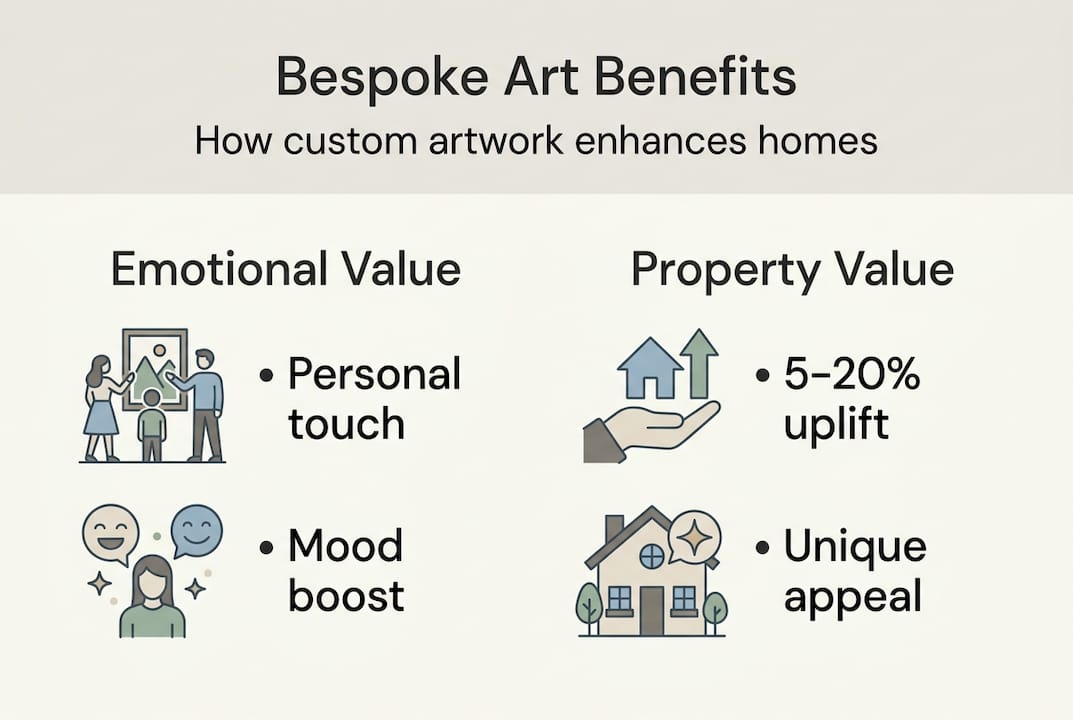
It is also worth considering bespoke art within the broader context of alternative investments. Research from Morgan Stanley found that art underperforms stocks and bonds on a risk-adjusted basis, with a Sharpe ratio of around 0.10. However, art offers genuine diversification benefits and functions as a hedge against traditional market volatility. Blue-chip art consistently outperforms decorative pieces as a pure financial asset, but for most homeowners the primary return is the property value uplift combined with daily enjoyment, rather than resale of the artwork itself.
Steps to think about when viewing bespoke art as an investment:
- Clarify your goals. Are you primarily investing in your property’s saleability, your daily quality of life, or both? Each goal points to different choices in scale, placement, and subject matter.
- Set a realistic budget. Quality bespoke art starts at several hundred pounds and scales significantly depending on medium, complexity, and the artist’s reputation. Consider it a line item in your renovation budget, not an afterthought.
- Choose pieces with longevity. Trends shift. Timeless subjects, strong composition, and quality materials ensure the work retains its appeal over years, not just seasons.
- Document your commission. Provenance adds value. Keep records of the artist, the brief, and the creation process. This documentation matters if you ever sell the property or the piece separately.
For a deeper look at how art functions as a long-term asset, exploring the case for investing in artwork reveals how the calculus differs between residential homeowners and those building broader art portfolios.
Personalisation: Creating a one-of-a-kind living space
While financial value is key, true investment means choosing art that reflects you or your client’s individuality. A beautifully framed print bought from a high-street retailer might complement a room perfectly, but it cannot do what a bespoke commission does: signal that someone thought carefully about this space and chose to create something entirely new for it.
Interior designers understand this distinction acutely. When you personalise artwork for your home, you transform a competent interior into a memorable one. For design professionals, bespoke pieces are the detail that earns client referrals, wins industry recognition, and ensures that photographs of the project stand apart from everything else in a portfolio.
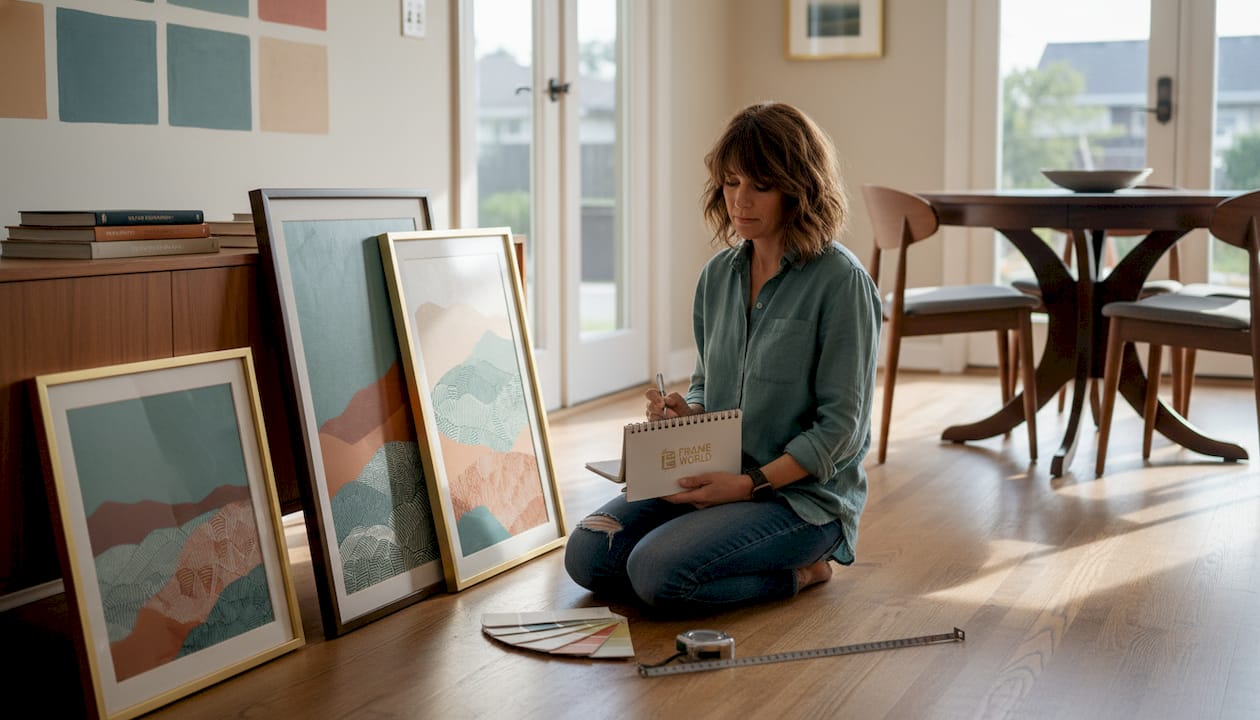
| Feature | Bespoke artwork | Mass-produced print |
|---|---|---|
| Unique to the space | Yes, entirely | No, thousands of copies exist |
| Exact sizing | Specified by you | Limited standard options |
| Colour matching | Precise to your scheme | Approximate at best |
| Emotional resonance | Deep personal connection | Generic appeal |
| Investment potential | Strong, especially with provenance | Minimal |
| Conversation starter | Almost always | Rarely |
The practical benefits for homeowners and interior designers are equally significant:
- Scale without compromise. Commission exactly the dimensions you need rather than hunting for a print that almost fits.
- Colour harmony. Work with your artist to match or contrast specific tones in your existing palette with precision.
- Subject matter that matters. Whether it is a skyline that holds sentimental significance, an abstract that captures a client’s brand energy, or a landscape from a meaningful location, bespoke art speaks directly.
- Exclusivity. No neighbour, no hotel corridor, and no dentist’s waiting room will have the same piece.
- Longevity. Pieces created with intention tend to be cherished rather than rotated out with seasonal trends.
The act of customising wall art also creates a natural design anchor. When you begin a commission by deciding what the art will say about the space, you make better decisions about everything around it. Colour, furniture, lighting, and textiles all become easier to choose when you have a central creative vision to respond to.
As property specialists confirm, the distinguishing factor between a home that photographs beautifully and one that sells exceptionally well is often a single transformative art investment. That is bespoke art doing its work on multiple levels simultaneously.
Practical considerations: Commissioning bespoke artwork
With the ‘why’ clear, here is what you need to know when starting your bespoke art journey. The commission process is more straightforward than many people expect, but a few informed decisions early on make a significant difference to the final result.
The commissioning process for bespoke wall art typically follows a clear sequence:
- Define the brief. Start with the wall and the room. Note the dimensions, the lighting conditions (natural and artificial), the dominant colours, and the mood you want to create. Is this a calming bedroom focal point or a bold statement piece for a hallway? The clearer your brief, the better the starting point for the artist.
- Research artists and styles. Look for artists whose existing work shows genuine skill in the medium and style you have in mind. Review portfolios carefully. Past client testimonials are worth reading, as they reveal as much about the working process as they do about the final results.
- Discuss the brief in detail. A good initial conversation covers subject matter, palette, medium, framing preferences, timeline, and budget. Be honest about all of these. Attempting to under-budget a commission rarely ends well for anyone involved.
- Review sketches or concepts. Most artists provide preliminary sketches or mood boards before beginning the final work. This is your opportunity to refine direction, request adjustments, and ensure you are aligned before significant work begins.
- Agree on terms in writing. Confirm the timeline, payment schedule, revision process, and delivery arrangements in a written agreement. This protects both parties and ensures no misunderstandings arise mid-commission.
- Plan for installation. Think about framing, hanging systems, and lighting before the piece arrives. A beautifully made work deserves equally considered installation.
Common mistakes to avoid include being too prescriptive about every detail (this constrains the artist’s creativity and often produces a weaker result), choosing an artist whose style is fundamentally different from your vision (hoping they will adapt), and neglecting to account for framing costs in your budget. Framing a large bespoke piece to a standard that does justice to the artwork itself is not inexpensive, and it should never be an afterthought.
When you commission artwork for unique home value, the relationship between homeowner or designer and artist is genuinely collaborative. The best results come when both parties feel heard and trusted.
Pro Tip: Share your vision generously but then give the artist room to interpret it. The pieces that most consistently delight clients are those where the artist was given enough creative latitude to bring their own expertise to the brief, rather than simply executing a rigid specification.
Perspective: What most guides miss about investing in bespoke art
Most articles stop at the financial metrics, which is understandable. Numbers are reassuring and easy to share. But if you only evaluate bespoke art through a property value lens, you are missing the investment that actually compounds daily.
The return on emotional and creative investment is something no spreadsheet captures cleanly. The way a piece of art you love changes how you feel when you walk into a room every morning. The way a commission rooted in family history becomes part of your children’s sense of home. The way a thoughtfully chosen work creates a quality of atmosphere that guests feel before they can articulate why.
We would argue that these returns are not soft or secondary. They are primary. Financial uplift is the measurable evidence that a deeper truth holds: spaces that feel genuinely meaningful command more attention, more appreciation, and more attachment. Bespoke art creates that meaning at the source.
For homeowners considering enhancing your home style with personal art, the real invitation is to stop treating art as a line item to be optimised and start treating it as an expression of how you want to live. When you get that right, the financial returns tend to follow.
Discover bespoke artwork options and start your project
If this article has sparked an idea about how a custom piece could transform your home or design project, the next step is easier than you might think. At Frame the World, you can explore collections spanning a wide range of styles, including Wabi Sabi wall art for those drawn to calm, natural aesthetics. If you have a specific vision in mind, you can commission a custom print directly, working with our team to bring your brief to life with precision. For something truly unique, our range of handmade oil paintings offers investment-quality pieces created by skilled artists. Whatever your space requires, we are here to help you find it.
Frequently asked questions
Does bespoke artwork really increase the value of my home?
Yes, custom art installations can boost property values by 5 to 20%, with commissioned murals achieving uplifts of 12 to 18% according to recent research.
Is bespoke art a better investment than stocks or bonds?
Art typically underperforms stocks and bonds on a risk-adjusted basis, but it offers genuine portfolio diversification and acts as a useful hedge against market volatility.
How do I commission bespoke artwork?
Begin by defining your wall dimensions, desired mood, and colour palette, then find an artist whose existing work aligns with your vision, agree on terms in writing, and review sketches before the final piece is created.
What is the difference between bespoke art and mass-produced prints?
Bespoke art is created specifically for your space, taste, and brief, whilst mass-produced prints are made in identical batches with no personalisation, meaning thousands of homes may share the same piece.
Can interior designers benefit from commissioning bespoke artwork?
Absolutely, since bespoke commissions allow designers to deliver genuinely differentiated projects, strengthen client relationships, and create interiors that stand out in portfolios and earn long-term referrals.


Leave a comment
This site is protected by hCaptcha and the hCaptcha Privacy Policy and Terms of Service apply.