

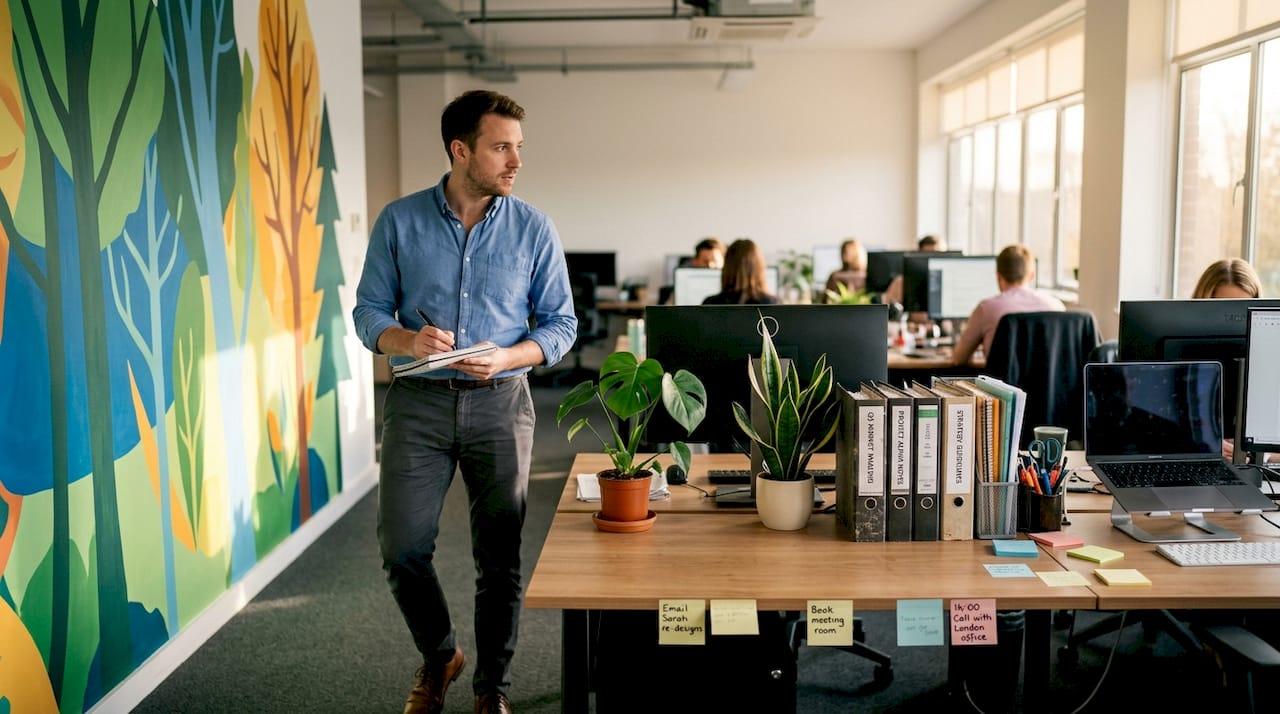
Wall art in the office is rarely treated as a strategic asset. Most workspace designers and facilities managers think of it as the finishing touch, something chosen after the furniture, the lighting, and the layout. Yet a University of Exeter study found that art in workspaces boosts productivity by 15%. That is not a marginal gain. For a team of 50, that is the equivalent of gaining seven and a half extra productive employees without hiring anyone. This guide will show you exactly how to use art as a deliberate, measurable tool for improving performance, well-being, and workplace culture.
Table of Contents
- Why art matters in the workplace
- How art influences productivity and well-being
- Choosing the right art: types, placement and potential pitfalls
- Aligning art with company culture and brand values
- Bringing it all together: practical steps and best practices
- Enhance your workspace with curated art solutions
- Frequently asked questions
Key Takeaways
| Point | Details |
|---|---|
| Art increases productivity | Well-chosen workplace art can measurably boost employee performance and engagement. |
| The right art reduces stress | Nature-inspired pieces and thoughtful curation promote workplace calm and well-being. |
| Alignment matters | Selecting art that reflects company values fosters a more inclusive and motivating environment. |
| Quality over quantity | Too much or poorly chosen art can reduce focus, so curate purposefully for best results. |
| Staff involvement is key | Employee feedback ensures art choices remain relevant and positively received over time. |
Why art matters in the workplace
The numbers are hard to ignore. 93.8% of UK respondents believe art makes a workplace more welcoming, and two thirds say it stimulates creativity. These are not soft, feel-good statistics. They reflect a genuine shift in how employees experience their environment and, by extension, how they perform.
Art works on several levels simultaneously. It signals to employees that the organisation values their experience. It creates visual anchors that break up monotonous environments. It can communicate brand identity without a single word. Understanding the role of art in interior design helps clarify why these effects are so consistent across different types of workplaces.
Here is what the evidence consistently shows art can deliver in a professional setting:
- Increased productivity through a more stimulating and engaging environment
- Reduced stress by introducing calming visual elements, particularly nature-based imagery
- Greater creativity by exposing employees to diverse visual stimuli
- Improved morale by demonstrating that leadership invests in the workplace experience
- Stronger brand identity when art is aligned with company values and culture
“Art is not decoration. It is a communication tool that shapes how people feel, think, and perform in a space.”
The misconception that art is simply a nice-to-have is costing organisations real productivity. Treating it as a strategic design element changes everything.
How art influences productivity and well-being
The psychological mechanisms behind art’s impact are well established. Attention Restoration Theory, developed by environmental psychologists Rachel and Stephen Kaplan, explains that exposure to visually engaging, non-demanding stimuli (such as nature scenes or abstract art) allows the brain’s directed attention system to recover. In practical terms, this means employees return to focused tasks with greater mental clarity after brief visual breaks.
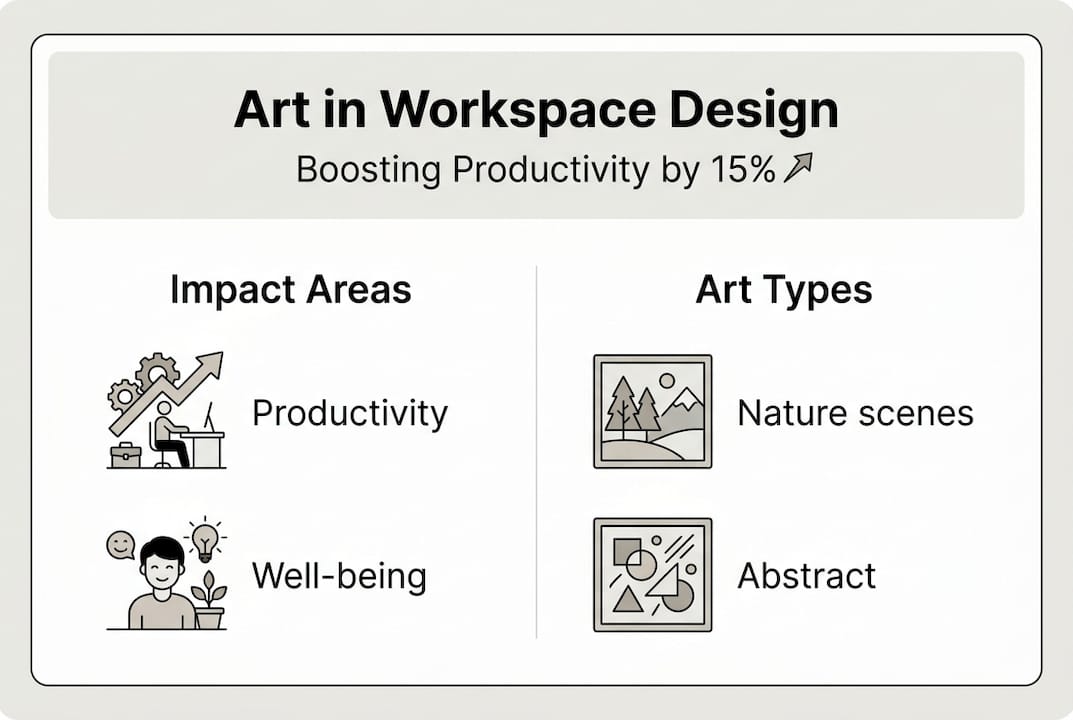
The 15% productivity boost from the Exeter study was measured in offices with art and plants compared to bare, austere environments. The effect was consistent and significant.
| Impact area | Measurable effect | Art type most effective |
|---|---|---|
| Productivity | Up to 15% increase | Varied, purposeful selection |
| Stress reduction | Significant decrease in cortisol | Nature-themed imagery |
| Creativity | Increased divergent thinking | Abstract and colourful works |
| Focus and fatigue | Reduced mental fatigue | Calming, low-complexity art |
| Morale and belonging | Higher engagement scores | Brand-aligned, inclusive art |
Using art as a design anchor in your workspace means it does more than fill a wall. It sets the tone for the entire environment. The benefits of custom wall art extend beyond aesthetics, particularly when pieces are chosen with specific spatial functions in mind.
The psychological effects employees report most frequently include:
- Reduced mental fatigue during long working sessions
- Greater sense of inspiration and creative confidence
- Feeling more comfortable and at ease in the workspace
- Stronger sense of connection to the organisation’s identity
- Improved mood during high-pressure periods
Pro Tip: Do not rely solely on anecdotal feedback. Track both objective output metrics (task completion rates, error frequency) and subjective measures (monthly staff surveys) before and after introducing new art. This gives you a defensible business case for future investment.
Choosing the right art: types, placement and potential pitfalls
Not all art delivers the same results. Nature art is more effective for stress reduction than abstract imagery, according to Attention Restoration Theory. However, excessive art in any style can create visual overload and actually reduce focus. The key is intentional curation, not volume.
The four main art types used in professional workspaces each serve different purposes:
- Nature-based art: Landscapes, botanicals, and organic forms. Best for reducing stress and supporting focus.
- Abstract art: Geometric or expressive works. Stimulates creative thinking in collaborative zones.
- Photographic prints: Documentary or architectural photography. Adds sophistication and narrative depth.
- Brand-based art: Custom pieces incorporating company colours, values, or history. Reinforces identity.
Placement is just as important as selection. Matching art to the space means calming imagery for focus areas and energising works for collaboration zones. Here is a practical comparison:
| Workspace area | Recommended art style | Effect sought |
|---|---|---|
| Focus/deep work zones | Calming nature or minimal abstract | Reduced distraction, mental clarity |
| Collaborative spaces | Bold, energising, thought-provoking | Stimulated dialogue and creativity |
| Entry and reception | Brand-aligned, high-impact statement | Strong first impression, identity |
| Hybrid/flexible areas | Modular, rotating collections | Adaptability, ongoing engagement |
For wall art ideas in collaborative spaces, bold formats and layered compositions tend to generate the most discussion and energy. Understanding how art shapes room mood is essential before committing to a placement strategy.
Common pitfalls to avoid:
- Hanging too many pieces, which creates visual noise rather than visual interest
- Choosing art based purely on personal taste rather than spatial function
- Ignoring cultural sensitivity, particularly in diverse or international teams
- Failing to update or rotate pieces, leading to visual fatigue over time
Pro Tip: Rotate your art collection every six to twelve months and invite staff to vote on new additions. This keeps the environment feeling fresh and gives employees a genuine stake in their surroundings.
Aligning art with company culture and brand values
The most effective workplace art programmes are not random. They are curated with a clear understanding of what the organisation stands for and what it wants employees and visitors to feel. Strategic curation means aligning art with company culture, rotating collections deliberately, and measuring return on investment through surveys and productivity metrics.
Here is a practical step-by-step framework for building a brand-aligned art programme:
- Audit your current collection: Photograph every piece currently displayed. Assess whether each one reflects your brand values or simply fills space.
- Consult your team: Run a short survey asking employees what they find inspiring, calming, or distracting. Their input is invaluable and increases buy-in.
- Define an art policy: Establish clear guidelines covering style, scale, placement, and rotation frequency. This prevents ad hoc decisions that undermine coherence.
- Commission bespoke pieces: Work with artists or platforms to create works that incorporate your brand colours, narratives, or values. This is where personalising your workspace with art becomes a genuine differentiator.
- Review regularly: Schedule a quarterly review to assess whether the collection still reflects the organisation’s direction and employee feedback.
For smaller organisations or those with limited wall space, art in small workplaces can still deliver significant impact when chosen with precision.
“A coherent, on-brand environment tells employees and clients alike that this organisation pays attention to detail and invests in quality.”
Brand alignment in art is not about plastering logos on walls. It is about choosing imagery, colour palettes, and themes that feel consistent with the organisation’s identity and aspirations.
Bringing it all together: practical steps and best practices
Implementing a workplace art strategy does not require an enormous budget. It requires clarity of purpose and a structured approach. Poor or mismatched art can actively reduce productivity, so the goal is always quality and relevance over quantity.
Here is a practical implementation guide:
- Start with a spatial audit: Map each area of your workspace and identify its primary function. Focus zones, collaboration areas, and reception spaces all have different needs.
- Set a realistic budget: High-quality prints are a cost-effective starting point. Large-scale art delivers outsized visual impact relative to its cost, particularly in reception and communal areas.
- Involve employees early: Present two or three shortlisted options for each area and let teams vote. Ownership increases satisfaction and reduces complaints.
- Source strategically: Consider a mix of ready-to-buy prints, rotating loans from local artists, and bespoke commissioned pieces for high-visibility areas.
- Document and measure: Record the date of installation, the rationale for each piece, and the staff feedback received. Use this data to inform future decisions.
- Iterate over time: No art programme is perfect from day one. Use structured feedback cycles to refine your collection and respond to changing team needs.
Pro Tip: Create a simple feedback form that employees can complete anonymously after each rotation. Ask three questions: Does this art make you feel more comfortable? Does it inspire you? Does it feel relevant to our organisation? The answers will guide your next selection with precision.
Enhance your workspace with curated art solutions
At Frametheworld, we work with interior designers, facilities managers, and workspace consultants to source and supply art that delivers genuine impact. Whether you need calming nature prints for focus zones, bold statement pieces for reception areas, or fully bespoke commissions that reflect your brand identity, we have the range and expertise to help. Our wabi sabi wall art collection is particularly popular for creating serene, focused environments. For tailored solutions, explore our custom print options or commission a custom oil painting that brings your brand narrative to life on the wall. Get in touch to discuss your project and we will help you build a collection that works as hard as your team does.
Frequently asked questions
How does art impact staff productivity?
Workplace art can boost productivity by up to 15%, particularly when pieces are selected with the function of each space in mind rather than chosen at random.
Which type of art is best for reducing workplace stress?
Nature-themed art is the most effective for stress reduction, as it supports the brain’s natural attention restoration process, while overuse of abstract imagery can sometimes have the opposite effect.
How should companies choose art for different workplace areas?
Calming, low-complexity art suits focus and deep-work zones, while energising or thought-provoking works are better suited to collaborative spaces where dialogue and creative thinking are the priority.
Is too much art in the workspace a problem?
Yes. Visual overload and poor-quality art are both linked to distraction and reduced productivity, which is why moderation and purposeful curation matter as much as the art itself.
What is the best way to measure the ROI of workplace art?
Combine anonymous staff surveys with measurable engagement or output metrics, as tracking ROI via surveys alongside productivity data gives you the clearest picture of what is working and what needs to change.


Leave a comment
This site is protected by hCaptcha and the hCaptcha Privacy Policy and Terms of Service apply.