

TL;DR:
- Custom art offers a unique, emotionally resonant expression of personal identity that enhances long-term value. It uses superior materials and craftsmanship, ensuring durability, sustainability, and a deliberate connection to your space. Unlike mass-produced or AI-generated work, custom pieces evoke authenticity, foster deeper engagement, and can significantly elevate your home’s atmosphere.
Walk into any high-street furniture shop and you’ll find the same prints hanging on the walls as you did three years ago. There’s nothing wrong with them exactly, but they don’t say anything about you. Research backs up what many people sense intuitively: custom art is valued 15 to 25% higher than AI-generated work, with stronger buying intent and creative engagement across empirical studies. That gap in perceived worth reflects something real. Custom art isn’t just decoration. It’s a direct expression of who you are, and it changes a space in ways that a factory print simply cannot.
Table of Contents
- What makes custom art unique
- Custom art vs mass-produced and AI art
- How custom art personalises your living space
- Sustainability and enduring value of custom art
- Why most people underestimate the power of custom art
- Find the perfect custom art for your space
- Frequently asked questions
Key Takeaways
| Point | Details |
|---|---|
| Custom art is preferred | Research shows buyers consistently favour custom art for authenticity and value. |
| Personalisation transforms spaces | Tailored artwork makes homes and projects truly unique and emotionally engaging. |
| Greater long-term value | Custom art is often more durable and likely to appreciate than mass-produced pieces. |
| Sustainability advantages | Using quality materials, custom art reduces environmental impact and waste. |
| Practical access for all | Anyone can commission custom art, regardless of budget or space size. |
What makes custom art unique
Mass-produced wall art is designed to offend no one. That’s precisely its weakness. When a piece is created to fit as many rooms as possible, it inevitably fits none of them perfectly. Custom art works in the opposite direction. It is made with your specific space, palette, and story in mind.
The difference begins with materials. Custom art uses superior materials and craftsmanship that support longevity, potential value appreciation, and sustainability over mass-produced items. An artist working on a commission will typically choose archival-quality inks, hand-stretched canvas, or acid-free paper. These choices mean the piece holds its colour and integrity for decades rather than fading within a few years.
Craftsmanship also brings something harder to quantify: intention. Every brushstroke, colour choice, and compositional decision has a reason behind it. When you commission a piece, you’re investing in an artist’s deliberate thought about your brief, your space, and your vision. That intentionality is visible in the finished work, even if viewers can’t always articulate why a piece feels different.
The benefits of custom wall art extend well beyond aesthetics. Here’s what genuinely sets custom art apart:
- Personalisation: The subject matter, colour palette, scale, and mood can all reflect your tastes and life experiences.
- Emotional resonance: Art connected to a personal story or memory carries emotional weight that generic prints cannot replicate.
- Material quality: Archival papers, professional-grade inks, hand-stretched canvases, and sustainable sourcing are standard in commissioned work.
- Uniqueness: You own something that exists nowhere else in the world. That is genuinely rare.
- Potential investment: Pieces by emerging or established artists may appreciate in value over time.
- Sustainability: Fewer pieces bought and discarded means less waste. One well-made commission lasts longer than a dozen cheap prints.
Pro Tip: Before commissioning, collect images and colour swatches from your room. Sharing these with an artist gives them a far clearer starting point than describing the room in words alone.
Custom art vs mass-produced and AI art
Now let’s see how custom art stacks up against the alternatives, from factory-made pieces to AI-generated works.
The comparison is more nuanced than simple snobbery about handmade versus machine-made. Both mass-produced and AI-generated art serve a purpose. But the data tells a clear story about what people actually prefer when given a choice.
Empirical studies show that human and custom art generates higher buying intent (p=0.028) and stronger creative engagement (p=0.009) than AI-generated equivalents, with valuations running 15 to 25% higher. These aren’t trivial margins. They suggest that buyers sense something meaningful is missing from algorithmically produced work, even when they can’t immediately identify what it is.
“Custom and human-made art is preferred for its authenticity, emotional depth, and long-term value retention, even as AI offers unmatched speed and accessibility.” — Visual Best
| Feature | Custom art | Mass-produced art | AI-generated art |
|---|---|---|---|
| Uniqueness | One of a kind | Identical copies | Potentially limitless copies |
| Emotional depth | High | Low to moderate | Variable, often low |
| Material quality | Archival, superior | Standard or low | Print dependent |
| Value over time | May appreciate | Typically depreciates | Uncertain, often low |
| Personal connection | Very strong | Weak | Weak |
| Sustainability | High, durable | Often low | Depends on output method |
| Cost | Higher upfront | Low | Low to moderate |
The table above is useful, but numbers can’t capture the full story. Mass-produced art often looks perfectly fine on a shop shelf under controlled lighting. The problem emerges when it’s on your wall, in your home, every day. Over time, its genericness becomes apparent. You stop seeing it because it was never really saying anything to begin with.
AI art is a more recent conversation. It can produce technically impressive results at speed and minimal cost. But as the value of bespoke artwork demonstrates, buyers consistently return to human-made work for emotional impact. AI cannot replicate the experience of knowing a real person made deliberate choices to bring your vision to life. That knowledge changes how you experience a piece every single time you look at it.
The strongest case for commissioning unique artwork isn’t about dismissing alternatives. It’s about understanding what you lose when you settle for them.
How custom art personalises your living space
Given its clear advantages, let’s explore how custom art can be practically applied to make your space truly your own.
This is where the abstract becomes concrete. Homeowners, renters, and professional interior designers all use custom art differently, but the underlying principle is the same: a thoughtfully chosen or commissioned piece anchors a room’s identity. It gives the eye somewhere to land and the mind something to engage with.
The way a piece of art is chosen or created directly affects art and room mood. A large-scale abstract in warm terracotta tones creates warmth and intimacy in a living room. A calm, coastal landscape in a bedroom encourages rest. A bold graphic print in a home office adds energy. When you commission art, you control all of these variables rather than adapting your room to whatever happens to be available.
Here’s a practical sequence for incorporating custom art into your home:
- Identify your space’s focal point. Every room has one wall or area that draws the eye naturally. This is typically where your most significant piece should live. Measure the space precisely before you brief an artist.
- Define your colour story. Pull the dominant and accent colours from your existing furnishings and finishes. Custom art should complement or intentionally contrast these tones, not fight with them.
- Think about scale. A piece that’s too small on a large wall feels timid. A rule of thumb: your artwork should fill roughly two-thirds of the wall width above a sofa or sideboard.
- Choose a subject that means something. This is your opportunity to go beyond generic florals or cityscapes. A portrait of a beloved pet, a landscape of somewhere you’ve lived, a pattern drawn from a fabric you love. Personal subjects create personal rooms.
- Brief your artist clearly. Share mood boards, colour references, preferred styles, and the specific room the piece is intended for. The more context you give, the more targeted the result.
- Consider the format. Canvas, fine art print, framed paper, metal, or wood. The format affects both the aesthetic and the longevity of the piece.
If you’re exploring how to personalise artwork at home, it helps to know that the process doesn’t have to start from scratch. Many artists and platforms allow you to adapt existing works, choosing your preferred colours, dimensions, and even adding personal details. This is a particularly accessible entry point for those commissioning for the first time.
Interior designers often begin with the art rather than the furniture. A commissioned piece sets the room’s emotional register before a single cushion is chosen. If you’re creating personalised artwork for a project, consider briefing your artist before you finalise your soft furnishings. The art becomes the anchor, and everything else responds to it.
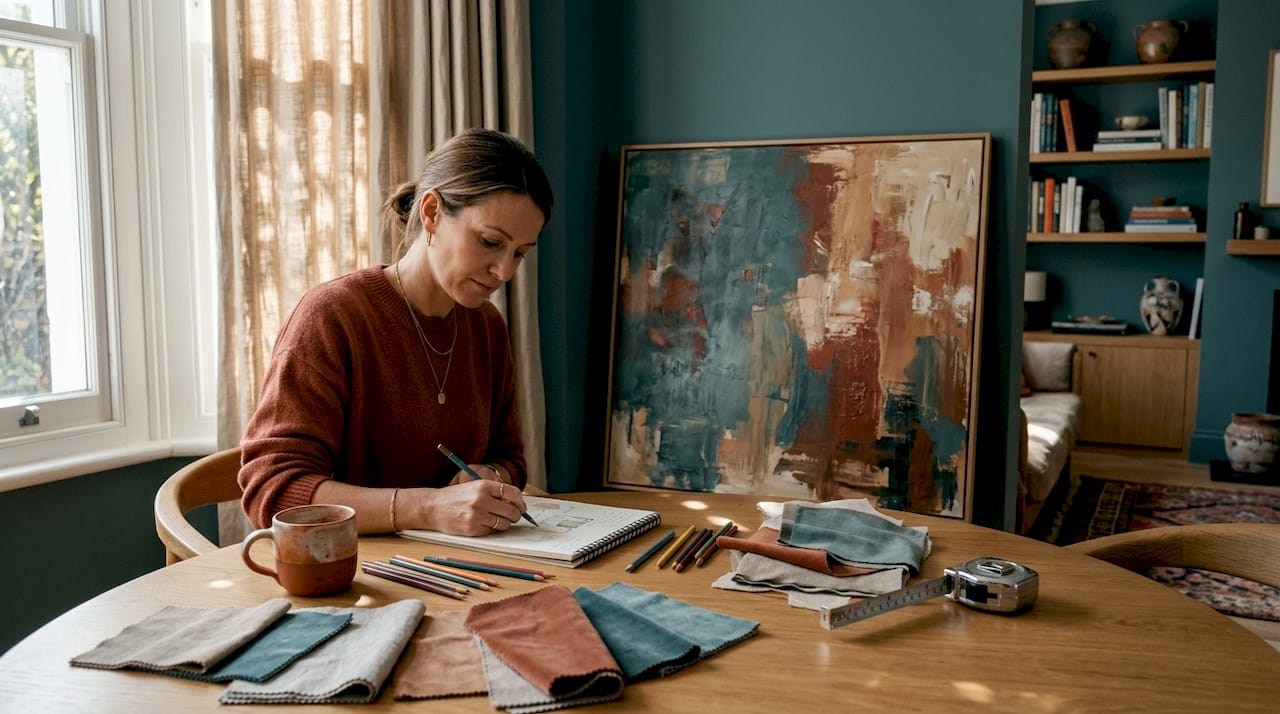
Pro Tip: Renters who can’t paint or install permanent fixtures can use large-format art to define a space and add personality without touching a wall. A single oversized piece, leaned against the wall in a substantial frame, can transform a neutral rental room entirely.
Sustainability and enduring value of custom art
Creating a personalised space also invites questions about lasting impact and sustainability. It’s a conversation that matters more than ever in 2026, when consumers are increasingly aware of the environmental cost of how they live and decorate.
The fast-furnishing cycle has a visual arts equivalent. Cheap prints are bought, enjoyed briefly, and discarded when tastes change or when the piece simply stops looking fresh. This cycle generates considerable waste, both in production and disposal. Custom art breaks that cycle because it is built to last and built to matter.
Custom art craftsmanship prioritises longevity through superior materials, which means less replacement and less waste over time. Archival inks resist UV degradation. Acid-free papers and boards prevent yellowing. Quality canvases remain taut and vibrant for generations. These are not marketing claims but measurable material properties that separate professional custom work from mass-produced alternatives.
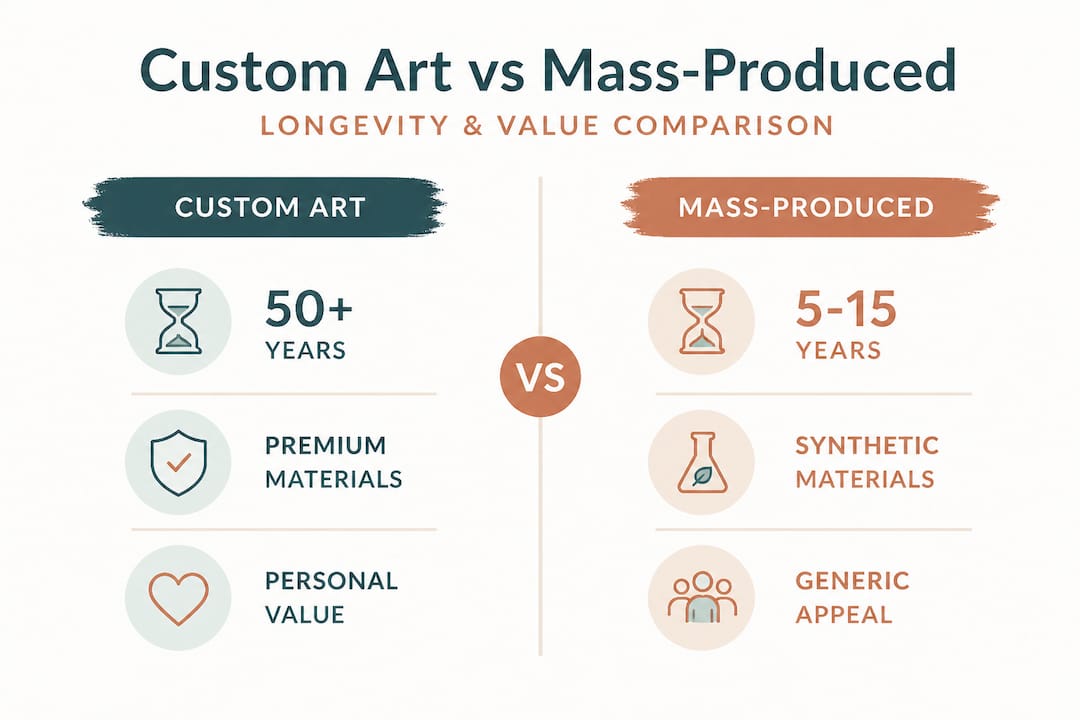
| Factor | Custom art | Mass-produced art |
|---|---|---|
| Expected lifespan | 50+ years with care | 5 to 15 years typically |
| Material quality | Archival grade | Standard commercial grade |
| Replacement frequency | Rare | Frequent |
| Waste generated | Low | High over time |
| Value retention | Likely appreciates | Typically depreciates |
The economic argument for custom art is equally strong. When you invest in a piece by an artist whose work is in demand, that piece may be worth considerably more in ten years than you paid for it today. Even without financial appreciation, a piece that remains personally meaningful is one you will never need to replace. That’s a form of value that spreadsheets don’t capture well.
The advantages of thoughtful custom framing benefits also feed into this picture. A frame chosen for the specific artwork and environment protects it, enhances it, and extends its life. It’s the final layer of quality in a chain that begins with the artist’s materials.
Beyond environmental and economic considerations, there is a personal dimension to the enduring value of custom art. A piece connected to a moment, a relationship, or a place you love becomes more meaningful with time, not less. That is the opposite of what happens with a mass-produced print. And that difference is worth understanding before you make your next decorating decision.
Why most people underestimate the power of custom art
Here’s a perspective that runs against the usual thinking: custom art is still widely assumed to be a luxury reserved for people with large houses and larger budgets. That assumption is doing a great deal of damage to a lot of interiors.
The reality is that the custom art market has changed substantially. A growing number of independent artists, digital printmakers, and platforms like Frametheworld have brought commissioned and bespoke work within reach of ordinary budgets. You don’t need to spend thousands to own something made specifically for you. A modest commission from an emerging artist can cost less than a well-known high-street print and will mean infinitely more.
What most people underestimate is the cumulative effect of generic decoration. When every piece in your home could belong to anyone, the space stops telling your story. Over time, this creates a low-level disconnection from your environment that’s easy to dismiss but surprisingly draining. Custom art counters this directly. Even one well-chosen original piece in a room creates a different quality of attention. You notice it. Guests notice it. It starts conversations.
We’ve seen this repeatedly at Frametheworld. Customers who start with a single bespoke piece often come back because the contrast with everything else in the room becomes too obvious to ignore. That one piece raises the standard for everything around it. In this sense, the value of bespoke artwork is partly its ability to make you see your entire space more clearly.
The emotional connection that comes from custom art is also frequently undervalued. Knowing that an artist interpreted your brief, made decisions in response to your space and preferences, and produced something that exists nowhere else in the world: that knowledge changes your relationship with the piece. You don’t just look at it. You feel it. And that’s the thing that no algorithm, no factory, and no perfectly adequate high-street print can replicate.
Find the perfect custom art for your space
If this article has prompted you to think differently about your walls, the next step is simpler than you might expect. At Frametheworld, we offer a wide range of original and customisable pieces across every style and budget. Whether your taste runs to the quiet, organic textures of wabi sabi wall art, the bold graphic energy of pop art pieces, or something entirely your own, our platform makes it straightforward to find or create work that fits your space. You can browse curated collections or go further and order a custom print tailored to your exact dimensions, colours, and vision. Personalised art is no longer a privilege. It’s a choice available to anyone who wants their home to genuinely reflect who they are.
Frequently asked questions
Does custom art increase the value of my home?
Well-crafted bespoke art pieces can contribute to perceived and actual property value, as custom craftsmanship and materials create lasting impact that generic decoration cannot match. Original works by recognised artists may also appreciate financially over time.
Is custom art more sustainable than mass-produced options?
Yes, because superior materials and craftsmanship mean custom pieces last significantly longer, reducing the cycle of replacement and disposal that mass-produced art typically involves. One lasting piece is far less wasteful than several cheap ones replaced every few years.
Why do people prefer custom art over AI-generated or factory art?
Studies demonstrate that custom art commands higher valuation (15 to 25% above AI equivalents) and generates stronger buying intent and emotional engagement, because human intention and personal connection are qualities buyers instinctively recognise and respond to.
How do I commission custom art for my home?
Begin by collecting reference images, your room’s colour palette, and a clear sense of scale, then brief an artist or use a platform that offers bespoke commissions. The clearer your brief, the closer the finished piece will be to your vision.


Leave a comment
This site is protected by hCaptcha and the hCaptcha Privacy Policy and Terms of Service apply.