
TL;DR:
- Public murals significantly reduce crime by signaling community care and increasing natural surveillance.
- Integrating public art fosters social cohesion, strengthens community bonds, and enhances urban resilience.
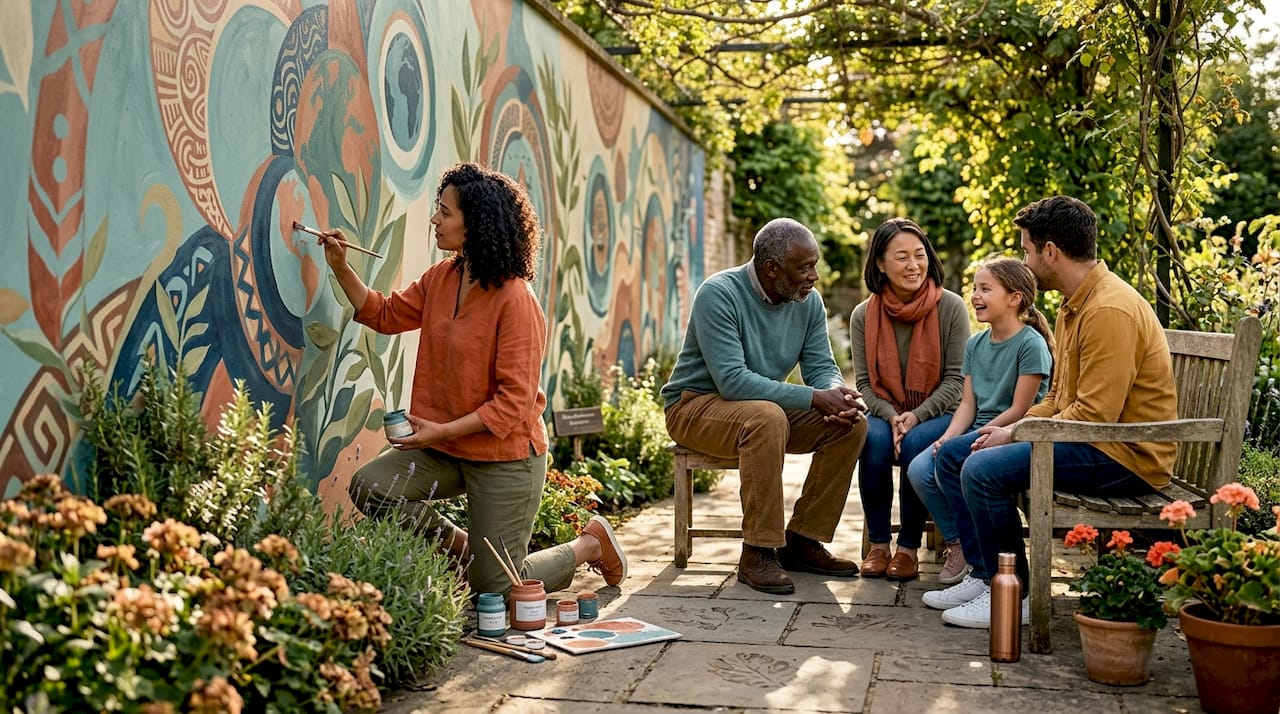
Art in communal spaces does far more than fill blank walls. Research shows that public murals reduce crime by over 40% in some neighbourhoods, a figure that stops most people cold. The role of art in communal spaces reaches into safety, social cohesion, economic value, and collective identity in ways that traditional urban planning tools simply cannot replicate. For community planners and local artists, understanding this evidence is not optional. It is the foundation of building places people actually want to inhabit.
Table of Contents
- How art enhances safety and reduces crime in public spaces
- Art’s role in strengthening social cohesion and community connection
- Integrating art into urban design: aesthetic, functional, and economic benefits
- Case studies: successful public art projects fostering community engagement
- Best practices for community planners and artists: creating impactful communal spaces with art
- Rethinking public art: beyond decoration to a catalyst for urban resilience
- Explore Frametheworld’s curated art collections for vibrant communal spaces
- Frequently asked questions
Key Takeaways
| Point | Details |
|---|---|
| Art reduces crime | Public murals can lower crime rates significantly by fostering community pride and deterrence. |
| Enhances social bonds | Engaging public art increases neighbourhood connectedness and residents’ well-being. |
| Boosts urban functionality | Integrating art improves navigation, safety, and environmental sustainability in cities. |
| Economic uplift | Public art attracts tourism, raises property values, and supports local economies. |
| Community participation matters | Inclusive planning ensures art reflects local voices and builds lasting social capital. |
How art enhances safety and reduces crime in public spaces
The connection between public art and community safety is better documented than most planners realise. Philadelphia’s Mural Arts Programme has generated some of the most rigorous evidence to date. Areas with murals installed between 2007 and 2023 experienced a 42% drop in daytime crime and a 40% drop in nighttime property crime. Those numbers are not incidental. They reflect a consistent pattern across multiple urban contexts.
The mechanism is not mysterious. Murals signal that a space is actively cared for, which changes the psychology of both residents and potential offenders. Criminologists refer to this as “environmental cuing.” When a wall depicts the faces of local children or scenes of neighbourhood history, it communicates ownership. The community is present, even when no one physically is.
Neighbourhoods with murals also show a 30% reduction in nuisance crimes compared to those without. Nuisance crimes, things like graffiti tagging, public disorder, and vandalism, are often the first domino in neighbourhood decline. Interrupt them and you interrupt a wider chain.
A few specific effects are worth naming:
- Murals increase foot traffic by making spaces visually engaging, which adds natural surveillance
- Community-created art builds collective efficacy, meaning residents feel responsible for protecting what they helped make
- Well-lit, visually rich environments are perceived as safer, which encourages more use and further reduces opportunity for crime
- Art depicting local culture fosters pride that translates into protective behaviour
“The value of a mural is not just what it shows, but what it signals: someone was here, someone cares, and someone is watching.”
One legitimate concern is crime displacement, where criminal activity simply moves to the next unmuralled street. Research suggests this is best addressed by scaling installations across a wider area rather than concentrating them in single blocks. For planners thinking about art enhancing community safety, the takeaway is clear: coverage matters as much as quality.
Art’s role in strengthening social cohesion and community connection
Beyond safety, art actively cultivates stronger social bonds and a sense of belonging among community members. A study published in a peer-reviewed urban wellbeing journal found that engaging with public art significantly increased participants’ sense of neighbourhood connectedness and overall wellbeing. The effect held even for brief, unplanned encounters with pedestrian-level exhibitions.
This matters because social cohesion is not built in council meetings or community newsletters. It is built in the daily, unremarkable moments when people share a glance at something surprising on a wall, stop to read a caption, or bring a visitor to show them a piece they love. Art manufactures these moments at scale.
Here are four ways that art and public art and social cohesion intersect in practice:
- Shared reference points. A striking sculpture or mural becomes a landmark that locals use in directions, conversation, and identity. “Near the whale mural” is both navigation and pride.
- Emotional resonance. Art that reflects a community’s history or cultural expression creates meaning. Meaning deepens attachment to place, which research consistently links to reduced antisocial behaviour and greater civic participation.
- Inclusive gathering. Installations in parks and plazas give people a reason to linger without spending money, which matters enormously in mixed-income communities.
- Programming hooks. A mural or sculpture provides a natural anchor for events, tours, and workshops that would otherwise have no focal point.
Renovated parks with strong community use show higher social cohesion and a stronger sense of community, particularly among Latino/a, Black, and middle-income residents. Art is not separate from this effect. It is part of what makes a park feel worth visiting. A concrete space with a bench is functional. Add a mosaic by local schoolchildren and it becomes a place people feel they own.
“Art does not just reflect a community’s identity. In many cases, it actively constructs it.”
Think about how personalising spaces via art operates at the household level and then scale that dynamic to a neighbourhood. The same psychology applies. People who see their story in a space treat it differently to those who see nothing of themselves there.
Integrating art into urban design: aesthetic, functional, and economic benefits
Understanding social cohesion’s benefits, it is crucial to recognise how art integration shapes not only community life but the city’s functioning and economy. This is where creative placemaking in urban spaces moves from philosophy to planning policy.
Seventy per cent of US cities over 100,000 population have formal public art programmes. These programmes exist not because planners are art enthusiasts, but because art improves wayfinding, enhances safety, and supports environmental solutions such as flood-resilient sculptures and rain gardens with integrated mosaic work.
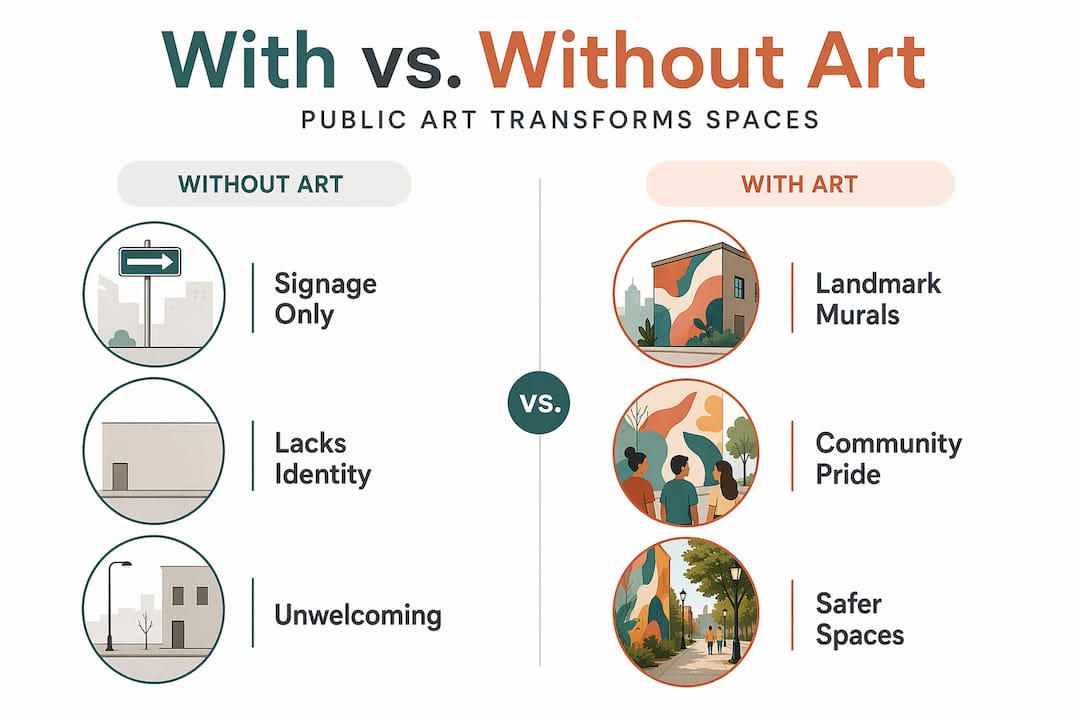
| Benefit area | Without public art | With public art |
|---|---|---|
| Wayfinding | Relies on signage alone | Landmarks guide movement intuitively |
| Safety perception | Neutral or negative | Significantly improved |
| Tourism appeal | Limited | Measurable visitor uplift |
| Property values | Baseline | Increased in surrounding areas |
| Youth engagement | Passive at best | Active participation through programming |
| Environmental adaptation | Purely functional | Functional and visually engaging |
The economic returns from creative placemaking in urban spaces are not hypothetical. Cities from Bilbao to Birmingham have documented tourism growth and property value increases around major public art investments. Even smaller installations produce measurable foot traffic changes in retail corridors.
Key considerations for planners embedding art into urban design:
- Cultural relevance: Commission artists with genuine ties to the community rather than importing external talent with no local knowledge
- Material durability: Murals and sculptures in high-traffic areas need materials selected for longevity, not just visual effect
- Functional integration: Art can double as environmental infrastructure, shade structures, acoustic barriers, or stormwater features
- Ongoing maintenance: A fading, damaged installation does the opposite of what a fresh one achieves
Pro Tip: When budgeting for a public art installation, allocate at least 15% of the project cost for ongoing maintenance and community programming over the first five years. The art that changes a neighbourhood is the art people keep engaging with, not the art unveiled once and then left to weather.
Thinking carefully about art shaping urban design at the outset of a project, rather than bolting it on at the end, is what separates token gestures from genuine transformation.
Case studies: successful public art projects fostering community engagement
Having explored art’s broad benefits, these examples highlight tangible strategies and outcomes from real urban art initiatives.
Pittsburgh’s new Arts Landing project is a £24 million public art space integrating sculptures, playgrounds, and civic amenities to enhance participation in the city centre. What makes it notable is not the scale but the integration. Art is not a feature of the space. It is the organising principle. Sculptures interact with seating, water features respond to movement, and community workshops are built into the programme from opening day.
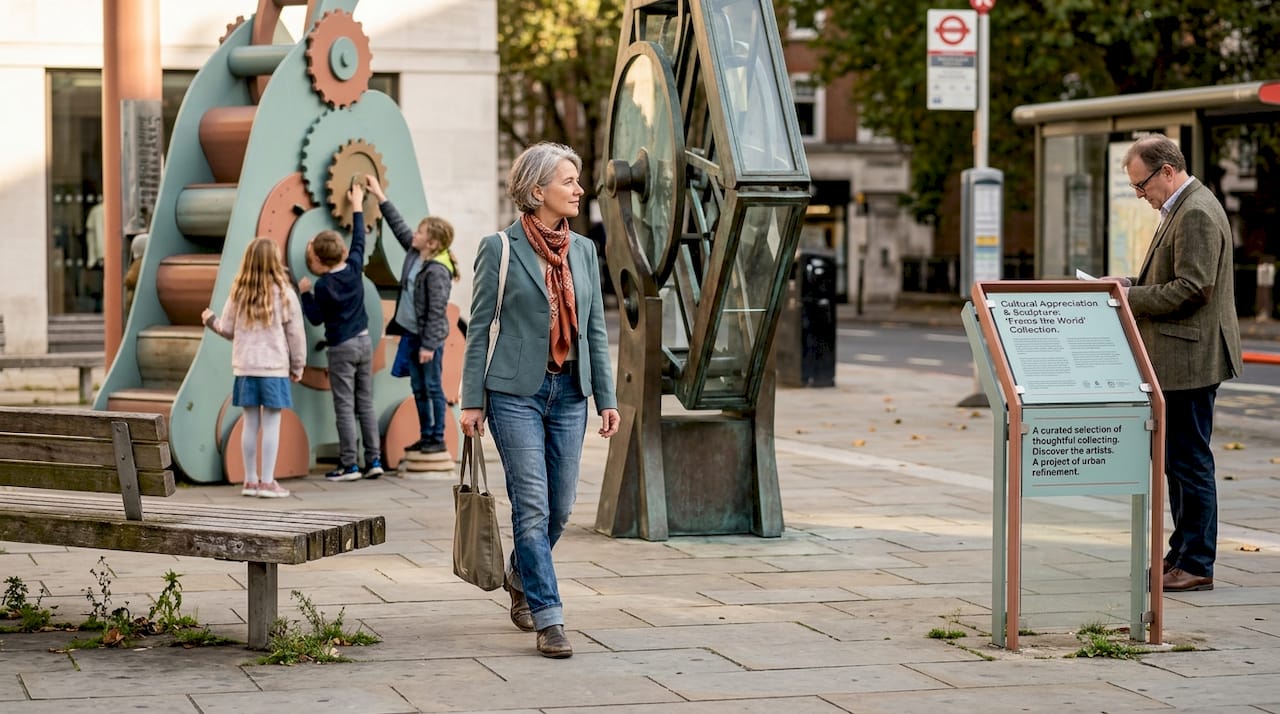
Project Row Houses in Houston takes a different approach. Artist residencies are woven into a network of community services including housing support and youth education. The art does not sit above the community. It works alongside it. The result is sustained engagement over decades, not the short burst of interest that follows most public unveilings.
In southern Italy, the Stramurales Festival in Sardinia demonstrates how participatory murals can reduce youth out-migration by building ownership and social capital. Young people who help create a mural are significantly less likely to leave a place they have literally marked as their own.
Characteristics shared across successful projects:
- Diverse artist representation that reflects the full cultural range of the community
- Participatory design processes that give residents meaningful creative input, not just consultation
- Rotating or evolving elements that sustain interest beyond the initial installation
- Connection to services or amenities that bring people to the space for reasons beyond the art itself
Pro Tip: If you are commissioning a mural for a community centre or housing development, run a co-design workshop before any sketches are produced. The ideas that emerge are almost always more specific, more resonant, and more locally meaningful than anything an outside artist would generate independently.
Understanding how public art supports urban development at a financial and social level helps make the case to sceptical stakeholders. And understanding how art fosters community wellbeing gives you the language to describe what is actually happening in a community once that art is in place.
Best practices for community planners and artists: creating impactful communal spaces with art
After reviewing successful examples, practical guidance now equips you to implement public art that truly serves your community’s needs.
Early collaboration and community participation ensure art relevance and acceptance while avoiding the risk of elite capture, where well-resourced voices dominate a process meant to serve everyone. This is not an abstract risk. It happens regularly when planners rely on open public consultations that favour articulate, organised residents over quieter, more marginalised ones.
Follow this process for genuinely inclusive public art:
- Map the community first. Before any artist is engaged, conduct listening sessions specifically designed to reach people who do not typically attend public meetings: shift workers, elderly residents, young people, recent arrivals.
- Brief artists on findings, not aesthetics. Share what you learned from the community before asking for proposals. Artists who understand the social landscape produce more relevant work.
- Use materials appropriate to context. A high-gloss resin finish may look striking in a gallery but will not survive a decade of northern English winters. Specify materials accordingly.
- Build in review points. Schedule community viewings during the creation process, not just at the unveiling. This allows meaningful feedback before decisions become permanent.
- Programme beyond the opening. Plan at least six months of events, workshops, or educational activities connected to the installation. The opening is not the outcome. Ongoing engagement is.
Pro Tip: Power dynamics in community participation in art projects do not disappear simply because a process is labelled participatory. Deliberately design for the quieter voices by using anonymous submission tools, translated materials, and outreach through trusted community organisations rather than official channels alone.
The most durable public art projects are those built on genuine relationships. Thinking about scaling art for community impact means accepting that the relational work takes as long as the physical work. Often longer.
Rethinking public art: beyond decoration to a catalyst for urban resilience
Here is the uncomfortable truth that most public art discourse avoids: when art fails in a communal space, it is almost never because the artwork was poor. It fails because the process was poor. The community was consulted rather than involved. The artist was imported rather than embedded. The installation was unveiled rather than grown.
Public art navigates complex social and political conditions, creating ripple effects in relationships and public dialogue that extend far beyond any single project. This is what makes it categorically different from other forms of urban investment. A new road improves access for as long as it is maintained. A deeply rooted public art project changes how people understand themselves and their neighbours, and that shift can last generations.
The conventional view of public art as embellishment, as the attractive but dispensable budget line that gets cut first, fundamentally misreads what it does. Cities that treat art as infrastructure, not decoration, consistently outperform those that treat it as a luxury. The evidence from Philadelphia, Pittsburgh, Houston, and Sardinia all points in the same direction.
Participatory murals via community assemblies prevent elite capture and reduce youth out-migration, sustaining the social capital that makes communities resilient to economic shocks and demographic change. That is not a soft benefit. That is urban resilience by another name.
The long-term value of public art is rarely captured in a single metric. It shows up in reduced antisocial behaviour, in the teenager who stays rather than leaves, in the resident who stops a stranger defacing a wall because they helped paint it. These are not anecdotes. They are outcomes, and they are achievable when art is treated with the same seriousness as any other civic investment.
Explore Frametheworld’s curated art collections for vibrant communal spaces
If you are working to bring genuine artistic quality into a community space, Frametheworld offers collections built for exactly this purpose. Browse the wabi sabi wall art collection for hand-painted, texture-rich pieces that bring warmth and authenticity to shared interiors, from community centres to reception areas. For spaces that need energy and visual impact, the colourful wall art collection offers bold canvases that command attention without overpowering a room. Every piece is crafted with genuine artistic intention. Whether you need a single focal point or a curated series across multiple communal areas, Frametheworld’s handmade oil paintings provide a reliable, quality-assured route from concept to installed artwork, with bespoke options available for larger projects.
Frequently asked questions
How does public art contribute to reducing crime in communities?
Public art, particularly murals, promotes community pride, increases natural surveillance through foot traffic, and signals active stewardship of a space. Areas with murals installed between 2007 and 2023 saw a 42% drop in daytime crime, demonstrating that the effect is measurable, not anecdotal.
What role does community participation play in public art projects?
Genuine participation ensures the finished work reflects local identity rather than an external vision, giving residents a sense of ownership that sustains protective attitudes toward the space. Participatory murals created through community assemblies have also been shown to reduce youth out-migration by building place attachment.
Can art in parks improve social cohesion among diverse urban populations?
Yes, and the evidence is specific. Frequent visits to renovated parks correlate with higher social cohesion and a stronger sense of community, with particularly pronounced benefits among Latino/a, Black, and middle-income residents who have historically had less access to quality public space.
What practical benefits does integrating art into urban design provide?
Art improves navigation by creating memorable landmarks, enhances safety perceptions, supports environmental features such as rain gardens, and drives measurable economic returns through tourism and increased property values. Public art programmes in cities across the US and Europe consistently demonstrate these outcomes when implemented with community input and long-term maintenance plans.


Leave a comment
This site is protected by hCaptcha and the hCaptcha Privacy Policy and Terms of Service apply.