

TL;DR:
- Effective commercial space art planning enhances employee engagement, reinforces brand identity, and boosts business performance. It requires understanding your audience, defining clear goals, assessing the space, and meticulous layout, lighting, and stakeholder coordination. Regular evaluation and strategic blending of bespoke and curated collections ensure lasting impact and adaptability in dynamic environments.
Art that goes unplanned rarely goes unnoticed. It just goes wrong. Poorly chosen pieces crowd walls, clash with brand colours, or simply bore the people who have to look at them every day. Done well, commercial space art planning is one of the most cost-effective tools available to business owners and interior designers who want spaces that genuinely perform. A well-designed commercial space can inspire employees, improve client experience, and increase revenue. This guide gives you the framework to get there without the guesswork.
Table of Contents
- Key takeaways
- What commercial space art planning actually requires
- How to select and install art step by step
- Avoiding the most common mistakes
- Measuring the success of your art installation
- Bespoke commissions versus curated collections
- My honest take on commercial art planning
- How Frametheworld can support your art project
- FAQ
Key takeaways
| Point | Details |
|---|---|
| Start with your audience | Understanding who uses the space shapes every art decision, from style to scale. |
| Align art with brand identity | Artwork should reinforce company values and build trust with both employees and clients. |
| Plan layout before you buy | Measuring walls and mapping focal points prevents costly mistakes during installation. |
| Lighting is non-negotiable | Poorly lit art loses impact and can suffer physical damage over time. |
| Evaluate impact after installation | Gather employee feedback and monitor atmosphere to refine your collection as the business grows. |
What commercial space art planning actually requires
Before you browse a single catalogue or request a quote, you need to understand what you are actually planning for. Skipping this stage is the single biggest reason corporate art projects stall or disappoint.
Know your audience and culture first. Tailoring art to visitor and employee profiles enhances engagement in ways that generic decoration simply cannot. A law firm with a formal client base needs different visual language than a tech startup with a mixed-age, creative team. Before selecting any piece, document who occupies the space, who visits it, and what impression you need to leave.
Define your goals clearly. Are you trying to reduce stress in a busy open-plan office? Signal creativity to prospective clients in a reception area? Celebrate company heritage in a boardroom? Each goal points toward a different medium, style, and scale. Write these down. They will guide every decision that follows.
Consider the following prerequisites before moving forward:
- Space assessment: Record wall dimensions, ceiling heights, existing finishes, and natural light sources. Photograph every intended installation area at different times of day.
- Budget framework: Separate your budget into three buckets. Procurement covers the cost of acquiring artwork. Installation covers hanging, framing, and specialist fitting. Maintenance covers cleaning, reframing, and future updates.
- Stakeholder alignment: Include voices from leadership, facilities management, and a sample of employees early. Disagreements are far cheaper to resolve at the planning stage than after artwork has been ordered.
- Tools you will need: A laser measure, mood-board software (digital or physical), a lighting plan, and a structured briefing document for any artist or supplier you commission.
| Planning element | Why it matters |
|---|---|
| Wall dimensions and finishes | Determines scale, framing options, and installation method |
| Foot traffic and sightlines | Identifies where art will have the greatest visual impact |
| Lighting conditions | Affects colour accuracy, glare risk, and artwork longevity |
| Brand guidelines | Keeps artwork coherent with existing visual identity |
| Budget per zone | Prioritises spend where impact is highest |
Pro Tip: Create a one-page brief for each installation zone before you contact any artist or supplier. Include the room’s function, the dominant colours, the intended viewer distance, and the emotional tone you want to achieve. This single document will save hours of revision.
How to select and install art step by step
Good workspace artwork planning follows a sequence. Skipping steps creates the most common and visible mistakes.
- Measure before anything else. Record wall width, height, and any architectural interruptions such as windows, sockets, or vents. Note the viewing distance. A piece that looks bold in a supplier’s showroom can feel lost on a 6-metre boardroom wall.
- Choose art styles suited to the environment. Open-plan offices benefit from large-scale abstract works that add visual interest without demanding focus. Art styles for commercial spaces are worth researching before committing to a direction, as the wrong style in a client-facing zone can actively undermine brand perception.
- Balance brand identity with employee experience. Art that only serves the brand can feel cold and corporate. Art that only serves staff preferences can feel inconsistent to clients. Using art to reinforce brand story and values is where this balance is achieved most effectively. Style, colour palette, and subject matter all carry meaning.
- Plan your layout before ordering. The three most practical arrangements for commercial environments are the grid layout, the salon-style gallery wall, and the anchor-plus-satellites format. Gallery wall layouts should account for safe wall margins, consistent spacing, and alignment to furniture or focal points. Use paper templates or low-tack tape on the wall to test positions before drilling.
- Address lighting and acoustics together. Proper lighting enhances mood, prevents glare on glass-fronted pieces, and supports productivity. Track lighting or adjustable spotlights give you flexibility as the collection evolves. Acoustic panels incorporated into or behind large-format works can reduce noise in open offices without sacrificing aesthetics.
- Commission or source with lead times in mind. Bespoke pieces can take 6 to 12 weeks. Even curated prints need framing and delivery time. Build these into your project schedule before confirming an office move or launch date.
Pro Tip: When planning a gallery wall, cut paper templates to the exact size of each intended piece and use painter’s tape to stick them to the wall. Live with the arrangement for two or three days before committing. What looks right on a mood board often feels different in the physical space.
Avoiding the most common mistakes
Even well-intentioned corporate art strategy fails when specific details are overlooked. Here are the pitfalls that most frequently derail commercial art projects.
- Overcrowding walls. Overcrowding art or placing it incorrectly detracts from the professional appearance of the space and creates visual noise. Leave breathing room. White space is not wasted space.
- Ignoring glare and reflection. Glass-fronted artwork positioned opposite large windows becomes a mirror in daylight. Use anti-reflective glazing or recess lighting to eliminate glare without darkening the piece.
- Neglecting maintenance. Canvas prints gather dust. Paper-based works can warp in humid environments. Plan a cleaning and inspection schedule into your facilities management rota from day one.
- Treating stakeholder disagreements as a nuisance. Resistance from leadership or staff usually signals that the art does not yet feel relevant to the people who have to share space with it. Address the underlying concern rather than overriding the objection.
- Buying art once and forgetting it. Companies evolve. A collection that reflected the culture five years ago may feel dated or even misaligned with new values. Budget for periodic updates, even if that means rotating a subset of pieces seasonally.
Art in a commercial space is a long-term commitment, not a one-time purchase. The organisations that get the most from their collections treat artwork as a living element of the workplace, reviewed and refreshed in the same way they review their brand or communications.
Measuring the success of your art installation
Installing the artwork is not the end of the project. Evaluating its impact is what separates a considered corporate art strategy from a decorating exercise.
- Gather structured feedback. Within six to eight weeks of installation, survey employees and collect qualitative observations from visitors. Ask specific questions about atmosphere, how the space feels to work in, and whether the art feels relevant to the company.
- Observe behaviour in the space. Do employees choose to work near certain pieces? Do clients pause in the reception area in a way they did not before? Behavioural cues are often more telling than survey responses.
- Inspect for durability. Check fixings, frames, and surface condition at three months and again at twelve months. Catching minor damage early is far cheaper than restoration.
- Plan seasonal and cultural updates. Rotating a small number of pieces, perhaps 20 to 30 per cent of the collection, keeps the environment feeling alive. This is especially relevant for client-facing spaces where repeat visitors notice when nothing changes.
- Document everything. Record what was installed, where, when, at what cost, and with what result. This documentation becomes the foundation for your next project and makes briefing new suppliers or designers significantly faster.
Pro Tip: Build a simple scoring sheet for your post-installation review. Rate each zone against the goals you set at the planning stage. If a piece scores poorly on two consecutive reviews, it is time to consider replacing it rather than adjusting expectations.
Bespoke commissions versus curated collections
When it comes to sourcing art for commercial environments, you have two primary routes. Each has genuine strengths and real limitations.
| Factor | Bespoke commission | Curated collection |
|---|---|---|
| Cost | Higher per piece, but unique | More accessible at scale |
| Lead time | 6 to 12 weeks or more | Days to a few weeks |
| Brand alignment | Directly tailored to brief | Dependent on selection quality |
| Flexibility | Limited post-commission changes | Easy to swap or rotate |
| Emotional impact | Often stronger and more memorable | Variable, depends on curation |
Bespoke commissioned artwork gives you a piece designed specifically for your space, your brand, and your people. It carries narrative weight that off-the-shelf work rarely matches. A hand-painted mural in a reception area tells clients something about the company that a printed canvas cannot. The trade-off is cost and time, and the risk that the brief is not interpreted as intended.

Curated collections solve the speed and flexibility problem. A well-curated art collection can be assembled, installed, and adjusted relatively quickly, which matters when you are fitting out multiple offices or working to a tight refurbishment timeline.
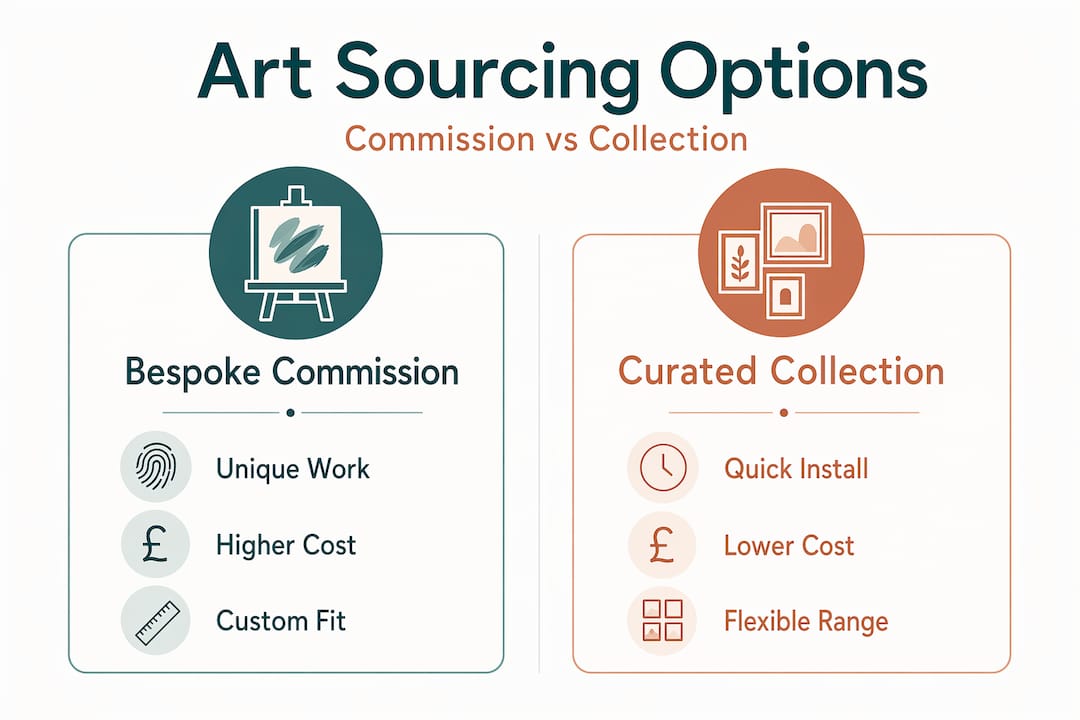
The most effective approach for most commercial environments is a hybrid: one or two bespoke statement pieces in the highest-visibility zones, supported by a curated collection throughout the rest of the space. This balances impact with practicality and gives you the flexibility to update secondary pieces without touching the anchor works.
Consider these questions when choosing your approach:
- How frequently does the company rebrand or refresh its visual identity?
- Are there spaces where a unique piece would actively support client acquisition or retention?
- What is the realistic budget per zone, including installation and future maintenance?
- How much time does the project timeline allow before the space needs to be operational?
My honest take on commercial art planning
I have seen companies spend significant budgets on artwork that was beautiful in isolation and ineffective in practice. What I have learned, working across corporate fit-outs and advising business owners on how art transforms commercial spaces, is that the gap between good art and good commercial art is almost always a planning gap, not a taste gap.
Most organisations underestimate how much a considered collection shapes daily experience. Employees who work in well-curated environments report feeling more valued. Clients who walk into a thoughtfully art-directed reception form stronger first impressions. These are not abstract benefits. They translate into retention, referrals, and revenue. Yet many businesses treat art as the last line item before a space is signed off, which means it is always under-budgeted and under-planned.
What I find consistently overlooked is the conversation that should happen between art planning and HR or culture teams. The artwork in your office communicates what the company values. If that communication is left entirely to an interior designer working from a mood board, you may end up with something that looks right but means nothing to the people who matter most.
My practical advice: do the planning work before you fall in love with any particular piece. The brief always matters more than the artwork that comes first to mind.
— Lennard
How Frametheworld can support your art project
Whether you are furnishing a single meeting room or planning a multi-floor office fit-out, Frametheworld offers collections and bespoke options built for exactly this kind of project. The Wabi Sabi wall art collection brings hand-painted texture and calm to open-plan offices and reception areas, while the Pop Art collection suits creative studios and client-facing spaces that need energy and personality. Both collections are browsable by size, style, and format, which makes narrowing down options against a planning brief genuinely straightforward. For spaces that call for something unique, Frametheworld also handles bespoke and hand-painted commissions. You can explore office art tips or browse directly to find pieces that fit your space and your brief.
FAQ
What is commercial space art planning?
Commercial space art planning is the structured process of selecting, sourcing, and installing artwork in corporate environments to meet aesthetic, functional, and brand objectives. It considers factors including audience, layout, lighting, and budget from the outset.
How do I start planning art for an office?
Begin by assessing your wall dimensions, understanding who uses the space, and defining the emotional tone you want to create. Set a clear brief before contacting any artist or supplier.
Should corporate art match the brand colours exactly?
Not necessarily. Art that harmonises with brand colours without replicating them often feels more sophisticated. The priority is that the overall palette and mood of the collection feels coherent with the company’s visual identity.
How often should a commercial art collection be updated?
Rotating 20 to 30 per cent of a collection every one to two years keeps the environment fresh without disrupting the overall scheme. High-traffic client-facing areas benefit from more frequent updates than internal staff spaces.
What is the difference between bespoke and curated art for commercial spaces?
Bespoke art is commissioned specifically for your space and brief, offering unique narrative impact at higher cost and longer lead times. Curated collections draw from existing works, offering faster turnaround, easier rotation, and more accessible pricing at scale.


Leave a comment
This site is protected by hCaptcha and the hCaptcha Privacy Policy and Terms of Service apply.