
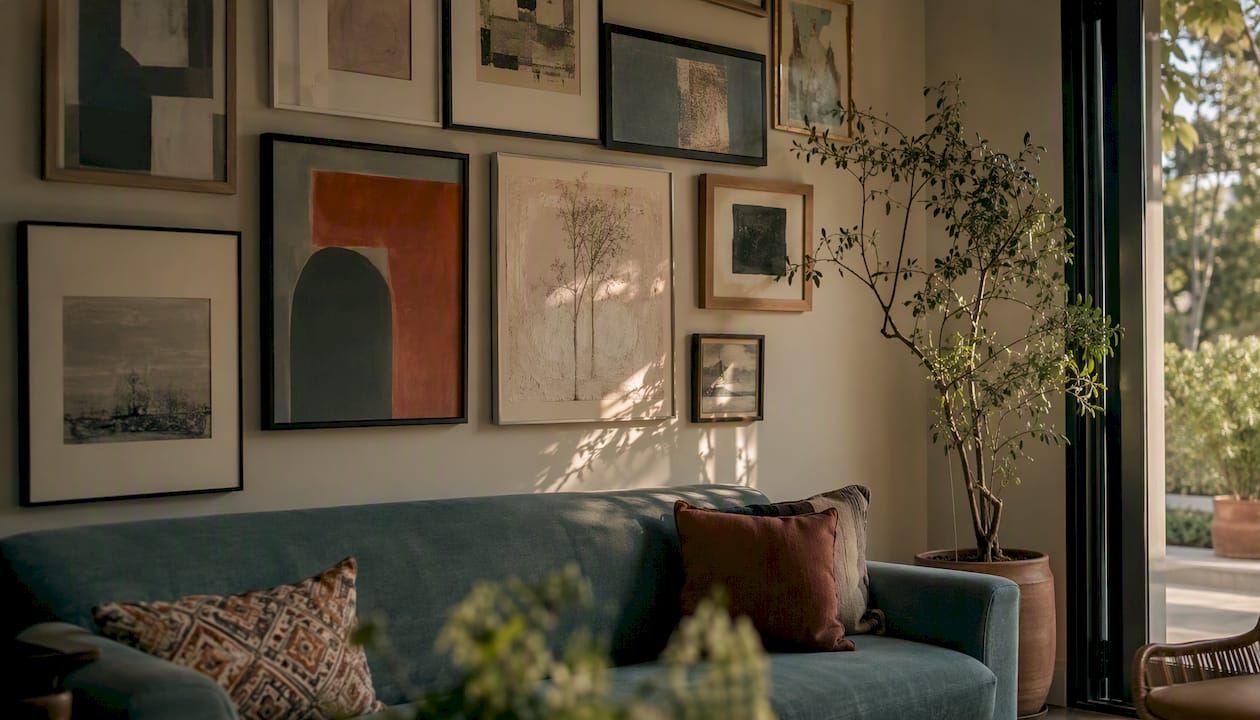
A well-chosen collage art wall combines a clear base palette, mixed scales and media, and a simple layout template to create a lived-in focal point. The three decisions that determine success are: which palette anchors the wall, which layout template you follow, and what mix of pieces you collect. Get those right and the rest falls into place.
Before you buy a single frame, run through this quick checklist:
- Measure the wall and mark the outer boundary with painter’s tape
- Identify your base colour palette (two or three tones drawn from the room)
- Sketch or photograph the pieces you already own
- Decide on a layout template (grid, salon, offset cluster)
- Set a rough budget and timeline (a weekend for a small wall; two to four weeks for a commissioned bespoke piece depending on complexity)
Key takeaways
A collage art wall works when palette, layout and materials are chosen together rather than separately — that single decision prevents most of the common mistakes.
| Point | Details |
|---|---|
| Fix the palette first | Choose two or three tones from the room before buying any pieces. |
| Trial the layout | Use painter’s tape on the wall or a floor mock-up before hanging anything permanently. |
| Layer large to small | Hang the anchor piece first, then work outward with medium and small pieces. |
| Match mounting to weight | Use Command strips for light pieces; picture hooks and wall plugs for anything over 2 kg. |
| Frametheworld for bespoke pieces | Custom hand-painted canvases, sized to your layout, available to order directly online. |
Table of Contents
- What do collage art wall examples actually look like?
- How do you plan a collage wall that looks intentional?
- What materials and mounting methods do you need?
- Step-by-step: how do you assemble and hang a collage wall?
- Which collage styles suit which rooms?
- Where can you source pieces and commission custom work?
- How do you keep a collage wall looking its best?
- What makes a collage wall genuinely work?
- Frametheworld can help you build the wall you have in mind
- Sources
What do collage art wall examples actually look like?
The range is wider than most people expect. Love Chic Living’s curated roundup shows everything from colourful eclectic displays to corner collages and hallway photo walls, each suited to a different room and mood. Here are the most useful types, with a note on where each works best.
- Salon hang — a dense, floor-to-ceiling mix of frames in varying sizes. Best for a large living room wall or a staircase run where the sheer volume creates drama.
- Symmetrical grid — equal-sized frames in a tight matrix. Works well in a home office or dining room where a clean, ordered look suits the function.
- Offset cluster — an asymmetric grouping anchored by one large piece. Ideal above a sofa or bed as a focal point that still feels relaxed.
- Travel ephemera collage — maps, postcards, ticket stubs and pressed botanicals layered behind glass. Perfect for a hallway or study where personal narrative matters.
- Mixed-media with 3D objects — shadow boxes, small shelves and framed textiles combined on one wall. Suits a bedroom alcove or reading nook.
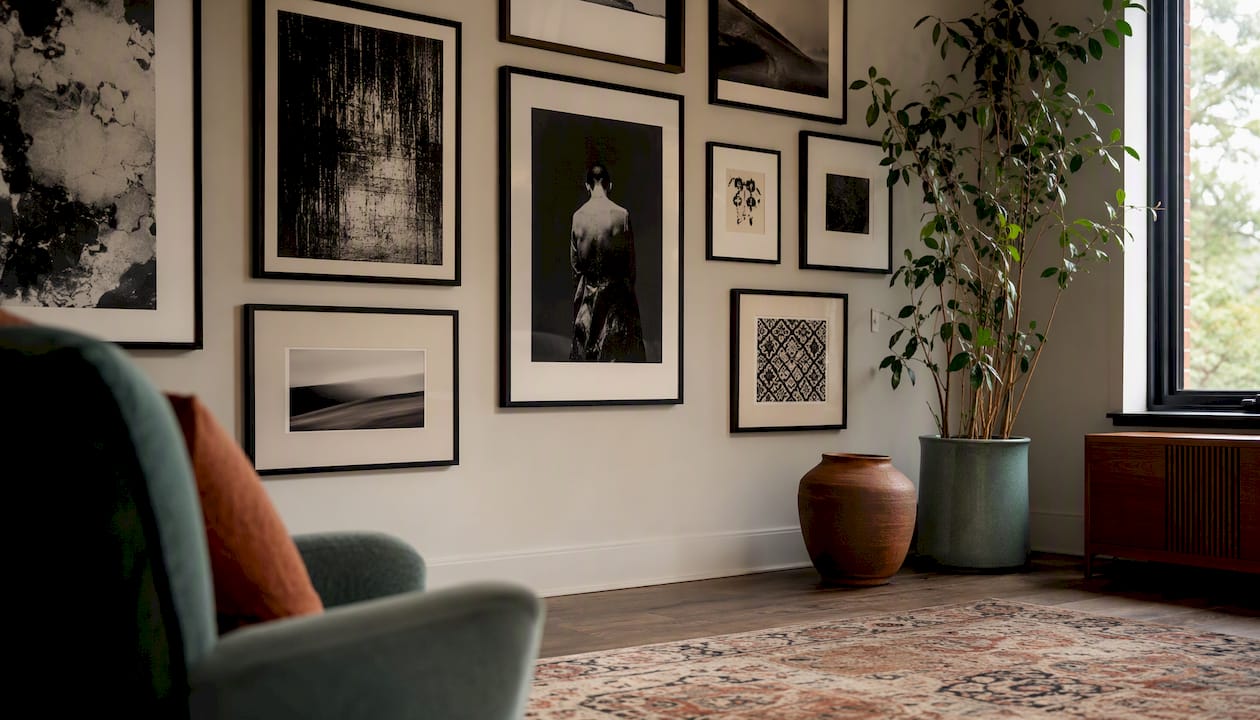
- Monochrome photo wall — black-and-white prints in mismatched frames. Timeless in a hallway or bathroom where colour would compete with fittings.
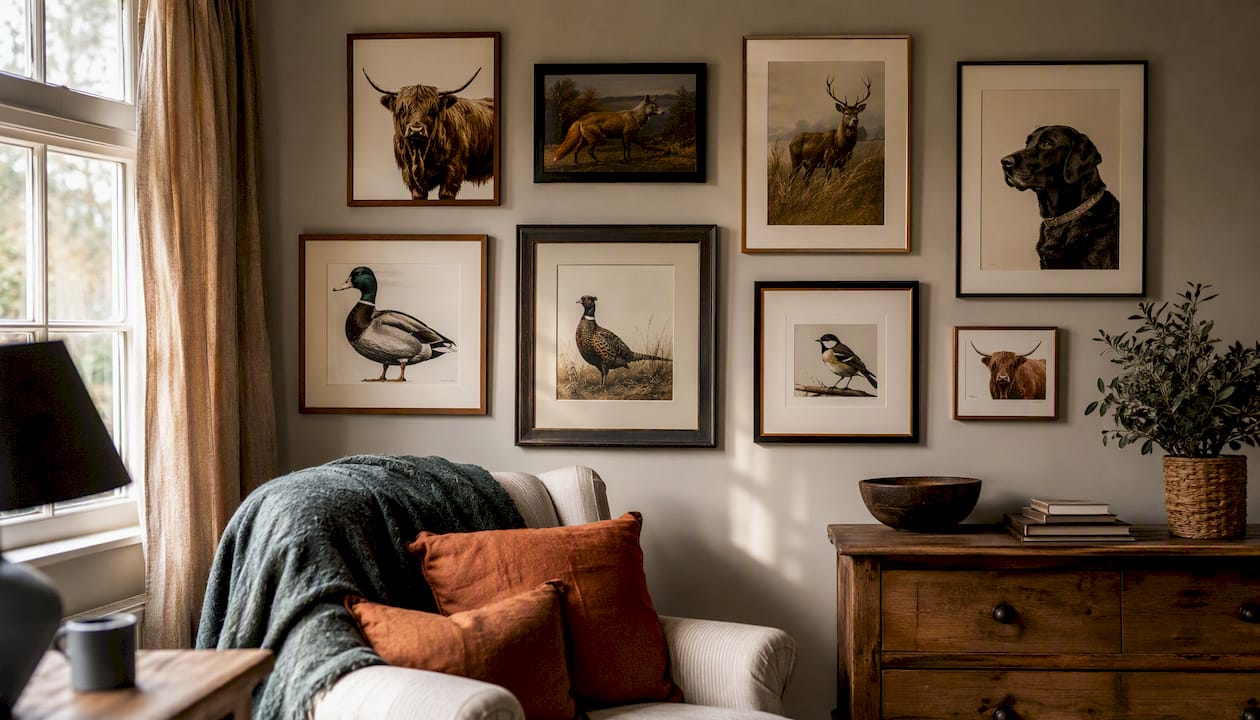
- Nature motif — botanical prints, pressed flowers and landscape photography grouped together. Works in a kitchen, conservatory or bedroom.
- Vintage nostalgia — aged maps, sepia portraits and antique illustrations. Strong in a dining room or library-style living space.
- Minimalist two- or three-piece cluster — two large prints flanking one smaller accent piece. Suits a bedroom or narrow hallway where space is limited.
- Decorative-object mosaic — found objects painted a single colour and mounted as a sculptural panel. Painting disparate found objects the same colour turns them into a unified sculptural element, useful for a feature wall in a living room or bar area.
Architectural Digest’s gallery wall guide describes this approach as a “wall of wonders” — the goal is a collected, unified installation rather than a forced perfect grid. Franz West’s Sammelwand at the Pinault Collection takes this furthest: 30 collages grouped so tightly that the wall itself becomes a single composed experience.
Pro Tip: Browse Frametheworld’s 2026 wall art ideas guide for trend-led examples that translate well to UK interiors.
How do you plan a collage wall that looks intentional?
Scale and placement come first. A collage wall needs a visual anchor — usually a piece of furniture (sofa, console, bed) — and the wall area should be roughly two-thirds the width of that anchor. Sight lines matter too: the centre of the arrangement should sit at eye level, roughly at average human eye height from the floor.
AccessArt’s collage wall guide recommends choosing a base palette that either complements or deliberately contrasts the room’s existing scheme, then layering personal mementos — ticket stubs, travel photos, natural fibres — to build an expressive composition. Two or three tones is enough; more than that and the wall starts to compete with the room rather than complete it.
A practical planning sequence:
- Photograph the wall and print it at A4 scale for sketching
- Cut paper templates to match each piece and lay them on the floor
- Map the arrangement on the wall with painter’s tape before committing
- Check spacing: 5–8 cm between pieces is a reliable starting gap
- Adjust until the layout feels balanced, then photograph it as a reference
For budget, a DIY collage wall using a mix of printed photos, thrift-shop frames and a few new prints typically costs £50–£150 for a medium wall. A commissioned bespoke piece from a specialist adds to that but removes the assembly work entirely. Timeline: one weekend for a DIY hang; two to four weeks if ordering custom pieces.
For more on placement rules and proportion, Frametheworld’s home decoration best practices guide covers the fundamentals clearly.
What materials and mounting methods do you need?
The materials list is shorter than most people expect. For a standard mixed-media collage wall you need:
- Paper and card — lightweight paper for layered backgrounds; 300gsm card for structural pieces
- Frames — a mix of depths and finishes (black, natural wood, white) adds visual texture
- Shadow boxes — for 3D objects, dried botanicals or layered ephemera
- Mounting tape and adhesive strips — Command strips (up to 3.6 kg per pair) work for most framed prints and are fully renter-friendly
- Picture hooks and wall plugs — for heavier pieces over 2 kg on plaster or brick
- Glue dots and mounting squares — for paper elements and lightweight card directly on the wall
For rented homes, removable adhesive strips are the practical answer. They hold reliably on painted plaster and leave no residue when removed correctly.
AccessArt advises sealing mixed-media collages with a clear matte medium before framing to protect against UV fading, dust and environmental wear. For framed pieces, acid-free backing and UV-protective glazing (glass or acrylic) reduce long-term deterioration significantly.
Pro Tip: Use acid-free backing board inside frames whenever paper or fabric elements are included. It costs very little and prevents the yellowing that ruins collages within a few years.
For a deeper look at framing choices, Frametheworld’s wall art framing process guide covers glass types, mount depths and finishing options in detail.
Step-by-step: how do you assemble and hang a collage wall?
Four layout templates cover most situations:
- Grid — uniform frames in rows and columns; ordered, calm, suits offices and dining rooms
- Salon hang — dense, varied sizes with minimal gaps; dramatic, suits large living room walls
- Offset cluster — one large anchor piece with smaller pieces radiating asymmetrically; relaxed, suits bedrooms
- Corner wrap — pieces extend across two adjacent walls; immersive, suits reading nooks and alcoves
The DIY sequence, once you have your pieces and templates ready:
- Gather all pieces and lay them on the floor in your chosen arrangement
- Cut paper templates for each piece and label them
- Map the layout on the wall with painter’s tape, starting from the centre
- Hang the largest anchor piece first, checking it is level
- Work outward, hanging medium pieces next, then small accent pieces last
- Step back every few pieces to check balance before committing
The Spruce recommends the floor mock-up and painter’s tape method as standard practice to avoid imbalance and unnecessary wall damage. Free Period Press adds that mixing sizes and embracing offset hanging produces a more natural result than forcing a perfect grid.
A single-session hang for a 10–15 piece wall takes roughly two to three hours once the layout is mapped.
Pro Tip: Build mixed-media collages from the background up: adhere larger, flatter elements first, then layer smaller or heavier pieces on top. This creates a stable composition and prevents warping.

Frametheworld’s art display arrangement guide has spacing templates worth bookmarking before you start.
Which collage styles suit which rooms?
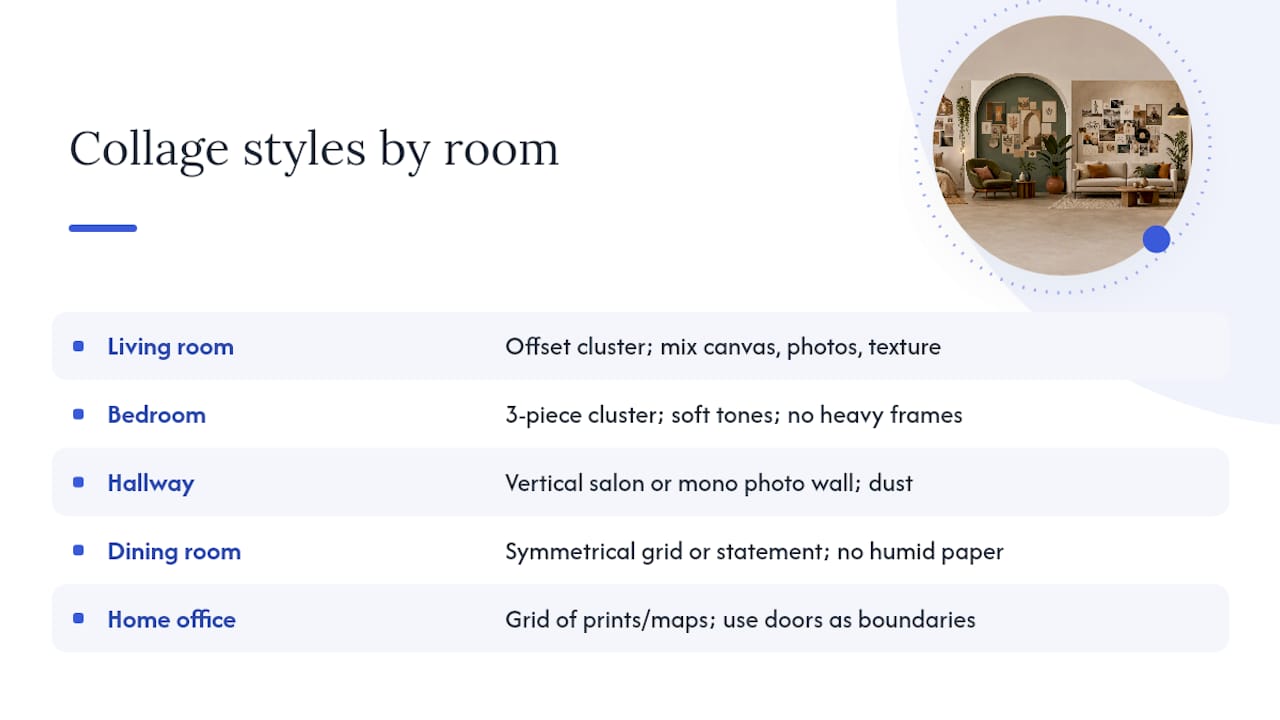
Living room — go for an offset cluster or salon hang above the sofa. Keep the centre at eye level and use a mix of canvas prints, framed photography and one or two textured pieces. Avoid direct sunlight on paper elements. For more on living room placement, see Frametheworld’s living room wall art guide.
Bedroom — a three-piece cluster above the headboard works well. Soft palettes (warm neutrals, dusty blues) suit the mood. Avoid heavy frames directly above the bed for safety.
Hallway — a vertical salon hang or monochrome photo wall makes a narrow hallway feel considered rather than cluttered. Dust regularly; hallways accumulate more airborne particles than other rooms.
Dining room — a symmetrical grid or a single large statement piece suits the formality. Avoid humidity-sensitive paper pieces near a kitchen opening.
Home office — a grid of motivational prints, maps or botanical illustrations keeps the space calm. Treat architectural features like doors and doorways as natural boundaries for the arrangement; One Day Doors & Closets notes that treating architectural elements as focal points rather than obstacles produces more cohesive room designs.
For maintenance across all rooms: dust frames with a dry microfibre cloth monthly, keep paper-based pieces out of direct sunlight, and check adhesive strips every six months in rooms with temperature fluctuations.
Where can you source pieces and commission custom work?
Most collage walls draw from several sources at once:
- Thrift shops and car boot sales — frames, vintage prints and found objects at low cost
- Personal photography — printed at A4 or A3 through a local print shop or online service
- Print collections — curated art prints bought individually or as sets
- Bespoke commissions — custom-sized, hand-painted pieces made to your palette and dimensions
For complex or large-scale walls, commissioning removes the guesswork entirely. Frametheworld offers bespoke hand-painted canvases customisable by size, colour, style and theme, with finishing options including shadow-box framing. Typical lead times for commissioned pieces run two to four weeks depending on complexity.
Pro Tip: Before commissioning, photograph your wall with the painter’s tape layout in place and send it to the supplier. It removes ambiguity about scale and proportion immediately.
Rough cost bands: thrift and print-based walls, £50–£200; mixed bought-and-commissioned walls, £150–£500+; fully commissioned bespoke installations, £300 upward depending on size and number of pieces. Typical lead times for commissioned pieces run two to four weeks depending on complexity.
How do you keep a collage wall looking its best?
Paper and fabric elements are more vulnerable than most people realise. UV light fades pigments within months if pieces are hung in direct sun. The practical steps:
- Hang paper-based pieces away from south-facing windows, or use UV-filtering acrylic glazing in frames
- Dust frames and surfaces monthly with a dry microfibre cloth; never use spray cleaners near paper
- Check adhesive strips every six months and replace any that show signs of slipping
- For mixed-media pieces, seal with a clear matte medium before framing to protect against dust and environmental wear
- Use acid-free backing and UV-protective glazing for any piece you want to preserve long-term
If a piece is damaged, most framed prints can be replaced without disturbing the rest of the arrangement, provided you kept the original layout photograph.
What makes a collage wall genuinely work?
The walls that hold up over time share one quality: they feel collected, not assembled. There is a difference. Assembled walls have matching frames, uniform spacing and a visible template. Collected walls have a strong palette, mixed periods and scales, and at least one piece that surprises you.
Architectural Digest’s advice to mix periods and scales is right, but the part people miss is restraint. A collage wall does not need to contain everything you love. It needs to contain the right things, edited down to the pieces that hold together as a group.
The other underestimated factor is the backing. Acid-free materials, UV glazing, and a sealed surface are not optional extras for serious pieces. They are what separates a wall that looks good for a decade from one that starts yellowing within two years.
Frametheworld can help you build the wall you have in mind
Frametheworld’s hand-painted canvases are made to order, customisable by size, palette, style and theme, which means you can match a piece precisely to the collage layout you have already planned. Whether you need a large anchor canvas for a salon hang or a set of smaller textured pieces to complete an offset cluster, the bespoke commission process starts with your brief and ends with a finished, ready-to-hang artwork.
The Wabi Sabi collection is particularly well suited to layered, texture-forward collage walls. Browse the collection, pick a size that fits your layout, and place your order directly online. For guidance before you order, the styling large wall art guide covers proportion and placement in detail.
Sources
- Artist Techniques: Collage Wall Art Tips To Create Unique, Textured Masterpieces At Home (2026)
- 13 gallery wall ideas to make your blank space a work of art | Architectural Digest
- 52 gallery wall ideas to energize any room | The Spruce
- How to make a DIY collage wall at home | Free Period Press
- 15 creative wall collage ideas unique display tips - Love Chic Living
- Wall decor ideas – make contemporary wall art from a collage of random items | Contemporist
- Sammelwand/Collecting Wall | Pinault Collection

Leave a comment
This site is protected by hCaptcha and the hCaptcha Privacy Policy and Terms of Service apply.