

TL;DR:
- Choosing the right frame enhances artwork and protects it with proper materials and technical details.
- Common frame materials include wood, metal, acrylic, and composite, each suited to different styles and environments.
- Effective gallery walls require consistent spacing, layout planning, and deliberate mixing of frame types to achieve cohesion.
Choosing the right frame is one of the most underestimated decisions in home decoration. The wrong choice can flatten even the most striking artwork, while the right one transforms a simple print into something you genuinely stop to admire. With so many materials, finishes, and technical considerations to navigate, it is easy to feel overwhelmed before you have even measured your wall. This guide cuts through the noise by setting out a clear decision-making framework, comparing the main framing materials side by side, and showing you how to match every choice to your specific space and style.
Table of Contents
- How to choose framing options: key criteria
- Wood, metal, acrylic, or composite: the main frame types explained
- Gallery wall strategies: framing options and creative arrangements
- Technical know-how: preservation, mounting, and framing mechanics
- How to match framing options to your space and style
- Our perspective: why perfect framing is part art, part science
- Find your frame: unique wall art options and custom prints
- Frequently asked questions
Key Takeaways
| Point | Details |
|---|---|
| Choose by criteria | Frame material, technique, and design should match your artwork and setting. |
| Use proper materials | Acid-free mats and backing preserve your art and prevent long-term damage. |
| Think arrangement | Consistent spacing and thoughtful frame pairing create cohesive gallery walls. |
| Mix for style | Blending wood, metal, and acrylic frames can add character when done intentionally. |
How to choose framing options: key criteria
Before you fall in love with a particular finish or material, it pays to establish your non-negotiables. The most visually stunning frame in the world will disappoint you if it buckles under the weight of a large canvas or causes your print to yellow within a few years. Getting the basics right first makes every subsequent decision far easier.
The technical foundation matters enormously. Acid-free mats and backing prevent yellowing and mat burn, proper joinery such as mitre or spline cuts keeps wood frames square over time, and mounting on foam core protects the artwork from warping. These are not optional extras; they are the baseline for any frame worth buying. Our personalised home framing tips go further on this point for those who want to explore it in depth.
With the technical baseline established, consider these key decision criteria before selecting a frame:
- Artwork size and weight: Larger, heavier pieces need robust frames with stronger joinery and appropriate hanging hardware.
- Style and theme: A sleek metal frame suits a contemporary abstract print; an ornate gilded wood frame suits a classical portrait.
- Mounting method: Float mounting, traditional matting, and canvas stretching all require different frame profiles.
- Light and humidity exposure: Bathrooms and kitchens demand moisture-resistant materials; south-facing rooms need UV-protective glazing.
- Budget: Quality archival materials cost more upfront but protect your investment for decades.
For gallery walls specifically, consistent mat widths create a sense of order even when frames vary in size. Good arrangement tips always emphasise leaving breathing room between frames so each piece can read on its own terms. You can also find excellent professional framing guidance if you are working on a more complex project.
Pro Tip: For gallery walls, standardise your mat widths across all frames. Even when the frame styles differ, uniform mats create an instant sense of curation and calm.
Wood, metal, acrylic, or composite: the main frame types explained
Once your criteria are clear, the material choice becomes much more straightforward. Common framing options for customisable wall art and prints include wood, metal, acrylic or plastic, and composite materials, each with its own personality and practical strengths.
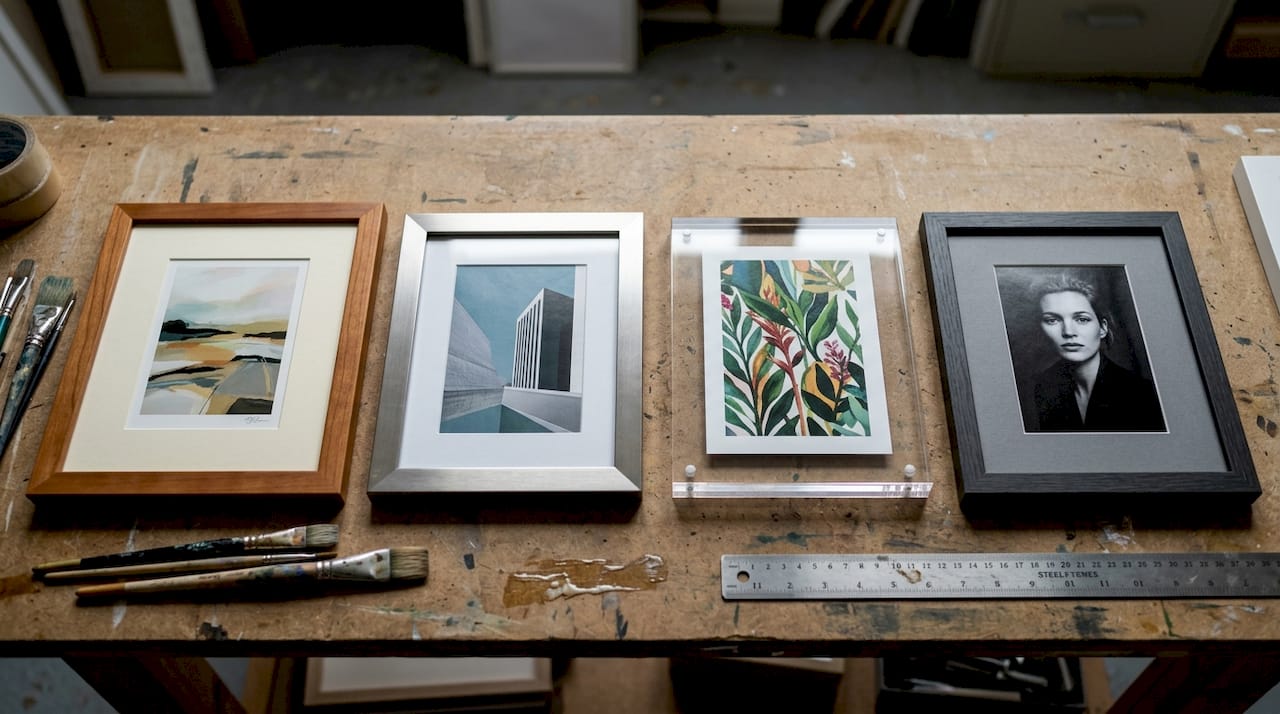
Here is a quick breakdown of how they compare:
| Material | Best use | Relative durability | Relative cost |
|---|---|---|---|
| Hardwood | Classic, traditional, fine art | Very high | High |
| Softwood | Casual prints, lightweight pieces | Moderate | Low to moderate |
| Aluminium | Minimalist, photography, offices | High | Moderate |
| Steel or brass | Industrial, statement pieces | Very high | High |
| Acrylic or plastic | Children’s rooms, budget projects | Low to moderate | Low |
| Composite (MDF) | Reproduction mouldings, painted finishes | Moderate | Low to moderate |
Each material carries distinct advantages and trade-offs:
- Wood offers warmth, versatility, and natural variation. Hardwoods such as oak and walnut are dense and durable; softwoods such as pine are lighter and more affordable but can dent more easily.
- Metal frames are slim, precise, and exceptionally durable. They suit photography and modern prints beautifully but can feel cold in traditional schemes.
- Acrylic and plastic are lightweight and inexpensive. They work well in low-risk environments but lack the visual weight that fine art often deserves.
- Composite materials such as MDF can replicate ornate mouldings at a fraction of the cost, though they are more susceptible to moisture than solid wood.
‘Wood’s warmth can soften modern interiors, while metal adds an edge.’
The best interior framing advice always recommends thinking about the room before the frame. If you are unsure where to start, browsing best framed art styles by décor theme can spark useful ideas.
Gallery wall strategies: framing options and creative arrangements
With a clear understanding of materials, you can start thinking about how frames work together in a group display. A gallery wall is not simply a collection of frames stuck to a wall; it is a curated composition that needs structure to feel intentional.
Professionals recommend 2 to 3 inches (roughly 5 to 7 cm) of consistent spacing between frames, and applying the rule of thirds when deciding on proportions and positioning. These principles give a gallery wall its visual rhythm.
Here is a simple spacing reference to guide you:
| Frame size | Recommended gap |
|---|---|
| Up to 30 cm | 5 cm (approx. 2 in) |
| 30 to 60 cm | 6 to 7 cm (approx. 2.5 in) |
| Over 60 cm | 7 to 8 cm (approx. 3 in) |
Follow these steps to plan a gallery wall that feels deliberate rather than random:
- Lay it out on the floor first. Arrange your frames on the ground and photograph the layout before committing anything to the wall.
- Anchor with a centrepiece. Choose the largest or most visually dominant piece and build outward from it.
- Mix sizes intentionally. Pair large frames with smaller ones to create movement across the wall.
- Trace frames onto paper. Cut paper templates and tape them to the wall to test positioning without driving a single nail.
- Step back regularly. What looks balanced up close can appear lopsided from across the room.
Our full gallery wall guide covers more advanced arrangement techniques for complex spaces.
Pro Tip: When mixing frame types, repeat at least one element across the group, whether that is the same colour, the same metal finish, or the same mat width. That single repeated element is what gives a mixed display its coherence.
Technical know-how: preservation, mounting, and framing mechanics
A stylish frame means very little without sound technical construction behind it. This is the part of framing that most people overlook until something goes wrong.
The most important archival components to understand are:
- Acid-free mats and backing: Archival-grade materials prevent acid from leaching into paper and causing yellowing or mat burn, which can permanently damage prints over time.
- Joinery quality: Mitre joins and spline reinforcements keep wood frames from racking (twisting out of square) over years of temperature and humidity fluctuation.
- Foam core mounting: Mounting artwork on acid-free foam core keeps it flat, stable, and separated from the backing board.
- Rabbet depth: The rabbet is the inner ledge of the frame that holds everything in place. It must be deep enough to accommodate the artwork, mat, glazing, and backing combined.
- Glazing choice: Standard glass, UV-filtering glass, and acrylic glazing each offer different levels of protection and clarity.
Common mistakes that undermine otherwise good frames include skipping archival materials to save money, choosing a frame with a rabbet too shallow for the full stack of components, and ignoring humidity in rooms such as kitchens or bathrooms.
For a thorough breakdown of each stage, the framing process breakdown explains professional methods in accessible terms.
Pro Tip: Always measure the rabbet depth of any frame before you order. Add together the thickness of your glazing, mat, artwork, and backing board. The rabbet must accommodate all of these layers comfortably, with a little room to spare.
How to match framing options to your space and style
Now that you understand the materials and the mechanics, the final step is pairing the right frame to the right context. Frame materials interact differently depending on the room, the décor style, and the type of artwork being displayed.
Use this shortlist as your practical reference:
- Living room: Hardwood frames in warm tones (oak, walnut) work beautifully here, adding richness without formality. Large statement pieces deserve substantial mouldings.
- Kitchen: Opt for composite or aluminium frames that resist moisture. Avoid solid wood in steamy environments unless it is well sealed.
- Home office: Slim metal frames in black or brushed silver suit a focused, minimal workspace and photograph well on video calls.
- Bedroom: Softer finishes work best here. White-painted wood, pale ash, or natural linen mats create a restful atmosphere.
- Classic décor: Gilded or dark-stained hardwood frames echo traditional interiors. Wide mats with fine inner lines feel appropriately considered.
- Contemporary décor: Thin metal or natural wood frames with minimal moulding keep the focus firmly on the artwork.
- Industrial scheme: Raw steel, blackened metal, or reclaimed wood frames suit exposed brick and concrete surfaces perfectly.
- Photographic prints: Clean metal or slim wood frames avoid competing with photographic detail. Avoid overly ornate mouldings.
- Canvas prints: Float frames, which leave a deliberate gap between the canvas edge and the frame, are purpose-built for stretched canvases.
- Eclectic schemes: Mix materials confidently, but keep at least one consistent element across the group to avoid visual chaos.
Exploring custom wall art choices can help you identify which styles suit your existing décor, and browsing modern UK wall art is a practical way to see how different frame types perform in real room settings.
Our perspective: why perfect framing is part art, part science
After years of working with homeowners and interior designers, we have come to believe that the biggest framing mistake is treating the frame as an afterthought. People spend weeks choosing the right artwork and minutes choosing the frame. That imbalance shows.
The myth that all frames are essentially the same is genuinely damaging. A low-cost frame with no archival backing can begin to degrade artwork within a few years, which means the money saved on the frame costs far more in lost art value down the line. This is especially true for original works and limited-edition prints.
Perhaps the most counter-intuitive insight we can share is this: the most effective frame is often the one you barely notice. When a frame is perfectly chosen, it does not compete with the artwork. It simply holds space for it. As we like to say internally, ‘great framing is as much about restraint as statement.’
The frame is not decoration surrounding the art. It is the final sentence of the artwork’s story, and it should be written with the same care as everything that came before it. Understanding art framing’s influence on how we perceive artwork is genuinely eye-opening once you start paying attention.
Find your frame: unique wall art options and custom prints
If this guide has clarified what you are looking for, Frame the World makes the next step straightforward. Browse our curated collections to discover styles that suit your space, from the quiet beauty of wabi sabi wall art to the bold energy of our pop art gallery. Every piece can be explored by size, style, and format so you can visualise it in your room before committing. If you have something specific in mind, our custom print service allows you to bring a bespoke vision to life, whether that is a single statement piece or a fully coordinated gallery wall for a commercial project.
Frequently asked questions
What is the best material for framing art prints?
Wood, metal, acrylic, and composite are the main options; wood is a timeless choice for its warmth, but the best material ultimately depends on your room’s style and environment.
Should I always use acid-free mats when framing?
Yes. Acid-free mats and backing are essential for preserving prints long-term, as they prevent the yellowing and mat burn that standard materials cause over time.
How much space should I leave between frames on a gallery wall?
Most professionals recommend 2 to 3 inches of spacing between frames, which equates to roughly 5 to 7 cm, for a balanced and readable gallery wall.
Can I mix frame materials in one display?
Absolutely. Mixing materials adds visual interest, but repeating at least one colour, finish, or mat width across the group is what keeps a mixed display feeling cohesive rather than chaotic.
How do I know my frame is deep enough for my artwork?
Measure the rabbet depth of the frame and compare it to the combined thickness of your glazing, mat, artwork, and backing to confirm everything fits before ordering.


Leave a comment
This site is protected by hCaptcha and the hCaptcha Privacy Policy and Terms of Service apply.