

TL;DR:
- Decorative prints are primarily intended to enhance a room’s appearance rather than serve as standalone artworks. Understanding this distinction helps in choosing prints that create cohesive, strategic interior designs rather than costly decorating mistakes.
Most people assume that any image hung on a wall qualifies as art, but that assumption leads to costly decorating mistakes. A gallery-quality oil painting and a printed botanical poster serve genuinely different purposes, even if they occupy the same wall space. The National Gallery notes that decorative art’s main function is the embellishment of something other than itself, meaning a room, a building, or a surface. Once you understand that distinction, choosing prints for your home stops feeling overwhelming and starts feeling strategic.
Table of Contents
- What is decorative print? A clear definition
- Types and formats of decorative prints
- How decorative prints enhance homes and interiors
- Tips for selecting and styling decorative prints
- The truth most people overlook about decorative prints
- Bring your walls to life with curated decorative prints
- Frequently asked questions
Key Takeaways
| Point | Details |
|---|---|
| Clear definition | Decorative prints are artworks reproduced primarily to enhance the look of an interior space. |
| Multiple formats available | You can choose framed prints, posters, canvas art, or textile prints to suit your style and room needs. |
| Real design impact | Decorative prints unify themes, add personality, and dramatically elevate the mood of a room. |
| Customisation is possible | Custom or bespoke decorative prints allow for unique, personalised home or office styling. |
What is decorative print? A clear definition
The term “decorative print” gets thrown around loosely, and that vagueness creates real confusion at the point of purchase. You might browse an online shop, see hundreds of images labelled as wall art, framed prints, fine art reproductions, and posters, and wonder whether there is any practical difference at all.
Here is the clearest way to think about it:
A decorative print is a reproduced artwork intended primarily to enhance room appearance, rather than exist as a standalone artistic statement. It is chosen for what it does to a space, not solely for what it is in itself.
That definition shifts the buying conversation entirely. Instead of asking “Is this good art?” you ask “Does this improve the room?” Both are valid questions, but decorative prints answer the second one first and foremost.
Fine art carries intrinsic value rooted in the artist’s hand, rarity, and cultural significance. A Hockney print and a mass-produced botanical poster may look superficially similar on a wall, but their purposes, provenance, and price points are entirely different. Understanding why investing in decorative prints is a smart decorating decision helps you shop with confidence rather than confusion.
Typical features of decorative prints include:
- Reproduced rather than original artwork
- Produced in multiple editions or on demand
- Priced accessibly for a wide range of budgets
- Chosen primarily for aesthetic and atmospheric fit within a space
- Available in formats that match practical room requirements (size, frame, material)
- Easily swapped out or updated as tastes and interiors evolve
That last point is especially relevant for renters and those who redecorate regularly. Decorative prints are flexible design tools, not permanent commitments.
Types and formats of decorative prints
Now that you understand what a decorative print is, the next step is knowing which format suits your space. The right format can make a print look considered and intentional; the wrong one can make even a beautiful image feel out of place.
Decorative prints are commonly delivered as framed art prints, posters, canvas prints, or textile-like printed décor, and each format has distinct strengths.
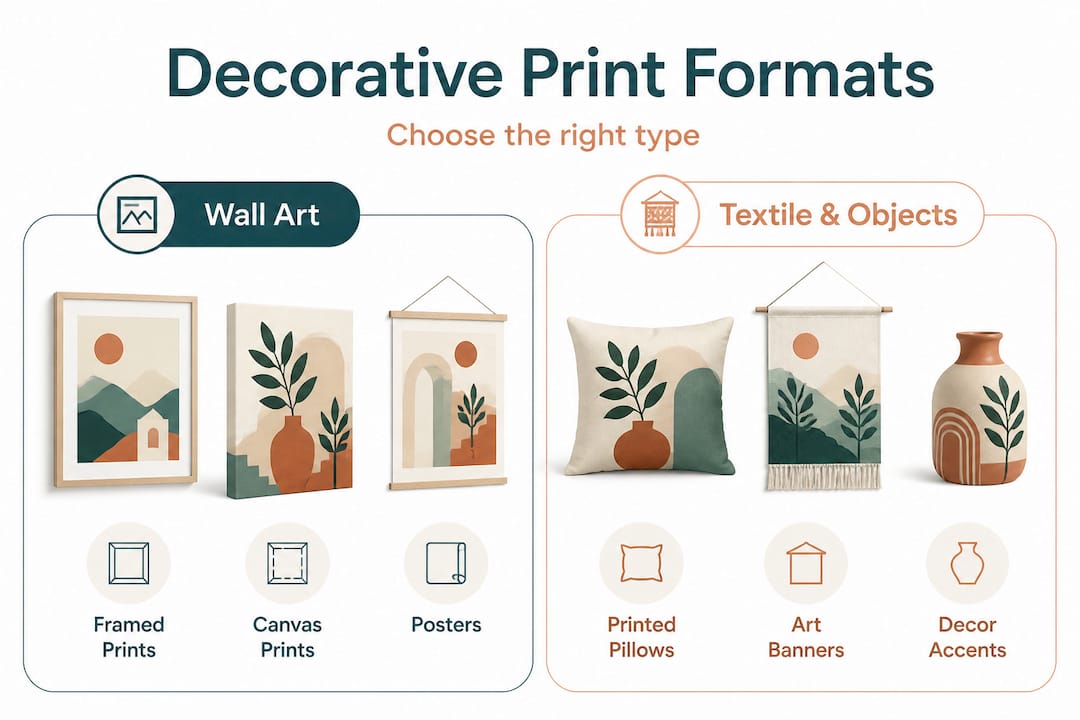
| Format | Typical size range | Cost range | Maintenance | Style flexibility |
|---|---|---|---|---|
| Framed art print | 20 cm to 100 cm+ | £15 to £300+ | Low (dust occasionally) | Very high |
| Poster (unframed) | A4 to A0 | £5 to £80 | Moderate (susceptible to moisture) | High |
| Canvas print | 30 cm to 150 cm+ | £30 to £400+ | Low (wipe clean) | High |
| Textile art | Variable | £40 to £250+ | Moderate (follow care label) | Moderate |
Choosing the right format for your space:
- Framed prints work beautifully in living rooms, home offices, and bedroom feature walls because the frame adds a finished, deliberate quality. Explore best framed prints for home decor for curated ideas.
- Posters suit younger, more casual spaces like student rooms, playrooms, or creative studios where swapping out art frequently makes sense.
- Canvas prints are ideal for large walls, open-plan areas, and anywhere you want an image to feel gallery-ready without the weight of a heavy frame.
- Textile art brings warmth and texture to spaces like reading nooks, nurseries, or Scandinavian-inspired interiors where softness is a priority.
For anyone interested in staying current, the latest decorative print trends in 2026 show a strong move towards oversized botanical prints, abstract line art, and layered gallery wall arrangements.
Pro Tip: In bathrooms and kitchens where moisture and steam are factors, always opt for canvas prints or well-sealed framed prints with acrylic rather than glass glazing. Unframed posters will buckle and fade quickly in damp environments, no matter how beautiful the image. For elegant decor ideas that balance aesthetics with practicality, humidity resistance is a detail that separates a polished space from a disappointing one.
Understanding the mechanics of framed print art in home decor also helps when you are mixing formats across a gallery wall, because inconsistent framing depths and materials can undermine an otherwise strong arrangement.
How decorative prints enhance homes and interiors
With the main formats in mind, it is worth considering how decorative prints actually work within a real room. The effect goes far beyond simply filling blank wall space.
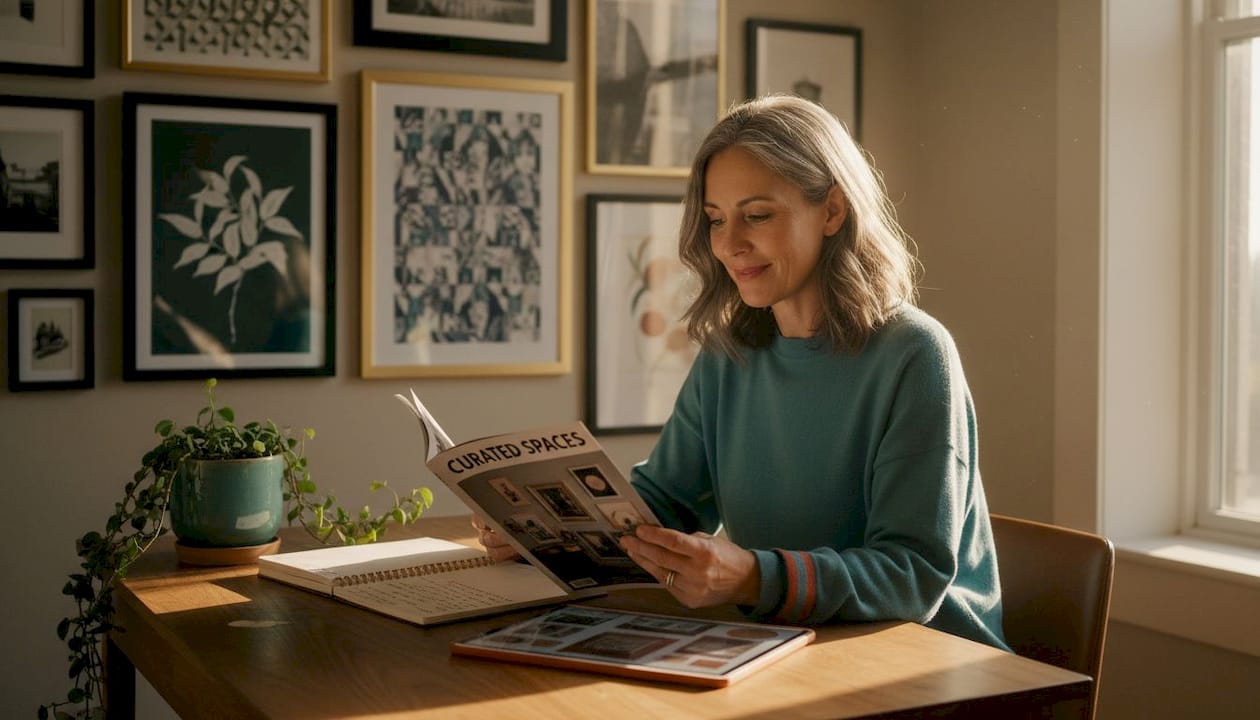
The National Gallery defines decorative work as primarily meant to embellish rooms or buildings, and in practice that means decorative prints carry out several distinct roles simultaneously. They introduce colour, create focal points, reinforce a room’s theme, establish mood, and even influence how spacious or intimate a space feels.
A striking statistic captures this well: research by the Art Fund found that 68% of people report feeling noticeably more comfortable and at ease in rooms that include artwork or decorative pieces on the walls, compared to bare-walled equivalents.
| Room | Recommended print types | Optimal size | Effect achieved |
|---|---|---|---|
| Living room | Abstract, botanical, landscape | Large (80 cm+) | Anchors the space, creates conversation focal point |
| Bedroom | Calming abstract, soft photography | Medium (50 to 70 cm) | Promotes relaxation, personalises the space |
| Home office | Motivational art, architectural prints | Medium (40 to 60 cm) | Boosts focus and creative thinking |
| Hallway | Portrait-oriented prints, series | Slim and tall | Draws the eye, makes narrow spaces feel intentional |
| Kitchen | Food art, botanical herbs, pattern | Small to medium | Adds character without overwhelming |
How to use decorative prints for maximum effect:
- Identify the room’s primary mood before selecting a print. A relaxing bedroom calls for muted tones and organic shapes, while a home office benefits from energising colours and bold compositions.
- Pick a print that shares at least one colour with a key piece of furniture or a soft furnishing. This creates visual cohesion without requiring a perfect match.
- Scale your print to the wall, not to the room overall. A small print on a wide wall looks lost; a large print on a narrow wall dominates uncomfortably.
- Consider the print’s subject matter as a storytelling tool. A coastal landscape in a bathroom can make a small room feel expansive. A dense botanical in a study communicates curiosity and depth.
- Hang prints at eye level as a starting point, which is typically around 145 to 150 centimetres from the floor to the centre of the image.
The ability to transform your interiors using prints is well-documented by interior designers, and many professionals rely on uplifting interiors with prints as a core part of their approach to refreshing a room without structural changes. Understanding why prints elevate your space goes beyond aesthetics alone: it is about how the human eye and brain respond to visual anchoring points within a room.
Tips for selecting and styling decorative prints
Understanding their effect is only half the task. Making smart choices at the selection and arrangement stage separates rooms that feel considered from those that feel chaotic or generic.
Step-by-step selection guide:
- Measure first, browse second. Knowing your available wall space in centimetres before you open a browser prevents the most common sizing mistake. Note the width and height, and consider whether you want a single large piece or a grouped arrangement.
- Define your dominant style. Is the room leaning minimalist, maximalist, rustic, industrial, or eclectic? The print’s style should amplify what is already present, not compete with it.
- Choose a frame that matches existing woodwork or metal finishes in the room. A warm oak frame will clash with cool chrome fixtures; a black frame tends to work across most modern interiors.
- Think about the print’s subject in relation to the room’s use. Energetic, graphic prints suit social spaces; quieter, more abstract work suits private rooms.
- Experiment with arrangements before committing. Use paper cutouts on the floor to plan gallery walls before you put a single nail in the wall.
Decorative prints have a primary function of enhancing and styling room appearance, and that means even a technically beautiful print will underperform if it is the wrong scale, colour, or style for its context. Knowing how to decorate living room walls with confidence takes the guesswork out of arrangement decisions.
Common mistakes to avoid:
- Hanging prints too high (a near-universal habit that disconnects art from the room)
- Choosing a print because it was on sale rather than because it fits the space
- Mixing frame styles without a unifying element such as colour or finish
- Ignoring the wall colour entirely when selecting print tones
- Buying too small out of caution and ending up with something that barely registers visually
For 2026, top framed prints are leaning towards earthy neutrals, warm terracotta palettes, and nature-inspired subjects that complement the biophilic design movement.
Pro Tip: If you want a room to feel genuinely personal rather than catalogue-ready, consider commissioning or requesting a custom print based on a colour, place, or concept that is meaningful to you. A print of your hometown’s skyline, a botanical illustration of plants you grow yourself, or a colour-matched abstract made to your exact palette creates a room that no one else could replicate.
The truth most people overlook about decorative prints
Here is an opinion that cuts against the grain of most decorating advice: the biggest mistake people make with decorative prints is treating them as the last decision in a room rather than one of the first.
Most decorating guides tell you to sort your sofa, flooring, curtains, and lighting, and then “add some prints to finish the space.” That approach relegates art to the role of garnish. And it shows. Rooms decorated this way often have prints that feel unrelated to anything else in the space, as if they were purchased in a panic on the way home from the furniture shop.
The interiors that genuinely stand out, whether in editorial photography, design awards, or simply in how they feel to inhabit, are the ones where a print or a series of prints was part of the concept from the start. The colour palette of the room was sometimes drawn from the print. The furniture was chosen to complement it. The print anchored the story.
This is even more true in professional and commercial settings. A well-chosen print in an office reception area communicates brand values without saying a word. A bespoke series of prints in a boutique hotel room creates a sense of place that generic stock photography never achieves. For innovative wall art ideas that work in both residential and commercial contexts, the starting point is always the story you want the space to tell.
Custom and personally significant prints are the most powerful tool available to both homeowners and designers. They shift a print from being decorative in the narrow sense to being defining in the fullest sense. The room becomes identifiable. It becomes memorable. That is what good decorating actually achieves.
Bring your walls to life with curated decorative prints
Now that you have clarity on what decorative prints are, how they work, and how to choose them strategically, the most enjoyable step begins: finding the ones that are right for your space. At Frame the World, we offer a wide-ranging collection of high-quality decorative prints across every major style and format, from the serene imperfection of Wabi Sabi wall art to the bold graphic energy of pop art wall art. Every piece is designed to bring genuine visual impact to a room rather than simply filling blank space. If you have a specific vision in mind, our custom print service allows you to commission something entirely tailored to your palette, theme, and dimensions. Whether you are refreshing a single room or working on a full design project, our catalogue makes it straightforward to find something that truly fits.
Frequently asked questions
What distinguishes a decorative print from fine art?
Decorative prints are chosen mainly to enhance a space’s appearance, whereas fine art is valued for its self-contained artistry, rarity, and cultural provenance. The National Gallery clarifies that decorative art is primarily meant to embellish something other than itself, which neatly captures the distinction.
Which rooms benefit most from decorative prints?
Living rooms, bedrooms, and hallways all benefit significantly, as decorative prints tie together colour themes, create focal points, and make spaces feel intentional rather than unfinished.
Are decorative prints expensive?
Decorative prints are generally far more affordable than original fine art, with quality options available from under £20 for unframed posters up to several hundred pounds for large canvas or bespoke framed pieces.
Can I personalise a decorative print?
Yes, many print studios and curated collections offer customisable or bespoke decorative prints, allowing you to specify colours, dimensions, subject matter, and framing to create something entirely your own.
Recommended
- How decorative prints transform and inspire your interiors
- Why choose decorative prints for uplifting interiors
- Decorative prints: inspiring examples and trends for 2026
- Why invest in decorative prints for standout interiors
- Sublimez votre intérieur moderne avec le velours : style et confort – Joya Home
- Why integrating fantasy into home photos creates magic — WonderLens | WonderLens


Leave a comment
This site is protected by hCaptcha and the hCaptcha Privacy Policy and Terms of Service apply.