
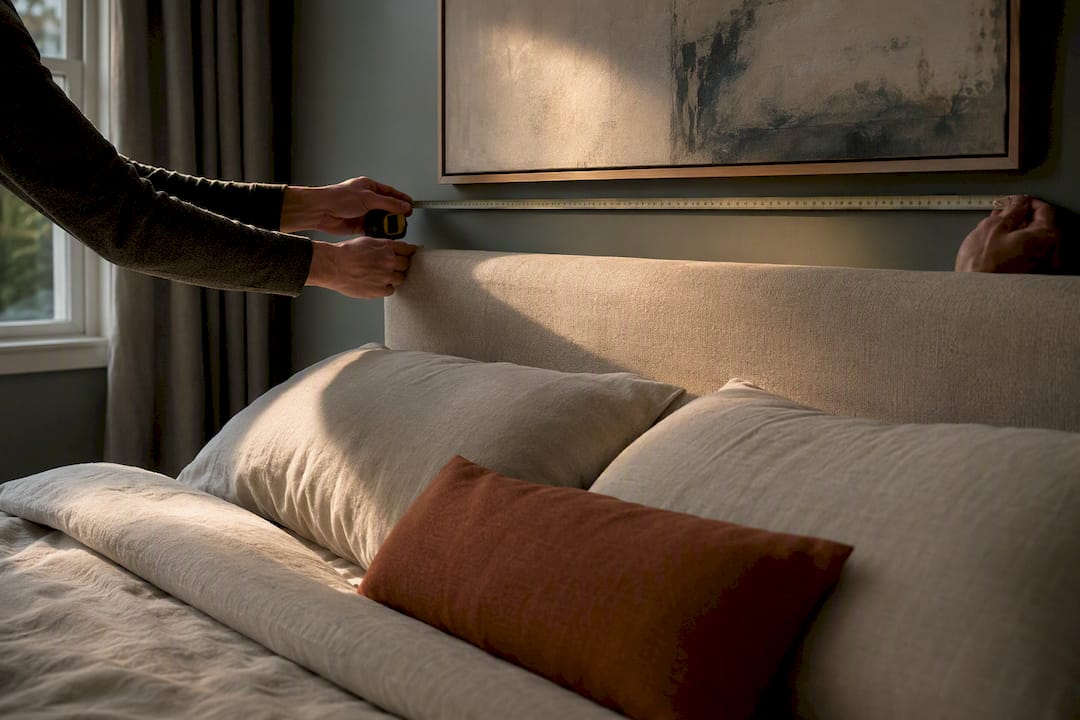
The rule that actually works: your artwork should span 50 to 75% of your bed or headboard’s width, with about two-thirds as a practical target found in many interior design guides. Hang it so the bottom edge sits 15 to 25cm above the headboard, or centre the piece at roughly 145 to 150cm from the floor. Below, you’ll find exact measurements for every bed size, plus templates to test before you buy.
TL;DR:
- Measure the headboard rather than the wall and aim for artwork that is 60 to 70% of that width for balanced proportions.
- Hang art so its bottom edge sits 15 to 25cm above the headboard or centre it roughly 145 to 150cm from the floor for optimal placement.
- Use paper templates to test size and placement before purchasing to ensure the art fits well with the furniture and room proportions.
- For rooms with tall headboards or high ceilings, adjust the art’s size and orientation, opting for vertical formats or smaller pieces in low-ceiling rooms.
- Choose acrylic glazing over glass and use proper wall anchors, especially on drywall, to ensure safety and durability above the bed.
Table of Contents
- What size art should you buy for above your bed?
- How high should art hang above a bed?
- Should you hang one piece, a pair, or a gallery wall?
- What if your bedroom doesn’t fit the standard rules?
- What frames and fixings are safest above a bed?
- How do you test your sizing before you buy?
- What do people get wrong most often above the bed?
- Getting the right size made for your bed
- Sources
What size art should you buy for above your bed?
Two rules say the same thing in different words, and once you know that, sizing gets simple. The 50–75% range gives you room either side of that, depending on how bold you want the statement to be. Both come from the same body of interior design guidance, and Welsh Design Studio’s sizing rule is one of the clearest versions of it: fill roughly half to three-quarters of the bed or headboard width, with roughly two-thirds as the practical target.
Here’s where most people go wrong: they measure the bed or headboard, not the wall. The wall behind your bed might be wider, but your art should relate to the furniture beneath it, not the room around it. Measure the headboard if you have one. If you don’t, measure the mattress width and work from that instead.
Once you’ve got that figure, multiply it by 0.6 and by 0.7 to get your target width range. A standard UK double bed is about 135cm wide, so aiming for around two-thirds of that width is typically recommended. Round to whatever’s available, and lean toward the higher number if you’re torn. Stylists tend to favour the slightly larger option when a piece is on the fence, because undersized art above furniture reads as an afterthought rather than a deliberate choice.
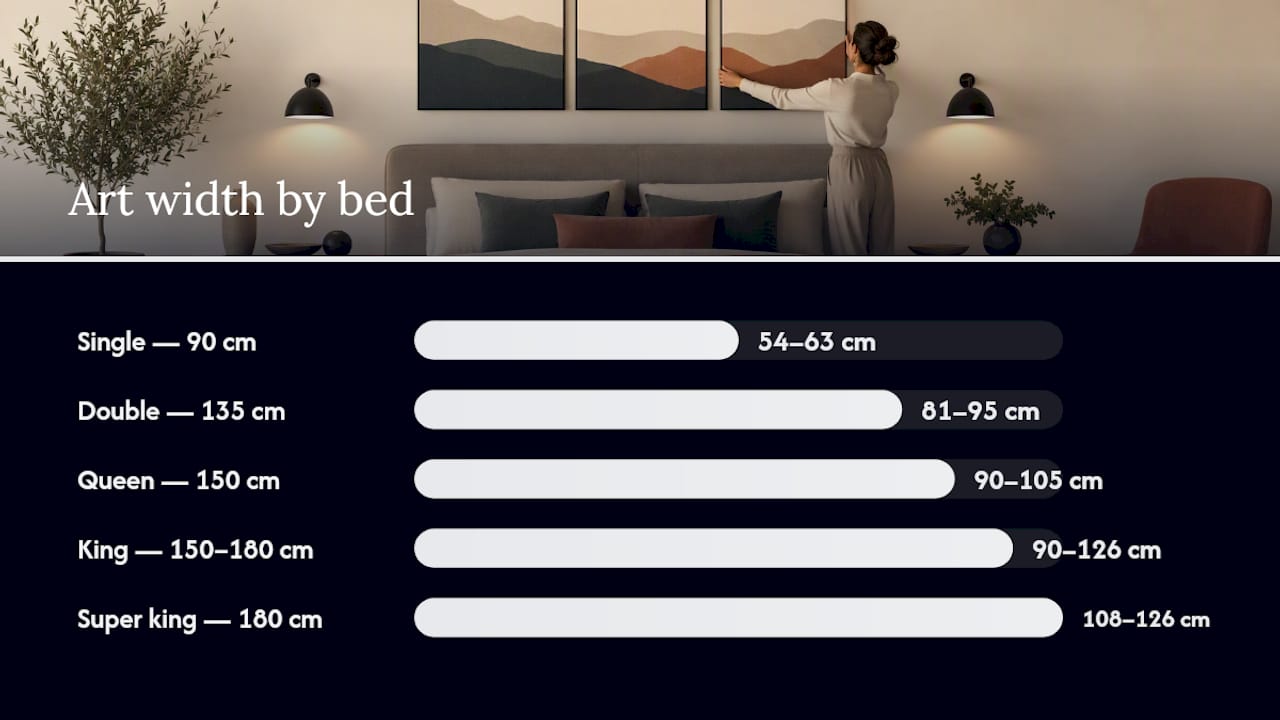
Here’s how that plays out across common bed sizes:
| Bed size | Headboard width (approx.) | Recommended art width (60–70%) |
|---|---|---|
| Single/twin | 90cm | 54–63cm |
| Double/full | 135cm | 81–95cm |
| Queen | 150cm | 90–105cm |
| King | 150–180cm | 90–126cm |
| Super king | 180cm | 108–126cm |
A few things to keep in mind when you’re measuring:
- Measure the headboard, not the mattress, if your bed has one, since the headboard is the visual anchor the eye reads first.
- If there’s no headboard, measure the mattress and add a small allowance, since bare beds tend to look better with slightly wider art.
- Round to the nearest standard frame size rather than chasing an exact centimetre, since most framing ranges jump in fixed increments.
- Treat a pair or trio of pieces as one combined width when checking it against the chart, gaps included.
If your number lands between two standard sizes, go up rather than down. A canvas that’s 5cm wider than “ideal” will barely register. One that’s 10cm too narrow will look stranded on the wall.
How high should art hang above a bed?
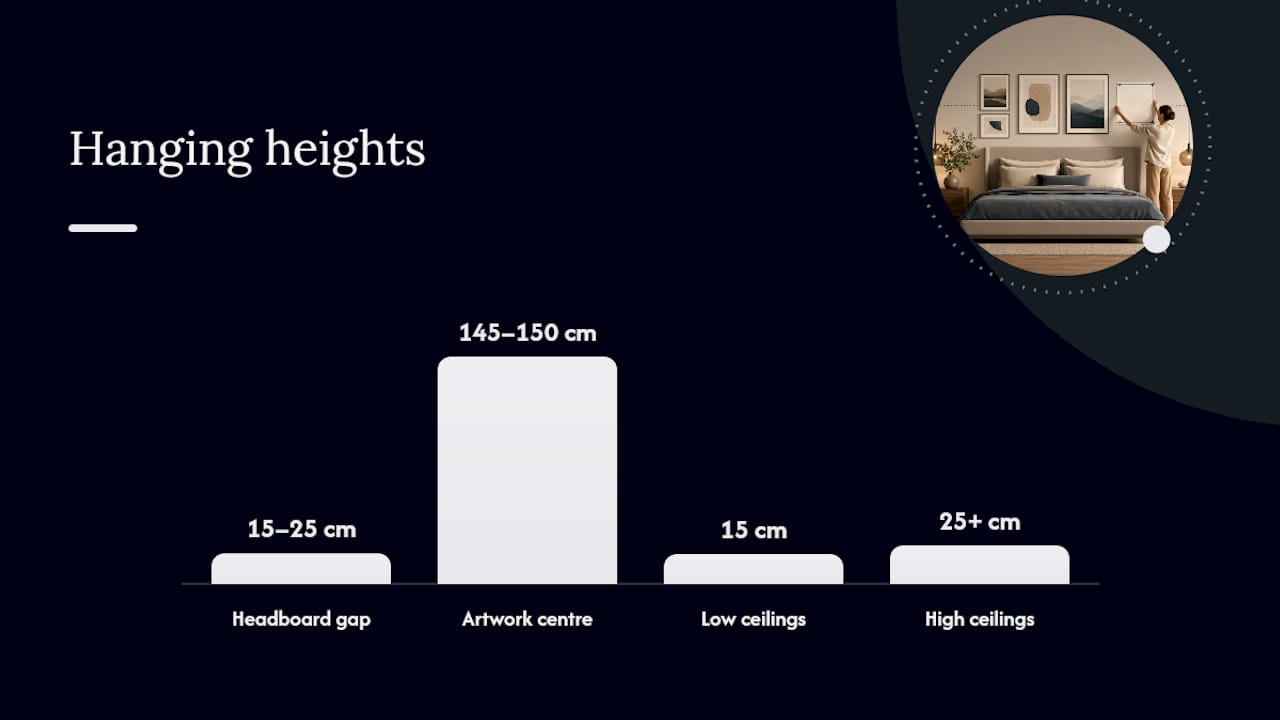
Height is where good sizing decisions get undone. Get the width right and hang it too high, and the whole composition disconnects from the bed. The rule that fixes this: leave 15 to 25cm (6 to 10 inches) between the top of the headboard and the bottom edge of the frame. That gap is tight enough to read as one grouping with the bed, not a separate piece floating on the wall above it.
If you’d rather work from a fixed point instead of measuring up from the headboard, centre the artwork at 145 to 150cm from the floor. That figure echoes the standard eye-level hanging guideline used across galleries and homes generally, and Home & Texture’s hanging guide confirms it as the benchmark most professionals default to before adjusting for furniture underneath. Above a bed specifically, you’ll usually end up lowering that centre point slightly so the piece visually locks to the headboard rather than floating at a generic “room” height.
Here’s a simple sequence for getting it right the first time:
- Measure from the floor to the top of your headboard (or mattress, if there’s no headboard).
- Add 15 to 25cm to that figure. That’s where the bottom of your frame should sit.
- Mark that point lightly in pencil at both ends of where the frame will hang.
- Check the marks with a spirit level before you commit to a fixing point.
- For a centred single piece, confirm the horizontal midpoint aligns with the centre of the bed, not the wall.
Ceiling height changes the maths slightly. In rooms with low ceilings (under 2.4m), stick closer to the 15cm end of the gap so the art doesn’t crowd the cornice. In rooms with high ceilings, you can push toward 25cm or even a touch beyond, since the extra breathing room reads as intentional rather than accidental.
Pro Tip: If you’re hanging without a headboard, measure from the top of the mattress instead of the floor. Anchoring the calculation to the bed itself, rather than the room, keeps the proportions correct even in oddly shaped bedrooms.
Should you hang one piece, a pair, or a gallery wall?
A single statement piece works well over beds with a clear headboard and an adequately wide wall. Aim for artwork covering roughly two-thirds of the headboard width to achieve good proportion.
Pairs and triptychs suit wider walls, especially behind king or super king beds where a single canvas would need to be unusually large to hit the right proportion. Splitting the space into two or three pieces lets you use smaller, more affordable formats while still covering the same total span.
Gallery walls suit rooms with more personality to spare, or where you’re mixing formats, frames, and even mediums. The trick, according to Grove Gallery & Interiors’ placement guidance, is to treat the whole arrangement as a single object when you’re checking it against the sizing rule, gaps and all.
Working out the total span for a multi-piece layout is simple arithmetic: add up the width of every piece, then add the gaps between them.
- Two frames side by side (diptych): two 50cm canvases with an 8cm gap between them gives a total span of 108cm, which suits a queen or king headboard.
- Three frames in a row (triptych): three 40cm pieces with 6cm gaps gives a total span of 92cm, a good fit for a double bed.
- Gallery cluster: mixed sizes (say 30 to 60cm pieces) arranged in two rows, kept within an overall footprint matching your 60 to 70% target width.
Keep gaps consistent across the whole set. Home & Texture recommends 5 to 8cm between frames as the range that reads as deliberate spacing rather than a mismatched hang. Anything tighter starts to look cramped; anything looser and the pieces stop reading as a group. Frametheworld’s gallery wall styling guide walks through laying pieces out on the floor first, which saves you from a wall full of pinholes if the spacing doesn’t work first time.
What if your bedroom doesn’t fit the standard rules?
Tall headboards reduce vertical space above the bed. For headboards around or over 120cm high, opting for shorter vertical art or horizontal formats can better suit the reduced space. A landscape-oriented canvas often solves this better than trying to force a portrait piece into a tight gap.
High ceilings invite taller art, and this is one case where going bigger than the standard percentage genuinely improves the room. A single vertical piece, or a triptych stacked with slightly larger top and bottom margins, fills the extra height without looking stretched.
Twin beds pushed together or a pair of matching singles need symmetry more than any other layout. Centre a single wide piece over the midpoint where the two beds meet, or hang matching smaller pieces centred over each bed individually. Mismatched positioning here reads as an error faster than almost any other mistake on this list.
In that case:
- Choose a taller, narrower format rather than forcing a wide horizontal piece into a tight space.
- Consider a vertical diptych stacked one above the other instead of side by side.
- Accept a slightly lower percentage (closer to 45 to 50%) if the wall genuinely won’t allow more, since a well-proportioned smaller piece beats a cramped oversized one.
What frames and fixings are safest above a bed?
Glass-fronted frames carry potential risk when placed directly above sleeping areas. Acrylic glazing is a safer, lighter alternative commonly recommended for above-bed framing. A knock, a settling wall, or a poorly seated hook can bring glass down onto a bed. Acrylic glazing gives you the same clarity and UV protection without that risk, and it’s considerably lighter to hang. Frametheworld’s framing options guide covers when acrylic makes more sense than traditional glass, and above a bed is one of the clearest cases.
Fixings matter just as much as glazing. Plasterboard walls require proper anchors beyond simple picture hooks, especially for artworks of considerable width or weight. Solid masonry walls are more forgiving, but a masonry bit and the correct wall plug still beat guesswork. For anything large, heavy, or destined for a wall you’re not confident drilling into, bringing in a professional installer costs little compared with the risk of a fixing failing overnight.
Frame style should echo your bedding rather than fight it. A few pointers worth keeping in mind:
- Warm wood tones and linen mats suit textured, natural bedding fabrics.
- Slim black or brushed metal frames pair well with more modern, minimal bed textiles.
- Oversized mats work well on smaller art when you need extra visual width without buying a bigger canvas.
- Matching frame finishes to bedside lamps or headboard hardware pulls the whole wall together.
Pro Tip: If your headboard has an upholstered or textured finish, choose a frame with a plain, uncomplicated moulding. Two busy textures fighting for attention above the same bed rarely works.
How do you test your sizing before you buy?
To avoid mistakes with sizing, it’s recommended to cut paper templates of intended artwork dimensions and tape them onto the wall to visualize size and placement before purchasing.
- Cut newspaper or lining paper to the exact width and height you’re considering.
- Tape it to the wall at your calculated height, using the 15 to 25cm headboard gap as your guide.
- Step back to the far side of the room and check how it reads from the doorway.
- Sit on the bed and look up at it from a lying position, since that’s the angle you’ll actually see it from most often.
- Photograph the wall with the template up. Photos flatten a room and often reveal proportion issues the eye misses in person.
Painters’ tape works just as well for a quick outline if you don’t want to cut paper, and it’s the method Welsh Design Studio recommends for testing scale before any purchase. Once you’ve settled on dimensions, Frametheworld’s art print sizing guide turns that percentage into a concrete size recommendation, and the how to select art size guide covers the same process for other rooms if you’re sizing art elsewhere in the house too. If you’re also rethinking the joinery or door styles in the room while you’re at it, One Day Doors & Closets’ guide to interior door styles is worth a look for keeping the whole room’s finishes consistent.
What do people get wrong most often above the bed?
The mistake I see repeated more than any other is sizing to the wall instead of the bed. A wide wall doesn’t need wide art; it needs art proportioned to the furniture sitting against it. Get that one distinction right and most of the rest falls into place.
The second mistake is hanging too high. People default to “eye level for someone standing” and forget that a bedroom is viewed from a seated or lying position most of the time. The 15 to 25cm headboard gap exists precisely to correct for that.
Three things to do right now: measure your headboard width, not your wall. Multiply it by 0.6 and 0.7 to get your target range. Then tape up a paper template before you spend a penny on the real thing.
— Lennard
Getting the right size made for your bed
Rather than rounding your ideal width up or down to whatever’s on the shelf, you can specify the exact dimensions your headboard calls for and choose the style, palette, and framing to go with it.
The hand-painted Wabi Sabi collection suits bedrooms where you want texture and subtlety over a bold statement, and it’s available across the size range this guide has walked through. If you’re after something with more colour and character instead, the Pop Art collection offers bolder pieces in multiple formats, including wider options built for king and super king headboards.
Whichever direction you go, the next step is straightforward: take the width figure you’ve just calculated, browse either collection with that number in hand, and use the customisation options at checkout to lock in the exact size before you commit.
Sources
- How to Choose the Perfect Art Size Above Your Bed – Welsh Design Studio
- How To Choose Wall Art For Your Home | Interior Stylist’s Guide
- The Art of Placement: How and Where to Hang Art for Maximum Impact - Grove Gallery & Interiors
- How to Hang Art the Right Way Every Time - Home & Texture

Leave a comment
This site is protected by hCaptcha and the hCaptcha Privacy Policy and Terms of Service apply.