

TL;DR:
- Art sizing involves choosing artwork dimensions that are proportionate to a space, furniture, and room layout. Matching art width to 60–75% of furniture width and hanging it at eye level ensures visual harmony and prevents decorating mistakes. Proper sizing enhances emotional impact and creates a calm, intentional room design.
You find a print you love, order it, hang it above your sofa, and something feels completely wrong. The art looks tiny. Or it crowds the wall and overwhelms the room. This is one of the most common decorating frustrations people face, and it almost always comes down to one thing: art sizing. Understanding what is art sizing, how to apply it practically, and why it matters as much as style itself will save you from expensive mistakes and genuinely transform how a room feels.
Table of Contents
- Key takeaways
- What is art sizing, exactly?
- Measurement principles for choosing art size
- Scale, proportion, and visual harmony
- Design solutions for different sizes and arrangements
- My honest take on art sizing
- Find your perfect size at Frametheworld
- FAQ
Key takeaways
| Point | Details |
|---|---|
| Art sizing is about proportion | Match art width to 60–75% of your furniture’s width for visual balance. |
| Eye-level hanging matters | Centre your artwork at 57–60 inches from the floor as a reliable starting point. |
| Scale differs from size | Scale describes how art relates to its surroundings, not just its physical dimensions. |
| Small art needs grouping | Pieces under 18 inches look lost alone; cluster them to build visual weight. |
| Measure before you browse | Record your wall and furniture dimensions before shopping to avoid costly mismatches. |
What is art sizing, exactly?
The art sizing definition most people assume is simply the physical dimensions of a piece of artwork. Width times height. That is correct as a starting point, but the term carries more meaning depending on context, and knowing the distinction makes you a far more confident buyer.
In interior design, art sizing refers to the deliberate process of selecting artwork dimensions that are proportionally appropriate for a given space. It is not just picking a size you like. It is choosing a size that works in relationship to the wall, the furniture beneath or beside it, the ceiling height, and the other objects in the room. This is sometimes called what is art dimensioning in professional design circles, where precise spatial thinking is part of the brief.
There is also a completely separate use of the word “sizing” in the art world worth knowing about. In art conservation, sizing refers to applying a liquid sealant to a canvas or paper surface before painting, creating a sealed barrier that affects how paint interacts with the material. This has nothing to do with choosing wall art for your home, but it does explain why searching “art sizing” online can sometimes produce conservation-related results that seem entirely irrelevant.
A few things the art sizing definition covers in home decoration:
- The literal size of a piece: its height and width in centimetres or inches
- The scale of the piece relative to the wall, furniture, and room
- The format: whether the artwork is portrait, landscape, or square
- The arrangement: whether one piece or a group of pieces fills the intended space
Pro Tip: Before you even look at art collections, write down your wall dimensions and the width of any furniture directly below or beside where the art will hang. This single step prevents the majority of sizing mistakes.
Understanding how to size art starts with separating what the piece looks like on its own from what it will look like in context. Those are two very different things.
Measurement principles for choosing art size
This is where the importance of art sizing becomes concrete. Rules exist not to constrain your taste, but to give you a framework that removes guesswork and prevents the single biggest decorating regret: art that looks wrong the moment it goes on the wall.
The foundational rule is proportion to furniture. Artwork above furniture should span 60–75% of the furniture’s width. For an 84-inch sofa, that means selecting art between 50 and 63 inches wide. Go narrower and the art floats awkwardly. Go wider and it competes with the sofa rather than complementing it.
The second rule covers hanging height. Centre your artwork at 57–60 inches from the floor to align with the average standing eye level. In dining rooms, where people are usually seated, drop this slightly lower to suit the seated eye line.
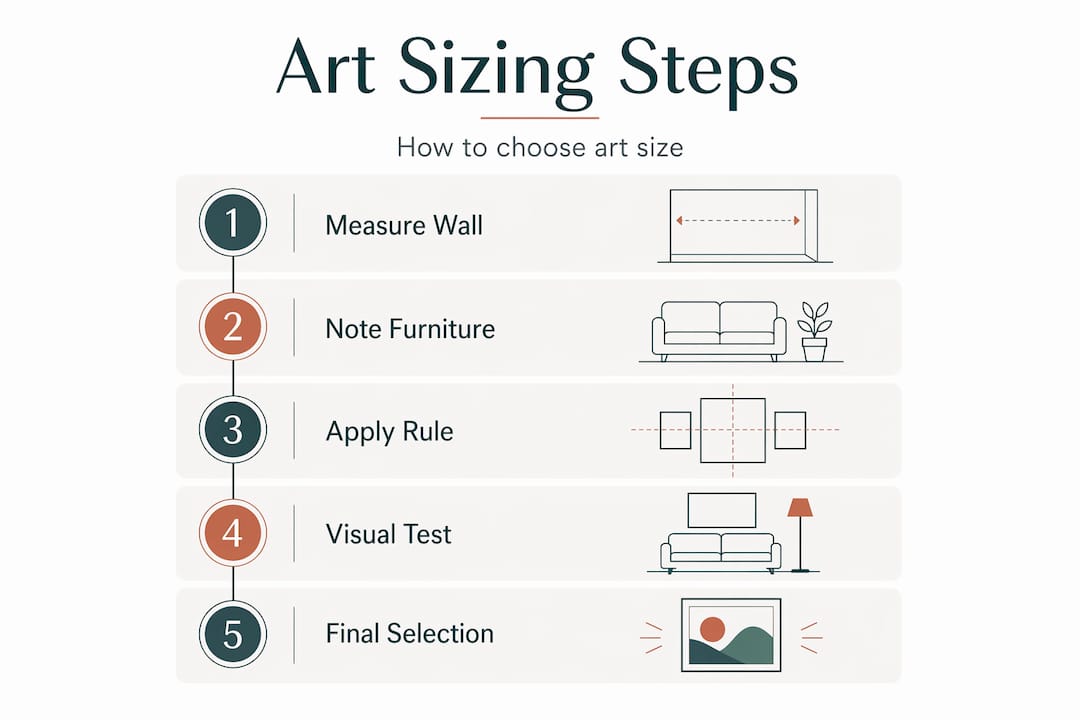
Here is a step-by-step process for measuring before you buy:
- Measure the width of your furniture piece (sofa, bed, sideboard, or dining table).
- Multiply that width by 0.6 and then by 0.75 to get your ideal art width range.
- Measure the total wall height from skirting board to ceiling.
- Measure the height of the furniture against that wall.
- Note how much bare wall sits above the furniture, which dictates the maximum art height.
- Check the spacing gap. A 6–8 inch gap between the bottom of the art and the top of the furniture creates a visual connection without crowding.
Different rooms also call for different approaches:
| Room | Key sizing guidance |
|---|---|
| Living room | Art width 60–75% of sofa; single large statement piece or grouped gallery wall |
| Bedroom | Art above headboard should not exceed headboard width; hang low enough to feel intimate |
| Dining room | Scale to table width; hang lower than standard to suit seated viewing |
| Entryway | Vertical formats work well in narrow hallways; use height to draw the eye upward |
| Home office | Mid-sized pieces at desk height; avoid art that distracts behind video call backgrounds |
| Bathroom | Smaller format art suits limited wall space; consider humidity-resistant prints |
Pro Tip: Cut newspaper or brown paper to the dimensions of art you are considering, tape it to the wall, and live with it for a day. This costs nothing and reveals immediately whether the size reads correctly in the space.
For those wanting a deeper reference when selecting artwork dimensions, a visual guide can make the whole process significantly clearer.
Scale, proportion, and visual harmony
Here is where best practices for art sizing move beyond measurement and into the realm of feeling. You can follow every rule above and still end up with a room that feels slightly off if you do not understand scale.
Art practitioners distinguish “size” from “scale” as two entirely separate concepts. Size is objective. A piece is 80 x 60 centimetres. Scale, by contrast, describes the relationship between those dimensions and everything around the piece. The same 80 x 60 centimetre print can feel generous and bold in a small study, yet timid and lost in a double-height open-plan kitchen. The physical size did not change. The scale did.
“Scale in art is not about the actual size of a piece. It is about how that size reads in relationship to its environment. Get the scale wrong and even the most beautiful artwork will feel out of place.”
Proportion relates specifically to the internal relationships within an artwork and between the artwork and its frame. Mathematical ratios in abstract art have been shown to influence viewer perception in ways that feel almost instinctive, which is part of why certain proportions simply look “right” even when you cannot explain why.
Here is a practical comparison of how scale plays out:
| Scenario | What happens | How to fix it |
|---|---|---|
| Large print in a small room | Overwhelms the space; feels oppressive | Choose a medium piece or use negative wall space intentionally |
| Small print on a large wall | Looks lost; no visual anchor | Group multiple pieces or scale up significantly |
| Art too wide for furniture | Breaks proportion; eye wanders | Respect the 60–75% rule even if you love the piece |
| Art too narrow for wide wall | Wall feels bare despite the art | Use a diptych, triptych, or gallery arrangement |
The scale of art in context affects how viewers emotionally experience both the piece and the space it occupies. A towering canvas in a lofty, light-filled room can feel extraordinary. The same canvas squeezed above a low console in a narrow hallway feels uncomfortable. Art sizing techniques that account for scale, not just dimensions, are what separate a thoughtfully decorated room from one that is merely furnished.
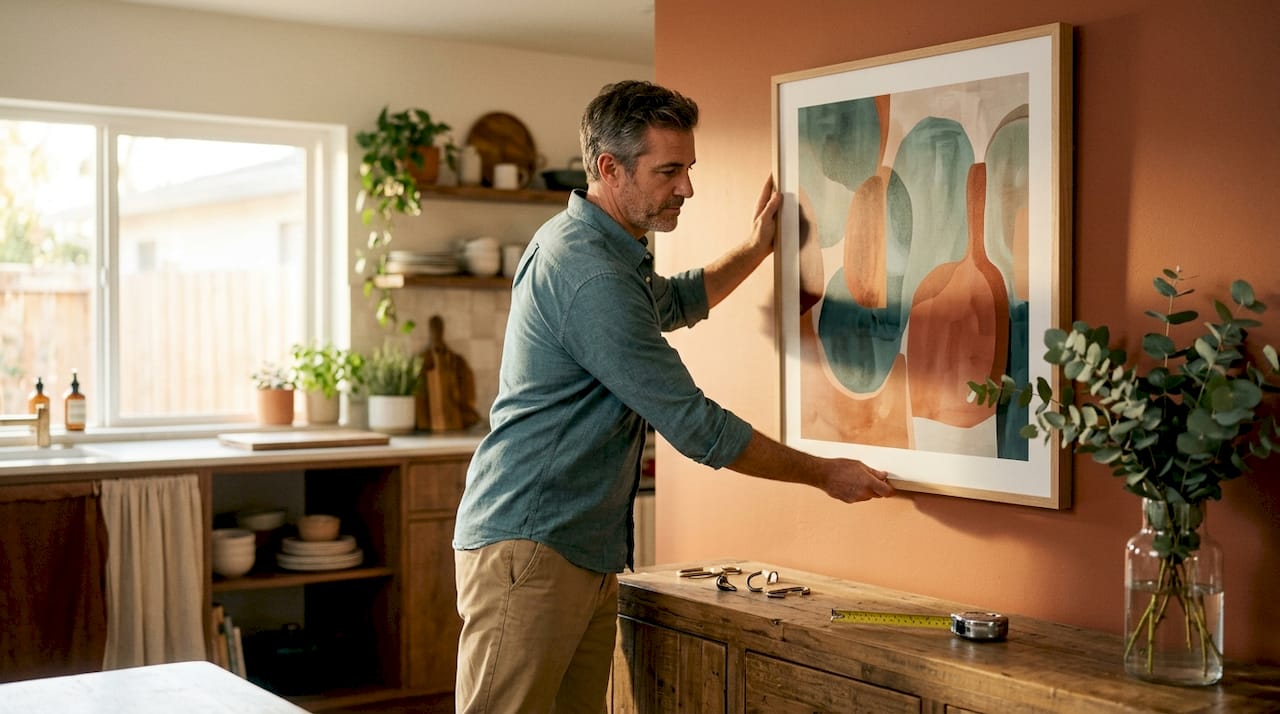
Design solutions for different sizes and arrangements
Knowing the rules is one thing. Applying them across real rooms with varying wall sizes, furniture arrangements, and art preferences is where art sizing techniques come into their own.
Working with small pieces
Small art under 18 inches needs to be grouped in clusters to create sufficient visual mass on a large wall. A single small print on a large expanse of wall does not read as a design choice. It reads as an oversight. Arrange small pieces in geometric formations, maintaining consistent spacing of 5–8 centimetres between frames. The group then functions as a single visual element with the combined width following the 60–75% rule.
Using large statement pieces
A single large artwork is one of the most effective design decisions you can make, provided the scale supports it. Large pieces work particularly well in living rooms with open walls, entryways with double-height ceilings, and dining rooms where a single focal point anchors the space. Artists and interior designers agree that art size matters more than style alone when creating harmonious interiors. A bold large piece in the wrong room will always feel more disruptive than a visually quieter piece in exactly the right scale.
Gallery walls as a single unit
Gallery walls should be treated as a single artwork whose combined width follows the same 60–75% proportion rule. This reframe changes how you plan a gallery wall entirely. You are not arranging individual pictures. You are designing one composite piece. Start by mapping the outer boundary of your arrangement before deciding on individual frame sizes within it.
Format and ceiling height
Vertical pieces suit spaces with higher ceilings or narrower walls, drawing the eye upward and making rooms feel taller. Horizontal pieces are better suited to standard ceiling heights and wide walls, where they reinforce the horizontal lines of furniture below. Matching format to architecture is one of the most underused art sizing techniques among home decorators. You can explore how this applies room by room in this guide on decorating living room walls for further ideas.
For a thorough checklist that brings all these principles together, the art selection checklist from Frametheworld covers sizing, placement, and style in one place.
My honest take on art sizing
I have seen more beautifully decorated homes derailed by poorly sized art than by almost any other single decision. And the reason is almost always the same: people fall in love with a piece before they have measured anything.
In my experience, the emotional pull of an artwork is powerful enough to override common sense. You see a print online, it looks perfect, and you order it without checking whether it actually fits your wall. Then it arrives and it is either swamped by the wall around it or fighting for dominance with the furniture below it.
What I have learned is that the rules for art sizing are not restrictive. They are liberating. When you know that your sofa is 200 centimetres wide and your ideal art is between 120 and 150 centimetres wide, you have narrowed your options down to pieces that will actually work. That clarity makes browsing faster and decisions more confident.
The thing most articles on this subject miss is that scale shapes emotional response more than any other quality of an artwork. A piece that is correctly sized for its environment feels calm, intentional, and right. The same piece in the wrong scale creates a low-level visual discomfort that you sense but cannot always name. Sizing is not the boring technical part of decorating. It is the part that determines whether a room feels designed or just decorated.
Combine the measurement rules with your genuine aesthetic preferences and you will make far better decisions than either instinct or rules alone would produce.
— Lennard
Find your perfect size at Frametheworld
Once you have measured your space and identified your ideal art dimensions, the rewarding part begins. Frametheworld offers curated collections organised by style, format, and size, making it straightforward to browse with your measurements already in hand. If you are drawn to organic, textured pieces that work beautifully as statement walls, the Wabi Sabi collection features hand-painted abstracts in a range of sizes suited to both intimate spaces and larger walls. For bolder rooms where you want genuine visual impact, the Pop Art collection offers vibrant, modern-scaled works in formats that command attention. And if your space calls for something that simply does not exist in a standard size, the custom print service lets you specify exact dimensions for a perfectly proportioned result every time.
FAQ
What is art sizing in home decoration?
Art sizing in home decoration is the process of selecting artwork dimensions that are proportionally appropriate for a specific wall, room, or furniture arrangement. It goes beyond physical measurements to include scale, format, and visual harmony within the space.
How wide should art be above a sofa?
Art above a sofa should span between 60% and 75% of the sofa’s width. For a 200-centimetre sofa, that means choosing art between 120 and 150 centimetres wide.
What height should art be hung at?
The centre of an artwork should sit at 57–60 inches (approximately 145–152 centimetres) from the floor, which aligns with the average standing eye level. In dining rooms, hang slightly lower to suit seated viewers.
What is the difference between size and scale in art?
Size refers to the literal dimensions of an artwork. Scale describes how those dimensions relate to the surrounding environment, including furniture, wall space, and room proportions, which determines whether a piece feels right in context.
What should I do with small art on a large wall?
Small art pieces under 18 inches should be grouped in clusters with consistent spacing to create visual mass. Treat the whole arrangement as a single element and apply the 60–75% proportion rule to the combined width of the group.


Leave a comment
This site is protected by hCaptcha and the hCaptcha Privacy Policy and Terms of Service apply.