

TL;DR:
- Decorative prints significantly influence mood, personal style, and cognitive focus within home environments. They are affordable, versatile, and can enhance perceived home value while supporting mental well-being through natural imagery and calming colors. Strategic placement of quality prints fosters mood regulation, focus, and creates an intentionally curated space.
Most homeowners spend more time choosing a sofa than choosing what goes on their walls. That’s a missed opportunity. The benefits of decorative prints go well beyond filling blank space. The right print can shift how a room feels, reduce daily stress, sharpen your focus, and communicate your personal aesthetic with more precision than almost any other design choice. This article covers six of the most compelling reasons to take wall art seriously, backed by psychology research and practical design experience.
Table of Contents
- Key takeaways
- 1. The benefits of decorative prints for mood and mental wellbeing
- 2. Adding colour and vibrancy to personalise your space
- 3. Affordability and accessibility compared to original artworks
- 4. Versatility across every room and style
- 5. Supporting focus and cognitive clarity in work spaces
- 6. Enhancing perceived home value and style credibility
- My take: prints are not decoration, they are environment
- Explore Frametheworld’s print collections
- FAQ
Key takeaways
| Point | Details |
|---|---|
| Mood and mental health | Prints with natural or calming imagery measurably reduce stress and support psychological recovery. |
| Colour and personalisation | Decorative prints offer a low-cost way to introduce controlled colour that reflects your personal style. |
| Affordability and flexibility | Quality prints cost far less than original artworks and can be updated to suit evolving tastes. |
| Versatility across spaces | Prints work across every room, from living spaces to home offices, when matched to scale and function. |
| Cognitive and focus benefits | Strategically placed prints with clear focal points restore attention and improve concentration. |
1. The benefits of decorative prints for mood and mental wellbeing
This is the benefit most people feel but rarely articulate. Walking into a room with a well-chosen print feels different from walking into a bare one. That difference has a physiological basis.
Biophilic art environments incorporating natural features have been shown to reduce depression symptoms by 78% and anxiety symptoms by 74% over twelve months, mediated by attention restoration and cortisol reduction. That research is about immersive environments, but the underlying mechanism applies to your living room. Prints that depict natural scenes, open landscapes, or soft organic forms engage what researchers call “soft fascination,” a state of effortless, low-demand attention that gives the overworked prefrontal cortex a chance to recover.
Attention Restoration Theory, developed by Rachel and Stephen Kaplan, explains precisely why natural imagery aids mental recovery. The brain processes these scenes without the directed effort required for problem-solving or screen use. The result is restored cognitive capacity and reduced stress. Restorative environments also downregulate amygdala activity, reducing emotional reactivity and improving overall cognitive control.
For maximum effect, choose prints that offer visual depth and perspective rather than flat, busy compositions. A forest path, a coastal horizon, or an abstract with calm gradients all qualify. Quality prints with low-arousal scenes are consistently more effective for supporting wellbeing than visually noisy imagery.
Pro Tip: Position a large focal print at eye level on the wall you face most often in your main relaxation space. Passive but genuine engagement compounds over time.
2. Adding colour and vibrancy to personalise your space
Colour is one of the most direct tools in interior design, and decorative prints give you precise, affordable control over it. Rather than repainting an entire room, a single well-placed print can introduce exactly the hue, saturation, and mood you want.
The psychological impact of colour in interiors is well documented. Blue tones calm, reduce heart rate, and are well suited to bedrooms and reading corners. Warm reds and oranges energise, making them effective in dining rooms or creative studios. Soft greens support focus and are increasingly popular in home offices. Prints let you test and shift these colour stories without committing to permanent changes.
Here are practical ways decorative prints enable colour control:
- A print with deep navy and gold tones can anchor a neutral living room and pull together existing furnishings without touching the walls
- A vibrant botanical print introduces green and warmth into a kitchen that lacks natural light
- Coordinated print groupings across a hallway create a consistent colour thread that makes the space feel designed rather than accumulated
- Swapping a print seasonally (warm tones in winter, cool ones in summer) refreshes a room for a fraction of the cost of new furniture
Pro Tip: Pull one accent colour from an existing furnishing and use it as your print selection filter. This creates visual harmony without requiring a full redesign.
3. Affordability and accessibility compared to original artworks
Original artworks carry enormous cultural value, but most homeowners cannot realistically collect them. Quality decorative prints close that gap in ways that were not possible before digital printing technology matured.
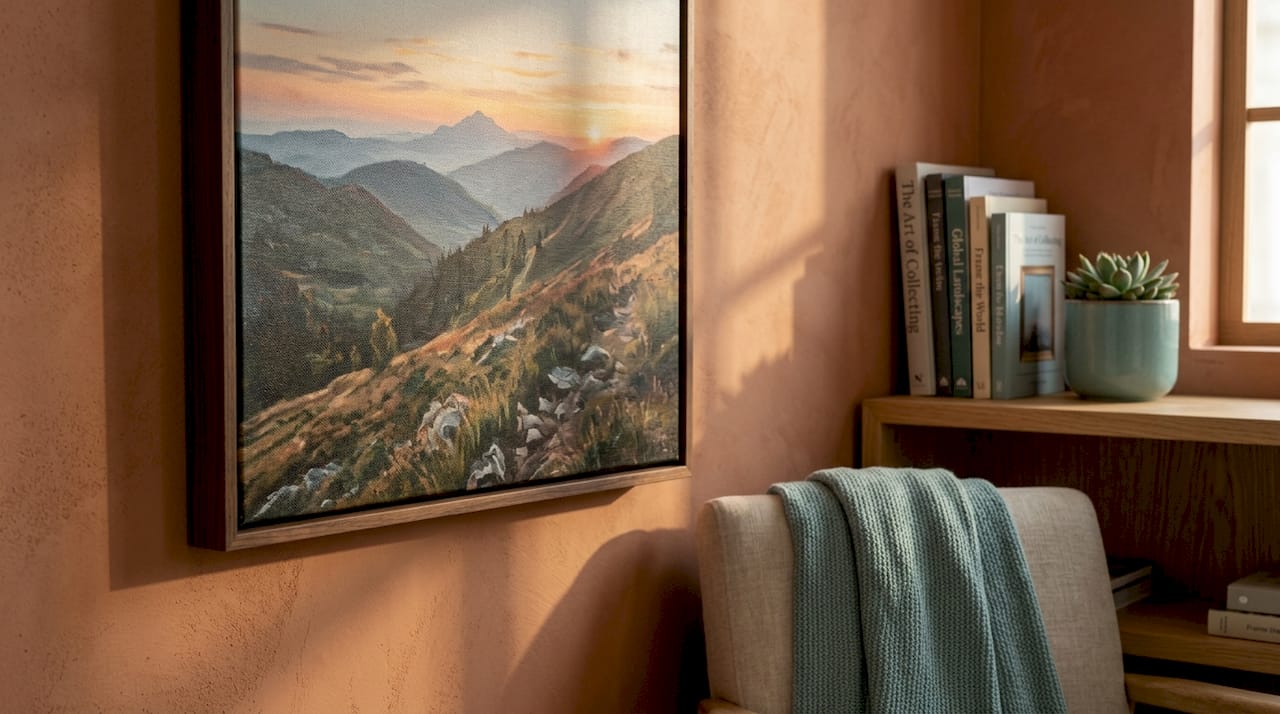
Canvas prints offer visual depth, vibrancy, durability, and texture that make them a preferred format for large-scale wall art. Their fade resistance and tactile quality mean they hold up over years of display without losing impact. Paper-based prints, particularly those on archival stock, deliver fine detail and a gallery feel at a lower price point. Digital prints offer flexibility for custom sizing and personalisation.
Here is a quick comparison of the most common print formats:
| Format | Visual quality | Durability | Best suited for |
|---|---|---|---|
| Canvas print | High depth and texture | Excellent, fade-resistant | Large statement pieces |
| Archival paper print | Fine detail, gallery quality | Good with proper framing | Detailed photography, illustration |
| Digital print on demand | Variable, format-dependent | Good | Custom sizing, bespoke projects |
| Framed poster print | Clean, modern appearance | Moderate | Budget-conscious styling |
The practical advantages of prints over originals include:
- Accessible price points that allow you to refresh your interiors every few years rather than committing to one piece indefinitely
- Wide availability across styles, sizes, and subjects without the scarcity of original works
- Customisation options for sizing, colouring, and framing to suit specific walls
This affordability does not mean settling. A high-quality canvas print, properly framed and thoughtfully placed, reads as confidently as many originals in a domestic setting. You can read more about why decorative prints represent a sound long-term investment for your interiors.
4. Versatility across every room and style
One of the underrated aesthetic advantages of prints is how well they adapt. Unlike a sculpture or a statement sofa, a print can shift context entirely depending on framing, scale, and placement. This flexibility is what makes wall art one of the most versatile decorative tools available.
Consider room by room:
- Living room: Large abstract or landscape prints anchor the space and set an emotional tone. Groupings of smaller prints create a gallery wall effect that rewards repeated viewing.
- Bedroom: Calming nature prints, soft botanicals, or muted watercolours support sleep hygiene by reducing visual stimulation before bed.
- Kitchen: Bold food-related prints, graphic botanicals, or pop art-influenced works add personality to a space that is often functional but visually underserved.
- Home office: Clear, structured prints with balanced negative space support focus without adding visual noise. Abstract geometric works often perform well here.
Scale matters more than most homeowners realise. A print that is too small for its wall reads as an afterthought, regardless of quality. As a general guide, aim for the print to occupy roughly 60 to 75 percent of the available wall width. Groupings should feel intentional, with consistent spacing (approximately 5 to 7 centimetres between frames) and a shared design element, whether that is colour, theme, or format.
Common pitfalls to avoid: hanging prints too high (eye level means the centre of the print sits at approximately 145 to 150 centimetres from the floor), choosing competing focal points in one wall arrangement, and mixing frame styles without a unifying colour or material.
5. Supporting focus and cognitive clarity in work spaces
The importance of wall decor extends beyond aesthetics when it comes to home offices and study areas. The right print does not just look good. It actively supports the kind of attention recovery that keeps you working at a high level throughout the day.
Naturalistic imagery invites soft fascination, facilitating mental recovery and improving task performance afterwards. In practice, this means placing a single, restful print within your sightline in a home office gives your attention a place to rest during micro-breaks. These brief, unforced pauses restore directed attention capacity faster than scrolling a phone or staring at a blank wall.
The most effective prints for work spaces share certain characteristics:
- A clear focal point that draws the eye without requiring scanning
- Balanced negative space that does not compete with your work materials visually
- Low-arousal colour palettes (grey-greens, soft blues, muted earth tones) that calm rather than stimulate
- Minimal complexity: one strong image is more restorative than a busy collage
Stress reduction from viewing art is amplified by dedicated viewing time of roughly 20 to 35 minutes rather than passive exposure. You do not need to take an art appreciation break mid-afternoon, but glancing intentionally at a well-chosen print for thirty seconds during a task transition is genuinely restorative. That is a meaningful return on a modest investment. For practical guidance on selecting prints for focus, the principles from Attention Restoration Theory offer a clear framework.
Pro Tip: Place a single restful print directly in your peripheral sightline rather than behind your monitor. You will engage with it naturally during thinking pauses without it becoming a distraction.
6. Enhancing perceived home value and style credibility
Curated wall art changes how a space reads to visitors, to estate agents, and to yourself. This is one of the decorative art benefits that rarely gets discussed directly, but its effect is real. A home with thoughtfully chosen prints reads as considered and styled. One without them, regardless of furniture quality, often feels unfinished.
From a property perspective, engagement with arts and aesthetically rich environments consistently correlates with positive wellbeing and perceived quality of life. When a potential buyer or tenant walks into a property, wall art is one of the fastest signals of character and care. Bare walls can subtly undermine even a well-furnished room.
For long-term style credibility:
- Invest in a small number of quality prints rather than filling walls quickly with low-cost options
- Choose prints that reflect enduring aesthetic themes (botanical, abstract, architectural) rather than trend-reactive choices
- Use consistent framing across a room or floor to create visual coherence without matching subjects exactly
- Consider bespoke sizing for statement walls where standard formats do not sit convincingly
This does not require a significant budget. Two or three well-chosen, properly framed prints in a living room will do more for its perceived quality than a dozen small, poorly placed ones.
My take: prints are not decoration, they are environment
I’ve spent a long time observing how people relate to their spaces, and the pattern I keep returning to is this: the homes that feel genuinely good to be in almost always have intentional wall art. Not expensive art. Intentional art.
What surprises most people is how how decorative prints enhance space has less to do with aesthetics and more to do with mood regulation. I’ve seen a single botanical canvas transform a home office from a place someone dreaded sitting in to a room they actually looked forward to using. The print did not change the desk, the chair, or the lighting. It changed the emotional tone.
The misconception I encounter most often is that prints are finishing touches. They are not. They are environmental decisions. The research on attention restoration and cortisol reduction confirms what most of us already feel but do not always act on. A well-placed print is doing quiet, consistent psychological work every time you glance at it.
My advice: choose fewer prints, choose them more deliberately, and position them where you actually look. The art selection process matters more than most people realise, and the returns, in mood, focus, and genuine satisfaction with your space, are disproportionate to the effort.
— Lennard
Explore Frametheworld’s print collections
If the research in this article has you thinking differently about your walls, Frametheworld makes it practical to act on that thinking. The Wabi Sabi wall art collection offers hand-painted abstract textures built around imperfection, negative space, and calm tonal palettes. These are exactly the qualities that research identifies as most effective for stress reduction and restorative viewing.
For those drawn to colour and visual energy, the Pop Art wall art collection delivers bold, hand-painted works that function as genuine focal points without overwhelming a space. Both collections are browseable by size, style, and format, and Frametheworld offers bespoke sizing for walls that do not suit standard dimensions. Whether you are redesigning a single room or working through an entire property, the range is wide enough to support a genuinely curated approach.
FAQ
Do decorative prints genuinely affect mood?
Yes. Research on biophilic art environments shows significant reductions in anxiety and depression symptoms linked to restorative imagery. Prints with natural scenes, soft colour palettes, and clear focal points are the most effective for mood support.
What type of print is most durable for home display?
Canvas prints are generally the most durable option. Their fade-resistant properties and tactile depth make them well suited to long-term display in living areas, bedrooms, and kitchens without deterioration in quality.
How many prints should I hang in one room?
One strong focal print is more restorative than multiple competing images, according to design research. If you prefer a gallery wall, keep spacing consistent and anchor the grouping with a shared colour or frame style to maintain visual cohesion.
Where should I hang a print for maximum calming effect?
Hang the print at eye level (centred at approximately 145 to 150 centimetres from the floor) on the wall you face most during rest or work. One focal piece in your direct sightline is more effective than several peripheral ones for restorative benefit.
Can decorative prints improve focus in a home office?
Yes. Prints with clear focal points and balanced negative space support attention recovery during natural work pauses. Positioned in your peripheral sightline rather than directly behind a screen, they encourage brief restorative glances without becoming a distraction.


Leave a comment
This site is protected by hCaptcha and the hCaptcha Privacy Policy and Terms of Service apply.