

Yes. An art commission contract is the single document that protects both artist and client by fixing what gets made, what it costs, and who can use it afterwards. Use one for any paid commission, no matter how small, and send a short template with a deposit request before you pick up a brush.
TL;DR:
- A commission contract is essential for any paid artwork, especially for commercial projects, public art, or large interior designs, to clearly define rights and obligations.
- The contract should include detailed scope, payment schedule, timeline, revision limits, and copyright or licensing terms, kept concise within three pages.
- Use non-exclusive or exclusive licenses depending on the project, explicitly stating territory, duration, and usage rights to avoid disputes over intellectual property.
- Deposits of 30% to 50% are standard upfront, with the final file only released once all payments are settled, and revisions limited to two or three rounds within set approval windows.
- Signatures can be electronic, and setting clear shipping, insurance, and risk transfer protocols helps prevent damage disputes during transit.
Table of Contents
- What is an art commission contract, and when do you need one?
- What clauses does a commission contract need?
- Sample clauses and a fillable checklist you can reuse
- How do you actually use and negotiate a commission contract?
- Licence or assignment: which rights clause do you actually need?
- What should pricing and deposits actually look like?
- How do you handle revisions, delivery and damage in transit?
- Is a signed commission contract legally enforceable?
- How does Frametheworld handle bespoke commissions in practice?
- What most guides get wrong about art commission contracts
- Sources
What is an art commission contract, and when do you need one?
An art commission contract is a written agreement that turns a vague conversation about “a painting for the hallway” into an enforceable set of obligations: what the artist will deliver, by when, for how much, and who owns the rights afterwards. It differs from buying a finished piece off a gallery wall in one crucial way. A sale transfers a physical object; a commission is a contract for skill and labour, as Artquest’s guidance on commissioning an artist puts it, which means the terms have to cover the process of making the work, not just the finished item.
Copyright works differently here too. Under UK law, the artist retains copyright in a commissioned piece unless they sign it away in writing. Paying for a painting does not automatically buy the copyright, and this trips up more clients than you’d expect.
A contract becomes essential, rather than optional, in these situations:
- Any commission involving payment, even a modest one between friends or on a marketplace.
- Work intended for commercial use, such as branding, packaging, or advertising.
- Public art or site-specific installations, where multiple stakeholders and long timelines raise the stakes.
- Bespoke interior projects, where dimensions, colour palettes, and installation logistics all need locking down early.
What clauses does a commission contract need?
Every commission contract, whatever the scale, should walk through the same core sections. Template providers such as Juro’s art commission agreement guide consistently list scope, payment, timeline, revisions, delivery, cancellation and signatures as the sections that separate a usable contract from a vague email chain.
- Parties and effective date — full names, business details if applicable, and the date the agreement takes effect.
- Scope of work — a detailed description of the piece, with dimensions, medium, colour references, and any attachments (mood boards, photos, sketches).
- Payment schedule — total fee, deposit amount, currency, and dates for each instalment.
- Timeline and milestones — start date, review points, and final delivery date.
- Approval windows — how long the client has to respond at each stage.
- Revision policy — how many rounds are included and what counts as a chargeable redesign.
- Copyright and licence terms — who owns what, and what the client is permitted to do with the image.
- Attribution and portfolio rights — whether the artist can display the work publicly or in a portfolio.
- Delivery, installation and insurance — who arranges shipping, who covers loss in transit, and what “acceptance” means.
- Cancellation and kill fees — what happens, and what’s owed, if either party pulls out midway.
- Signatures, governing law and dispute resolution — how the agreement is signed off and what happens if things go wrong.
Pro Tip: Number every clause and keep the whole document under three pages for a standard commission. A contract nobody reads because it’s ten pages of legal boilerplate protects nobody.
Sample clauses and a fillable checklist you can reuse
Copy-ready wording saves time and avoids the classic mistake of leaving a licence clause blank, which PandaDoc’s commission agreement template calls the empty-box problem: vague permitted-use wording that neither party can actually rely on later.
Scope clause: “The Artist shall create one original [medium] artwork, approximately [dimensions], based on the reference materials attached as Appendix A, for the Client’s [intended location/use].”
Payment clause: “The Client shall pay a deposit of [percentage]% of the total fee of [amount] upon signing, with the balance due within [number] days of delivery.”
Revision clause: “The fee includes up to [number] rounds of minor revisions. A redesign involving a change to composition, subject, or medium will be quoted and invoiced separately.”
Delivery clause: “The Artwork will be delivered by [method] to [address] by [date]. Risk of loss or damage transfers to the Client upon acceptance at the delivery address.”
Rights clause: “The Artist retains copyright in the Artwork. The Client is granted a [exclusive/non-exclusive] licence to use the image for [specified purpose] within [territory] for [duration].”
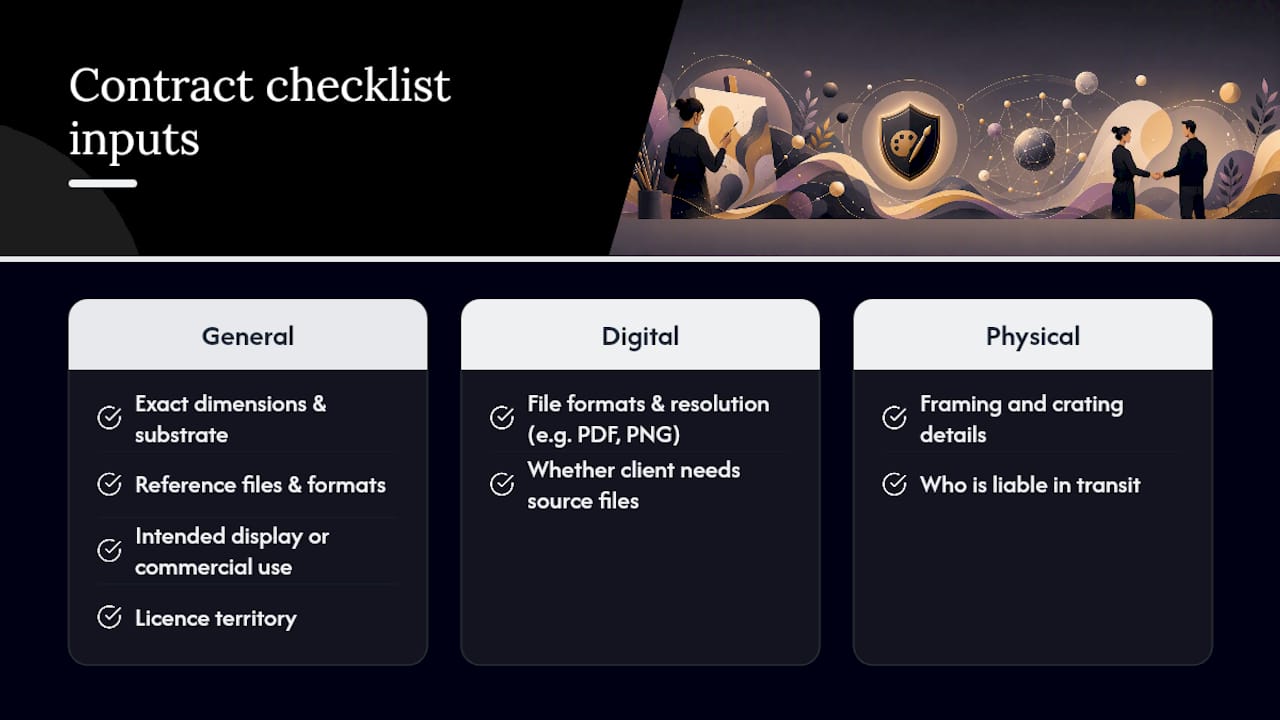
Before sending any of this across, fill in a short checklist: exact dimensions and substrate, all reference files and their formats, the intended display or commercial use, territory for any licence, file formats for digital deliverables (print-ready PDF, high-resolution PNG, layered files), and whether the client needs source files at all. Digital commissions need extra clarity on file formats and resolution; physical works need clarity on framing, crating, and who’s liable in transit.
How do you actually use and negotiate a commission contract?
Getting the paperwork right matters less than getting the sequence right. Here’s the order that keeps most commissions friction-free:
- Prepare a precise brief. Attach reference images, colour swatches, and dimensions before you even discuss price.
- Propose a pricing model and request a deposit. Standard deposit ranges sit between 30% and 50% of the total fee, according to commercial template guidance.
- Agree milestones and approval windows. Set a fixed number of working days for client feedback at each stage, and build in a deemed-approval rule if they go quiet.
- Confirm the licence scope or assignment in writing, then sign. Verbal agreements about usage rights cause more disputes than any other clause.
- Store the executed contract somewhere both parties can access, along with dated versions of any reference material or briefs that changed along the way.
Pro Tip: If a client hasn’t approved a stage after 10 working days despite two reminders, treat it as deemed accepted under your contract’s deeming clause. This single line prevents projects stalling indefinitely on someone else’s inbox.
If the commission sits within a larger interior project, mapping the brief against a resource like Frametheworld’s guide to ordering bespoke artwork can help both sides sanity-check the sequence before signing anything.
Licence or assignment: which rights clause do you actually need?
Under UK copyright law, the artist keeps copyright by default. Nothing transfers automatically just because money changed hands, a point DACS’s guidance on copyright and commission agreements makes explicitly for both artists and commissioning clients. A licence, not a full assignment, is usually the right tool: it lets the client use the work for its intended purpose while the artist retains control over everything else.
Choose between three options depending on the job:
- Non-exclusive licence — fine for a personal portrait or a piece for a private home, where the client just needs the right to own and display it.
- Exclusive licence — appropriate when a brand needs sole use of an image for packaging or advertising within a set territory and term.
- Full assignment — reserved for high-value commercial work where the client genuinely needs to own the copyright outright, not just a licence to use it.
Whichever you pick, state territory, media, duration, and whether sublicensing is allowed. Leaving any of these blank is the single most common drafting failure in amateur templates.
Moral rights add a UK-specific wrinkle: they can’t always be waived as cleanly as in some other jurisdictions, so word any waiver carefully rather than copying a US template verbatim. And in 2026, it’s worth adding an explicit clause addressing AI training. Contractable’s guidance on modern commission contracts recommends stating outright whether the client may use the delivered image, or any process files, to train or fine-tune AI models. Most artists want that closed off by default.
What should pricing and deposits actually look like?
Flat fees suit most single-piece commissions; hourly rates suit open-ended concept work; tiered pricing suits projects with multiple deliverables or size options. Pick whichever matches how predictable the scope actually is.
- Deposits of 30% to 50% up front are standard practice, and it’s worth stating clearly that the deposit becomes non-refundable once work has started.
- Commercial-use licences are usually priced separately from the base commission fee, either as a fixed add-on or a multiple of the base rate.
- Late payment should have a stated remedy: interest, a hold on further work, or withholding final high-resolution files until the balance clears.
- Never send the final print-ready file before the last invoice is paid. It’s the only leverage that actually matters once the work is done.
How do you handle revisions, delivery and damage in transit?
Define a revision precisely: a colour tweak or minor composition shift is a revision; a change to subject, medium, or size is a redesign and gets billed separately. Cap included rounds at two or three.
- Set a fixed approval window (5 to 10 working days is typical) with a deeming clause for clients who go quiet.
- State clearly who books and pays for shipping, and who insures the piece in transit; for large or fragile pieces, this should never default to “whoever remembers first.”
- Fix the exact point risk transfers, ideally on signed acceptance at the delivery address, not on dispatch.
Pro Tip: Photograph the finished piece from multiple angles before it leaves the studio. It’s the fastest way to settle a damage dispute without argument.
Is a signed commission contract legally enforceable?
A contract becomes effective once both parties sign, and that no longer needs to be a wet signature. Email agreement or e-signature tools work fine for most commissions, provided both parties clearly consented to the terms. Practical Law’s drafting notes on commissioning agreements recommend an express written assignment on payment for any full copyright transfer, with legal review for high-value work.
State a governing law and jurisdiction that suits both parties, usually wherever the artist is based for smaller commissions. For disputes, try direct negotiation first, then mediation, before considering small-claims court for lower-value disagreements.
How does Frametheworld handle bespoke commissions in practice?
Frametheworld’s own commissioning process gives a working example of how these contract fields map onto a real project. Site-specific pieces for UK homes and interiors typically run to a 5 to 8 week turnaround, covering brief, deposit, milestone review, and delivery. A commissioning brief maps almost directly onto contract fields: dimensions and palette become the scope clause, the review stage becomes the approval window, and installation becomes the delivery clause. Browsing a collection such as hand-painted Wabi Sabi wall art is a useful starting point for clients still shaping their brief before contract stage.
What most guides get wrong about art commission contracts
Most advice on this topic treats the contract as a legal shield to deploy only when things go wrong. That’s backwards. The real value of a commission contract shows up before any dispute, in the simple act of forcing both parties to agree on scope, price, and rights before a single brushstroke happens. Artists who skip this step aren’t taking on more risk in some abstract sense; they’re guaranteeing a harder conversation later, usually at the exact moment payment is due.
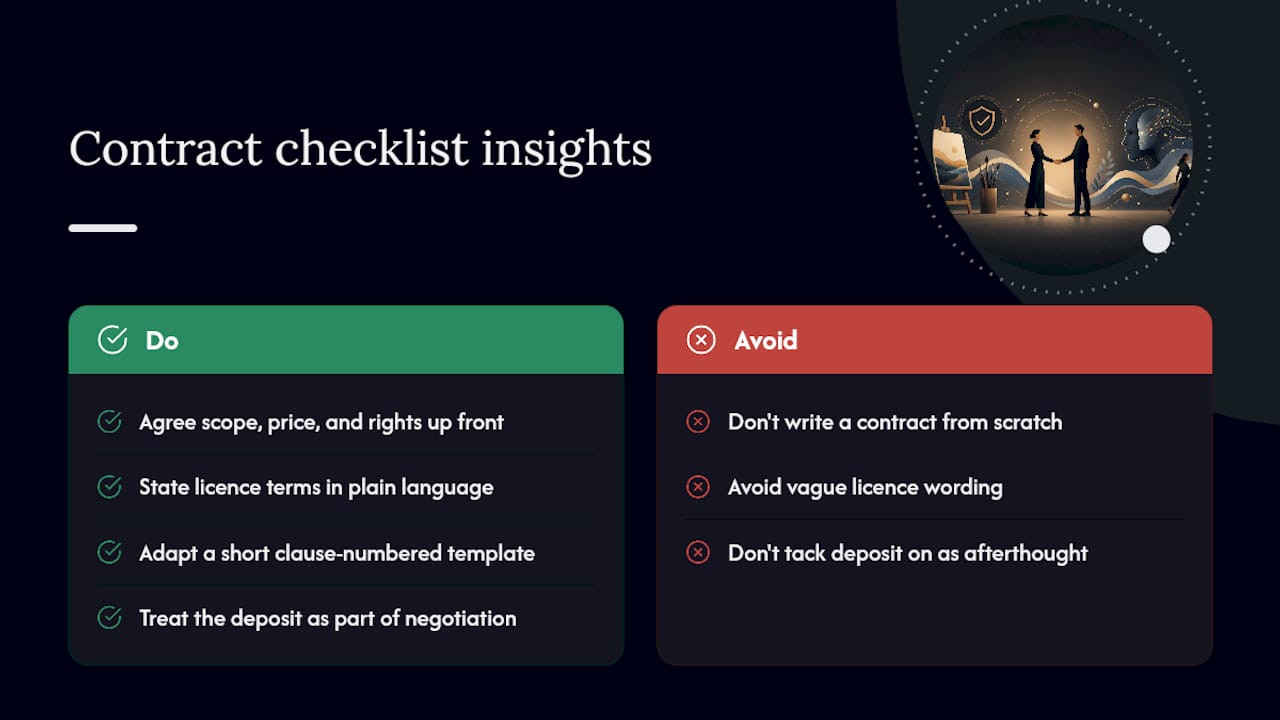
The conventional advice also underweights the licence clause. Most disputes I’ve seen reasoned through aren’t about money at all. They’re about a client assuming they bought unlimited commercial rights when they’d actually paid for a single print for their own wall. State the licence terms in plain language, even if it feels over-explicit, because vagueness here costs more goodwill than any missed deadline.
If you take one thing from this: don’t write a contract from scratch. Adapt a short, clause-numbered template, fill in the checklist fields properly, and treat the deposit conversation as part of the negotiation, not an afterthought tacked on at the end.
— Lennard
Sources
- Commissioning agreement for artistic work | Practical Law
- Copyright and commission agreements | DACS
- Art commission agreement template - Juro
- Art Commission Contract Template (Invoice24)


Leave a comment
This site is protected by hCaptcha and the hCaptcha Privacy Policy and Terms of Service apply.