
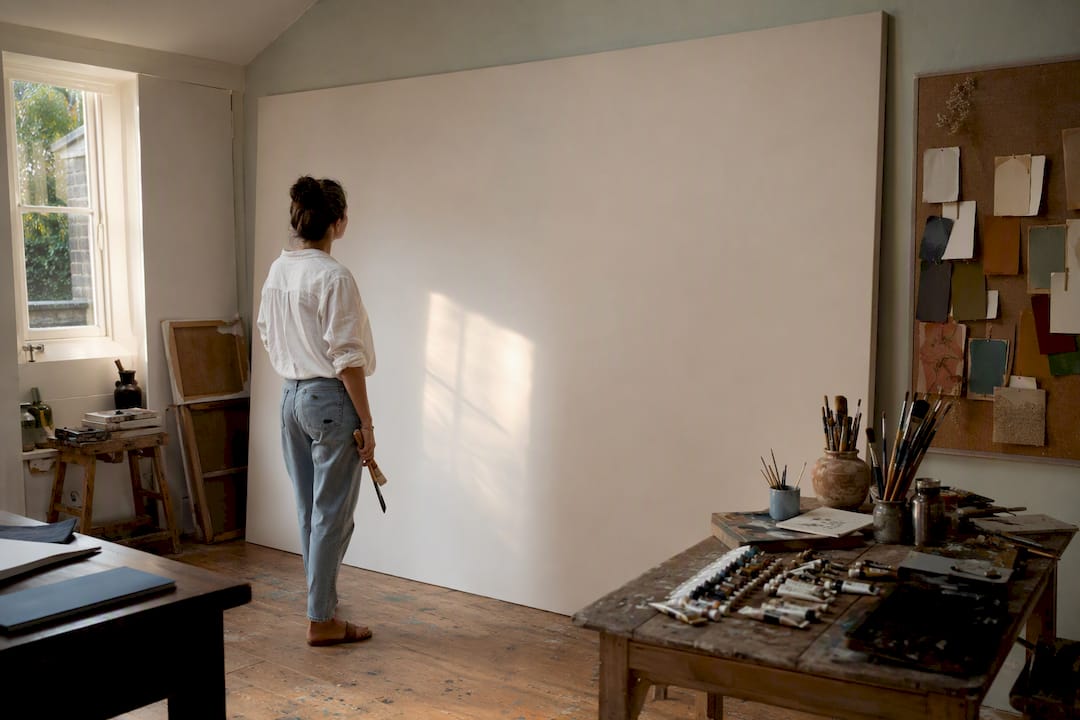
Site specific artwork is bespoke wall art commissioned to fit the exact dimensions, palette and purpose of one room, wall or building, rather than picked from an existing collection. You commission it when scale, colour precision or architectural integration matter more than convenience. This guide covers briefing, timelines, pricing logic and how Frametheworld handles the process from first sketch to installation.
TL;DR:
- If the wall is unusually shaped, requires exact color matching, or faces heavy traffic, commissioning bespoke artwork is recommended over ready-made options.
- Providing a detailed brief including wall photos, precise measurements, physical color samples, and a confirmed installation date is crucial to avoid delays and costly revisions.
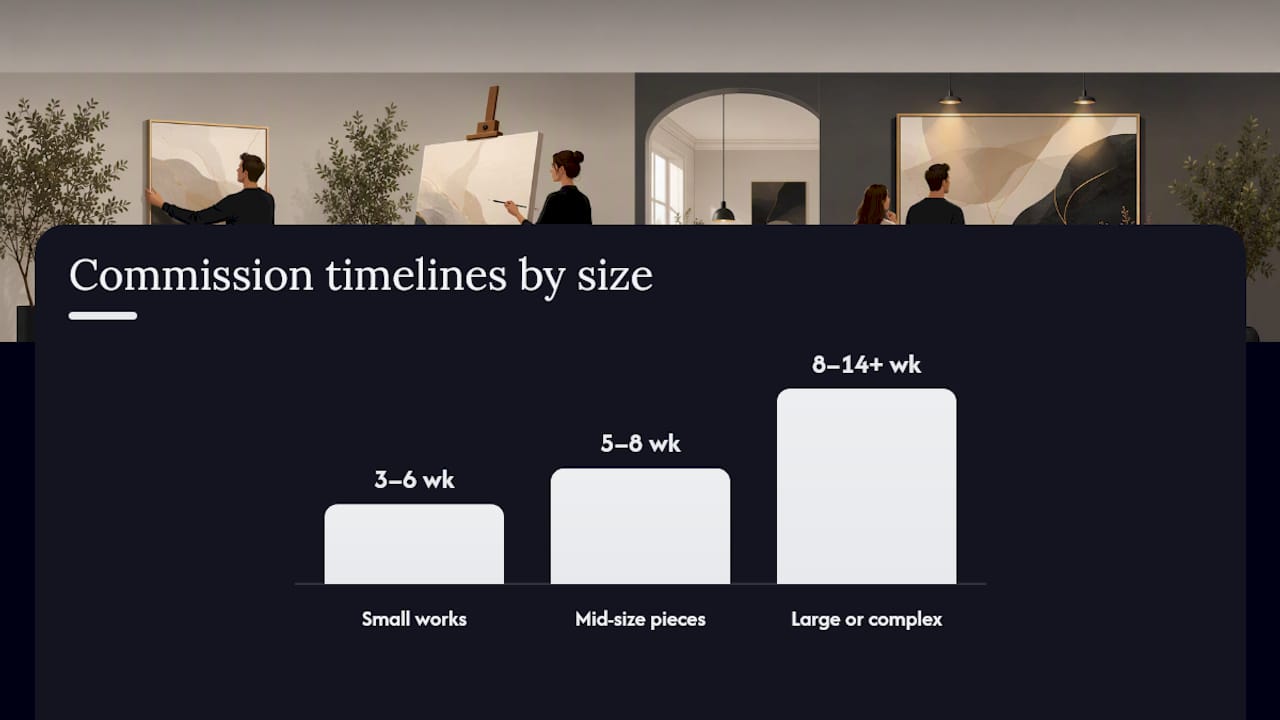
- Mid-size commissions typically take 5 to 8 weeks, while larger or complex works may require 8 to 14 weeks or more, with scheduling errors often causing delays.
- Using durable materials like archival panels and UV-resistant varnish enhances long-term preservation, especially in high-light or busy environments.
- Confirming copyright, reproduction rights, and installation responsibilities in a formal contract protects both parties, especially in commercial projects.
Table of Contents
- What is site specific artwork, and when should you commission it?
- How do you brief an artist or studio properly?
- How long does a commission take, and what does it cost?
- Which materials, finishes and installation methods work best?
- What does a real commissioning project look like?
- Where does the idea of commissioned art for a space come from?
- How does commissioned wall art differ from murals or installations?
- Which artists have shaped how we think about art made for a space?
- What legal and copyright issues should you settle before you commission?
- How do you design for a specific space and its conditions?
- How do you maintain and conserve a commissioned piece over time?
- How do you request a commission from Frametheworld?
- Three commissioning rules worth following
- Sources
What is site specific artwork, and when should you commission it?
You commission rather than buy ready-made when the wall itself sets the terms. A stairwell that runs 4.2 metres with an awkward dogleg, a boardroom wall that must echo the exact terracotta in the reception flooring, a lobby piece that needs to survive constant foot traffic and UV glare through south-facing glass: none of these are solved by browsing a collection and hoping something fits.
Commissioning gives you control over three things ready-made art can’t guarantee: precise scale, exact palette matching, and integration with the room’s architecture. A detailed brief built around wall photos, dimensions and swatches lets the artist solve for your space specifically, not for a generic rectangle.
Ready-made art still wins in plenty of situations. If you’re working to a deadline under four weeks, if the budget is tight, or if you simply want to see the finished piece before you commit, buying from an existing collection removes the guesswork a commission inevitably carries.
Run through this before you decide:
- Is the wall an unusual size, shape or aspect ratio that off-the-shelf pieces won’t fill cleanly?
- Does the piece need to match a specific paint, stone or fabric reference exactly?
- Will the artwork face heavy footfall, direct sunlight or humidity that demands specific materials?
- Do you have more than four weeks before installation day?
- Is budget flexible enough to absorb a deposit and staged payments rather than a single upfront price?
Three or more “yes” answers point towards a commission. Fewer, and a considered bespoke wall art piece from an existing range will likely serve you just as well, faster and cheaper.
How do you brief an artist or studio properly?
A weak brief is the single biggest cause of delay, disappointment and expensive revisions on a commission. Get this stage right and everything downstream moves faster.
- Send a straight-on photo of the wall, taken square rather than at an angle, plus a wider shot of the room to show context.
- Give exact measurements: wall width and height, ceiling height, and the position of any switches, radiators or doors that constrain placement.
- Provide colour references physically, not just as digital swatches. Paint chips, fabric samples and flooring cuttings all read differently under different light than they do on a screen.
- Note the lighting conditions, including whether the space uses warm or cool bulbs and their CRI (colour rendering index), since this affects how pigments will actually appear once installed.
- State the artwork’s job: is it a quiet backdrop, a conversation piece, or something that needs to withstand a commercial kitchen’s steam and grease?
- Confirm your installation date early, and build in a buffer either side of it.
- Ask for a scale mockup and payment schedule before work begins, so you know what you’re approving and when money moves.
A detailed brief with wall photos, exact dimensions, material swatches and an installation date is the single biggest predictor of a smooth commission. Commissioning guidance from bodies such as Modus Operandi goes further, recommending you treat the artist as a technical collaborator with a proper contract, not an informal supplier.
Pro Tip: Photograph the wall at the time of day the artwork will most often be seen. Morning light and evening light change how a colour reads, and that’s the light your finished piece has to work with.
How long does a commission take, and what does it cost?
Timelines scale with size and complexity, and the biggest scheduling mistake is planning to the minimum quoted time rather than the maximum.
- Small works: roughly 3–6 weeks from confirmed brief to delivery.
- Mid-size pieces: typically 5–8 weeks, which covers most residential feature walls and boardroom commissions.
- Large or complex pieces: 8–14 weeks or more, particularly for multi-panel works or anything requiring specialist framing.
Commission timelines commonly cluster around 5 to 8 weeks for mid-size work, with larger or more complex pieces sometimes running to 14 weeks. Build client expectations around the upper end of that range rather than the lower one, and add extra time for varnish curing, framing and shipping, which routinely get squeezed out of optimistic schedules.
Pricing usually follows a sliding scale by area rather than a flat rate. Larger pieces tend to cost less per square metre than smaller ones, because setup, mockup and consultation time are spread across more canvas. Commissions are priced separately from ready-made trade discounts, so if you’re used to negotiating volume discounts on stock pieces, don’t assume the same margin applies here. Expect a deposit to secure the artist’s time, with milestone payments tied to mockup approval and final delivery.
Put the artist on your critical path the same way you would an electrician or a glazier. Whoever runs the fit-out programme needs the confirmed installation date at the brief stage, not once the piece is nearly finished.
Which materials, finishes and installation methods work best?
The support you choose affects longevity as much as looks. Stretched canvas is lightweight, cost-effective and suits most residential walls, though it’s more vulnerable to knocks in high-traffic commercial areas. Archival panel (often called cradled board) offers a rigid, dent-resistant surface that’s better suited to lobbies, corridors and anywhere the public brushes past. Varnish finishes protect against dust and minor abrasion, and a matte varnish reduces glare under strong artificial lighting where a gloss finish would bounce distracting reflections.
Framing decisions follow function as much as taste:
- Gallery-wrap (canvas folded around the frame edge, no visible border) gives a clean, contemporary look and suits modern interiors.
- Bespoke framing adds protection and gravitas, and makes sense for boardrooms, hospitality settings or anywhere the piece needs to read as a serious investment.
- Float frames create a shadow gap around the canvas, useful when the artwork needs to sit slightly apart from a busy wall finish.
Installation on anything above head height or over 1.5 metres wide should involve a specialist installer using French cleats or a security hanging system, not standard picture hooks. Ask for a condition report before and after installation, and check the piece is covered under your contents or commercial insurance from the moment it arrives on site.
Lighting matters more than most briefs acknowledge. Successful commissions account for daylight shifts and traffic flow so the piece reads correctly at different times of day, not just under gallery-standard lighting during the studio visit.
Pro Tip: If the wall gets direct sun for more than two hours a day, ask your artist about UV-resistant varnish. Untreated pigments can visibly shift within a year under strong, unfiltered daylight.
What does a real commissioning project look like?
A typical residential feature wall commission runs a fairly consistent path: an initial brief with wall photos and a Pantone reference from the client’s existing sofa fabric, a palette study returned within a week, a scale mockup signed off before paint touches canvas, and delivery around six weeks later timed to a kitchen renovation’s completion date.

Commercial projects add layers. A hospitality lobby piece, for instance, typically needs sign-off from more than one stakeholder, and the brief has to account for how the artwork reads under evening event lighting as well as daytime ambient light, since the two can look completely different.
The recurring lessons from projects that go smoothly, and the ones that don’t:
- Briefs missing a straight-on wall photo cause the most revision cycles.
- Clients who fix an installation date before agreeing the brief scope create avoidable pressure on the artist.
- Palette matching against a physical swatch, rather than a screenshot or paint code alone, produces far fewer surprises at delivery.
- Projects with a signed brief and payment schedule from day one rarely stall midway through.
You can browse examples of bespoke artwork that show this brief-to-installation arc in more detail, including how palette decisions carried through from swatch to finished canvas.
Where does the idea of commissioned art for a space come from?
Painting to fit a specific setting is centuries old. Renaissance fresco cycles were designed for one chapel wall and nowhere else; Georgian country houses commissioned overmantel paintings sized precisely to the space above a particular fireplace. What’s changed isn’t the principle, it’s the accessibility.
Digital consultation, photo-based briefing and remote palette matching have brought a process once reserved for aristocratic patrons and major institutions within reach of homeowners and mid-size businesses. A design studio commissioning a feature wall for a client’s new-build kitchen today follows a version of the same logic a nineteenth-century patron used when commissioning a portrait to hang above a particular staircase: fit the piece to the room, not the room to the piece.
The interior design boom of the past two decades has pushed this further. As open-plan living and statement feature walls became standard in residential and commercial fit-outs, the demand for art sized and coloured to a specific space grew alongside it. Ready-made prints solve for the general case; a commissioned piece solves for the room you’re actually standing in.
How does commissioned wall art differ from murals or installations?
The terms get used loosely, so it helps to separate them by what they actually involve.
A mural is painted directly onto a wall or architectural surface, permanently bonded to that structure. It can’t be relocated if you move house or refit the space; when the wall goes, the mural goes with it.
Commissioned wall art, the subject of this guide, is a standalone piece painted on canvas or panel to fit a specific room’s dimensions and palette, then hung using standard or specialist fixings. It integrates visually with the space but remains a portable object you can rehang, sell or move to a new property.
An installation in the gallery or public art sense typically involves multiple objects, materials or media occupying a space, often temporary and frequently interactive or spatial rather than a single flat picture plane.
For most homeowners, interior designers and commercial project managers, commissioned wall art hits the practical sweet spot: it fits the wall as precisely as a mural would, without the permanence, and it carries far more individual character than a generic installation piece bought to fill a corner.
Which artists have shaped how we think about art made for a space?
You don’t need a public art history lesson to commission well, but knowing the tradition helps you brief with confidence. Painters working in impasto and palette-knife techniques, building thick, textured layers of paint directly onto canvas, have become particularly popular for commissions where the client wants tactile depth rather than a flat print-like finish. Frametheworld’s own Urban Love piece demonstrates this approach applied to a cityscape brief, where texture does as much visual work as colour.
Abstract expressionist approaches, favouring gesture and colour field over representation, suit commissions where the room’s existing palette needs to be echoed rather than illustrated, a boardroom wall picking up the exact grey-green of a stone floor, for instance. Pop art commissions, by contrast, work well where a space wants energy and boldness rather than subtlety, often in hospitality or retail settings where the artwork needs to hold its own against busy signage and lighting.
What matters for a commissioner isn’t memorising art movements. It’s recognising which visual language, textured and gestural, flat and graphic, or bold and pop-inflected, suits the mood the room is trying to create, then briefing the artist with reference images that show that language clearly.
What legal and copyright issues should you settle before you commission?
Copyright in a commissioned painting sits with the artist by default under UK law, even though you’ve paid for the work, unless your contract explicitly transfers or licenses those rights to you. This surprises a lot of first-time commissioners who assume payment equals ownership of the intellectual property.
Get four things confirmed in writing before work starts:
- Reproduction rights: can the artist photograph and use the finished piece in their own portfolio or marketing?
- Resale and relocation: does moving the piece to a new owner or property require notifying the artist, particularly for larger commercial commissions?
- Alteration clauses: who has the right to amend, restore or repaint the piece if it’s damaged?
- Delivery and installation responsibility: does the artist’s obligation end at delivery, or does it extend to installation and sign-off?
Formalising this with a proper brief and contract protects both sides and treats the artist as a technical collaborator on your project, with clearly defined responsibilities for delivery, installation and any future maintenance. For commercial commissions involving multiple stakeholders, get this signed before the deposit stage, not after work is underway.
How do you design for a specific space and its conditions?
The wall you’re commissioning for isn’t a neutral surface, it’s a set of environmental conditions the artist needs to know about before they pick up a brush.
Light is the biggest variable. North-facing rooms deliver cool, consistent daylight; south-facing rooms swing from soft morning light to harsh midday glare. A piece designed under studio lighting alone can look completely different once it’s hanging under your actual bulbs, particularly if your fittings have a low CRI rating that mutes certain pigments.
Traffic and touch matter just as much in commercial settings. A corridor piece that gets brushed past daily needs a more resilient surface and finish than a boardroom wall nobody physically approaches. Considering natural light shifts and traffic flow at the design stage turns the artwork into part of the room’s architecture rather than something bolted on afterwards.
Humidity and temperature swings, common in bathrooms, kitchens and older buildings with variable heating, can warp canvas over stretcher bars or cause panel supports to expand and contract. Flag these conditions in your brief so the artist can recommend the right support material and sealant.
Sightlines deserve a mention too: a piece that reads beautifully from a seated position in a living room might sit awkwardly if the main approach to the wall is from an angle down a hallway. Walk the space at the times people actually use it, not just when the light is flattering.
How do you maintain and conserve a commissioned piece over time?
Commissioned pieces need more thought than a printed poster, but far less than most people assume, provided a few conditions are managed from day one.
UV exposure is the main long-term threat to pigment. Direct sunlight, even filtered through glass, gradually shifts colour saturation, particularly in reds and certain blues. A UV-resistant varnish, agreed at the brief stage, slows this considerably and is far easier to specify upfront than to correct later.
Dust and surface grime build up faster in commercial settings than most people expect, especially near kitchens, entrances or anywhere with airflow from HVAC systems. A soft, dry brush or specialist art-cleaning cloth handles routine maintenance; anything beyond that should go to a conservator rather than a general cleaner.
Structural checks matter for canvas works in particular. Stretcher bars can loosen over years, especially in buildings with fluctuating humidity, leading to a slightly slack canvas surface. An annual visual check, tightening keys where the canvas has a wooden stretcher frame, catches this early.
A certificate of materials or lightfastness note from the artist at delivery is worth requesting and keeping on file. It tells you, or whoever inherits responsibility for the piece later, exactly what pigments, varnish and support were used, which matters enormously if restoration is ever needed years down the line.
How do you request a commission from Frametheworld?
Frametheworld handles bespoke commissions the way this guide describes them: custom sizing to your exact wall dimensions, palette-matching against physical swatches or reference material, and trade support for interior designers and project managers running multi-stakeholder approvals. White-glove installation is available for larger or commercial pieces where hanging isn’t a job for standard fixings.
To request a quote, send wall photos, exact dimensions, your colour references and your target installation date. You’ll typically hear back with an initial consultation, an indicative timeline and a deposit figure to confirm the brief before work begins. If you’d rather see finished styles before committing to a bespoke brief, browse the hand-painted Wabi Sabi collection for texture-led pieces or the pop art collection for bolder, graphic commissions, both available in custom sizing on request. Start your brief today by getting in touch with the details above.
Three commissioning rules worth following
Send more detail than feels necessary, especially wall photos and physical swatches, because vague briefs cost you weeks later. Accept flexibility on budget or install dates before you accept vagueness on palette or scale; those two are far harder to fix after the paint’s dry. And always get the brief and payment schedule in writing before the artist starts, no exceptions.
— Lennard
Sources
- How to Commission Original Artwork for Interior Design Projects | UK Guide – MadhavFineArt
- Commissioning Custom Art: A Trade Guide for Designers
- Public Art Online Resources - Practical advice - Commissioning - Modus Operandi Commissioning Guidelines


Leave a comment
This site is protected by hCaptcha and the hCaptcha Privacy Policy and Terms of Service apply.