
TL;DR:
- Curated artwork in rental properties enhances first impressions, attracting better tenants and increasing inquiries. It also boosts perceived property value, tenant retention, and organic marketing through social sharing. Selecting appropriate art—scale, theme, and durability—drives measurable rental performance benefits.
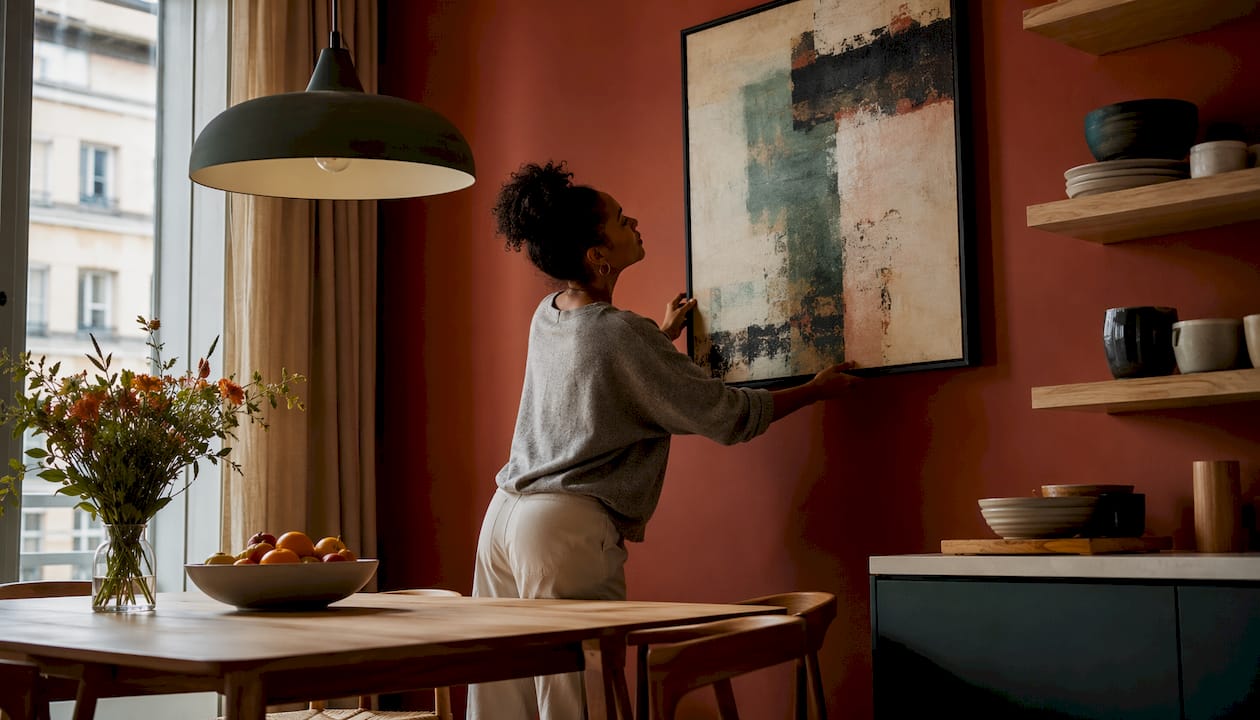
Art transforms how prospective tenants judge a rental within seconds of walking through the door. Properties with curated artwork receive noticeably more enquiries and attract more qualified, long-term tenants. The single most effective first step: hang one considered focal piece in the main living area or entrance. That one decision shifts the entire perception of the space.
Table of Contents
- 1. Why art changes how renters judge a space
- 2. The measurable landlord benefits of curated art
- 3. How to choose art that actually works for lettings
- 4. Ready-made or commissioned? Costs, timescales and what to ask
- 5. Installation, care and UK landlord considerations
- 6. Mini case studies: art improving rental and commercial projects
- Key takeaways
- Art in rentals: what the evidence actually says
- How Frametheworld helps landlords and commissioners
- Useful sources and further reading
1. Why art changes how renters judge a space
Art functions as an affective stimulus — it shapes mood and signals care before a prospective tenant has consciously assessed a single room. The psychological mechanisms are well-documented:
- First impressions: The brain forms an emotional response to a space in under a second. A well-placed canvas anchors that response positively.
- Attention restoration: Art gives the eye somewhere purposeful to land, reducing the low-level cognitive fatigue that empty or cluttered walls produce.
- Place identity: A distinctive piece tells a story about the property. Tenants remember the flat with the abstract coastal triptych; they forget the one with bare magnolia walls.
- Signalling: Art communicates that the landlord invests in the property. That signal correlates directly with how carefully tenants treat a space.
Scale and composition amplify these effects. A canvas sized to anchor a wall — rather than floating awkwardly above a sofa — reads as intentional. Biophilic themes (botanicals, landscapes, water) carry an additional benefit: sustained exposure to biophilic art environments produces measurable reductions in anxiety symptoms, which matters for tenant wellbeing and retention alike. Research into home aesthetics and wellbeing reinforces the same point from a residential perspective.
2. The measurable landlord benefits of curated art
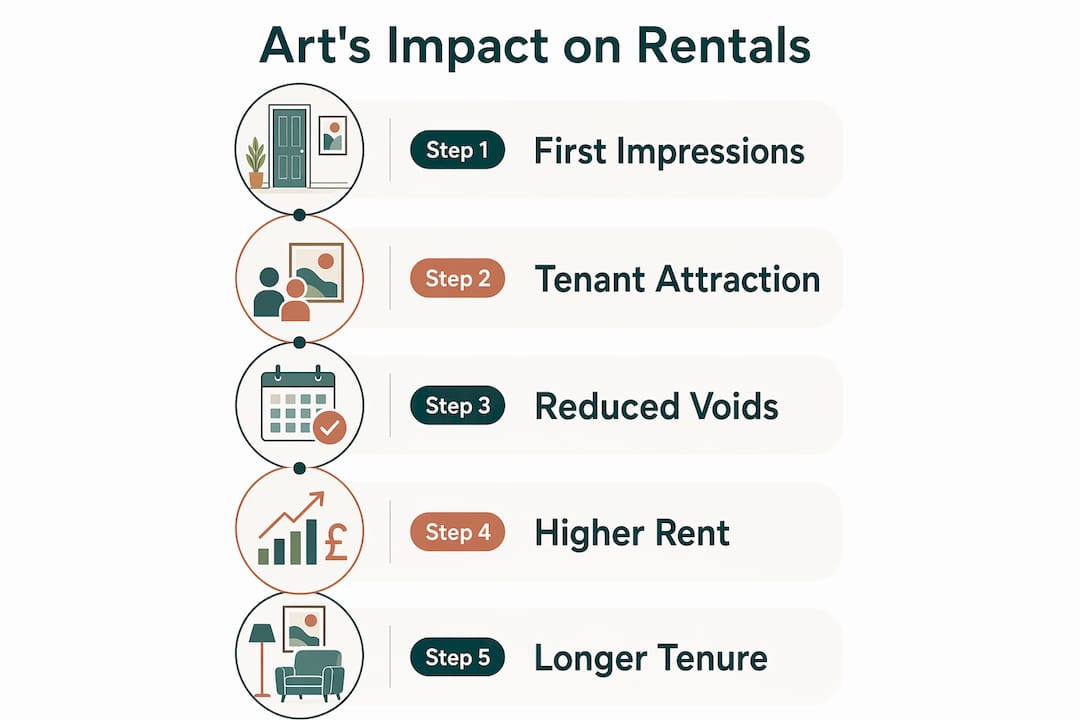
Art in rental properties is not a soft, decorative afterthought. The impact on rental performance is concrete:
- More enquiries: Properties with thoughtfully chosen art consistently attract higher enquiry volumes, giving landlords the pick of applicants.
- Better tenant quality: Higher enquiry rates allow landlords to select more reliable, long-term tenants rather than accepting the first applicant.
- Referrals and social sharing: Spaces with thoughtful art installations are more likely to be referred and shared organically on social media — free marketing for short-let operators in particular.
- Tenant retention: A property that feels designed and cared-for encourages tenants to stay longer, reducing void periods and re-letting costs.
The ROI logic is straightforward. If a single curated canvas costing £200–£400 reduces one void week per year, it pays for itself many times over. A scoping review of visual art in healthcare settings found measurable improvements in reported wellbeing — evidence that art’s effect on how people feel in a space extends well beyond aesthetics.
3. How to choose art that actually works for lettings
The single most important rule: match the piece to the target renter and the room’s scale. Everything else follows from that.
- Tenant demographic: Young professionals respond to bold abstract or graphic work; families lean towards calm landscapes or botanical prints; short-let guests want something that feels local or distinctive.
- Room function: Living areas suit statement pieces; bedrooms benefit from calmer, lower-contrast work; corridors and lobbies need something that reads well at a glance from a distance.
- Colour palette: Art should complement, not fight, the wall colour. Neutral walls give you maximum flexibility; a warm terracotta or muted teal accent piece can anchor an otherwise plain scheme.
- Scale and sightlines: A canvas should fill roughly two-thirds of the wall width above a sofa or bed. For a gallery wall, the overall arrangement should read as a single visual unit from the doorway.
- Durability: Canvas prints and hand-painted works on stretcher bars outlast paper prints and fragile glass-framed pieces across multiple tenancies.
- Biophilic options: Botanical, landscape and water-themed pieces add wellbeing value and appeal to the widest demographic range.
For art placement guidance that covers sightlines and hanging heights in detail, Frametheworld’s placement guide is a practical reference.
Pro Tip: For a rental that needs to appeal broadly, choose one statement piece in a neutral palette with textural interest — a hand-painted abstract works harder than a photographic print because it reads as considered without imposing a specific taste.
4. Ready-made or commissioned? Costs, timescales and what to ask
For most standard rentals, a well-chosen ready-made canvas is the faster, lower-risk route. Commission bespoke work when the property targets premium tenants, when a specific size or colour match is required, or when you want a piece that genuinely cannot be found elsewhere.
| Option | Typical cost range | Lead time |
|---|---|---|
| Entry-level ready-made canvas | £150 | Immediate to 5 days |
| Custom small canvas (bespoke size/colour) | £150–£400 | 2–4 weeks |
| Large commissioned hand-painted work | £400 | 4 weeks |
Before placing a commission, ask the supplier:
- Who holds copyright after delivery, and can the image be reproduced?
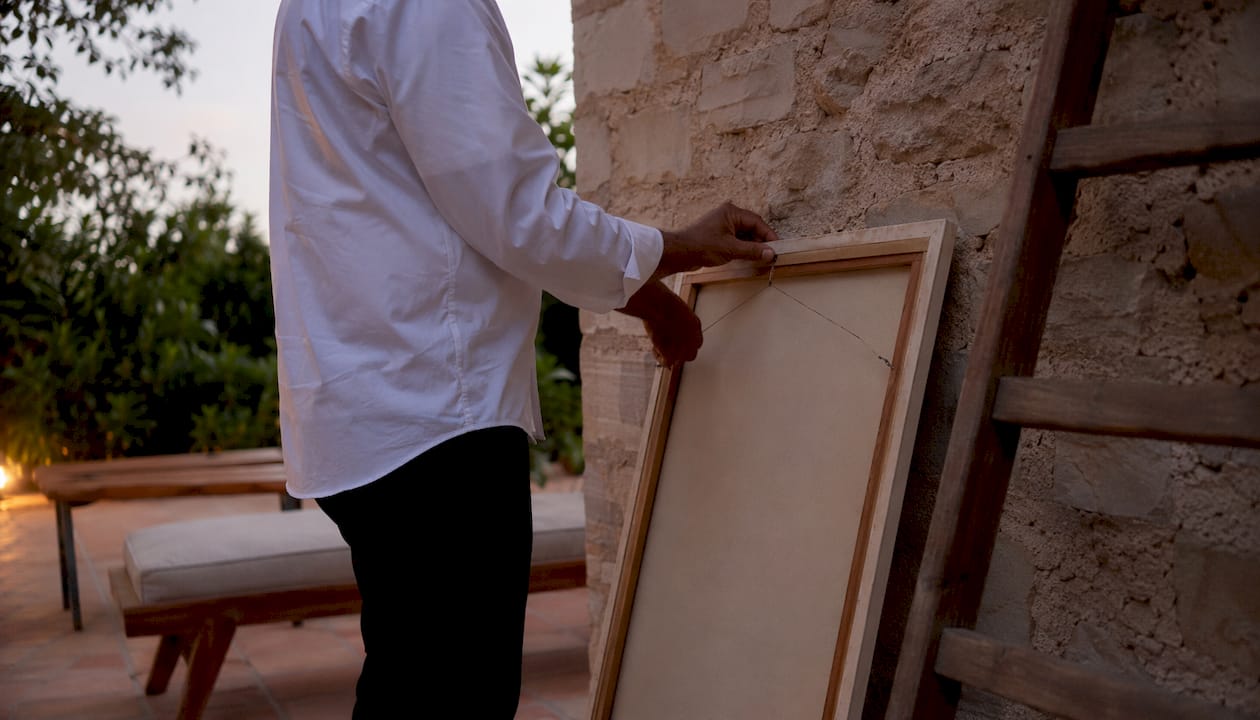
- Does the piece come with installation hardware and hanging instructions?
- What protective backing or coating is applied for durability?
- Can the work be resized or replicated for multiple units?
- What is the returns or damage policy during transit?
- Is the piece insured during shipping?
For new development projects involving multiple units, commissioning a small series of related works is often more cost-effective than buying individual pieces per flat.
5. Installation, care and UK landlord considerations
The practical goal is permanence for the landlord and flexibility for the tenant. Get that balance wrong and art becomes a deposit dispute waiting to happen.
- Permission and tenancy agreements: Specify in the tenancy agreement that wall art is a landlord fixture and must not be moved or removed by the tenant.
- Fixings: Use proper wall plugs and picture hooks rated for the canvas weight. For heavy or large works, locate studs or use cavity anchors.
- Non-permanent options: For furnished lets where tenants may want to rearrange, adhesive picture strips rated to the canvas weight (such as Command strips for lighter pieces) avoid wall damage entirely.
- Hanging height: Eye level at approximately 145–150 cm to the centre of the piece is the standard for most rooms.
- Deposit notes: Document the art in the inventory with photographs and condition notes at the start of each tenancy.
- Cleaning: Canvas surfaces can be lightly dusted; avoid moisture. Hand-painted works with a varnish coat are more resilient than uncoated prints.
Pro Tip: When commissioning, specify a protective backing board and D-ring fixings rather than sawtooth hangers. The piece rehangs faster at turnover and the backing prevents wall scuffing — two small details that save time and deposit disputes across multiple tenancy cycles.
6. Mini case studies: art improving rental and commercial projects
Art’s impact on rental performance shows up most clearly in specific contexts.
Short-term holiday let, coastal property The owner replaced generic prints with a set of three hand-painted abstract seascape canvases sized to the main living wall. Listing enquiries increased, and the property began appearing in guests’ social media posts, generating organic reach the owner had not previously seen. First impressions and destination connection are the primary drivers in short-let bookings.
Urban professional flat, city centre A landlord targeting young professionals added a single large-format abstract canvas to the living area and two smaller botanical prints to the bedroom. Viewings converted faster, and the flat let within days of listing rather than weeks.
Mixed-use lobby installation, commercial letting A property manager commissioned a site-specific large-scale work for the building entrance. Cortland’s approach to local, site-specific art illustrates the principle: art takes a community from well-designed to memorable. Tenants in the building reported a stronger sense of identity with the space.
“Art is what takes a community from ‘well-designed’ to ‘memorable’.” — Cortland, multifamily developer, on the role of site-specific installations in apartment communities.
Small commercial letting, co-working space Curated art in communal areas reduced the sterile, transient feel that deters longer-term tenants. The role of art in communal spaces is particularly pronounced in shared environments where belonging and identity matter to retention.
Key takeaways
Art in rental properties drives measurable outcomes: more enquiries, stronger referrals, better tenant retention, and a property that photographs and presents at a higher perceived value than its unfurnished equivalent.
| Point | Details |
|---|---|
| Enquiries increase with art | Properties with curated artwork receive noticeably more enquiries than comparable listings without it. |
| Psychology works fast | Art functions as an affective stimulus, shaping mood and signalling care within seconds of arrival. |
| Biophilic themes add wellbeing value | Botanical and landscape pieces reduce anxiety symptoms and appeal to the widest tenant demographic. |
| Commission when targeting premium tenants | Bespoke hand-painted work justifies higher asking rents and creates a narrative no generic print can match. |
| Frametheworld for ready-made and bespoke | Frametheworld offers both curated collections and custom commissions sized and styled for rental interiors. |
Art in rentals: what the evidence actually says
The conventional wisdom treats art in rental properties as a nice-to-have styling detail. The evidence says otherwise. A property that signals care through a considered canvas is not just prettier — it attracts a different calibre of enquiry, photographs better for listings, and gives tenants a reason to stay. The landlords who treat art as infrastructure rather than decoration are the ones reducing void periods and fielding referrals.
What most guides miss is the commissioning argument. A bespoke, hand-painted piece sized precisely for a wall does something a generic print cannot: it creates a narrative for the home. Tenants remember it. They mention it to friends. They photograph it. That is not a soft benefit — it is organic marketing with a one-time cost.
The biophilic angle is also underused. Botanical and landscape works are not just aesthetically safe choices; they carry documented wellbeing benefits that translate directly into tenant satisfaction and retention. For landlords managing multiple units, that is a compounding advantage.
How Frametheworld helps landlords and commissioners
Frametheworld offers hand-painted wall art and bespoke commissions built specifically for the demands of rental and commercial interiors. Ready-made pieces ship quickly for landlords who need to turn a property around fast. For premium lettings or multi-unit projects, the commissioning service delivers work sized, coloured, and styled to brief — with protective finishes and installation hardware included.
The Wabi Sabi collection is a strong starting point for landlords who want textured, neutral focal pieces that photograph well and appeal across tenant demographics. For properties targeting design-forward or younger renters, the Pop Art collection delivers the kind of bold, memorable statement that drives social sharing. Browse both collections at Frametheworld.co.uk, or get in touch to discuss a bespoke commission for your next project.
Useful sources and further reading
Primary research and external sources:
- Investment aesthetics: how visual decor affects rental value — World Business Outlook; property-management research on enquiry rates and tenant quality.
- Beyond beauty: how strategic art installations increase building value — Buildings.com / Toronto Metropolitan University; referrals and social sharing findings.
- How Cortland is using local art to create more distinctive apartment communities — Multifamily Executive; developer insights on place identity and memorability.
- Long-term effects of urban biophilic art environments on depression and anxiety symptoms — Springer; longitudinal evidence for biophilic art and mental wellbeing.
- The effects of viewing visual artwork in healthcare settings: a scoping review — PLOS ONE; synthesis of 68 publications on art and wellbeing outcomes.
- Art and wall decor in short-term rentals — Lake.com; practical guidance on bookings and guest satisfaction.
- Beyond decoration: the emotional psychology of art placement — Academic synthesis on affective stimulus and attention restoration.
Frametheworld resources:
- The role of art in property value explained — Landlord-focused overview of tenant retention and referral benefits.
- Art as a design anchor — Scale and focal-point strategy for rental and commercial interiors.
- The role of art in wellness spaces — Biophilic and wellbeing-oriented installation strategies.
- Tips for choosing artwork for new developments — Commissioning and budgeting guidance for multi-unit projects.

Laat een reactie achter
Deze site wordt beschermd door hCaptcha en het privacybeleid en de servicevoorwaarden van hCaptcha zijn van toepassing.