

TL;DR:
- Art curation involves selecting, interpreting, and organizing artworks to craft meaningful narratives that shape cultural memory and influence institutions. It is a multidisciplinary process encompassing research, spatial design, public engagement, and administrative tasks, with ethical and political considerations now central to its practice. Understanding curation enhances collectors’ ability to build coherent collections, navigate institutional constraints, and extend artistic narratives into personal or public spaces.
Art curation is the disciplined practice of selecting, organising, and interpreting artworks to create coherent narratives that connect art, artists, and audiences meaningfully. Far beyond arranging objects on a wall, the role of art curation shapes cultural memory, drives institutional strategy, and determines which voices enter the historical record. Institutions from Tate Modern in London to the Venice Biennale depend on curatorial expertise to give exhibitions their intellectual spine. For collectors and art enthusiasts alike, understanding how curation works is the difference between experiencing art passively and engaging with it on its own terms.
What does the art curation process involve in contemporary practice?
Curatorial mediation is understood as selection, interpretation, and presentation, encompassing research, spatial design, cataloguing, and fundraising. This definition matters because it reveals curation as a multidisciplinary discipline, not a single act of taste. A curator working on a major exhibition at the Serpentine Gallery, for instance, will spend months building a conceptual framework before a single artwork is confirmed.
The contemporary art curation process unfolds across several distinct but overlapping phases:
- Research and concept development. Curators identify a thesis, survey existing scholarship, and map which artworks or artists best embody the argument they want to make.
- Artist and artwork selection. This is where trained judgement becomes indispensable. Curatorial selection is a scarce skill involving specialised perception developed over thousands of hours, which means it cannot be replicated at scale by algorithms or generalist staff.
- Spatial and interpretive design. Curatorial layout decisions, or what specialists call “constraints design,” fundamentally shape visitor cognition by sequencing and grouping artworks to create interpretive narratives. The physical journey through a room is itself an argument.
- Public programming and engagement. Talks, catalogues, educational workshops, and digital content extend the exhibition’s reach beyond its physical walls.
- Institutional administration. A curator’s role blends scholarly research with operational administration, including acquisitions, conservation priorities, exhibition planning, and publishing. This administrative layer is often invisible to visitors but determines whether an exhibition actually opens on time.
Pro Tip: If you are building a personal collection, apply the same conceptual rigour a curator uses. Define a clear theme or argument before acquiring new works, rather than accumulating pieces reactively. A collection with a coherent narrative is far more compelling and valuable than a disparate group of objects.
How do ethical and political considerations shape curation today?

Contemporary curation increasingly acts as ethical and political mediation, navigating representation, decolonisation, and institutional critique. This is not a peripheral concern. It sits at the centre of every significant exhibition decision made in 2026.
The ethical stakes are high because, as one analysis of curatorial authority puts it, selections and contextualisation construct viewpoints, directly challenging any claim of neutrality. A curator who presents only Western European modernism as the canon is making a political statement, whether they intend to or not.
Several specific pressures define the ethical terrain today:
- Decolonisation of collections. Museums including the British Museum and the Musée du quai Branly face ongoing demands to repatriate objects acquired under colonial conditions. Curators are increasingly required to contextualise provenance honestly rather than silently.
- Representation of marginalised voices. Biennials such as Documenta and the São Paulo Bienal have explicitly prioritised artists from the Global South, Indigenous communities, and historically excluded groups. Curatorial selection is the mechanism through which this shift either happens or stalls.
- Institutional critique as curatorial practice. Some curators now treat the institution itself as a subject, exposing its funding relationships, governance structures, and historical blind spots within the exhibition space.
“Curation matters because it mediates meaning by selecting what to include and exclude, shaping art’s cultural narratives.” The implication is clear: every act of selection is also an act of exclusion, and that responsibility cannot be delegated.
The relationship between curatorial authority and institutional governance adds another layer of complexity. Curators rarely have unilateral power. Their ethical commitments are constantly negotiated against board priorities, donor relationships, and public relations considerations.
How does institutional context influence what gets curated and shown?
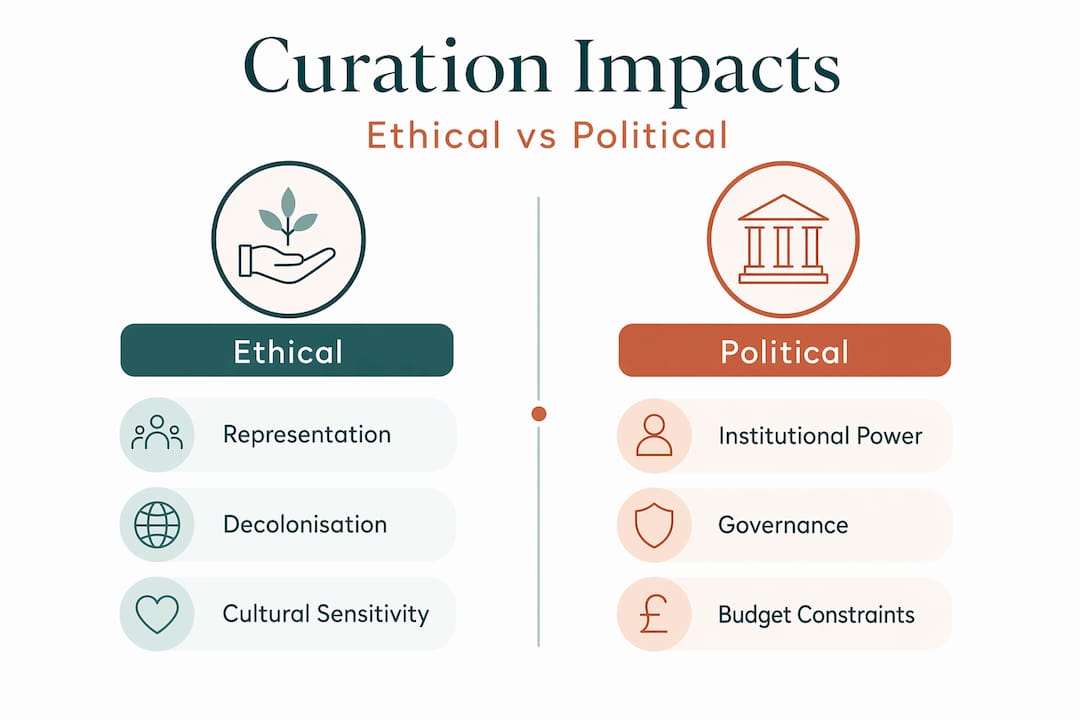
Museum governance structures balance curatorial vision with finance, public interest, and strategic oversight, constraining curation within institutional missions. Directors and boards influence priorities through funding and politics, meaning exhibitions are not solely curatorial choices. This is one of the most under-discussed realities of the art world.
Consider how three major institutions approach this tension differently:
- Tate Modern operates with a publicly funded mandate to serve broad audiences, which means its curatorial team must balance scholarly ambition with accessibility and visitor numbers.
- The Metropolitan Museum of Art (The Met) in New York relies heavily on private philanthropy, which creates subtle but real pressure to programme exhibitions that appeal to major donors and corporate sponsors.
- The Louvre in Paris navigates both state funding and commercial partnerships, including its Abu Dhabi franchise, each of which carries distinct curatorial expectations.
The table below illustrates how institutional type shapes curatorial freedom:
| Institution type | Primary funding source | Curatorial constraints |
|---|---|---|
| National museum | Government grants | Public mandate, political scrutiny |
| Private foundation | Donor philanthropy | Donor preferences, market alignment |
| Commercial gallery | Sales revenue | Commercial viability of artists shown |
| Biennial | Mixed public/private | Thematic brief set by organising committee |
Curatorial impact balances intellectual research with institutional approval, navigating board scrutiny, budget constraints, and conservation considerations. For collectors who lend works to institutions, understanding this dynamic is practical knowledge. The exhibition your work appears in is shaped by forces well beyond the curator’s personal vision.
What is the historical evolution of art curation?
The history of art curation begins not in public museums but in private royal collections and cabinets of curiosities in 16th and 17th century Europe. These early assemblages, such as the Kunstkammer of Rudolf II in Prague, were displays of power and wonder rather than educational programmes. The curatorial logic was accumulation, not interpretation.
The Enlightenment shifted this fundamentally. The founding of the British Museum in 1753 and the Louvre’s transformation into a public institution in 1793 introduced the idea that collections existed to educate citizens, not merely impress them. This is the moment when the role of curators began to acquire its modern character: the curator as interpreter, not just custodian.
Pro Tip: When visiting a major museum, read the wall text not just for information but as a curatorial argument. Notice which artists are grouped together, which works are given prominence, and what the sequence implies. You will start to see the curator’s hand in every room.
The 20th century brought the rise of the independent curator, most visibly through figures like Harald Szeemann, whose 1969 exhibition When Attitudes Become Form at the Kunsthalle Bern treated the exhibition itself as an artwork. This was a turning point: curation became a creative act with its own authorship.
| Historical period | Curatorial role | Primary purpose |
|---|---|---|
| 16th to 17th century | Collector and keeper | Display of wealth and curiosity |
| 18th to 19th century | Scholar and educator | Public enlightenment and classification |
| 20th century | Independent creative | Exhibition as authored cultural statement |
| 21st century | Ethical and digital mediator | Inclusion, access, and global reach |
Today, digital galleries, virtual reality exhibitions, and AI-assisted collection management have expanded the curator’s toolkit enormously. The core intellectual challenge, deciding what matters and why, remains entirely human.
How does art curation affect collectors and access to collections?
For private collectors, the importance of art curation extends well beyond aesthetics. Lending a work to a major institutional exhibition can significantly raise an artist’s market profile and, by extension, the value of the collector’s holdings. Curatorial endorsement functions as a form of critical validation that the market responds to directly.
International travelling exhibitions depend on meticulous curatorial coordination with logistics, conservation, risk management, and insurance agreements. Loan agreements specify conditions of protection and care during transport and display. Collectors who lend without understanding these frameworks expose themselves to significant risk.
Practical considerations for collectors engaging with institutional curation include:
- Early alignment on logistics. Collectors should align with curators and logistics teams on transport, security, and insurance well before any loan agreement is signed.
- Conservation assessment. Works must be assessed for travel-worthiness. A curator’s enthusiasm for including a fragile piece does not override the conservator’s judgement.
- Regional access schemes. The Irish Mobility of Collections Scheme funds loans from national collections to regional institutions, enhancing public access beyond urban centres. Similar schemes in the UK and across Europe demonstrate how curatorial coordination can democratise access to art that would otherwise remain in storage or in a single location.
- Market visibility. Exhibitions curated around a specific artist or movement create critical momentum. Collectors holding works by featured artists often see renewed interest from buyers and institutions following a well-reviewed show.
The scarcity of genuine curatorial expertise also has direct implications for collectors building their own displays at home or in commercial spaces. Applying curatorial thinking to home art selection produces spaces that feel considered and coherent rather than merely decorated.
Key takeaways
The role of art curation is the primary mechanism through which artworks acquire public meaning, institutional authority, and lasting cultural relevance.
| Point | Details |
|---|---|
| Curation shapes meaning | Every selection and exclusion constructs a cultural narrative, making neutrality impossible. |
| Ethics are central, not peripheral | Decolonisation, representation, and institutional critique are now core curatorial responsibilities. |
| Institutions constrain curators | Boards, donors, and funding structures shape exhibitions as much as curatorial vision does. |
| History defines the present | The shift from custodian to ethical mediator spans four centuries and continues to accelerate. |
| Collectors benefit from curatorial knowledge | Understanding curation protects loans, raises artist profiles, and improves personal collection coherence. |
Why I think curation deserves far more attention than it receives
Most art lovers focus on the artwork itself and treat the curatorial frame as invisible infrastructure. That is a mistake. After years of engaging with exhibitions across London, Basel, and beyond, I have come to believe that the curator’s argument is often more interesting than any single work in the room.
The ethical complexity alone is worth serious attention. Curators today are asked to reconcile institutional conservatism with genuine calls for decolonisation, to satisfy donors while championing marginalised voices, and to produce accessible public experiences without dumbing down scholarship. Very few professions carry that combination of intellectual and political pressure simultaneously.
For collectors specifically, I think the practical implications are underestimated. The framing and presentation of art in your own space is a curatorial act. The sequence in which you hang works, the relationships you create between pieces, and the narrative you build across a room all determine how guests experience your collection. Treating that as decoration misses the point entirely.
The digital turn is the next frontier I watch closely. Virtual exhibitions and AI-assisted curation are genuinely expanding access, but they risk flattening the spatial and sensory dimensions that make physical curation so powerful. The best curators will be those who use digital tools to extend their arguments rather than replace them.
— Lennard
Bring expert curation into your own space with Frametheworld
Understanding the role of art curation changes how you approach your own walls. At Frametheworld, every collection is assembled with the same principles that drive institutional curation: coherence, quality, and visual argument. The Wabi Sabi wall art collection brings hand-painted texture and considered imperfection to interiors that reward close attention. For spaces that demand energy and presence, the Pop Art collection delivers bold, hand-painted pieces curated to create immediate visual impact. Whether you are furnishing a home or a commercial space, Frametheworld offers the curatorial range and customisation options to make your walls say something deliberate.
FAQ
What is art curation in simple terms?
Art curation is the process of selecting, organising, and interpreting artworks to create a coherent experience or narrative for an audience. It applies in museums, galleries, biennials, and private collections alike.
Why is the role of curators important for art audiences?
Curators determine which artworks are seen, how they are contextualised, and what meaning audiences are invited to draw from them. Without curatorial mediation, collections are simply storage.
How does the art curation process differ between museums and private galleries?
Museum curation operates within governance structures involving boards, public mandates, and conservation obligations, while private galleries prioritise commercial viability and artist market positioning. Both involve selection and interpretation, but the constraints differ significantly.
How does art curation affect the value of a collector’s works?
Institutional exhibition of a work, driven by curatorial selection, raises an artist’s critical profile and typically increases market interest in their pieces. Collectors who lend strategically often see measurable returns in valuation and visibility.
Has digital technology changed the art curation process?
Digital tools have expanded access through virtual exhibitions and AI-assisted collection management, but the core curatorial skill of trained selection and interpretive judgement remains irreducibly human.

Laat een reactie achter
Deze site wordt beschermd door hCaptcha en het privacybeleid en de servicevoorwaarden van hCaptcha zijn van toepassing.