
TL;DR:
- Abstract art expresses ideas and emotions through color, form, and composition instead of recognizable subjects. It enhances home atmosphere, mood, and design by relying on scale, color, and texture choices to evoke specific feelings. Engaging with original abstract artwork benefits mental wellbeing by promoting mindfulness, reducing stress, and encouraging psychological flexibility.
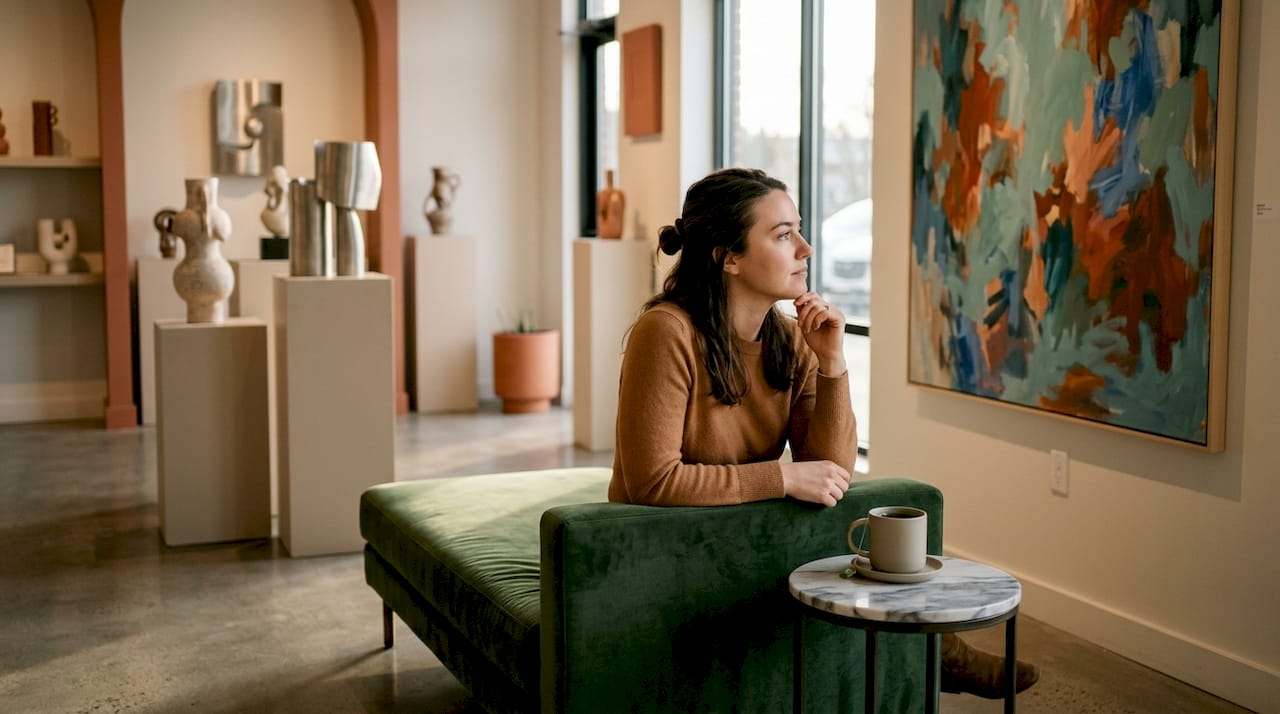
Abstract art is defined as visual work that uses colour, form, and composition to express ideas and emotions rather than depict recognisable subjects. That quality is precisely why abstract art suits homes so well. It adapts to any room, any mood, and any personal story without demanding a fixed interpretation. 62% of consumers prioritise artistic wall décor over other decorative elements in living areas. That figure tells you something important: people instinctively understand that art does more than fill a wall. It sets the emotional tone of a space.
Why abstract art suits homes: atmosphere, mood, and room design
Abstract art shapes a room’s atmosphere through three core elements: colour palette, scale, and surface texture. Each one works differently depending on the room’s function and the mood you want to create.
Colour palette and mood
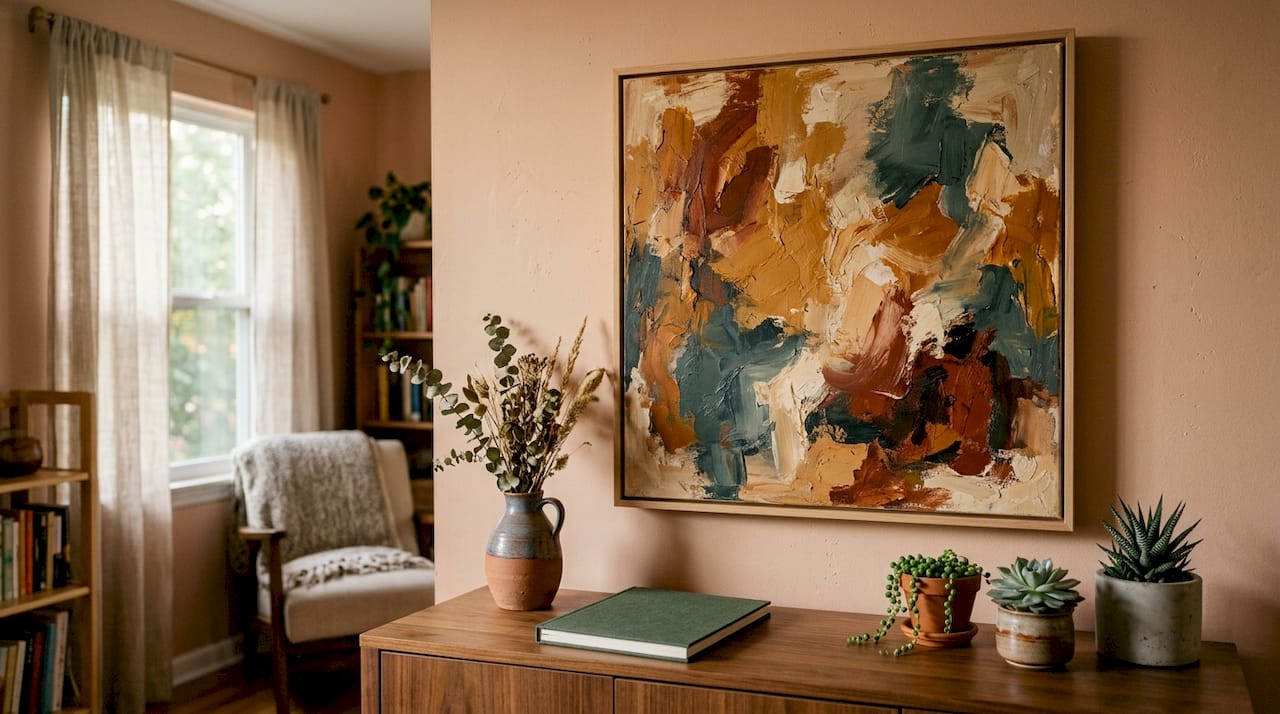
Warm tones such as ochre, terracotta, and burnt sienna raise energy levels and create a sense of welcome. They work particularly well in dining rooms and hallways, where you want guests to feel engaged from the moment they arrive. Cool palettes, including slate blue, sage, and soft grey, lower visual temperature and promote calm. These are the right choices for bedrooms and reading rooms. Layered neutrals, where cream, taupe, and warm white build on each other, suit open-plan living spaces because they hold the room together without competing with furniture.
Scale and spatial perception
A large canvas placed above a sofa or fireplace draws the eye immediately and anchors the entire seating arrangement. Smaller works, grouped in a considered cluster, can add rhythm to a narrow wall or staircase. The mistake most homeowners make is choosing art that is too small for the wall. A piece that floats without visual weight reads as an afterthought rather than a design decision.
Texture and surface quality
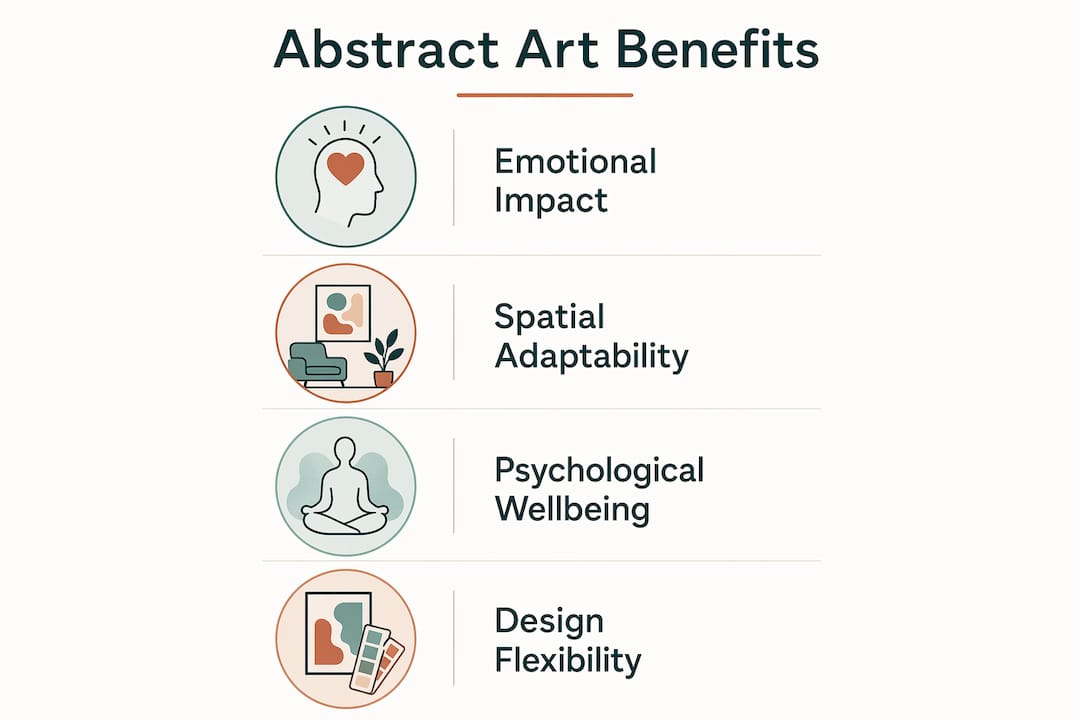
Hand-painted abstract artworks provide unique texture and depth that change their appearance with light and viewing angle. A print cannot replicate that. The physical presence of layered paint creates a living quality that shifts subtly throughout the day as natural light moves across the surface.
- Living rooms: bold, large-format abstracts in warm or contrasting tones to create a focal point
- Bedrooms: soft, gestural works in muted palettes to encourage rest and reflection
- Dining areas: mid-scale pieces with energetic brushwork to stimulate conversation
- Home offices: compositions with structured forms and cool tones to support focus
Pro Tip: Hang abstract art at eye level, with the centre of the piece sitting at approximately 145–150cm from the floor. This is the standard used in professional galleries and it works equally well in domestic spaces.
Does abstract art genuinely improve your wellbeing at home?
The answer is yes, and the evidence is specific. Engaging with art for 100 or more hours annually can improve wellbeing scores, reducing stress-related cortisol by 15–20% and mental strain by nearly 30%. That is not a marginal effect. It means that living with art you genuinely respond to has a measurable impact on how you feel each day.
Abstract art is particularly effective in this regard because it requires active participation. Unlike a photograph or a landscape painting, an abstract work does not hand you a meaning. You construct one yourself. That active interpretation cultivates mindfulness, reduces mental fatigue, and fosters psychological flexibility. The process of looking and finding your own response is itself a form of mental rest.
“Abstract art reduces cognitive load by offering mental space from digital noise, encouraging active viewer participation and slowing down the mind in ways that representational art rarely achieves.”
Neurological research adds another layer. Viewing original paintings evokes up to ten times greater emotional response than prints. That gap matters when you are choosing art for a home rather than an office corridor. Original works carry a physical and emotional presence that reproductions simply cannot match. If you want the full psychological benefit, the medium matters as much as the image.
Abstract art also builds what psychologists call tolerance for ambiguity, which is the ability to sit comfortably with open questions. That quality transfers directly into daily life. People who regularly engage with abstract art tend to approach problems with more flexibility and less anxiety. Living with art that invites interpretation, rather than delivering answers, trains that mental habit quietly and consistently.
For homeowners interested in the psychological impact of wall décor on daily mood, this body of evidence is worth taking seriously. The art on your walls is not passive decoration. It is an active part of your home environment.
How to select and position abstract art for maximum impact
Choosing abstract art for your home is more straightforward than most people expect. The process works best when you follow a clear sequence of decisions rather than browsing without criteria.
- Start with the wall, not the art. Measure the wall space before you look at anything. A wall that is 200cm wide needs a piece that is at least 100–120cm wide to hold visual weight. Going smaller creates imbalance.
- Choose by emotional response first. Stand in front of a piece and notice what you feel before you analyse what you see. Abstract art bypasses intellectual decoding and appeals directly to sensation and emotion. If a work makes you feel something within the first ten seconds, that is the right signal.
- Decide between a single large piece and a cluster. A single large-format abstract piece anchors a room better than multiple smaller pieces, creating calm and visual intention. Clusters work well in transitional spaces like hallways or on gallery walls where variety is the point.
- Consider viewing distance. Highly textured works reward close inspection. If your sofa sits three metres from the wall, a piece with bold colour blocking will read better at that distance than one with fine detail.
- Use vertical formats in narrow spaces. A tall, narrow canvas draws the eye upward and makes a low-ceilinged room feel taller. This is one of the most underused tricks in residential design.
- Match lighting to the work. Directional spotlights or picture lights bring out surface texture in hand-painted pieces. Flat overhead lighting flattens everything and reduces the visual impact of any artwork.
Pro Tip: If you are unsure whether a piece suits your space, photograph your room and use the image as a reference when browsing. Colour temperature in photographs is close enough to help you judge tonal compatibility before you commit.
Experienced designers use large, texturally rich abstracts as architectural anchors to organise living spaces visually and emotionally. That principle applies equally to a Victorian terrace and a new-build flat. The art does not need to match the architecture. It needs to hold its own within it.
For a broader guide on selecting wall art that suits your specific space and style, the principles of scale, tone, and emotional resonance apply across every format and budget.
Why abstract art remains relevant across every interior style
Abstract art does not belong to a single design era or aesthetic. That independence is its greatest practical advantage for homeowners. A minimalist flat in Shoreditch and a Victorian townhouse in Edinburgh can both carry abstract art convincingly, because the work does not compete with the architecture. It responds to it.
Abstract art’s emotional immediacy and openness invite personal interpretation, resonating more universally and timelessly than representational art. A landscape painting dates itself to a tradition. An abstract composition belongs to no tradition in particular, which means it never looks out of place.
- Minimalist interiors: a single large abstract in a restrained palette becomes the room’s only statement, which is exactly what minimalism requires
- Industrial spaces: raw, gestural abstracts with heavy texture complement exposed brick and concrete without softening the aesthetic
- Eclectic homes: abstract works act as visual mediators between mismatched furniture and periods, providing a unifying thread
- Modern new-builds: bold colour and geometric abstraction add warmth and personality to spaces that can otherwise feel clinical
Abstract art also invites freedom from literal narratives, giving homeowners a personal, evolving experience that aligns with how emotions and memories naturally change over time. A piece you chose five years ago can mean something entirely different today. That capacity for reinterpretation is something no figurative work can offer in the same way. It makes abstract art a genuinely long-term investment, not just in financial terms, but in emotional ones.
The compositional balance found in strong abstract works often reflects underlying mathematical structures that guide the viewer’s eye subconsciously. That hidden order is part of why well-made abstract art sustains interest over years rather than months. You keep finding new things in it. That quality is rare in decorative objects and almost impossible to replicate with prints or mass-produced wall coverings.
For homeowners who want to personalise their space through art, abstract work offers the widest creative latitude of any genre. You are not constrained by subject matter, period, or style. The only criterion that matters is whether the work speaks to you and fits the space.
Key takeaways
Abstract art suits homes because it combines emotional resonance, spatial adaptability, and measurable psychological benefits that no other decorative element consistently delivers.
| Point | Details |
|---|---|
| Colour drives mood | Warm palettes energise social spaces; cool tones calm bedrooms and reading rooms. |
| Scale anchors a room | A single large-format piece above 80x100cm creates visual intention better than clusters. |
| Original art outperforms prints | Neurological studies show original paintings produce up to ten times greater emotional response. |
| Active interpretation builds wellbeing | Engaging with abstract art reduces cortisol and builds psychological flexibility over time. |
| Abstract art suits every interior style | Its freedom from literal narrative makes it compatible with minimalist, industrial, and eclectic homes alike. |
Abstract art and the homes I have seen it transform
I have spent years watching homeowners make the same two mistakes with abstract art. The first is buying something that matches the sofa. The second is waiting until the room is “finished” before adding art. Both approaches treat art as an afterthought. The rooms that work best are the ones where the art came first and everything else was built around it.
The pieces that stay with people are never the ones they chose because they were safe. They are the ones chosen because something in the work felt true. Choosing abstract art is, at its best, an act of emotional honesty. You are not selecting a pattern. You are deciding what you want to feel when you walk into a room each morning.
What I find most underappreciated is the cumulative effect of living with a strong abstract work. In the first week, you notice the colours. In the first month, you notice the composition. After a year, you notice things you cannot quite name. That depth of engagement is what separates a piece of art from a decorative object. Most homes have plenty of the latter and not enough of the former.
My honest advice: buy the piece that makes you stop. Not the one that fits the colour scheme, not the one that seems like a sensible size. The one that makes you stand still for a moment longer than you expected. That response is not arbitrary. It is your nervous system telling you something worth listening to.
— Lennard
Frametheworld’s hand-painted abstract collections
Frametheworld offers two collections that demonstrate what original abstract art can do for a home interior. The Wabi Sabi wall art collection brings hand-painted texture and deliberate imperfection to living spaces, creating pieces that shift in character as light changes throughout the day. Each work carries the physical presence that prints cannot replicate. The Pop Art collection takes a bolder direction, with hand-painted retro and modern abstracts that suit confident, high-contrast interiors. Both collections are available in multiple sizes, and Frametheworld also offers bespoke options for homeowners who want a piece made for a specific wall or colour scheme.
FAQ
Why does abstract art work better in homes than prints?
Original abstract paintings produce up to ten times greater emotional response than reproductions, according to neurological research. The physical texture and layered paint of an original work also change appearance with light, giving the piece a living quality that flat prints cannot match.
What size abstract art suits a living room wall?
A piece of at least 80x100cm is the minimum for a standard living room wall above a sofa. Larger walls benefit from canvases of 120cm or wider to maintain visual weight and prevent the art from looking undersized.
How do I choose abstract art if I have no design background?
Choose by emotional response rather than by matching colours to furniture. Abstract art bypasses intellectual analysis and appeals directly to sensation, so the right piece is the one that makes you stop and look for longer than you expected.
Does abstract art suit minimalist interiors?
Abstract art is one of the strongest choices for minimalist spaces. A single large work in a restrained palette becomes the room’s defining statement, which aligns directly with the minimalist principle of deliberate, meaningful selection.
Can abstract art genuinely reduce stress at home?
Research shows that engaging with art for 100 or more hours annually can reduce stress-related cortisol by 15–20% and mental strain by nearly 30%. Abstract art is particularly effective because it requires active interpretation, which promotes mindfulness and reduces mental fatigue.

Leave a comment
This site is protected by hCaptcha and the hCaptcha Privacy Policy and Terms of Service apply.