

Selecting the right artwork can feel daunting when you want your living space to express more than just style. Abstract wall art introduces shapes, colours, forms, and gestural marks that speak directly to mood and atmosphere, rather than trying to copy the visible world. This unique approach makes it possible for homeowners and designers to create interiors that feel personal, modern, and alive. Discover how abstract pieces can transform your rooms with energy, calm, or vibrant colour perfectly matched to your vision.
Table of Contents
- Abstract Wall Art Defined And Explained
- Main Styles And Categories Of Abstract Art
- Key Visual Features And Artistic Techniques
- Role Of Abstract Wall Art In Interior Design
- Pitfalls And Mistakes To Avoid When Choosing
- Tips For Selecting And Displaying Abstract Art
Key Takeaways
| Point | Details |
|---|---|
| Understanding Abstract Art | Abstract wall art focuses on emotional expression through shapes and colours, rather than representational forms. This allows for personal interpretations and versatile interior applications. |
| Selecting the Right Style | Different abstract styles, such as Geometric Abstraction and Expressionism, evoke varying moods and should align with the intended atmosphere of the space. |
| Careful Display Choices | Proper scale, hanging height, and frame selection are crucial for maximising the impact of abstract art within a room’s design. |
| Emotional Resonance | Choose pieces that resonate with your desired emotional response for the space, ensuring long-term satisfaction with your art selection. |
Abstract wall art defined and explained
Abstract wall art stands apart from traditional representation because it doesn’t aim to capture what you see in the real world. Instead of painting a landscape or portrait, abstract artists use shapes, colours, forms, and gestural marks to create an effect that speaks directly to your emotions and senses. This approach strips away the need for accurate depiction, allowing the artwork to exist purely as a composition of visual elements. For homeowners and designers, this means you’re investing in something that communicates through colour relationships, spatial balance, and movement rather than narrative or representation.
The beauty of abstract work lies in what it emphasises. Rather than focusing on realistic detail, abstract artists prioritise form, colour, line, tone, and texture as the primary language of the piece. This shift occurred gradually through art history, developing through movements like Fauvism and Expressionism before reaching its fully realised form with pioneers like Kandinsky and Malevich in the early twentieth century. What this means for your space is that abstract pieces often convey a sense of order, purity, or spirituality that transcends what a literal image could express. A single abstract canvas can evoke calm through its colour palette or energy through dynamic brushwork, making it remarkably versatile for different rooms and moods.
When selecting abstract wall art for your home or design project, understanding these foundational principles helps you recognise quality work and identify pieces that genuinely resonate with your aesthetic. An effective abstract piece demonstrates intentional composition in how colours interact, how forms balance within the frame, and how the viewer’s eye moves through the composition. The flexibility of abstract work means it adapts beautifully to contemporary spaces, industrial interiors, minimalist homes, or maximalist environments seeking visual complexity. Whether you prefer bold geometric abstractions or expressive, gestural works, abstract art offers unlimited options for personalisation and customisation to match your exact vision.
Tip When browsing abstract pieces, consider the colour scheme of your existing furnishings and how warm or cool tones in the artwork will interact with your space, as this relationship significantly influences the overall atmosphere of the room.
Main styles and categories of abstract art
Abstract art isn’t one monolithic style. Instead, it encompasses many overlapping styles that evolved from the late 19th century onward, each with its own visual language and philosophical approach. Understanding these distinct categories helps you recognise what draws you to certain pieces and makes selecting artwork for your space a more informed decision. Whether you’re furnishing a contemporary apartment or designing a commercial office, knowing the difference between these movements allows you to curate cohesive collections that genuinely reflect your aesthetic vision.
The major abstract categories each take a different approach to composition and expression. Geometric abstraction relies on clean lines, shapes, and mathematical precision, creating ordered, structured compositions that convey calm and stability. Expressionism embraces emotional intensity through bold colour and gestural marks, often feeling raw and dynamic. Cubism breaks down objects into facets and reassembles them from multiple perspectives, creating complex layered compositions. Fauvism prioritises colour intensity and liberation from natural representation, using vivid, contrasting palettes to create visual impact. Abstract Expressionism combines the emotional spontaneity of Expressionism with pure abstraction, resulting in large-scale, immersive works. Minimalism strips composition to its essentials, using limited colour palettes and simple forms to create powerful, meditative pieces. Each style communicates differently, making them suitable for different spaces and moods within your home or commercial environment.
When selecting pieces for your walls, consider how different abstract styles interact with your space’s existing character. Geometric abstractions work beautifully in modern or minimalist interiors where their structured nature complements clean lines and open floors. Expressionist pieces bring energy to neutral spaces, whilst Minimalist works can ground busy environments or create breathing room in smaller areas. Understanding how to style large wall art across different abstract categories ensures your selections enhance rather than overwhelm your room. The flexibility of abstract forms means you can mix styles within a single space, creating visual interest through colour relationships and compositional contrast rather than competing narratives.
To help you distinguish between the main abstract art styles in interior design, here is a comparison table summarising their key approaches and effects:
| Abstract Style | Visual Approach | Mood Created | Best Suited Environments |
|---|---|---|---|
| Geometric Abstraction | Uses precise shapes and symmetry | Calm, ordered | Modern, minimalist rooms |
| Expressionism | Emphasises gestural marks and bold colour | Energetic, raw | Neutral or eclectic spaces |
| Cubism | Facets objects with multiple viewpoints | Complex, layered | Artistic or innovative settings |
| Fauvism | Highly saturated, vivid colour | Impactful, lively | Spaces needing a visual punch |
| Minimalism | Utilises simple forms, minimal colour | Meditative, open | Busy or small rooms |
| Abstract Expressionism | Large scale, spontaneous brushwork | Immersive, intense | Contemporary feature walls |
Tip Start by identifying which emotional response you want from your space—whether that’s calm order, energetic expression, or meditative simplicity—then select abstract styles that embody those qualities, as this emotional alignment ensures the artwork remains satisfying long-term.
Key visual features and artistic techniques
Abstract art communicates through a distinct visual language that operates entirely differently from representational work. Rather than depicting recognisable objects, abstract artists employ shapes, colours, forms, and gesture to convey emotions and ideas. This fundamental shift means that every element within the composition serves an expressive purpose. A single brushstroke, a colour transition, or the placement of a geometric form becomes laden with meaning. For homeowners selecting abstract pieces, this means you’re responding to visual elements in their purest form, without the distraction of narrative or subject matter competing for your attention.

The technical approaches artists use vary significantly, creating vastly different visual outcomes from the same fundamental principles. Simplification reduces complex forms to their essential shapes, creating clarity and impact. Distortion warps and stretches elements to amplify emotional intensity. Colour relationships become the primary communicative tool, with intense colours, dynamic brushstrokes, and textured surfaces working together to evoke specific responses. Geometric fragmentation breaks space into interlocking shapes that guide the viewer’s eye through the composition. Fluid brushwork embraces spontaneity and gesture, capturing movement and energy on the surface. Layering builds depth through overlapping transparent and opaque elements, creating visual complexity. Spontaneous mark-making prioritises the immediacy of the artist’s hand, with each mark remaining visible and intentional rather than blended into seamless surfaces.
When evaluating abstract pieces for your space, pay attention to how these techniques interact to create the overall effect. A work dominated by geometric shapes and limited colour palettes will feel ordered and contemplative, whilst one featuring bold gestural marks and varied textures will feel more dynamic and emotionally charged. The physical texture of the piece matters significantly—some abstract works employ thick impasto that creates actual dimensional surface, whilst others remain flat and graphic. Understanding these visual distinctions allows you to select pieces that genuinely align with both your aesthetic preferences and the atmosphere you want to create. Materials and processes take precedence in abstract work, meaning the how is often as important as the what, making craftsmanship and technique central to appreciating the finished piece.
Tip Examine abstract pieces in person when possible, as photographed images often fail to capture how light interacts with textured surfaces, how colours actually sit beside one another, and how the scale of the work impacts your emotional response to it.
Role of abstract wall art in interior design
Abstract wall art functions as far more than decoration in interior design. It operates as a powerful design element that shapes how a room feels, connects its various components, and communicates the personality of the space. Unlike representational art that draws attention to a specific subject matter, abstract pieces work with your existing furnishings, colour schemes, and architectural features rather than competing with them. When you select abstract wall art intentionally, you’re creating a visual anchor that influences everything from furniture arrangement to lighting choices. This strategic approach transforms a simple painting into a design decision that orchestrates the entire room’s aesthetic impact.
The versatility of abstract work makes it exceptionally valuable in interior design across different contexts. In a minimalist space, a single bold abstract piece can serve as the focal point, drawing the eye and preventing the room from feeling sterile or empty. In maximalist interiors saturated with pattern and colour, abstract works can act as visual breathing room, their non-representational nature allowing them to coexist peacefully with competing design elements. Art serves as a design anchor by establishing colour palettes that inform textile selections, accent wall decisions, and even furniture choices. Urban homeowners often use abstract pieces to bridge modern and traditional elements, whilst commercial designers leverage abstract work to create professional atmospheres that feel contemporary without dating quickly. The ability to customise abstract pieces means you can commission work specifically calibrated to your colour scheme, scale requirements, and stylistic vision rather than compromising on a ready-made option.
Abstract art also solves practical design challenges that representational work cannot. It works in corridors, kitchens, and bathrooms where representational subjects might feel awkward or dated. It complements any interior style from industrial to Scandinavian to maximalist, adapting rather than dictating aesthetic direction. Scale becomes less problematic with abstract work since composition matters more than subject recognition. A massive abstract canvas can dominate a living room wall without overwhelming viewers the way an enormous portrait might. Additionally, abstract pieces age gracefully because they don’t reference specific design trends or cultural moments, meaning your investment remains visually relevant across years and changing aesthetic preferences.
Tip Select your abstract piece before finalising paint colours and major furniture purchases, then use the artwork’s dominant and secondary colours as your design guide, ensuring every subsequent decision reinforces rather than contradicts the visual foundation your art establishes.
Pitfalls and mistakes to avoid when choosing
Selecting abstract wall art involves more than aesthetic preference. Many homeowners and designers make predictable mistakes that result in pieces that underperform in their spaces or fail to deliver the intended visual impact. The most common error is drastically underestimating scale. A painting that looks substantial in a gallery or online shop often appears lost on an actual wall, failing to command attention or establish presence. Selecting pieces too small for the space undermines the entire design strategy, leaving walls feeling bare and unfinished. Measure your wall carefully, then consider art that occupies at least 50 to 75 percent of the wall’s visual weight rather than something timid and undersized. Equally problematic is choosing abstract work in colours that clash with existing furnishings because you fell in love with the piece in isolation. A stunning cobalt blue abstract might be visually jarring against warm terracotta walls or create visual chaos alongside existing jewel tones.
Another critical mistake involves improper hang height and positioning. Hanging art at eye level or relative to furniture ensures the piece relates properly to the room’s architecture and furnishings. Too high and it becomes part of the ceiling rather than engaging with the space. Too low and it dominates uncomfortably. Poor lighting compounds these errors, especially with textured abstract work where surface qualities remain invisible in dim conditions. Many homeowners also neglect framing choices, treating them as afterthoughts rather than integral design decisions. The frame colour, material, and style either enhance or diminish your abstract work’s impact. A contemporary geometric abstract deserves a clean, simple frame, whilst an expressive gestural piece might benefit from something more substantial.
Style harmony deserves serious consideration before purchasing. Choosing abstract work that clashes with your room’s overall aesthetic creates visual discord rather than cohesion. An ultra-minimalist, austere geometric abstraction feels jarring in a maximalist space filled with pattern and texture, whilst a chaotic expressionist piece overwhelms a calm, serene Scandinavian interior. The mismatch between the art’s energy and your room’s intended mood disrupts the entire design scheme. Additionally, many people ignore the room’s practical function. A piece selected purely for its visual qualities might be entirely inappropriate for the space’s actual use. Calm, meditative abstract work suits bedrooms and home offices, whilst more dynamic, energetic pieces work better in living areas and entertaining spaces.
Tip Bring paint samples, fabric swatches, and photographs of your actual wall and furniture to any gallery visit or consultation, then view potential pieces against these materials under different lighting conditions to avoid colour and scale surprises.
Tips for selecting and displaying abstract art
Selecting abstract art requires a deliberate approach that balances emotional response with practical considerations. Start by considering the space itself rather than viewing pieces in isolation. Visit galleries or browse collections whilst thinking about your specific wall, existing colour schemes, and the room’s overall atmosphere. Ask yourself whether the piece energises or calms you, and whether that emotional quality aligns with the room’s intended function. A tranquil, meditative abstract work belongs in a bedroom or study, whilst a bold, kinetic piece suits a living area or workspace. Finding the painting that feels like home involves trusting your instinctive response whilst remaining strategic about scale, colour relationships, and how the piece will interact with existing furnishings. Consider commissioning bespoke abstract work through customisation options if you need something precisely calibrated to your space rather than compromising on ready-made alternatives.
Once you’ve selected your piece, display decisions determine whether it achieves its full impact. Hanging it at eye level creates proper engagement with viewers, typically placing the centre of the artwork approximately 1.5 metres from the floor. Frame selection matters tremendously and shouldn’t be an afterthought. The frame should complement rather than compete with your abstract work, enhancing its visual qualities through colour, material, and style choices. A sleek metal frame suits geometric abstractions, whilst natural wood works beautifully with expressive gestural pieces. Lighting transforms how abstract art appears throughout the day and evening. Proper illumination highlights textural elements, reveals colour nuances, and prevents the piece from disappearing into shadows. Consider dedicated picture lights or track lighting that targets the artwork without creating glare or harsh shadows.
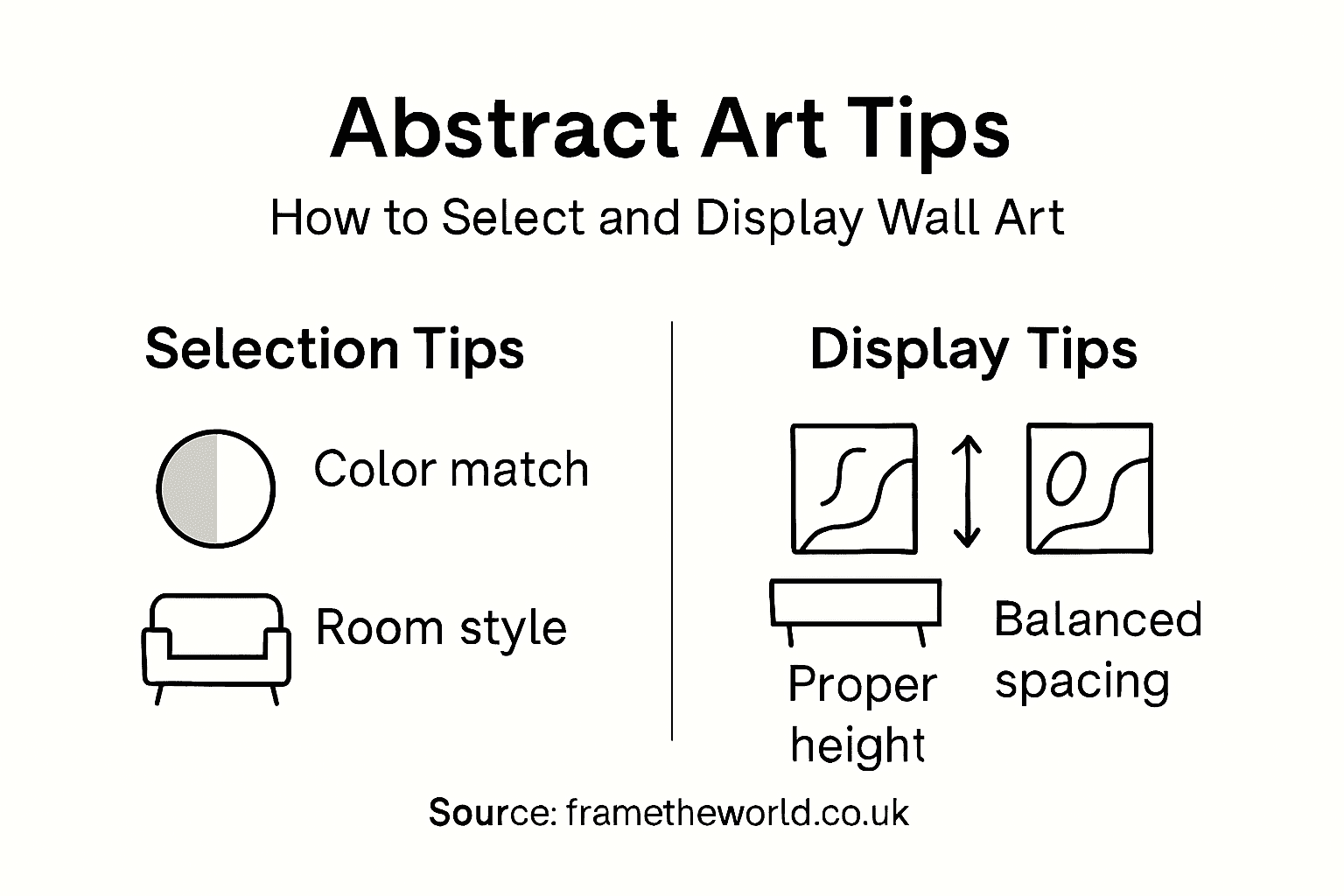
To guide your selection and display of abstract art, here is a summary table of practical considerations and their impact:
| Selection Aspect | Why It Matters | Potential Impact |
|---|---|---|
| Colour Harmony | Ensures cohesion with furnishings | Enhances or disrupts ambience |
| Scale & Proportion | Matches artwork to wall size | Creates presence or leaves gaps |
| Hanging Height | Engages viewer appropriately | Facilitates focus and flow |
| Frame Choice | Complements artwork style | Boosts or diminishes visual appeal |
| Lighting | Reveals texture and nuance | Accentuates or dulls colours |
When displaying multiple abstract pieces, composition and spacing determine whether they create cohesion or visual chaos. Consistent spacing between frames creates rhythm and intentionality, whilst varying sizes and orientations prevent monotony. Group thematically related pieces together whether by colour palette, style, or emotional tone, creating visual conversation between works. Large open walls benefit from substantial abstract pieces that command attention, whilst smaller pieces work better in grouped arrangements or gallery-wall configurations. The relationship between your abstract art and surrounding furniture deserves consideration. A bold abstract should relate proportionally to furniture groupings, anchoring the space rather than floating disconnectedly. Step back regularly to assess how the displayed piece functions within the complete room composition, adjusting placement or lighting if the impact feels off.
Tip Take photographs of your space with your selected abstract piece positioned at different locations and heights, then view these images on your phone or computer where you can assess the overall composition without the distraction of being physically present in the room.
Discover the Transformative Power of Abstract Wall Art for Your Space
Choosing the right abstract wall art can be challenging when balancing scale, colour harmony, and emotional impact as explained in our article. You want artwork that not only complements your room but also sets the desired mood—whether calm, energetic, or meditative. Many find it difficult to visualise how a piece will engage with existing furnishings and lighting or worry about selecting works that feel timeless rather than trendy. Understanding styles like Geometric Abstraction or Abstract Expressionism is crucial but applying that knowledge practically requires trusted guidance.
At Frametheworld.co.uk, we offer an extensive collection of high-quality abstract pieces ready to elevate your interiors. Benefit from our customisation options to personalise artworks that perfectly match your colour palette and spatial needs. Our platform supports private customers and professional designers alike, ensuring you select art that works harmoniously with your environment. Begin your journey toward creating spaces with intentional impact today by browsing our curated selections or commissioning bespoke abstract art designed to enhance your unique vision. Explore how expertly chosen abstract art can transform your interior now.
Frequently Asked Questions
What is abstract wall art?
Abstract wall art is a form of art that doesn’t depict recognizable objects or scenes. Instead, it uses shapes, colours, and forms to evoke emotions and create visual experiences.
How can I choose the right abstract wall art for my space?
To choose the right abstract wall art, consider the existing colour scheme, furniture style, and the emotional atmosphere you want to create in the room. Look for pieces that resonate with your personal aesthetic while also balancing the space.
What are the main styles of abstract art?
The main styles of abstract art include geometric abstraction, expressionism, cubism, fauvism, abstract expressionism, and minimalism. Each style communicates different emotions and aesthetics, making them suitable for various environments and moods.
How should I display abstract wall art in my home?
When displaying abstract wall art, hang it at eye level for the best visual engagement, choose a frame that complements the piece, and ensure there is adequate lighting to highlight its features. Consider the scale of the artwork and how it interacts with surrounding furnishings.


Leave a comment
This site is protected by hCaptcha and the hCaptcha Privacy Policy and Terms of Service apply.