
Most bespoke wall art takes between 6 and 20 weeks from order to installation, depending on size, medium and framing. The single rule worth memorising: find the longest-lead item in your order (usually the framing or a large hand-painted panel), add a buffer of 4 to 6 weeks, then count backwards from your installation date to fix your order deadline.
TL;DR:
- The longest lead times usually come from bespoke framing or large hand-painted panels, requiring an additional four to six weeks beyond the core production schedule.
- Small bespoke pieces with straightforward approval processes typically take six to ten weeks, while large or site-specific works often extend to several months or up to a year.
- Most delays stem from approval cycles, custom framing, and international shipping, especially when customs or site constraints cause additional setbacks.
- Scheduling should start by fixing the installation date, then working backwards to order the longest-lead item and adding buffers to prevent missed deadlines.
- Speeding up projects can be achieved with in-stock options, simplified approvals, and rush services, but each shortcut comes with trade-offs in cost or complexity.
Table of Contents
- What is the typical lead time for commissioned art?
- What happens at each stage from brief to installation?
- What makes lead times longer or shorter?
- How do you schedule a commission backwards from installation day?
- Can you shorten a commission’s lead time?
- How Frametheworld manages the commissioning schedule
- Why the “quoted lead time” is rarely the real one
- Start a commission with Frametheworld
- Sources
- FAQ
What is the typical lead time for commissioned art?
Small commissioned pieces move fastest. A single hand-painted canvas at standard dimensions, ordered with a straightforward brief and no revision rounds, often lands somewhere between 6 and 10 weeks. What shortens that window is decisiveness: approve the sample on first review, pick a stock frame, and skip the second round of sketches.
Medium and large works behave differently. Oversized canvases, multi-panel pieces, or anything painted specifically for a stairwell or reception wall commonly take multiple months, and site-specific commercial installations can take longer. Luxury commissioning guidance puts full bespoke art projects anywhere from a few months to a year, with simpler works on paper finishing in under three months.
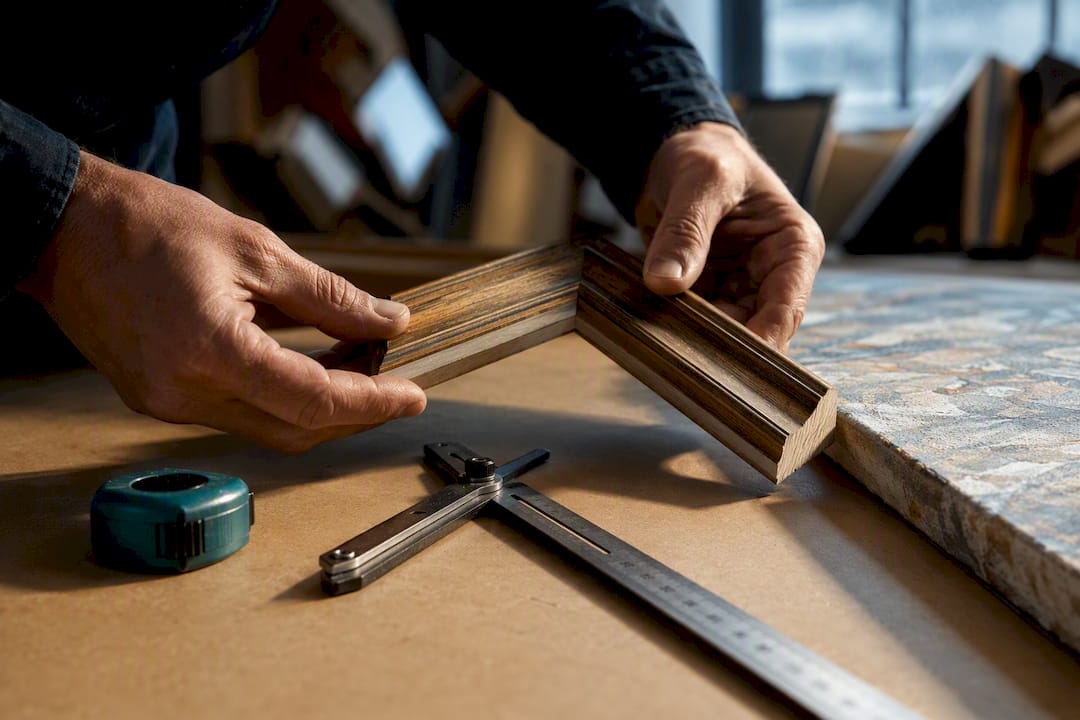
Framing decides more of the timeline than most buyers expect. A stock frame profile in a standard size can be fitted relatively quickly once the canvas is finished. A bespoke frame, cut to an unusual panel size or in a specific moulding, adds its own production queue on top of the artwork itself, and that queue often starts only once the artwork’s final dimensions are confirmed, not when the order is placed.
What happens at each stage from brief to installation?
Breaking a commission into phases shows exactly where the weeks go, and where you have some control over the pace.
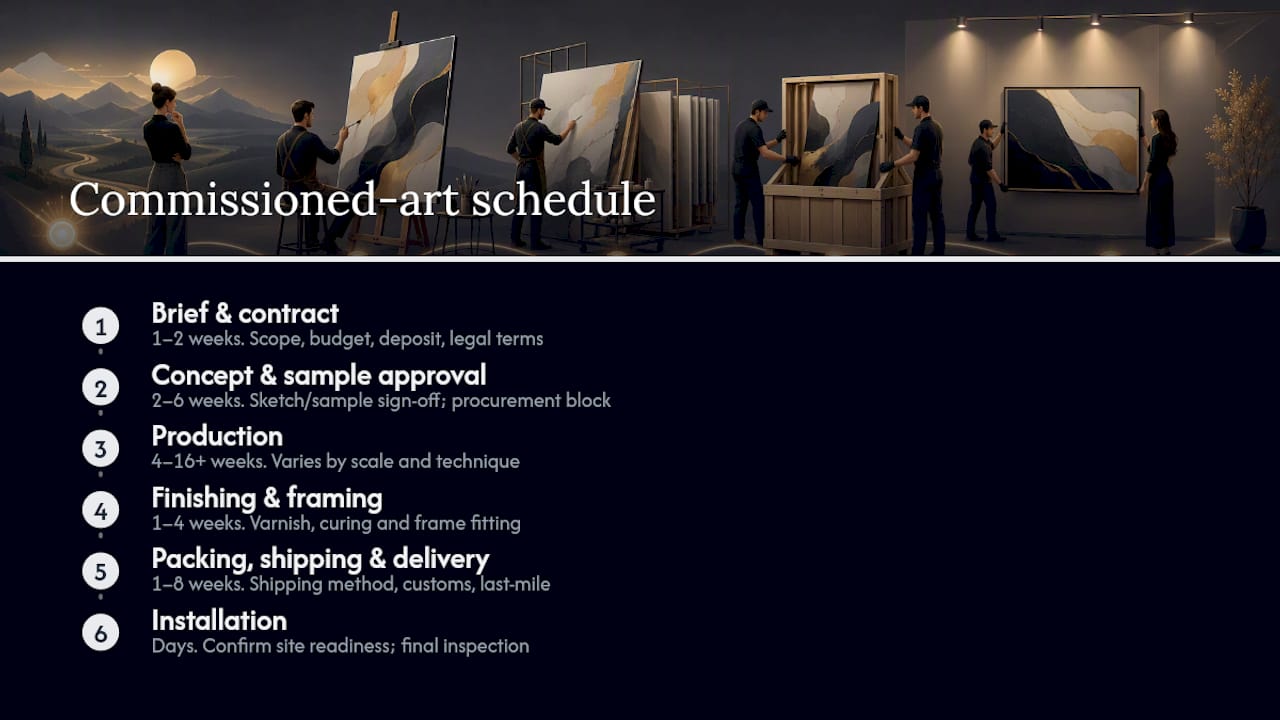
Brief and contract (1 to 2 weeks). Scope, budget, deposit and delivery date get agreed here. This is also where a kill-fee clause and inspection rights should go into writing, not left as a verbal understanding.
Concept and sample approval (2 to 6 weeks). Sketches or a painted sample go to you for sign-off. Procurement guidance for custom categories consistently shows this phase eating 2 to 6 weeks, and FF&E sourcing practice treats it as a distinct block that sits before, not inside, the quoted production window.
Production (4 to 16+ weeks). Hand-painted work on canvas varies hugely by scale and technique. A single artisan working a large multi-layer piece can easily need 16 weeks; a smaller commission might clear production in four.
Finishing and framing (1 to 4 weeks). Varnishing, curing and frame fitting all add time here, and custom furniture and bespoke manufacture guidance flags finishing as one of the most underestimated stages in any bespoke schedule.
Packing, shipping and delivery (1 to 8 weeks). Origin, shipping method and, for international orders, customs clearance all factor in. A furniture and interiors lead-time guide notes that quoted production windows commonly start from an approved sample, with shipping and last-mile delivery added afterwards, not folded into the production quote.
Installation (days, but plan the access). Confirm site readiness, book installers, and build in a final inspection before sign-off.
What makes lead times longer or shorter?
A handful of factors decide whether your project sits at the tight end of the range or the long one:
- Production queue and season: studios and manufacturers work through orders in sequence, and peak periods (autumn refits, pre-Christmas retail launches) push new orders further back.
- Customisation depth: multi-panel works, unusual aspect ratios and complex textured finishes all add fabrication time.
- Framing complexity: a bespoke frame dependent on a separate supplier is very often the true critical-path item, not the painting itself.
- International sourcing: cross-border shipments can face customs delays, particularly post-Brexit for goods moving between the UK and the EU.
- Approval rounds: every additional revision cycle adds a full sample-and-review loop, typically 2 to 4 weeks each time.
- Site constraints: restricted access, lift bookings, or working around other trades on a commercial site can delay the final fit even after the artwork itself is ready.
How do you schedule a commission backwards from installation day?
Set your installation date first, then work backwards. This is standard practice in FF&E procurement for hotel and commercial projects, where the longest-lead item gets ordered first and everything else is sequenced around it.
- Fix the installation date. Everything else is calculated from this fixed point.
- Identify the longest-lead item. Usually the largest painted panel or the bespoke frame, whichever quotes the longer window.
- Add a buffer. A widely used planning rule is to add 4 to 6 weeks, or a percentage buffer, on top of any quoted lead time.
- Place the longest-lead order first, then run sample approvals for smaller items in parallel rather than in sequence.
- Set milestone checkpoints: initial brief sign-off, sample approval, a midway production check, and a pre-shipment inspection before the piece leaves the studio.
- Write the contract to match: dates, sign-off windows, a kill-fee clause and your right to inspect before dispatch all belong in writing.
Pro Tip: Ask your supplier for a lead-time matrix, one line per item with its quoted window, so you can see the critical path at a glance instead of chasing separate quotes by email.
Can you shorten a commission’s lead time?
Yes, though every shortcut trades something. Stock or quick-ship prints, and smaller hand-painted pieces held in limited sizes, can cut weeks off the schedule because there’s no production queue to join. Fixing your approvals to a single revision round, rather than leaving them open-ended, removes an entire sample cycle. Choosing an in-stock frame profile instead of a bespoke one avoids a second supplier’s lead time altogether. Paid rush production and premium shipping exist too, usually at a cost premium, and they buy time rather than remove it from the process.
How Frametheworld manages the commissioning schedule
Commissions can be managed with milestone reviews: an initial brief, sample approval, and a check before a piece ships, rather than a single quote-and-wait model. At enquiry, we ask for your installation date, dimensions, preferred palette and any site photos, because that information sets the schedule from day one rather than adding delay later. Our large-scale art planning guide covers how designers typically brief a site-specific piece.
Why the “quoted lead time” is rarely the real one
Here’s what most buyers get wrong: they treat the number a studio quotes as the finish line, when it’s actually the starting gun for production, measured from an approved sample rather than from the order date. That single misunderstanding accounts for more missed installation dates than any actual production delay. A quoted 10 week lead time that doesn’t account for a 3 week approval cycle beforehand, plus a bespoke frame ordered separately, easily becomes 16 weeks in practice, and nobody lied to you. The number was just measured from a different starting point than you assumed.
The fix isn’t more patience. It’s asking the blunt question at enquiry stage: does this quote start now, or does it start once I approve a sample? Buyers who ask that question and build in a buffer rarely miss their date. Buyers who don’t, routinely do, then blame the studio for something that was actually a scheduling gap on their side.
— Lennard
Start a commission with Frametheworld
Commissions can be built around your dimensions and installation date, with custom sizing, hand-painted ranges and options for framing suitable for various projects. Before you enquire, have your wall dimensions, target installation date, preferred palette and, ideally, a couple of site photos ready. That single package of information is what lets a studio quote you a realistic schedule rather than a best-case one.
Two collections worth browsing first: the Wabi Sabi Wall Art range, hand-painted with abstract texture and available to customise or commission outright, and the Pop Art collection, which offers bold hand-painted pieces in custom sizes and framing. Browse either, note what’s close to your brief, and send us your dimensions and date to get a schedule back.
Sources
- Furniture lead times guide for interior designers (2026)
- FF&E lead times by category: order sequencing for hotel projects
- Commissioning a living artist: the brief, the timeline, and what to expect when the work arrives
FAQ
How long does a typical art commission take?
Most bespoke wall art takes 6 to 20 weeks from order to installation, depending on size, medium and whether framing is bespoke or stock.
Does the lead time include shipping and framing?
Yes. A realistic lead time covers sample approval, production, finishing, framing, packing, shipping and final delivery, not just the painting itself.
What is the single best rule for scheduling a commission?
Identify the longest-lead item in your order, add a 4 to 6 week buffer, and count backwards from your installation date to set your order deadline.
Why do quoted lead times sometimes run over?
Quoted production windows commonly start from an approved sample, not from the purchase order, so an unaccounted sample approval cycle is the most common cause of schedule slippage.
Can I speed up a commissioned art order?
Stock or quick-ship prints, fixed single-round approvals and in-stock framing all cut time, while paid rush production and premium shipping can compress the schedule further at extra cost.



Leave a comment
This site is protected by hCaptcha and the hCaptcha Privacy Policy and Terms of Service apply.