

TL;DR:
- Eco-friendly art emphasizes using recycled, natural, and low-toxicity materials while critiquing consumption and ecological issues. It incorporates conceptual themes like ecological grief and social intervention, exemplified by Joseph Beuys’s socially engaged projects. Major art institutions now adopt measurable standards and renewable practices to promote genuine sustainability and combat greenwashing in the art world.
Eco-friendly art is defined as artwork created with environmental responsibility at its core, covering both the materials used and the ideas explored. Known formally as sustainable art or eco art, it operates across two distinct dimensions: material and conceptual sustainability. On the material side, artists choose recycled, biodegradable, or low-toxicity supplies over conventional alternatives. On the conceptual side, works question consumption, ecological grief, and civilisational fracture. German artist Joseph Beuys pioneered this dual approach decades ago, treating art as social and ecological intervention rather than decorative object. The Venice Biennale has since carried that spirit into institutional practice, while growing awareness of volatile organic compounds (VOCs) in standard paints has sharpened the conversation around studio health and environmental impact.
What materials and techniques define eco-friendly art?
Eco-friendly art materials are those that reduce chemical output, avoid virgin resource extraction, and minimise waste across the full production cycle. Sustainable art practices commonly recommend water-based paints, natural pigments derived from plants or minerals, plant-based binders, and reclaimed or found objects as primary media. These choices lower the chemical burden on both the artist and the surrounding environment without sacrificing expressive range.
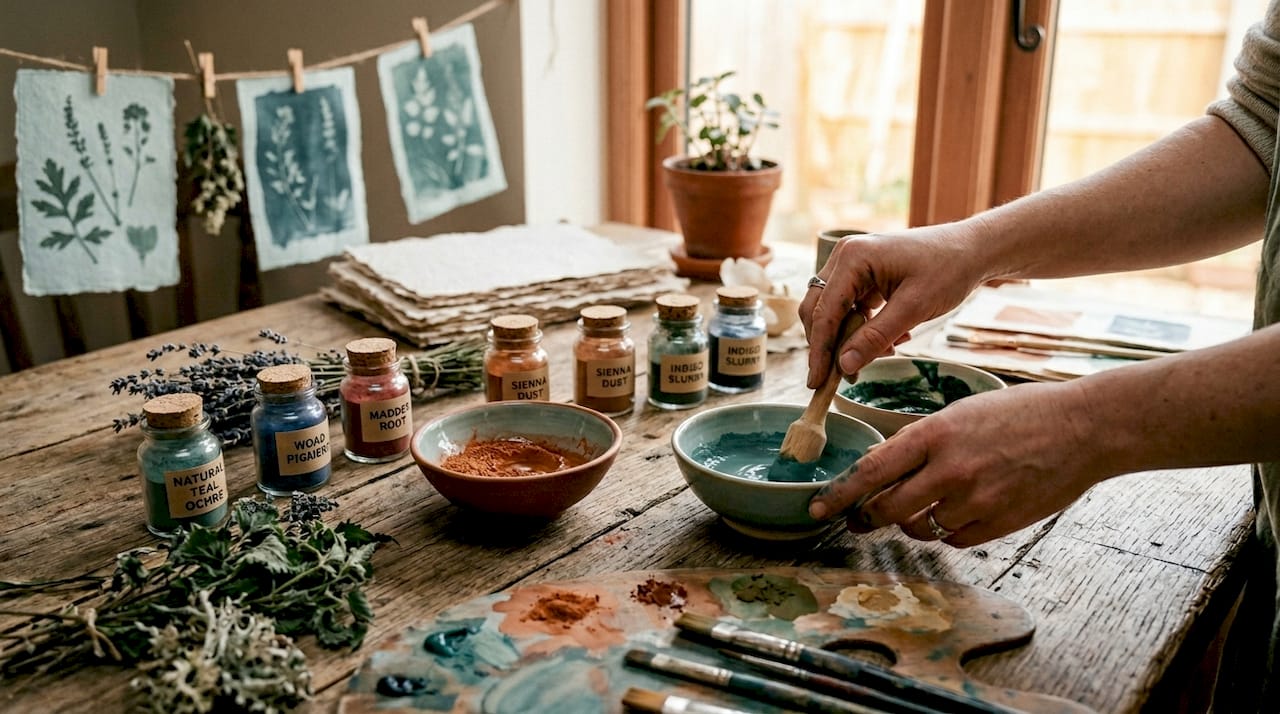
The contrast with conventional materials is significant. Standard oil paints rely on petroleum-derived solvents that off-gas long after the work is finished. Acrylic mediums often contain synthetic polymers that shed microplastics when washed down studio drains. Natural alternatives such as egg tempera, watercolour with plant-based pigments, or encaustic wax made from beeswax sidestep many of these issues while producing surfaces with their own distinctive character.
Beyond pigment choice, studio workflow matters as much as individual materials. Zero-waste approaches include cutting canvas from full rolls to avoid offcuts, repurposing failed works as collage substrate, and keeping a running inventory to prevent over-purchasing. These methods reduce both financial and environmental cost simultaneously.
Eco-friendly vs conventional art materials at a glance
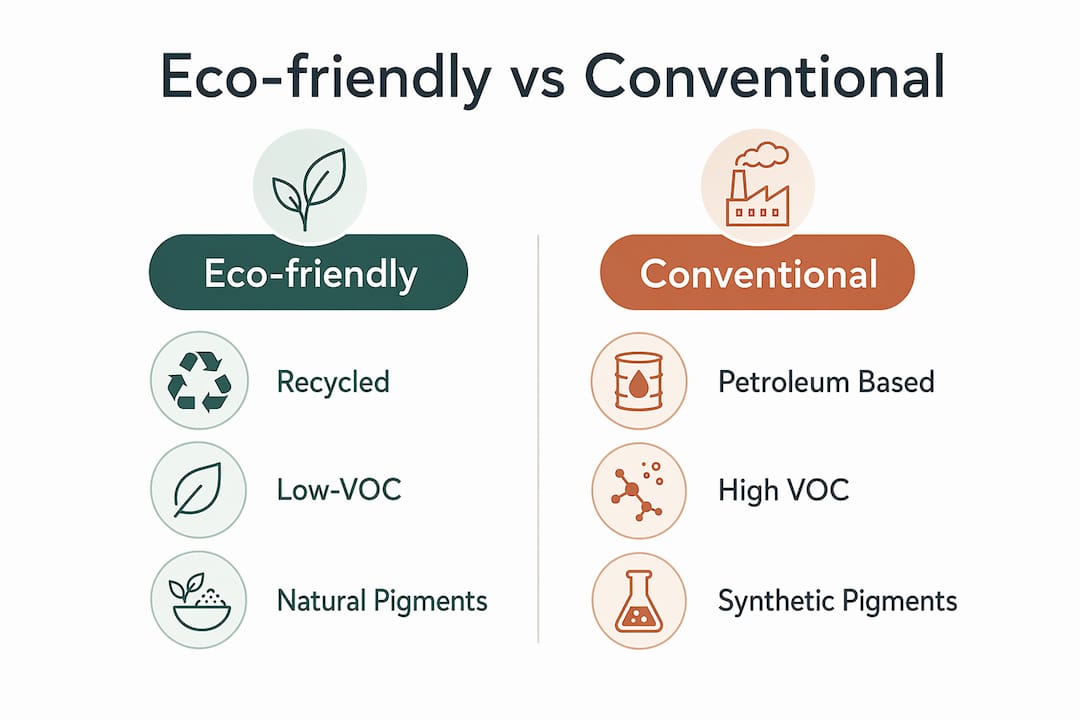
| Material type | Conventional option | Eco-friendly alternative |
|---|---|---|
| Paint medium | Oil paint with mineral spirits | Water-based or plant-binder paint |
| Pigment source | Synthetic petroleum-derived | Natural plant or mineral pigment |
| Support surface | Virgin cotton or linen canvas | Reclaimed fabric or recycled board |
| Adhesive | Solvent-based glue | Water-based or starch paste |
| Finishing coat | Solvent varnish | Water-based or beeswax finish |
Key material choices for eco-conscious artists include:
- Recycled and reclaimed supports: salvaged wood panels, repurposed cardboard, and second-hand frames reduce demand for new raw materials.
- Natural dyes and pigments: ochres, madder root, indigo, and charcoal have been used for centuries and biodegrade without toxic residue.
- Water-based mediums: acrylic, gouache, and watercolour in water-based formulations eliminate solvent disposal problems.
- Biodegradable packaging: when selling or shipping work, recycled tissue, cardboard, and paper tape complete the sustainability chain.
Pro Tip: When sourcing paints, look for products that publish a full ingredient list rather than relying on marketing language alone. Brands that disclose their formulations give you the information needed to make a genuinely informed choice.
How do art supplies affect indoor air quality and health?
VOC concentrations during painting can spike up to 1,000 times outdoor levels, making indoor air quality a central concern for any artist working in an enclosed studio. This figure is not an edge case. It reflects standard conditions when using conventional solvent-based paints in a room with average ventilation. The practical threshold for safer choices is low-VOC paint at under 50 g/L or zero-VOC paint at under 5 g/L.
The problem is that zero-VOC labels are not uniformly regulated. A 2023 study by the Healthy Building Network found that approximately 50% of tested paints, including some carrying zero-VOC claims, contained per- and polyfluoroalkyl substances (PFAS). PFAS are persistent chemicals linked to hormonal disruption and immune system effects. Their presence in products marketed as eco-friendly represents a significant gap between label and reality.
Certifications offer a more reliable signal than self-declared marketing claims. Green Seal GS-11 is one of the most rigorous third-party standards for architectural and decorative coatings, requiring both low VOC content and restrictions on hazardous ingredients including PFAS. When a product carries this certification, it has been independently verified rather than self-assessed.
Surface coatings contribute around 30% of anthropogenic VOC emissions in the United States, which illustrates the cumulative scale of the problem when multiplied across millions of studios, homes, and commercial spaces. For individual artists, the implication is clear: material choices aggregate into measurable environmental and public health outcomes.
Practical steps for reducing VOC exposure in the studio:
- Choose water-based formulations wherever the technique allows.
- Open windows and use a fan to create cross-ventilation during and after painting sessions.
- Store opened paint containers in sealed bags to reduce off-gassing between sessions.
- Check for third-party certifications such as Green Seal GS-11 or GREENGUARD Gold before purchasing.
- Avoid tinting white zero-VOC bases with standard colourant systems, which often reintroduce VOCs at the mixing stage.
Pro Tip: Ventilation is not optional when working with any paint, even water-based products. A simple box fan positioned to push air out of a window creates a meaningful reduction in airborne VOC concentration within minutes.
What role does conceptual sustainability play in eco-friendly art?
Conceptual sustainability treats art as a form of cultural diagnosis rather than decoration. Sustainability in art must be considered holistically, integrating environmental, social, and economic factors rather than focusing solely on recycled content or visual aesthetics. This is the dimension that separates eco-friendly art from simply making things out of cardboard.
Joseph Beuys articulated this most forcefully through his concept of “social sculpture,” arguing that every human action shapes the social and ecological fabric of the world. His 1982 project 7000 Oaks, in which he initiated the planting of 7,000 oak trees across Kassel, Germany, was simultaneously a public artwork, an ecological act, and a critique of urban indifference to the natural world. The work did not hang on a wall. It grew.
Contemporary artists working with microplastic collages demonstrate how material symbolism engineers audience cognition, guiding viewers from initial aesthetic appreciation through gradual recognition of pollution to something closer to disgust. This emotional arc is more effective at shifting environmental behaviour than factual messaging alone. The material is the argument.
“Eco-friendly art is most impactful when it embraces ambiguity and contradiction rather than striving for moral purity, deepening emotional engagement with sustainability challenges.”
This insight matters for collectors and enthusiasts as much as for artists. A work that makes you uncomfortable, that holds two contradictory truths at once, is doing more ecological work than a painting of a forest made from recycled paper. The conceptual dimension of what is sustainable art asks not just how a work was made, but what it asks of its audience.
How are major art events promoting eco-friendly practices?
The Venice Biennale’s San Giacomo island now operates on 100% onsite renewable energy, using solar panels, heat pumps, and biofuel generators while remaining entirely disconnected from external utilities. This configuration cuts CO2 emissions by up to 90% compared to grid-connected equivalents. For an event of the Biennale’s scale, that figure represents a genuine structural commitment rather than a symbolic gesture.
Measurable standards are emerging at the exhibition level as well. The Sustainable Creations Exhibition, run by Fallbrook Art Center, requires that at least 60% of materials in submitted works be reclaimed or recycled. This threshold transforms eco-friendly from a vague aspiration into an auditable criterion. It also creates a useful benchmark for artists preparing work for submission and for collectors evaluating provenance.
Eco-friendly art event initiatives: a comparison
| Initiative | Organisation | Key metric |
|---|---|---|
| San Giacomo island energy | Venice Biennale | 100% onsite renewable energy, up to 90% CO2 reduction |
| Sustainable Creations Exhibition | Fallbrook Art Center | Minimum 60% reclaimed or recycled materials required |
| Ecological restoration projects | Various public art programmes | Participatory planting and habitat creation as artwork |
Greenwashing remains a real concern within the art world. Some institutions publicise sustainability credentials while continuing to fly artists and works internationally, generating carbon footprints that dwarf any savings made through recycled exhibition materials. The most credible initiatives address the full operational picture, from logistics and energy to catering and waste, rather than focusing on one visible metric. For eco-conscious collectors and enthusiasts, asking about an institution’s full carbon accounting is a reasonable and increasingly expected question.
Key takeaways
Eco-friendly art requires both material rigour and conceptual depth to deliver genuine environmental and cultural impact.
| Point | Details |
|---|---|
| Two core dimensions | Sustainable art combines material choices (recycled, low-VOC, natural pigments) with conceptual critique of consumption. |
| VOC and PFAS risk | Paint VOCs can reach 1,000 times outdoor levels indoors; zero-VOC labels do not guarantee PFAS-free formulations. |
| Certification over labels | Green Seal GS-11 and published ingredient disclosures are more reliable than self-declared eco-friendly marketing claims. |
| Conceptual power | Artists like Joseph Beuys and microplastic collage makers show that material symbolism shifts behaviour more effectively than facts alone. |
| Institutional standards | The Venice Biennale and Fallbrook Art Center demonstrate that measurable, auditable criteria separate genuine eco practice from greenwashing. |
Why eco-friendly art is more than a trend: Lennard’s view
I have spent years watching “eco-friendly” become a marketing adjective applied to almost anything with a leaf on the label. What strikes me about the best sustainable art is that it refuses that comfort. Joseph Beuys did not plant 7,000 trees to make his studio practice look responsible. He did it because he understood that art’s real medium is human attention, and that attention, directed well, changes things.
The material science matters enormously. Knowing that VOC concentrations can reach 1,000 times outdoor levels during a painting session should change how every artist sets up their workspace. Knowing that half of tested zero-VOC paints contain PFAS should change how every collector thinks about the works they bring into their homes. These are not abstract concerns. They are immediate, practical, and largely ignored by the mainstream art market.
What gives me genuine optimism is the emergence of quantitative standards. When an exhibition requires 60% reclaimed materials as a submission criterion, it creates a floor. It makes the conversation specific. And specificity is where real progress happens, not in vague commitments to “greener practices” but in auditable numbers and disclosed ingredients.
The going green conversation in art is maturing. The next step is for collectors and enthusiasts to demand the same transparency from galleries and platforms that they are beginning to demand from food producers and fashion brands. Art that is genuinely eco-friendly will welcome that scrutiny. Art that is merely eco-adjacent will not.
— Lennard
Discover hand-painted eco-conscious art from Frametheworld
If this article has sharpened your eye for what genuine eco-friendly art looks like, Frametheworld’s wabi sabi wall art collection is worth exploring. Each piece is hand-painted, embracing the wabi sabi philosophy of imperfection, natural texture, and material honesty. These are not mass-produced prints. They are works made with the kind of deliberate, considered process that sustainable art practice demands. Frametheworld also offers expert interior design guidance to help you place eco-conscious art in your home in a way that feels considered rather than incidental. Supporting artists and platforms aligned with these values is one of the most direct ways to put the principles in this article into practice.
FAQ
What is eco-friendly art?
Eco-friendly art, also called sustainable art or eco art, is artwork created using environmentally responsible materials and practices, often combined with conceptual themes that critique consumption and ecological harm. It covers both how a work is made and what it communicates.
What materials are used in sustainable art?
Common sustainable art materials include water-based paints, natural plant and mineral pigments, reclaimed or recycled supports, biodegradable adhesives, and found objects. These choices reduce VOC emissions, avoid toxic solvents, and minimise waste across the production process.
Are zero-VOC paints genuinely safe for artists?
Not necessarily. A 2023 Healthy Building Network study found that approximately 50% of tested paints, including some zero-VOC labelled products, contained PFAS chemicals. Third-party certifications such as Green Seal GS-11 offer a more reliable indicator of genuinely low-toxicity formulations.
How does conceptual sustainability differ from material sustainability in art?
Material sustainability focuses on what a work is made from, while conceptual sustainability addresses what a work asks its audience to think and feel about ecological and social issues. Artists like Joseph Beuys demonstrated that art can function as direct ecological intervention, not merely as an object made from responsible materials.
How can I tell if an artwork or exhibition is genuinely eco-friendly?
Look for auditable criteria rather than vague claims. The Fallbrook Art Center’s Sustainable Creations Exhibition, for example, requires a minimum of 60% reclaimed or recycled materials. For individual works, ask for material disclosures and check whether any certifications are third-party verified rather than self-declared.


Leave a comment
This site is protected by hCaptcha and the hCaptcha Privacy Policy and Terms of Service apply.