

TL;DR:
- Custom prints are designed to fit specific space, size, and mood, providing unique wall art solutions.
- Clear briefs, mockups, and communication are essential to ensure satisfaction and prevent delays.
- Building good relationships with providers enhances project success and emotional impact.
Off-the-shelf wall art has a way of making spaces feel like they belong to nobody in particular. You’ve seen it: the same abstract canvas in a hundred hotel lobbies, the same botanical print in a dozen living rooms. Custom prints solve this completely. A bespoke piece is designed around your specific dimensions, colour palette, and mood, meaning it fits your space rather than forcing your space to fit around it. This guide walks you through every stage of the commissioning process, from writing your first brief to hanging the final print, with practical steps for both homeowners and professional interior designers.
Table of Contents
- Understanding custom prints and your project goals
- What you’ll need: planning materials, decisions, and specifications
- Commissioning step-by-step: from brief to final print
- Common pitfalls and how to avoid them
- Our take: what most guides miss about custom print commissions
- Ready to commission your own custom print?
- Frequently asked questions
Key Takeaways
| Point | Details |
|---|---|
| Define your vision | Clarifying your project’s goals, preferences, and measurements ensures a smooth custom print process. |
| Gather required information | Prepare all specifications, images, and details up front to avoid costly changes and delays. |
| Follow commissioning steps | Move through mockups, sign-off, and production in order for professional results and fewer frustrations. |
| Avoid common pitfalls | Review proofs carefully and maintain communication to achieve the best possible outcome with your custom print. |
| Value the collaboration | Working closely with your artist or print service can make a crucial difference to the final piece. |
Understanding custom prints and your project goals
Before you speak to a single artist or print studio, it helps to understand what the term actually covers. Custom prints is a broad category. It includes bespoke art reproductions, where an existing original artwork is reproduced to your specified size and material. It includes original digital artworks created from scratch to your brief. And it includes collaborative pieces, where you work directly with an artist to develop something entirely new. Each route has different timelines, costs, and creative outcomes.
The settings for custom prints are equally varied. Homeowners commission pieces for living rooms, hallways, and bedrooms, often wanting something that reflects a personal memory or a specific colour story. Interior designers order custom prints for entire schemes, coordinating multiple pieces across a hospitality project or commercial office fit-out. The scale changes, but the core process remains the same.
The most important thing you can do before commissioning is clarify your brief. Ask yourself these questions before picking up the phone or filling in an online form:
- What wall or space is this for, and what are the exact dimensions?
- What mood or atmosphere should the artwork create?
- What colours are already present in the room, and should the print complement or contrast them?
- What material do you want: paper, canvas, metal, or giclée?
- What is your realistic budget, including framing and installation?
- Do you have a deadline, such as a project handover or a housewarming?
“A well-defined brief is the single biggest factor in a successful commission. The more specific you are about size, style, and intended atmosphere, the less room there is for costly misunderstandings.”
The commissioning art process works best when you use workflows involving mockups and prototypes, especially for giclée reproductions from originals. This is not just a professional designer’s concern. Homeowners who personalise their home with artwork consistently report greater satisfaction with the result when they invest time in the brief upfront. Generic décor fills a wall. Tailored artwork changes the feeling of a room entirely.
What you’ll need: planning materials, decisions, and specifications
Once you know your objectives, gather all the information and decisions needed for a smooth commission. Walking into the process without this prepared is the fastest way to cause delays and unexpected costs.
Here is a checklist of what to have ready:
- Accurate wall measurements (width and height in centimetres)
- Reference images or a mood board showing styles you respond to
- Your preferred material: fine art paper, stretched canvas, metal print, or giclée
- Desired finish: matte, satin, or gloss
- Mounting or framing preference: framed, unframed, mounted, or float-mounted
- File format requirements if you are supplying your own image (typically TIFF or high-resolution JPEG)
- Budget range and any hard deadlines
The table below shows the key decisions and why each one matters:
| Decision | Options | Why it matters |
|---|---|---|
| Material | Paper, canvas, metal, giclée | Affects texture, longevity, and price |
| Finish | Matte, satin, gloss | Influences how light interacts with the piece |
| Dimensions | Custom to your wall | Ensures proportional fit in the space |
| Mounting style | Framed, unframed, float-mounted | Changes the visual weight and installation method |
| Colour profile | sRGB or CMYK | Critical for accurate colour reproduction |
The wall art selection process is much smoother when these decisions are made before you approach a provider, not during the commission itself. Changes mid-production can add days or weeks to a timeline and sometimes trigger additional charges.
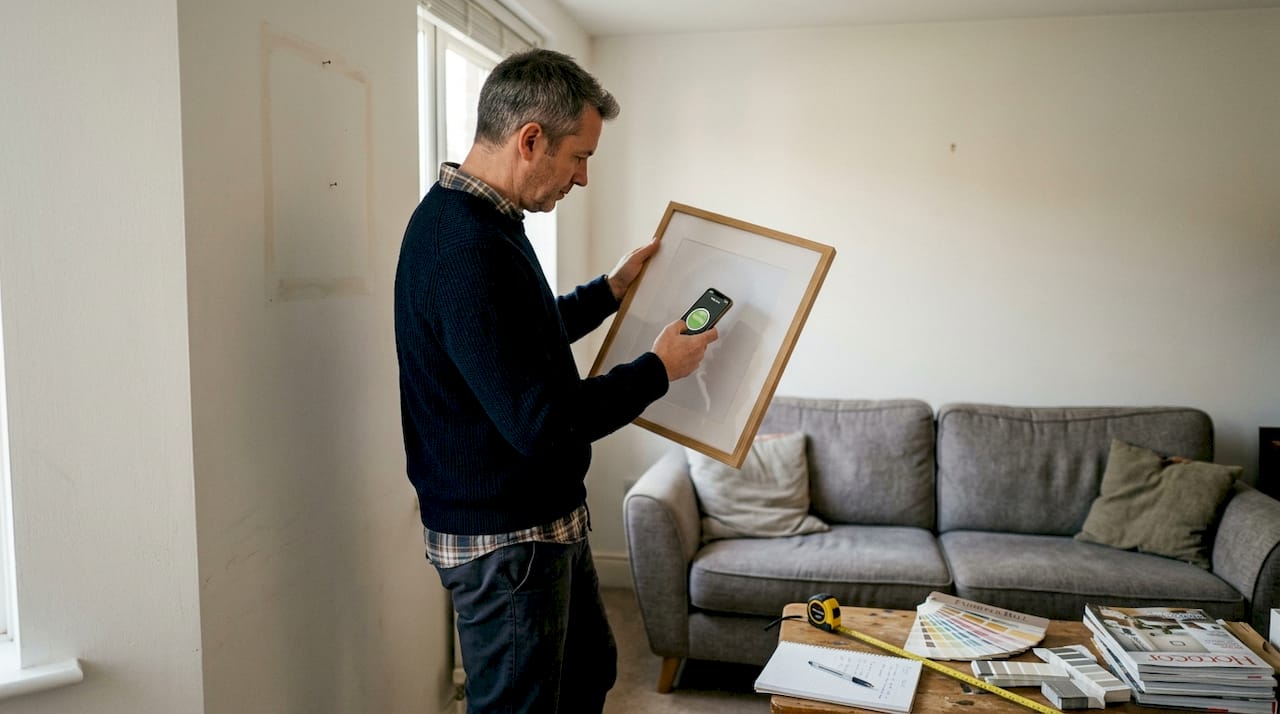
The commissioning workflow follows a clear sequence: brief, options package, sign-off, production, quality control, and installation. Knowing this in advance means you can plan your own schedule around each stage.
Pro Tip: Always ask for a digital mockup showing the artwork in situ on your wall before approving production. Many studios offer this as standard, and it can save you from a very expensive surprise on delivery day.
Commissioning step-by-step: from brief to final print
With everything in hand, you are ready to move through the actual commissioning process. Here is how it works in practice:
- Write your brief. Include dimensions, material, style references, colour palette, mood, and deadline. The more detail, the better.
- Request a quote. Share your brief with one or more providers and compare pricing, timelines, and what is included.
- Review the options package. A good provider will offer you a selection of approaches or initial concepts before committing to production.
- Approve the mockup or prototype. This is your chance to see how the piece will look before it is printed. Request changes here, not after production.
- Sign off on final artwork. Once you are satisfied, give written approval. This protects both you and the provider.
- Production and quality control. The print is produced, checked for colour accuracy, and inspected for defects before dispatch.
- Delivery and installation. Confirm packaging standards upfront, especially for large or fragile pieces.
One of the biggest decisions is who to commission from. The table below compares the two main routes:
| Independent artist | Professional print service | |
|---|---|---|
| Uniqueness | High, fully bespoke | Medium, template or file-based |
| Cost | Higher | Lower to mid-range |
| Timeline | 4 to 12 weeks | 1 to 4 weeks |
| Collaboration | Direct and personal | Structured and process-driven |
| Risk | Higher (originals) | Lower (reproductions) |
| Best for | Signature pieces, gifts | Scalable projects, reproductions |
As noted in custom art selection guidance, working directly with an artist delivers unique, collaborative results, while print services are faster and more cost-effective for scalable or reproduction work. Neither is universally better. The right choice depends on your project.
The customise prints process and the decorative prints workflow both reinforce the same lesson: communication at each milestone is what separates a smooth commission from a frustrating one.
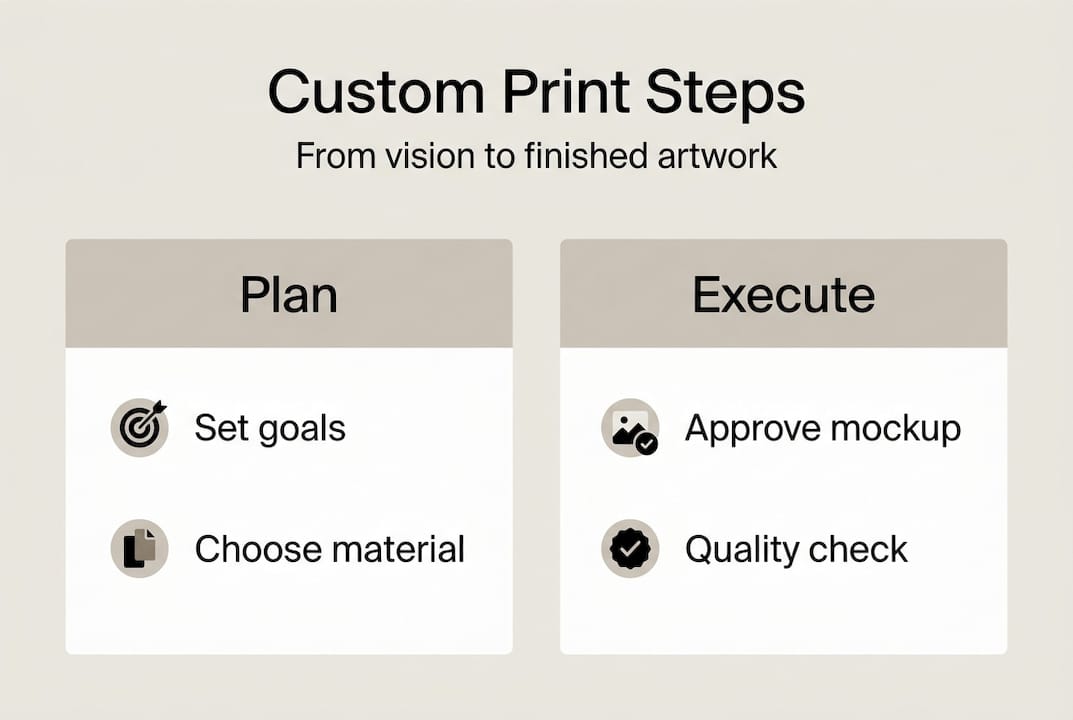
Pro Tip: Build a formal review stage into your timeline before final sign-off. Even one round of amends can take several days, so factor this into your project schedule rather than treating it as an afterthought.
Common pitfalls and how to avoid them
Even with the perfect plan, common traps can trip up even the most experienced buyer. Knowing what to watch for makes the difference between a piece you love and one you regret.
The most frequent mistakes include:
- Vague briefs. Saying “something modern and colourful” gives a provider almost nothing to work with. Specific references, exact dimensions, and named colour values (such as Pantone or hex codes) remove ambiguity entirely.
- Skipping the mockup stage. It is tempting to rush to production, especially when you are excited about a piece. Skipping the proof or mockup is the single most common cause of reprints.
- Poor communication during production. If you go quiet after signing off, small questions from the provider can go unanswered and cause delays. Respond promptly to any queries.
- Ignoring colour profiles. What looks right on your screen may print very differently. Always confirm whether the file is in sRGB or CMYK and ask for a colour proof if the piece is large or expensive.
- Underestimating lead times. Custom work takes time. Ordering a large commission two weeks before a project handover is a gamble that rarely pays off.
“Rushing the final approval is the most expensive mistake in custom print commissioning. A reprint costs money, time, and goodwill. One careful review before sign-off costs nothing.”
For quality control on delivery, inspect the piece in good light before signing any delivery note. Check for colour banding, edge damage, and that the dimensions match your order exactly. A reputable provider will have a clear process for commissioning art that includes quality checks before dispatch, but the final check is always yours to make.
For a deeper look at getting the details right, the bespoke wall art tips guide covers specific scenarios for both residential and commercial projects.
Our take: what most guides miss about custom print commissions
Most step-by-step guides focus on process and checklists. Those things matter, but they miss something important: the quality of the relationship between you and whoever is making your print.
We have seen projects with perfect briefs and detailed specifications fall flat because the buyer and the provider never really communicated as people. And we have seen loose, informal briefs produce extraordinary results because both sides were genuinely invested in getting it right. The workflow matters, but the conversation matters more.
The uncomfortable truth about custom art prints is that cheap and fast rarely delivers the emotional impact that makes a space feel truly considered. Investing in a proper approval process, asking questions, and being willing to push back on a mockup that does not feel right, these are the habits that separate a forgettable print from one that becomes a talking point in your home or project for years.
Prioritise the relationship and the process over the price, and the results will follow.
Ready to commission your own custom print?
If this guide has given you the confidence to start, the next step is straightforward. At Frametheworld, we work with both homeowners and interior designers to bring bespoke artwork to life, whether that means a single statement piece for a living room or a coordinated series for a commercial scheme. You can request a custom print directly and we will guide you through the brief and options process from there. If you would like to explore styles first, textured wall art is a popular starting point, or you can browse our full collection to find something that sparks an idea.
Frequently asked questions
What is a custom print?
A custom print is a unique artwork or reproduction tailored to your specific requirements for style, size, and material. Unlike off-the-shelf options, it is made to fit your space and brief, often using archival giclée methods for high-quality reproductions.
How long does it take to commission a custom print?
Timelines typically range from two to six weeks depending on complexity and the number of revision rounds. The commissioning workflow covering brief through to installation gives a clearer picture of where time is spent at each stage.
Can I request changes after seeing a preview or mockup?
Yes, most providers allow one or two rounds of revisions before final approval, which is precisely why the mockup and prototype stage exists. Use it fully rather than rushing straight to sign-off.
Is it better to commission directly from an artist or a print service?
It depends on your priorities. Direct artist commissions offer more personal collaboration and uniqueness, while professional print services deliver speed, consistency, and lower costs for scalable projects.
What is a giclée print?
A giclée print is a high-quality, archival reproduction using pigment-based inks to achieve rich colour depth and fine detail. It is the preferred method for fine art reproductions where colour accuracy and longevity are priorities.
Recommended
- How to customise prints for personalised wall art
- Custom Art Prints: Transforming Urban Interiors
- Decorative prints workflow 2026: reduce delays by 33%
- How to create personalised artwork to enhance your space
- Smart Design Tips to Maximize Space in Small Kitchens & Bathrooms - E.V.A Design and Build Specialists


Leave a comment
This site is protected by hCaptcha and the hCaptcha Privacy Policy and Terms of Service apply.