
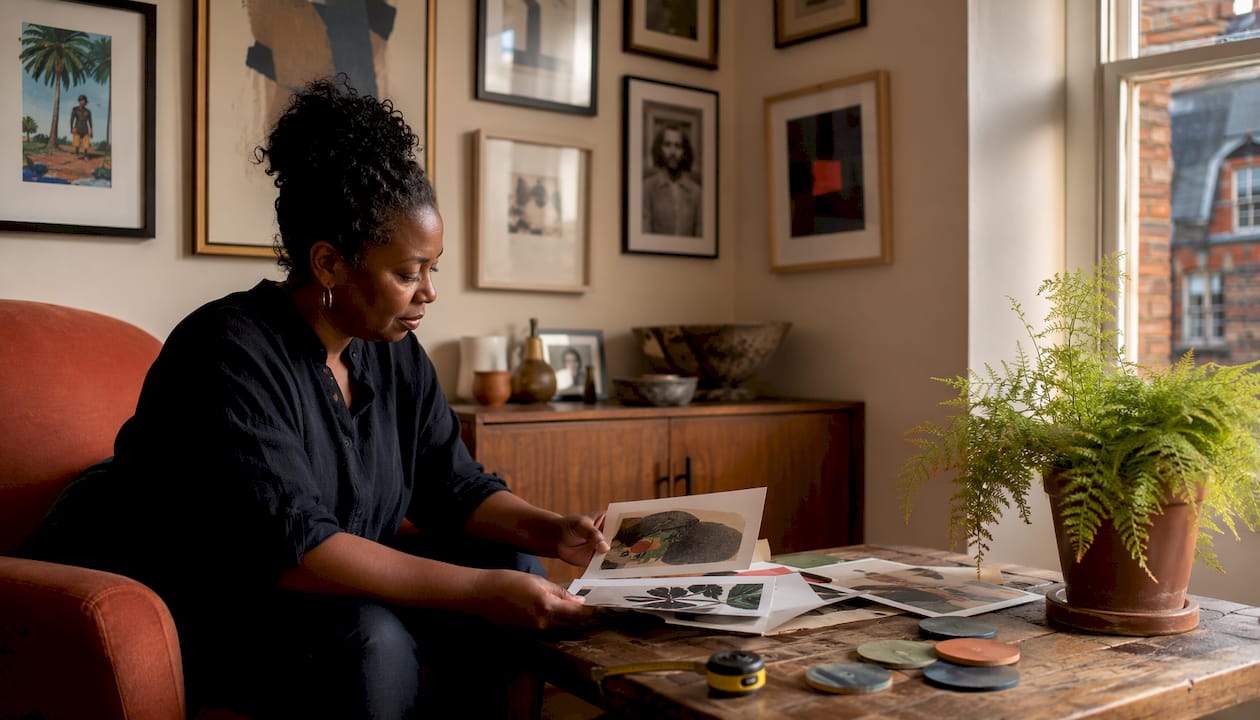
TL;DR:
- Budget wall art options in UK homes include prints, posters, and DIY projects, all at affordable prices. For focal pieces, bespoke commissions or large canvas reproductions offer long-term value, especially in main living spaces. Combining budget-friendly art with well-chosen frames creates a curated look that enhances room design and personal style.
The most reliable budget wall art options for UK homes are prints and posters in a low to moderate price range unframed or framed, canvas reproductions in a moderate price range, thrifted frames repurposed with new prints at low cost, DIY and upcycled pieces in a budget-friendly range, textiles and tapestries at moderate prices, and wall decals affordably priced. For a single focal piece in a main living room, a bespoke hand-painted commission is worth considering alongside these routes. Interior design guidance consistently describes art as the “final layer” that ties a room together, which is why mixing one investment piece with several budget accents tends to produce the most considered result.
Three quick actions to take today:
- Buy a print: Order an unframed giclée or poster print from an online print platform, then pair it with a charity-shop frame for under £40 total.
- Reframe a find: Pick up a solid-wood vintage frame from a charity shop or car boot sale and drop in a contemporary print you already own or order cheaply.
- Try a one-evening DIY: A geometric painter’s-tape canvas costs roughly £20–£30 in materials and takes a single evening to complete.
For focal pieces in rooms you plan to keep long-term, a bespoke commission is worth budgeting separately. The sections below cover every route in detail.
Table of Contents
- What are the best budget wall art options, and what do they actually cost?
- Where can you find affordable wall art in the UK?
- DIY wall art projects that look good and cost very little
- How do you arrange budget pieces so they look curated?
- Budget framing and mounting that lifts the look of cheap art
- Room-by-room guide to choosing size, scale, and colour
- When should you buy budget pieces, and when does a commission make sense?
- What to check before you buy or commission wall art in the UK
- Key takeaways
- The case for patience over panic-buying
- When a hand-painted piece is worth the investment
- Useful sources and further reading
What are the best budget wall art options, and what do they actually cost?
Not all cheap wall art is equal. The route you choose affects durability, finish, and how much effort you put in, so it helps to know what you are actually buying before you spend anything.
Prints and posters
Paper posters are typically available at entry-level prices unframed for standard A3 or A2 sizes. Giclée prints use archival inks on heavier cotton or fine-art paper and cost more than basic posters unframed. The difference is longevity. A standard inkjet poster can fade noticeably within a few years near a sunny window; a giclée on acid-free paper holds colour for decades. Framed versions from online print platforms cost more depending on frame quality and size.
Canvas reproductions
Stretched canvas prints (image printed directly onto canvas and wrapped around a wooden frame) from mass-market retailers typically come at an affordable price for medium-size pieces. Gallery-wrapped versions with thicker stretcher bars look more finished and are priced somewhat higher. They need no additional framing, which saves both money and effort.
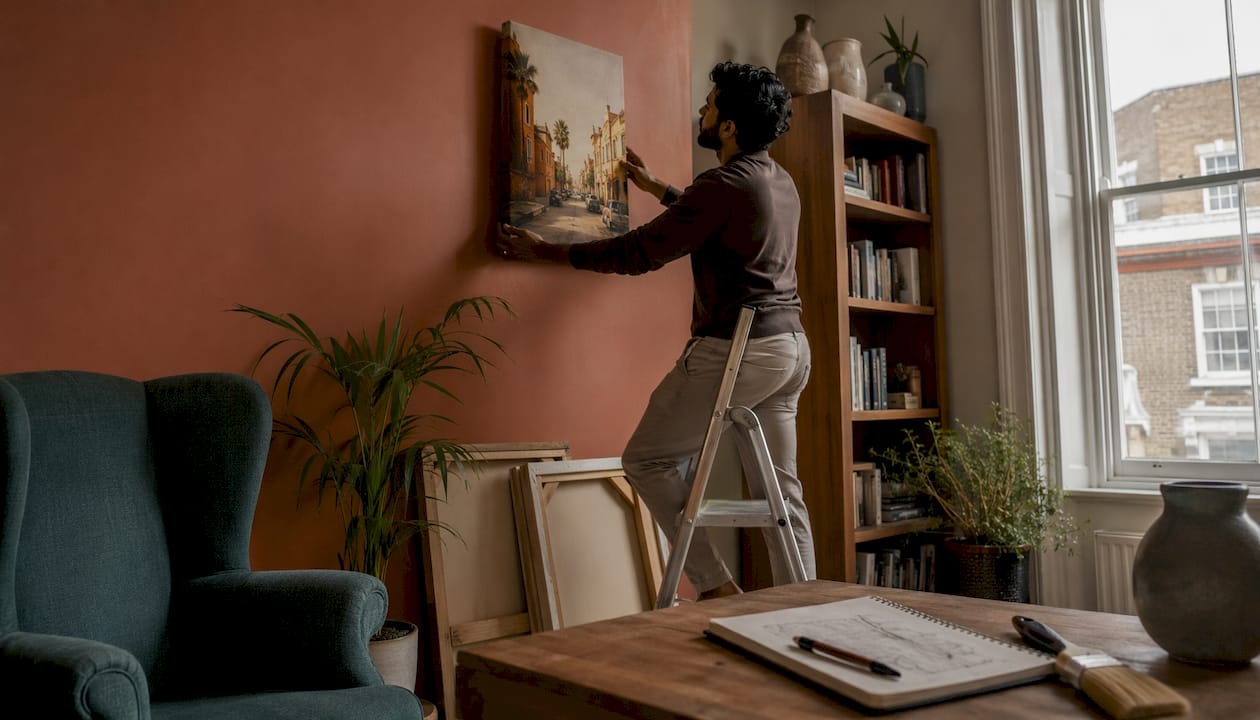
Thrifted and vintage framed pieces
Charity shops and vintage fairs are frequently undervalued as art sources. The real play is buying the frame, not the picture inside it. A solid-wood vintage frame in good condition can be found affordably at a charity shop. Replace the original picture with a contemporary print and you have a finished, high-value result for a fraction of what a new framed print would cost at retail.
Decals and tapestries
Wall decals (vinyl stickers applied directly to the wall) come at a low to moderate price range and suit rental properties where drilling is restricted. Fabric tapestries and woven wall hangings are available at moderate prices and add texture that flat prints cannot. Both are removable, which makes them practical for renters or anyone who redecorates frequently.
DIY and upcycled pieces
DIY wall art projects can be completed at relatively low cost using materials from UK craft and hardware shops. The cost is dominated by primer, paint, and a canvas rather than framing. A geometric painter’s-tape canvas or a textured drywall-compound piece delivers a bespoke-looking result with minimal tools.

| Option | Typical UK price band | Best use case |
|---|---|---|
| Paper poster (unframed) | £10–£25 | Gallery wall filler, rental flat |
| Giclée print (unframed) | £25–£80 | Statement print, long-term home |
| Canvas reproduction | £30–£150 | Bedroom, living room focal point |
| Thrifted frame + new print | £15–£50 total | Any room, budget-conscious buyer |
| Tapestry / textile | £30–£40 | Bedroom, boho or eclectic scheme |
| Wall decal | £10–£60 | Rental, children’s room |
| DIY / upcycled canvas | £20–£50 in materials | Custom size or colour, any room |
| Bespoke commission | £150+ | Long-term focal piece, main living room |
Where can you find affordable wall art in the UK?
Knowing which seller type to use for each route saves time and avoids disappointment. The categories below cover the main options, along with what to expect from each.
Online print platforms and curated marketplaces are the most convenient starting point. Many list entry-level original works alongside prints, with price filtering that makes it easy to stay within budget. Look for platforms that state print type (giclée vs. standard inkjet), paper weight, and whether framing is available at checkout. Delivery times and packaging quality vary considerably, so check reviews before ordering a larger piece.
High-street and homeware retailers stock canvas prints, framed posters, and decorative wall hangings at entry-level prices, with frequent sales that bring larger pieces within reach of tight budgets. The trade-off is limited originality: the same designs appear in many homes. Seasonal sales and print-platform promotions are worth timing purchases around, particularly for framed pieces that would otherwise exceed your budget.
Museum shops and gallery print rooms are an underused source. The V&A, Tate, and National Gallery all sell high-quality reproduction prints at reasonable prices, often with archival paper and accurate colour reproduction. These carry a provenance that mass-market prints do not, and they tend to hold their visual appeal over time.
Charity shops, car boot sales, and vintage fairs are best for frames. Solid-wood frames in good condition are routinely priced at a fraction of their replacement cost. UK art prints sourced from online platforms pair well with vintage frames for a result that looks deliberately curated.
Independent artists and social marketplaces (Etsy, Instagram shops, local craft fairs) offer original or limited-edition prints at accessible prices, often with the added benefit of direct contact with the maker. Useful when you want something specific that mass-market sources do not carry.
Local print shops and framers can produce custom-sized prints from your own files at reasonable cost, and many offer basic framing services. Useful for oversized pieces that standard online platforms do not stock.
Seller evaluation checklist
Before you buy, run through these checks:
- Returns policy: Can you return or exchange if the colour or size is wrong? Look for at least 14 days.
- Print type: Is it giclée (archival inks, acid-free paper) or standard inkjet? The listing should state this.
- Frame measurements: Does the frame size match standard print sizes so you can swap prints later?
- Shipping and packaging: Is the piece rolled or flat-packed? Rolled prints in tubes are fine; flat-packed framed pieces need robust corner protection.
- Artist credit: For original or limited-edition prints, is the artist named and the edition size stated?
- Material details: For canvas prints, is the stretcher bar depth listed? Thicker bars (38 mm+) look more substantial on the wall.
- Delivery time: Bespoke or print-on-demand pieces can take 1–3 weeks; check before ordering for a deadline.
DIY wall art projects that look good and cost very little
These six projects are repeatable, require no advanced skills, and each comes in well under £50 in materials. All supplies are available from UK craft shops, hardware stores, or charity shops.
1. Geometric painter’s-tape canvas
Materials: Stretched canvas (£8–£15 from an art shop), acrylic paints (£5–£10 for a small set), painter’s tape (£3–£5). Total: approximately £20–£30.
- Lay the canvas flat and apply painter’s tape in a geometric pattern (triangles, chevrons, or a grid).
- Press tape edges firmly to prevent paint bleeding underneath.
- Paint each section in your chosen colours with a flat brush or small roller.
- Allow to dry fully (at least one hour per coat).
- Peel tape slowly at a 45-degree angle while paint is still slightly tacky for clean edges.
- Touch up any bleed lines with a fine brush once dry.
2. Thrifted canvas repaint
Materials: Charity-shop canvas or framed print (£2–£8), gesso primer (£6–£10), acrylic or chalk paint (£5–£10). Total: approximately £15–£25.
- Lightly sand the existing surface if it is glossy.
- Apply two coats of gesso, allowing each to dry fully.
- Paint your chosen design or abstract composition over the primed surface.
- Seal with a matte or satin varnish for durability.
3. Framed fabric or wallpaper sample
Materials: Charity-shop frame (£3–£10), fabric offcut or wallpaper sample (£0–£8 from a sample service), mount board (£3–£5). Total: approximately £10–£20.
- Cut mount board to fit the frame’s rebate.
- Cut fabric or wallpaper to the same size, adding 2 cm on each side for folding.
- Stretch fabric over the board and secure at the back with a staple gun or strong tape.
- Place in the frame and hang.
4. Large-scale paper installation
Materials: A1 or A0 cartridge paper or kraft paper (£5–£10 for a roll), paint or ink (£5–£8), washi tape or bulldog clips for hanging (£3–£5). Total: approximately £15–£25.
- Unroll paper onto a flat surface and apply paint or ink in broad, gestural strokes.
- Allow to dry completely.
- Hang directly on the wall using washi tape (for lightweight paper) or bulldog clips on a wooden dowel for a more finished look.
5. Photographic print montage
Materials: Printed photographs (£0.10–£0.30 per 6×4 print at a UK pharmacy or supermarket photo kiosk), a large frame or clip rail (£10–£20). Total: approximately £15–£30.
- Select 9–16 photographs with a consistent colour palette or theme.
- Arrange them in a grid on a flat surface before committing to the wall.
- Mount in a multi-aperture frame or attach to a clip rail for an informal, changeable display.
6. Textured drywall-compound canvas
Materials: Stretched canvas (£8–£15), ready-mixed drywall compound (£5–£8 from a hardware shop), palette knife (£3–£5), paint (£5–£8). Total: approximately £25–£40.
- Apply drywall compound to the canvas in thick, textured strokes using a palette knife.
- Create ridges, swirls, or geometric forms while the compound is wet.
- Allow to dry overnight (compound shrinks slightly as it dries).
- Paint over the dried texture in one or two tones for a contemporary, tactile finish.
Pro Tip: To achieve a professional finish on any repainted or upcycled frame, strip old paint with a fine-grit sanding block, apply a wood primer, then finish with two thin coats of chalk paint in a matte tone. Distress lightly at the corners with fine sandpaper for an intentional, aged look rather than a worn one.
How do you arrange budget pieces so they look curated?
The single biggest mistake with gallery walls is trying to match everything too precisely. Pick one consistent thread — frame finish, border size, or a loose theme — and let everything else vary. That single shared element is what makes mixed price points read as curated rather than random.
Layout options and spacing rules
| Layout | Best wall size | Spacing rule |
|---|---|---|
| Linear (single row) | Narrow hallway or above a console | Centre line at 145–150 cm from floor; 5–8 cm between frames |
| Salon (asymmetric cluster) | Large living-room wall | Start from the centre piece and work outward; maintain 5–8 cm gaps |
| Triptych (three equal pieces) | Above a sofa or bed | Total width 75–80% of the furniture below; equal gaps of 3–5 cm |
| Centred single large piece | Any room | Centre of piece at eye level (145–150 cm from floor) |
For a gallery wall above a sofa, the total width of the arrangement should cover roughly two-thirds to three-quarters of the sofa’s length. Going wider than the sofa makes the wall feel unanchored; going narrower makes the sofa look oversized.
Hanging checklist:
- Spirit level and pencil for marking positions
- Picture hooks rated for the weight of each piece (check packaging)
- Picture wire or D-ring fixings rather than sawtooth hangers for heavier frames
- Paper templates (cut to the size of each frame) taped to the wall before drilling
- Measuring tape and a second pair of hands for large arrangements
Pro Tip: Before drilling a single hole, cut paper templates the exact size of each frame, tape them to the wall with painter’s tape, and live with the arrangement for a day. You will almost always move at least one piece, and paper is free.
For more detailed planning, gallery walls explained covers the full process from layout to final hang.
Budget framing and mounting that lifts the look of cheap art
A £15 print in a poor frame looks cheap. The same print in a well-chosen frame looks considered. Framing is where most budget art buyers underinvest.
Ready-made frames from homeware shops and online retailers are the most accessible option. IKEA’s RIBBA and HOVSTA ranges are widely used precisely because they are neutral, well-made for the price, and available in standard print sizes. Expect to pay £5–£25 depending on size.
Thin float frames (where the artwork appears to float slightly in front of the backing) suit canvas prints and textured pieces. They add a gallery feel without the cost of a bespoke frame. Available from art supply shops for £15–£50.
DIY rebate framing involves buying lengths of frame moulding from a timber merchant or art shop and cutting mitred corners yourself. It requires a mitre saw or box, but the cost per frame drops significantly for larger pieces.
Glazing choices: Acrylic (Perspex) is lighter and less likely to shatter than glass, making it safer for larger frames and easier to post. It scratches more easily, so handle with care. Standard glass is heavier but gives a crisper, less reflective finish on smaller pieces. For prints you want to protect long-term, opt for UV-filtering acrylic or glass to prevent fading.
Mounting hardware:
- Self-adhesive picture strips (Command strips): suitable for frames up to approximately 3.5 kg; ideal for renters.
- D-ring fixings with picture wire: more secure for heavier pieces; allows fine horizontal adjustment after hanging.
- French cleats: the most secure option for very heavy or oversized pieces; requires two parallel strips of angled timber fixed to the wall and the frame.
When you find a solid vintage frame at a charity shop, check the rebate size before buying a print to go inside it. Standard UK print sizes (A4, A3, A2, 50×70 cm) do not always match older frame sizes, so measure the rebate opening rather than the outer frame dimensions.
To keep framed pieces looking their best, dust the glass or acrylic with a dry microfibre cloth rather than a spray cleaner, which can seep under the frame and damage the print.
Room-by-room guide to choosing size, scale, and colour
Getting the scale wrong is the most common decorating mistake. A piece that is too small for a wall looks like a postage stamp; one that is too large overwhelms the room.
Living room:
- Art above a sofa should span 60–75% of the sofa’s width. For a standard 2.2 m sofa, that means a single piece or arrangement roughly 130–165 cm wide.
- Hang the centre of the piece at 145–150 cm from the floor, which places it at average eye level when standing.
- For neutral schemes, a single bold print with high contrast creates a focal point without competing with furniture. For already-busy rooms, tonal prints in two or three related colours sit quietly without adding visual noise.
Bedroom:
- Above a bed, art should be roughly 60–70% of the headboard width. A standard double headboard (135 cm) suits a piece or triptych around 80–95 cm wide.
- Hang lower than in a living room: the centre of the piece at roughly 130–135 cm from the floor, so it reads well from a seated or lying position.
- Soft, muted tones and organic shapes tend to work better in bedrooms than high-contrast graphic prints, which can feel restless in a space designed for rest.
Hallway:
- Narrow hallways suit vertically oriented pieces or a single linear row of small frames. Avoid anything wider than 60% of the wall width or it will feel cramped.
- A series of three identically framed prints at consistent spacing creates rhythm in a corridor without requiring large individual pieces.
- Darker or more dramatic colour choices work well in hallways because the space is transitional rather than lived-in.
Kitchen:
- Small to medium pieces (A4–A3) suit kitchen walls, where wall space is often interrupted by cabinets and appliances.
- Food-related prints, botanical illustrations, and typographic pieces are popular choices, but any subject works if the colour palette ties to the kitchen’s existing tones.
- Avoid paper prints near a hob or sink where steam and moisture can cause warping; canvas or acrylic-glazed frames are more durable in these spots.
Thinking about how art fits alongside other design elements, including interior doors as focal points, can help you plan a more cohesive scheme before committing to any purchases.
When should you buy budget pieces, and when does a commission make sense?
The decision is simpler than most decorating guides suggest. It comes down to three questions: How long are you staying? Is this a focal wall or a supporting one? And does the space have an unusual scale that standard prints cannot fill?
- Temporary or rented space: Budget prints, tapestries, and decals are the right call. Spend £10–£60, enjoy them, and leave them behind or roll them up when you move.
- Supporting walls in a long-term home: Mid-range prints (£25–£80) in good frames are sufficient. These are the pieces that fill a gallery wall or add colour to a secondary bedroom. They do not need to be precious.
- Focal wall in a main living space you plan to keep: This is where a bespoke commission earns its cost. A hand-painted piece sized precisely for your wall, in a palette matched to your room, cannot be replicated by a print. The investment is higher, but the result is genuinely one-of-a-kind and tends to outlast trends.
- Unusual wall dimensions: Very large walls (above 2 m wide), awkward alcoves, or double-height spaces rarely suit standard print sizes. A commission is often the only practical solution.
Signals that justify investing in a bespoke piece:
- The wall is the first thing visitors see when they enter the room.
- You have tried several prints and none have felt right for the scale or palette.
- You want something that reflects a specific place, memory, or aesthetic that stock prints do not capture.
- You are decorating a property for long-term ownership rather than a quick resale.
Pro Tip: When briefing an artist for a commission, give them three reference images (not necessarily of art, but of colours, textures, or moods you respond to), your exact wall dimensions, and the dominant colours already in the room. That brief takes ten minutes to put together and dramatically narrows the gap between what you imagine and what arrives.
For more on the case for commissioning, why commission artwork covers the practical and aesthetic arguments in detail.
What to check before you buy or commission wall art in the UK
A quick checklist you can run through while shopping online or in person:
For any purchase:
- Confirm the exact size in centimetres before ordering. A print listed as “A2” may have a slightly different image area depending on the border.
- Check whether the piece is framed or unframed, and whether the frame size matches standard print dimensions.
- Read the returns policy. A minimum of 14 days is standard; bespoke or print-on-demand pieces are often non-returnable, so confirm before ordering.
- Check shipping and packaging notes. Framed pieces should be double-boxed with corner protection; rolled prints in tubes are generally safe.
- Confirm the material: paper weight (gsm), print type (giclée vs. standard inkjet), and whether the paper is acid-free for long-term display.
- Note the delivery time, particularly for print-on-demand or custom pieces.
For vintage or thrifted art:
- Examine the frame for signs of woodworm (small round holes in the timber) before bringing it into your home.
- Check the print or painting for water damage: brown tide marks, buckling, or a musty smell indicate moisture damage that is difficult to reverse.
- Look at the back of the frame for conservation notes or gallery labels, which can indicate the provenance and age of the piece.
- If the glass is cracked or the backing board is damaged, factor in the cost of replacement before deciding the frame is a bargain.
Key takeaways
The most cost-effective approach to decorating UK walls is to combine low-cost prints and DIY pieces for supporting walls with a single bespoke or higher-quality piece for the main focal point.
| Point | Details |
|---|---|
| Match route to commitment | Use budget prints and decals for rentals or temporary spaces; invest in canvas or bespoke for long-term homes. |
| Thrifted frames are undervalued | A solid-wood charity-shop frame (£3–£20) plus a contemporary print often beats a new framed print at retail. |
| DIY projects cost under £50 | Geometric tape canvases, textured compound pieces, and framed fabric samples typically require under £50 in materials. |
| Scale rules prevent costly mistakes | Art above a sofa should span 60–75% of its width; hang the centre at 145–150 cm from the floor. |
| Frametheworld for focal pieces | When a wall needs a hand-painted, bespoke piece sized to your exact dimensions, Frametheworld offers custom commissions and curated collections. |
The case for patience over panic-buying
There is a version of budget decorating that goes wrong in a predictable way: you buy ten cheap prints in a rush to fill blank walls, none of them feel right, and six months later you replace them all. The total spend ends up higher than if you had bought two or three pieces you genuinely liked from the start.
The better approach is to treat art as the last thing you add to a room, not the first. Live with the furniture and lighting for a few weeks. Notice which walls actually draw your eye and which ones you never look at. Spend your budget on the walls that matter and leave the others blank for longer than feels comfortable. A single well-chosen piece on the right wall does more than a dozen filler prints scattered around a room.
Budget art is not a compromise. A giclée print from an independent artist, a thrifted frame with a new print inside, a geometric canvas you painted yourself on a Sunday afternoon: any of these can hold a room together if the choice is deliberate. The price is not the point. The intention is.
When a hand-painted piece is worth the investment
Budget prints and DIY pieces cover most walls in most homes. But there are spaces where nothing off-the-shelf quite works: a wide chimney breast that dwarfs standard print sizes, a hallway that needs a specific palette to tie two rooms together, or a living room where you have tried four different prints and none of them have felt like the room’s own.
That is where a hand-painted commission changes the result. Frametheworld’s hand-painted collections and bespoke commission service are built for exactly this situation: pieces sized to your wall, painted in a palette matched to your room, and finished to a standard that a printed reproduction cannot replicate. Whether you want a textured abstract, a bold statement canvas, or something more restrained, the process starts with your brief and ends with something genuinely one-of-a-kind.
If you are at the point where budget options have not solved the problem, browse Frametheworld’s collections or get in touch to discuss a commission.
Useful sources and further reading
- 7 inspiring types of wall art for modern UK homes — Frametheworld’s overview of wall-art formats and how they suit different UK interiors.
- Gallery walls explained: transform your home with art — Step-by-step planning and hanging guidance for gallery walls.
- 7 innovative wall art ideas for urban interiors — Creative concepts for modern urban homes, including budget-friendly approaches.
- The Spruce: DIY wall art projects — A broad collection of step-by-step DIY projects with materials lists and cost guidance.
- Apartment Therapy: best places to buy affordable art — Curated roundup of online platforms and retailers with price filtering for budget shoppers.
- Artfinder — Curated marketplace listing original works and prints across a wide range of price bands, including entry-level originals.
- Oxfam shops — A reliable source for solid-wood vintage frames at low prices; worth checking regularly for good-quality finds.
- Architectural Digest: affordable art sourcing — Editorial guide to online and in-store sources for art at accessible prices, with framing options noted.

Leave a comment
This site is protected by hCaptcha and the hCaptcha Privacy Policy and Terms of Service apply.