
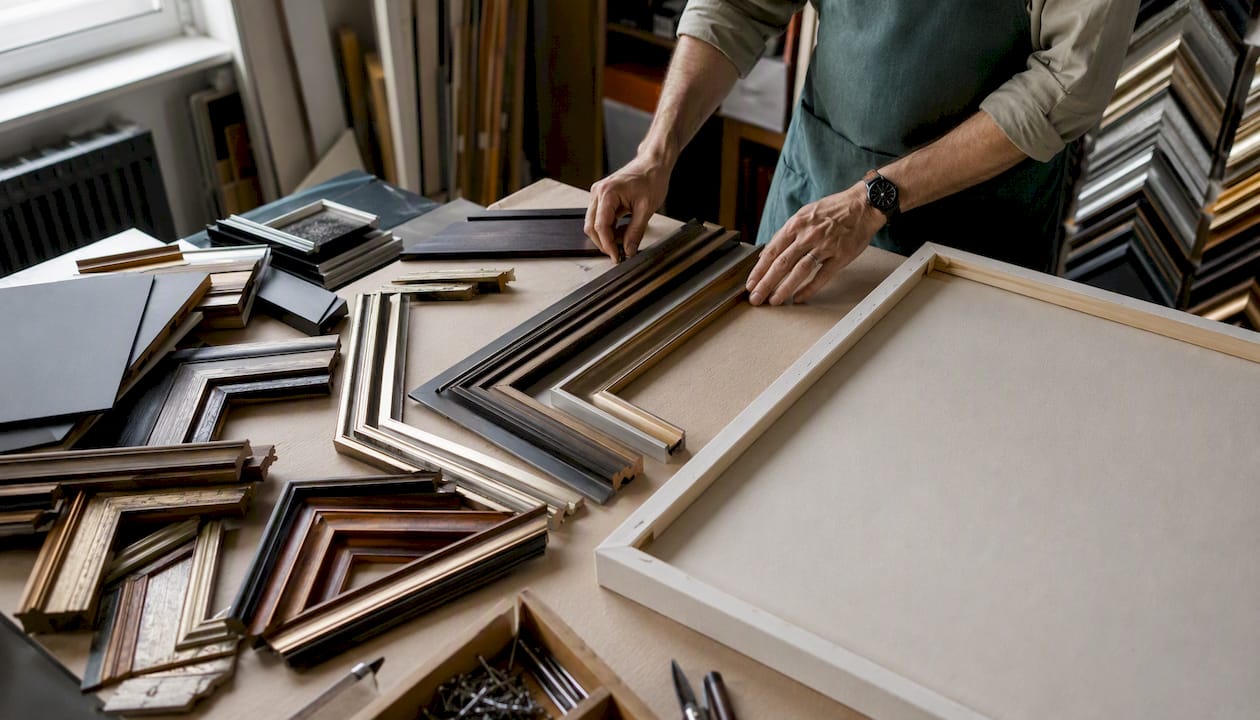
When ordering or specifying framed artwork, a professional framer needs five categories of information to quote accurately: frame style and construction, moulding profile and finish, mount and backing details, glazing and protection type, and fixtures, hardware and installation requirements. Miss any one of them and you risk a quote that does not reflect the finished piece, or worse, a frame that damages the work it was meant to protect.
Here is the minimal set of sub-items each category requires:
- Frame style and construction: style group (ornate, minimalist, floater, box/shadow), rebate depth, overall profile depth, and whether glazing is included
- Moulding profile and finish: material (solid timber, aluminium, MDF), profile name or sketch reference, finish type (painted, gilded, lacquered), and RAL or NCS colour code
- Mount and backing: outer board dimensions, window opening size(s), number of plies, board grade (conservation/museum), and mounting method (hinges, corners, spacers)
- Glazing: type (standard, anti-reflective, UV-filtering, acrylic, museum glass), thickness, and any anti-shatter or UV-percentage requirement
- Fixtures and installation: hanging system type, weight rating, wall construction, security fixing requirements, and number of fixing points
As How to Specify Framing for Design Projects makes clear, a complete specification covers exact artwork dimensions and substrate type, moulding profile and finish with RAL or NCS references where needed, glazing type, mount specification, and installation requirements including hanging hardware ratings. Without all five, a framer is guessing.
Key takeaways
A complete framing specification covers five categories: frame style and construction, moulding profile and finish, mount and backing, glazing and protection, and fixtures and installation hardware.
| Point | Details |
|---|---|
| Five core categories | Every specification must cover style, moulding, mount, glazing, and hardware to allow accurate quoting. |
| Conservation non-negotiables | Use conservation-grade board, keep artwork separated from glazing by at least 2 mm, and request corner samples before full production. |
| Glazing by size | Specify acrylic for pieces larger than approximately 1.2 metres; use museum glass where optical clarity is the priority and weight is acceptable. |
| Batch consistency | Specify all pieces in a series at once and require the same moulding run to avoid finish variation across the set. |
| Frametheworld | Offers bespoke hand-painted art with a built-in specification process covering conservation materials, colour approval, and installation requirements. |
Table of Contents
- Which frame style suits your artwork and setting?
- How do you specify moulding materials, profiles and finishes?
- What mount and backing details does a framer need?
- Which glazing option gives the best protection?
- What hanging hardware and installation details should you specify?
- How do framing specifications change by medium?
- A professional framing specification template
- Common specification mistakes and how to avoid them
- A framer’s perspective on getting specifications right
- Frametheworld’s bespoke framing and specification service
- Sources
Which frame style suits your artwork and setting?
Frame constructions fall into five primary groups, and the right one depends on the medium, the interior context, and how much protection the work needs.
Ornate and gilded frames
Ornate frames, typically carved or cast in resin with genuine or imitation gilding, suit oil portraits, Old Master prints, and formal interiors. A hotel lobby or period dining room calls for this treatment. The rebate on ornate mouldings tends to be shallow (often 8–12 mm), so check that the artwork and any backing board fit before specifying.

Traditional moulding frames
A stepped or reverse-stepped timber moulding in a stained or painted finish is the workhorse of residential framing. It works across botanical prints, watercolours, and limited-edition photography. The profile creates a visual border that draws the eye inward, which is why it remains the default for gallery-hung paper works.
Minimalist and flat frames
Thin aluminium or flat-faced timber profiles in matte black, white, or natural wood suit contemporary photography, digital prints, and abstract works. The frame recedes rather than competes. For a series of prints hung in a grid, a flat aluminium profile keeps the installation visually clean and the weight manageable.
Floater and tray frames
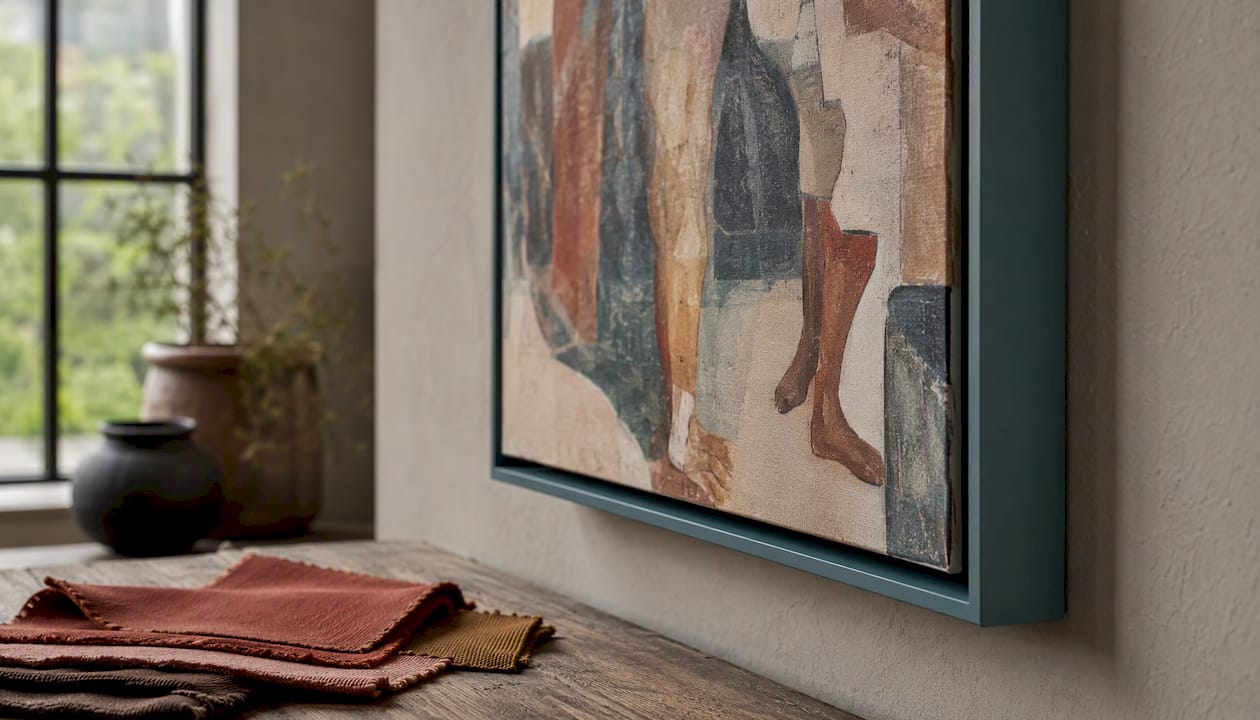
A floater (also called a floating or tray frame) leaves a visible gap between the canvas edge and the frame face, giving the impression the artwork hovers. Specify a floater for stretched canvas with a depth greater than 20 mm. The rebate must be deep enough to accept the stretcher bar without the canvas sitting proud of the frame face.
Box and shadow frames
Box frames create a deep recess behind glass, making them the right choice for three-dimensional objects, medals, textiles, and keepsakes. The depth of the box must be specified precisely: too shallow and the object touches the glazing; too deep and the object appears lost. Jacksons Art notes that there is no single best frame, and that the right pairing of style and construction depends on the artwork itself.
Quick decision rules for a brief:
- Choose a floater for stretched canvas with a depth greater than 20 mm
- Choose a box/shadow frame for any three-dimensional object or textile
- Choose a flat aluminium profile for photography series or grid installations
- Choose an ornate or traditional moulding for works on paper in formal settings
- Choose a minimalist flat frame when the artwork, not the frame, should dominate
How do you specify moulding materials, profiles and finishes?
The moulding is the structural backbone of the frame. Getting the material and finish specification right prevents warping, colour drift across a batch, and costly remakes.
Moulding materials
- Solid timber: the most durable and dimensionally stable option for long-term installations; accepts stain, paint, lacquer, and genuine gilding; heavier than alternatives
- Engineered wood (MDF with veneer or foil): cost-effective for large runs; consistent surface for painted finishes; less resistant to humidity over time
- Aluminium: lightweight, precise, and ideal for large-format photography or minimalist interiors; available in anodised and powder-coated finishes; does not warp
- Resin or composition moulding: used for ornate profiles where carved timber would be prohibitively expensive; accepts gilding and paint; check weight for large pieces
Profile types and rebate depth
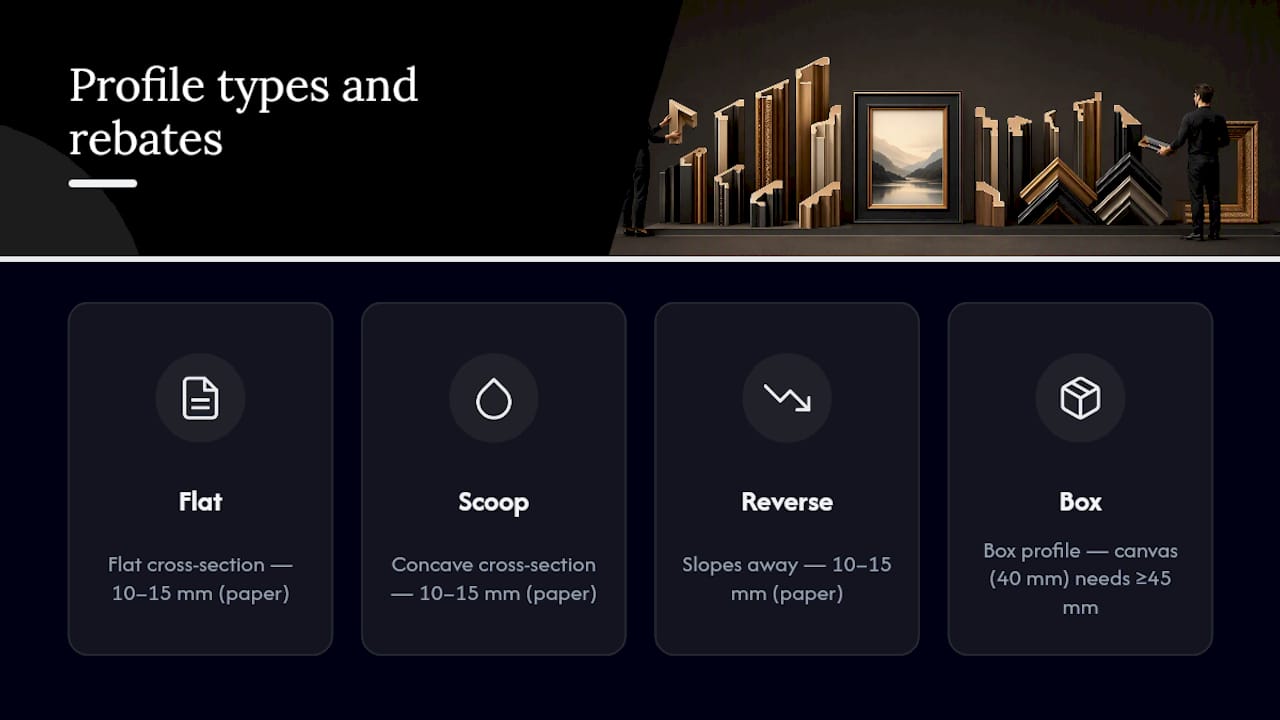
The profile describes the cross-section shape of the moulding: flat, scoop (concave), reverse (sloping away from the artwork), or box. Profile choice directly determines rebate depth, which is the measurement from the front face of the frame to the back of the rebate. A standard rebate depth of 10–15 mm suits most paper works with a single mount and glazing. Canvas on a 40 mm stretcher bar needs a rebate of at least 45 mm, or a floater frame with an open back.
Always specify rebate depth as a minimum measurement, not a target. A framer who has to force a canvas into an undersized rebate will damage the work.
Specifying finish and colour
Painted finishes should be referenced by RAL or NCS code wherever colour matching matters across a batch. A verbal description such as “warm white” is not a specification. For gilded finishes, state whether genuine gold leaf, Dutch metal, or imitation gold is required, and the burnish level (matte, satin, or burnished bright).
Pro Tip: Request sprayed colour samples on the actual moulding profile, not a flat swatch. Colours read differently on profiled surfaces, particularly on scoop and reverse profiles where the angle catches light. A decorative moulding profile that looks pale grey on a flat card can appear almost white on a concave face.
When specifying a new finish for a multi-piece project, always request a corner sample before approving production. A corner sample shows the join quality, the finish on the mitre, and how the profile reads at scale.
What mount and backing details does a framer need?
The mount (or mat) is not decorative padding. It is a conservation component that separates the artwork from the glazing and provides a chemically stable environment for the work on paper behind it.
Mount board grades
- Museum/conservation-grade cotton rag board: 100% cotton fibre, pH neutral, no optical brighteners; the correct choice for original works, limited editions, and anything with long-term value
- Conservation-grade purified wood pulp board: acid-free and buffered; suitable for most prints and photographs where museum board is not required
- Standard mount board: not acid-free; will yellow and transfer acids to the artwork over time; avoid for anything you want to preserve
The Conservation Center for Art and Historic Artifacts specifies that mat boards must be chemically stable, made from 100% cotton rag or purified wood pulp, and that photographic mats must pass the Photographic Activity Test (PAT). Some photographic processes are sensitive to alkaline environments, so if the process is known, state it in the specification so the framer can select the correct board chemistry.
Mount measurement fields
A complete mount specification includes:
- Outer board size (width × height in mm, based on the artwork dimensions plus the desired border)
- Window opening size (the visible area of the artwork, with a small overlap to hold the work in place)
- Border widths (top, bottom, left, right in mm; a weighted bottom border is traditional for paper works)
- Number of plies (single or double mount; a double mount adds depth and a reveal of a second colour)
- Colour and surface finish of each ply
Backing boards and spacers
The backing board provides rigid support and, in conservation framing, forms part of the sealed package. Specify conservation-grade foam board or Coroplast for the backing. For works requiring extra depth between the artwork and glazing, a spacer mount (a strip of board around the perimeter of the glazing) achieves separation without a full window mat.
Mounting methods
- V-hinges with mulberry paper and wheat starch paste: the standard reversible method for works on paper; the hinge tears before the paper does
- Polyester corners or photo corners: non-adhesive; appropriate for photographs and works where no adhesive contact is acceptable
- Dry-mounting: permanent; only appropriate for reproduction prints where reversibility is not required; never use on original works or photographs with archival value
Which glazing option gives the best protection?
A correctly specified frame functions as a protective technical package, not merely a decorative border. Glazing is the component that does the most work against UV radiation, pollutants, and humidity-driven condensation.
Glazing types compared
- Standard float glass: clear, affordable, no UV protection; suitable for low-value reproductions in low-light environments only
- Anti-reflective glass: etched or coated to reduce surface reflection; improves legibility in bright rooms; limited UV protection unless combined with a UV filter
- UV-filtering glass: blocks a significant proportion of UV radiation; the baseline specification for any original work or limited edition; available in standard and anti-reflective variants
- Acrylic sheet (e.g., Tru Vue Optium Acrylic): lightweight, shatter-resistant, and available with both UV-filtering and anti-reflective coatings; the practical choice for large-format pieces
- Museum glass (e.g., Tru Vue Museum Glass): low-iron glass with multi-layer anti-reflective coating and UV protection; the highest optical clarity available; heavy and expensive, but the correct choice for original works in gallery or high-value residential settings
For larger pieces, acrylic glazing is generally recommended for safety and weight reasons, though museum glass may be preferred where optical clarity is the priority and shatter risk is acceptable.
Conservation standards specify that artwork must be separated from glazing by window mat(s) or spacer(s). The minimum separation commonly recommended is one 4-ply matboard, approximately 2 mm. Artwork that touches glazing is at risk of condensation damage, sticking, and mould growth. This is not a guideline to treat as optional. See Artfacts Standards for maximum preservation framing for the full conservation baseline.
Environmental considerations
Direct sunlight accelerates fading even through UV-filtering glass. If the installation wall receives direct sun for more than two hours a day, specify the highest UV-protection glazing available and note the light exposure in the specification. High humidity environments (bathrooms, conservatories, basement galleries) require sealed backing and, ideally, acrylic rather than glass to reduce condensation risk. Include site lighting type and direction in the specification so the framer can advise on anti-reflective coatings.
For more on how glazing affects long-term value, the Frametheworld blog covers the trade-offs in detail.
What hanging hardware and installation details should you specify?
Hardware is where specifications most often fall short. A frame that looks perfect on the bench can fail on the wall if the fixings are wrong for the substrate.
Common hanging systems
- Picture wire with D-rings: the standard domestic system; easy to level; specify wire gauge and D-ring weight rating in kg
- Twin D-ring with mirror plates: more stable than wire for heavy pieces; the frame sits flush against the wall
- Security fixings (tamper-resistant screws and plates): required for commercial, hotel, and public installations; specify the security level and whether a specialist tool is needed for removal
- French cleats and rail systems: the correct choice for large or very heavy pieces, or for installations requiring frequent repositioning; specify cleat width, material, and wall-fixing centres
Pro Tip: For any commercial or public installation, include a weight rating in the specification and request confirmation that the proposed fixing meets it. A D-ring rated to 10 kg on a frame weighing 8 kg leaves no safety margin once the glass is included. Always specify the total framed weight, not the artwork weight alone.
Wall construction and site-specific requirements
State the wall construction in the specification: masonry, plasterboard on timber stud, plasterboard on metal stud, concrete, or suspended ceiling. Each requires different fixings. A masonry wall takes a rawlbolt or frame anchor; plasterboard on stud requires fixings into the stud or a specialist hollow-wall anchor rated for the load. For modular or non-standard wall constructions, the installation considerations are worth reviewing before finalising the hardware specification.
Commercial and seismic requirements
For hotel, museum, or public building installations, specify whether seismic or anti-theft ratings are required. Some insurance policies for commercial art collections require documented fixing specifications. Include in the specification:
- Number of fixing points per piece
- Location diagram or dimensioned drawing showing fixing positions
- On-site verification requirement (a signed-off sample installation before full production proceeds)
- Whether the installer is required to provide a fixing schedule
For a step-by-step approach to the framing and installation process, the Frametheworld guide covers commissioning through to final hang.
How do framing specifications change by medium?
The substrate determines the construction. A specification written for a watercolour on paper is structurally different from one for an oil on canvas, and both differ from a textile or a three-dimensional object.
Paper and works on paper
Always include a window mount or spacer to prevent glazing contact. Specify archival mounting (V-hinges or polyester corners) and conservation-grade backing. Never dry-mount an original work on paper. The mount border width should be generous enough to allow for paper expansion in humidity.
Photographic prints
Require PAT-tested mat boards for any photographic process where chemical stability matters. State the photographic process in the specification if known (chromogenic, inkjet, silver gelatin, cyanotype) so the framer selects the correct board chemistry. Prints can be float-mounted (adhered to a backing board with the edges visible) or window-mounted (with a mat covering the edges). Float-mounting suits fine-art photography where the full image area must be visible; window-mounting suits prints where a border is acceptable.
Canvas and painted surfaces
Specify a floater frame or a frame with a deep rebate that accommodates the stretcher bar depth. Glazing is usually omitted for oil and acrylic paintings on canvas, both for aesthetic reasons and because the paint surface needs to breathe. If glazing is required (for a pastel on canvas, for example), include a spacer to prevent contact. Jacksons Art confirms that float frames are the standard pairing for contemporary canvases.
Textiles and objects
Box or shadow frames are the correct construction. Specify the internal depth of the box to accommodate the object without contact with the glazing. Non-adhesive fixings (pins, monofilament, conservation-grade foam supports) are preferred over adhesives. For textiles, include a backing fabric specification (conservation-grade linen or cotton) and state whether the textile is to be mounted on a stretcher or laid flat.
A professional framing specification template
A complete specification groups project-level information with per-piece fields. The table below covers the fields a framer needs to quote and produce accurately.
Conservation standards require a minimum separation of one 4-ply matboard (approximately 2 mm) between artwork and glazing. Build this into every mount specification as a non-negotiable minimum. See Artfacts Standards for maximum preservation framing.
A few points worth adding to any batch specification:
- State that all pieces in the batch must be produced from the same moulding run to ensure finish consistency
- Include a tolerance for outer frame dimensions (typically ±2 mm)
- Note the acceptance criteria for corner sample approval before full production proceeds
- For multi-piece projects, specify lead times from sample approval, not from order date
Pro Tip: Online custom-framing services are useful for preliminary quotes and visual previews, but as Blick Art Materials notes, physical corner samples remain important before committing to full production. Use online tools to narrow options, then request samples before signing off.
For a project-level art selection checklist that complements this specification template, the Frametheworld guide covers the broader interior design context.
Common specification mistakes and how to avoid them
Most framing problems trace back to a handful of recurring errors. Knowing them in advance saves time, money, and the artwork.
Specifying frame size instead of artwork size. The framer calculates the frame from the artwork dimensions, accounting for expansion allowances, mount overlaps, and rebate offsets. Providing the desired outer frame size instead of the physical artwork size produces a frame that does not fit. Always measure the artwork itself.
Insufficient rebate depth. A rebate that is too shallow forces the framer to either leave the backing board proud of the frame back (which looks poor and weakens the package) or omit it entirely. For canvas, measure the stretcher bar depth and add at least 5 mm. For paper works with a double mount and conservation backing, the rebate needs to accommodate glazing, two plies of mount board, the artwork, and the backing board.
Allowing artwork to touch glazing. Condensation forms on the inner face of glazing in fluctuating temperatures. Artwork in contact with glazing will stick, develop mould, or suffer tide-marking. The minimum separation is one 4-ply matboard (approximately 2 mm), but a full window mount is the correct solution for works on paper.
Inconsistent batch framing. Ordering frames for a series at different times, or from different production runs, produces visible finish variation across the set. Specify the full batch at once and note that all pieces must come from the same moulding run.
Maintenance checklist for owners:
- Clean glazing with a soft, lint-free cloth and a glass cleaner applied to the cloth, not the glass
- Check fixings and wire annually; replace picture wire every three to five years
- Keep framed works away from direct sunlight, radiators, and exterior walls prone to condensation
- In high-humidity rooms, check the backing seal annually for signs of moisture ingress
- If the artwork shows any sign of tide-marking, sticking to glazing, or mould, contact a conservator rather than attempting cleaning
Pro Tip: Build a simple sign-off process into every project: approve a corner sample before production, and for multi-piece installations, request a dry-run of one piece on site before the full batch is delivered. Catching a colour or depth problem at the sample stage costs a fraction of what it costs after production.
A framer’s perspective on getting specifications right
The single most common frustration in professional framing is not a difficult artwork or an unusual medium. It is an incomplete brief. A client who arrives with exact artwork dimensions, a clear sense of the installation environment, and a conservation requirement already stated saves hours of back-and-forth and almost always ends up with a better result.
What the specification process reveals, when done properly, is that framing is a technical discipline as much as an aesthetic one. The choice between museum glass and acrylic is not a matter of taste; it is a decision about weight, safety, and optical performance that depends on the size of the piece and the conditions of the room. The choice between a cotton rag mount board and a standard board is not a budget question; it is a question about how long the artwork will remain in good condition.
At Frametheworld, the approach to specification starts with the artwork, not the frame. Bespoke commissions go through a sample approval process before production, colour references are confirmed on the actual moulding profile rather than a flat swatch, and conservation materials are the default for any original or limited-edition work. For complex multi-piece projects, treating the framer as a specification partner from the outset, rather than a supplier who receives a finished brief, consistently produces better outcomes. Involve them early, share the site conditions, and ask for their input on glazing and hardware before the brief is finalised.
The checklist in this guide covers the fields. The judgement about which options to choose within those fields is where experience matters.
Frametheworld’s bespoke framing and specification service
Frametheworld offers hand-painted wall art and decorative canvases that can be customised by size, style, theme, and colour, with bespoke commissions available for both residential and commercial interiors. For clients who need framing alongside their artwork, the specification process is built into the order: you provide the artwork dimensions and installation context, and the team works through glazing, mount, and hardware choices with you before production begins.
The practical next step is to use the specification checklist above when requesting a quote. Upload your artwork dimensions, note the wall construction and lighting conditions, and state whether conservation-grade materials are required. For a starting point on hand-painted pieces that work across a range of framing styles, the Wabi Sabi wall art collection shows the kind of textured, original work that benefits most from a considered framing specification. For broader guidance on framing options and materials, the Frametheworld blog covers the full range of choices in detail.
Sources
These UK-relevant sources cover conservation standards, specification procedures, and material guidance in more detail:
- How to Specify Framing for Design Projects
- Matting and Framing Specifications for Objects on Paper | Conservation Center for Art & Historic Artifacts
- Artfacts Standards - Requirements for maximum preservation framing
- Picture Frame Styles and Constructions: A Maker’s Guide
- Choosing the Right Frame for Your Artwork
- Custom Framing & Matting Online | BLICK Art Materials


Leave a comment
This site is protected by hCaptcha and the hCaptcha Privacy Policy and Terms of Service apply.