
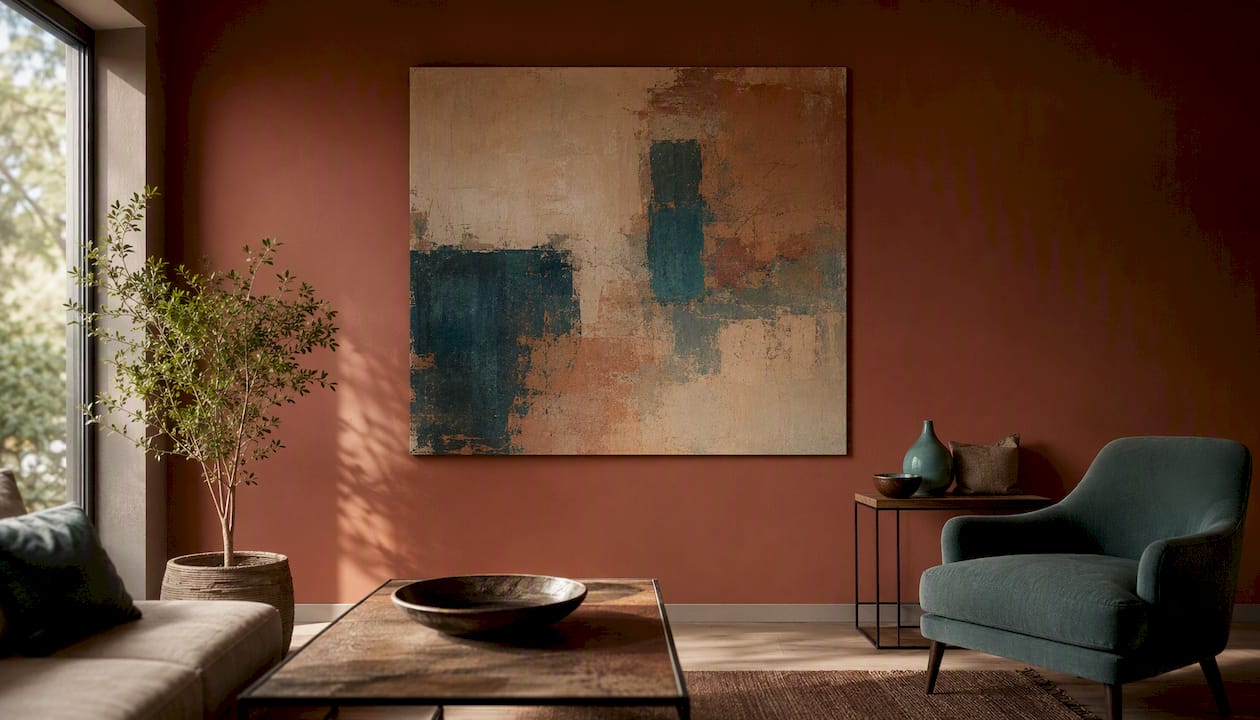
TL;DR:
- Select one to three large, transport-tolerant artworks scaled to wall dimensions for best visual impact.
- Begin with precise measurements, a complete brief, and schedule art delivery within the final fit-out phase.
Choose a small number of large, transport-tolerant pieces sized to your wall and palette, then commission or order with delivery dimensions confirmed before you buy. Three actions to take right now:
- Measure your primary viewing wall (width, height, distance from the main seating or entry point) and photograph it from that angle.
- Decide on scale and finish before browsing: one statement piece almost always reads better than a cluster of small works in a compact module.
- Start a one-page brief or check delivery dimensions on any ready-made piece. Frametheworld offers bespoke hand-painted canvases sized to your specification, with trade support from Lennard and the team for designers and developers working to a programme.
Table of Contents
- How do you choose the right scale for art in modular rooms?
- How to commission bespoke art: brief, timeline and budget
- Delivery, access and installation in a modular home
- Common mistakes when choosing art for modular homes
- Key takeaways
- The case for restraint: a perspective on modular art commissioning
- How Frametheworld supports modular home art projects
- Useful sources
How do you choose the right scale for art in modular rooms?
Module dimensions, transport limits and factory coordination set the starting point for every interior decision, including artwork scale. Begin with a measurement checklist before you look at a single piece:
- Wall width at the hanging height
- Ceiling height and any beam or service intrusion
- Furniture footprint and the clearance above the primary piece (typically 15–20 cm above a sofa back)
- Viewing distance from the main seating or entry point
- Sightlines from adjacent rooms or the module join
Furniture layout and circulation pathways directly affect how large a piece needs to be to read correctly. Design guidance recommends maintaining circulation pathways of sufficient width in compact modules, which constrains where you can stand and therefore what viewing distance you actually have.
Suggested artwork sizes by module width
| Module width | Single focal piece | Grouped arrangement |
|---|---|---|
| — | — | Two pieces at 60 × 80 cm with a 5 cm gap |
| 3.0 m | — | Three pieces in a horizontal row |
| — | — | Two pieces or a diptych |
For groupings, keep the combined visual mass within 60–70% of the wall width and align the top edges. A single large piece usually wins in rooms under 3.0 m wide because it reads as one calm decision rather than several competing ones.
Pro Tip: A single oversized canvas hung so its centre sits at eye level (roughly 145–150 cm from the floor) can make a compact room feel taller and more resolved. The key is proportion: the piece should span at least half the wall width to anchor the space rather than float awkwardly.
How to commission bespoke art: brief, timeline and budget
The single most reliable predictor of a smooth commission is a complete brief sent at the start. Trade commissioning guides recommend sending room photos, dimensions and material swatches; mid-size commissions typically need several weeks lead time, with larger works requiring more.
One-page brief: fields to include
- Finished artwork dimensions (width × height in cm)
- Wall photograph from the primary viewing angle (high resolution)
- Physical fabric or material swatches, or a clearly labelled colour reference
- Palette notes: dominant tones, accents to avoid, any fixed joinery colours
- Emotional intent: calm and tonal, bold focal point, narrative, abstract texture
- Installation date and any programme constraints
- Budget band (directional, not a ceiling)
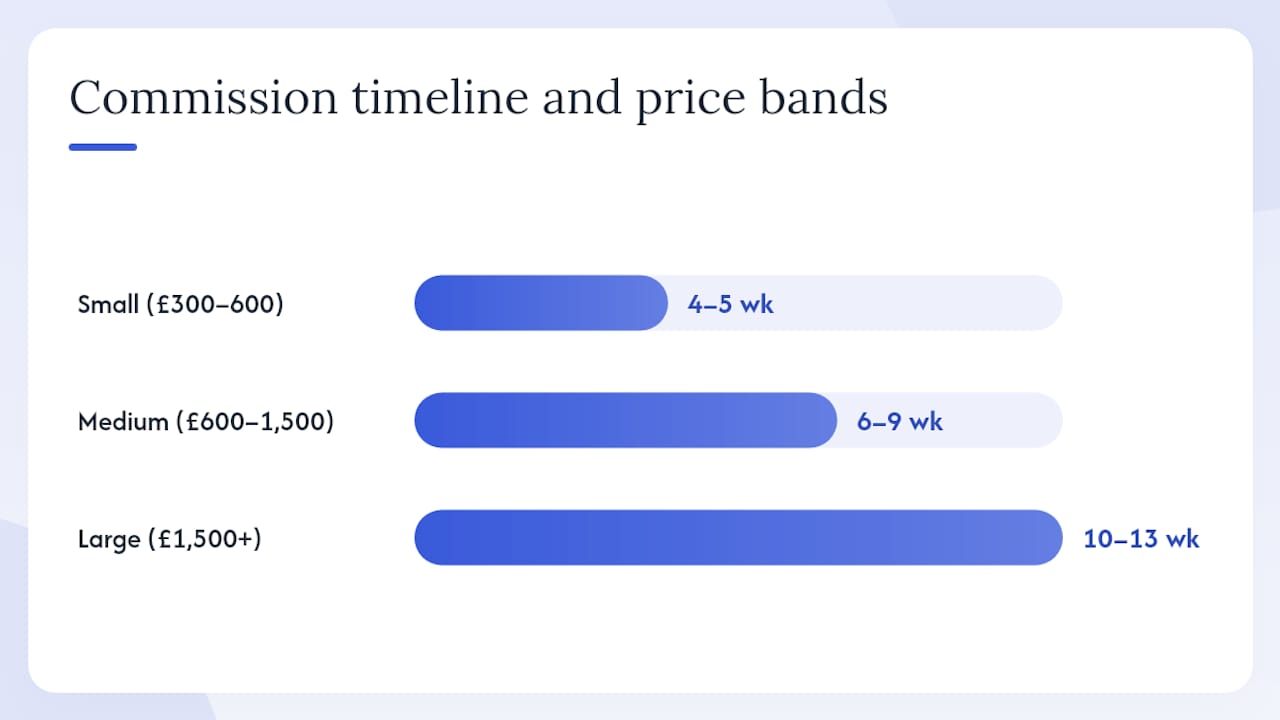
Commissioning timeline guide
| Commission size | Painting | Framing/finishing | Shipping buffer | Total |
|---|---|---|---|---|
| Small (up to 60 × 80 cm) | 2–3 weeks | 1 week | 1 week | 4–5 weeks |
| Medium (up to 120 × 120 cm) | 3–5 weeks | 1–2 weeks | 1–2 weeks | 6–9 weeks |
| Large (150 cm+) | 6–8 weeks | 2–3 weeks | 2 weeks | 10–13 weeks |
Interior choices for modular homes are best resolved early; the same principle applies to art. Lock the commission before fit-out begins, not after.
Directional price bands for bespoke hand-painted work in the UK run from roughly £300–£600 for small pieces, £600–£1,500 for medium, and £1,500 upwards for large-format originals. Custom prints on Dibond or canvas are usually priced below the equivalent painted work. These are illustrative ranges; studio, complexity and framing all shift the final figure.
Pro Tip: Send physical swatches, not digital colour samples. Screen calibration varies, and a hue that reads as warm grey on your monitor can arrive as cool blue under the interior’s actual lighting.

Delivery, access and installation in a modular home
Transport constraints and planning freeze discipline influence what can be installed pre-assembly and when deliveries should be scheduled. Factory manufacture typically runs 4–12 weeks, with assembly taking 3–15 days depending on the system. Art delivery should land in the final fit-out window, not before.
Delivery and access checklist
- Internal door widths (standard UK modular doors are often 76–82 cm clear)
- Corridor turns and any fixed service runs that reduce effective width
- Stair or lift clearances if the room is on an upper module
- Module join lines: avoid fixing through a structural junction
- Any fixed elements (built-in joinery, service panels) that conflict with the planned hanging position
Installation sequence
- Confirm wall construction type with the module manufacturer (timber stud, MDF panel, plasterboard with lining, or masonry core) and select fixings accordingly.
- For lightweight pieces (under 5 kg), standard plasterboard anchors are sufficient. For anything heavier, locate the stud or use a spreader plate.
- Photograph labelled fixing positions before the artwork goes up.
- Protect finished floors and joinery with dust sheets during installation.
- Complete a written installation sign-off noting fixing type, load, and any warranty implications for the wall finish.
Documenting performance evidence and commissioning certificates aligns the installation with building control expectations and protects the client at handover. The same rigour that applies to the building applies to what goes on its walls. When coordinating with a joinery contractor, interior door dimensions and finish choices affect both access routes and the visual language the artwork needs to complement.
Common mistakes when choosing art for modular homes
- Wrong scale: Too small reads as an afterthought; too large overwhelms a narrow module. Measure before you browse.
- Ignoring transport constraints: A piece that cannot pass through the access route is a problem discovered too late.
- Under-briefing the artist: Vague briefs produce generic results and expensive revisions.
- Choosing fragile frames: Standard glass on large pieces is a liability in tight corridors.
- Mismatched palette: Art chosen in isolation from the fixed joinery and lighting rarely lands well on site.
Pre-sign-off checklist for designers
- Wall measurements and photographs confirmed
- Delivery dimensions checked against access route
- Installation plan agreed with the site team
- Delivery window matched to the fit-out schedule
- Contingency of at least one week built into the programme
Every one of these errors traces back to the commissioning process: a complete brief and early coordination prevent most of them.
Key takeaways
A restrained selection of one to three large, transport-tolerant pieces, sized to the module width and briefed with full wall dimensions and palette references, is the most reliable approach to decorating modular homes.
| Point | Details |
|---|---|
| Measure before you buy | Confirm wall width, ceiling height and viewing distance; use the module width table to select a size that anchors the space. |
| Prefer transport-tolerant formats | Stretched canvas and acrylic-glazed frames survive tight access routes; avoid standard glass on pieces over 60 × 80 cm. |
| Brief early and completely | Send dimensions, wall photos and physical swatches; mid-size commissions typically need several weeks from brief to delivery. |
| Match delivery to fit-out | Schedule art arrival in the final fit-out window, not before; confirm fixing type with the module manufacturer first. |
| Commission through Frametheworld | Frametheworld provides bespoke hand-painted canvases sized to specification, with trade support and transport-aware packing for UK modular projects. |
The case for restraint: a perspective on modular art commissioning
The pattern that repeats most often in modular and prefab projects is this: the art is chosen last, quickly, and at the wrong scale. Everything else in a modular interior is resolved early, with precision, because the building system demands it. The art gets treated as decoration rather than a design decision, and it shows.
The projects that work are the ones where the artwork brief goes out at the same time as the joinery specification. Not because art is structurally significant, but because the palette, the scale and the emotional register of a space are set by what is on the walls as much as by what is underfoot or overhead. A single well-proportioned canvas in a 3.0 m module does more for the room than six smaller pieces ever will.
The one-page brief is not bureaucracy. It is the fastest route to a piece that actually belongs in the space.
How Frametheworld supports modular home art projects
Frametheworld is the direct route from brief to finished piece for UK homeowners, designers and developers working on modular projects. The platform offers custom sizing on every canvas, transport-aware packing designed for tight access routes, in-house framing, and trade brief support for professional clients. Ready-made collections are available immediately: the Wabi Sabi wall art range offers hand-painted abstract textures in neutral, tactile palettes that suit modular interiors directly off the shelf, while the Pop Art collection provides bold graphic focal pieces for clients who want stronger contrast.

For bespoke commissions, Frametheworld’s trade team works from your one-page brief and confirms lead times against your installation window. Request a quote or browse the collections at frametheworld.co.uk.
Useful sources
- How prefabricated house interiors are designed
- Designing interiors for modern prefab cabins | Koto Design
- Space‑saving furniture ideas for modular homes that actually work — Petalwood Interiors
- Commissioning custom art: a trade guide for designers
- Interior design considerations for modular and manufactured homes — Jacobsen Homes
- Prefabricated homes: practical guide to design, build and siting
- Prefab house build process UK | KD‑Haus
- Design dos & don’ts for smart modular living spaces & annexes | Smart Garden Offices

Leave a comment
This site is protected by hCaptcha and the hCaptcha Privacy Policy and Terms of Service apply.