

You might assume that filling a wall with several small prints creates more visual interest than a single large piece. Research proves otherwise. Large format prints deliver emotional immersion and spatial sophistication that multiple smaller artworks cannot match, transforming ordinary rooms into compelling environments. Whether you’re redesigning your home or planning a commercial interior project, understanding the unique benefits of large format prints helps you make confident decisions about wall art investments that truly elevate your space.
Table of Contents
- How Large Format Prints Transform Interior Spaces
- Technical Quality And Longevity Of Large Format Prints
- Choosing The Right Materials And Finishes For Your Large Print
- Practical Tips For Integrating Large Format Prints In Your Decor
- Discover Custom Large Format Prints At FrameTheWorld
- Why Use Large Format Prints: Frequently Asked Questions
Key takeaways
| Point | Details |
|---|---|
| Emotional impact | Large prints create focal points that enhance mood and spatial perception far beyond smaller artworks |
| Archival quality | Premium pigment inks on archival substrates ensure prints last 200+ years without fading |
| Material choices | Canvas, acrylic, and paper each offer distinct textures and detail levels suited to different interior styles |
| Customisation options | Tailored sizing, finishes, and framing allow precise alignment with design themes and personal preferences |
| Technical solutions | AI upsampling and soft proofing enable high quality output even from lower resolution source images |
How large format prints transform interior spaces
The psychological impact of large art makes rooms feel more important and sophisticated, outperforming dozens of small prints by avoiding clutter and enhancing emotional immersion. When you enter a space dominated by a single commanding artwork, your attention focuses immediately on that visual anchor. This concentrated focus creates what environmental psychologists call spatial hierarchy, where the room’s purpose and mood become instantly clear.
Small prints scattered across walls fragment attention and create visual noise. Your eye jumps from piece to piece without settling, producing a restless feeling that undermines the calm or energy you want to establish. Large format prints eliminate this problem entirely by providing one powerful statement that commands respect and sets the emotional tone.
Consider how large scale wall art essentials influence room perception. A 150cm by 100cm print doesn’t just fill space; it actively expands how large the room feels. The generous scale tricks the eye into perceiving greater depth and volume, particularly when the artwork features perspective or horizon lines. This effect proves especially valuable in smaller rooms where you want to counteract cramped feelings.
Pro Tip: Position your large format print on the wall opposite the room’s entrance to maximise the spatial expansion effect and create an immediate focal point.
The emotional benefits extend beyond aesthetics. Studies in environmental psychology confirm that cohesive visual environments reduce stress and improve concentration. A single large artwork creates this cohesion naturally, whilst multiple small pieces require careful curation to avoid overwhelming the senses. For interior designers working on commercial projects, this distinction becomes critical when designing spaces meant to influence client behaviour or employee productivity.
Exploring benefits of large scale art for interior projects reveals another advantage: large prints establish authority and credibility. In reception areas, conference rooms, or upscale residential spaces, substantial artwork signals investment in quality and attention to detail. Clients and visitors register this commitment subconsciously, forming positive impressions before any conversation begins.
Large format prints don’t just decorate walls; they architect experiences and emotions within the spaces we inhabit daily.
The transformation happens through three mechanisms:
- Visual dominance: Large prints naturally draw focus, eliminating competition from furniture or architectural features
- Colour saturation: Expansive areas of coordinated hues influence room temperature perception and energy levels
- Textural presence: Physical depth in canvas or acrylic prints adds tactile richness that small works cannot achieve
Technical quality and longevity of large format prints
High quality large prints use pigment inks on archival materials with 200 to 400+ year longevity, surpassing traditional silver gelatin prints which last 100+ years. This extraordinary durability stems from pigment chemistry that resists UV degradation and environmental pollutants. When you invest in a large format print using archival standards, you’re acquiring an heirloom that maintains colour accuracy across generations.
The technical specifications for large prints differ significantly from small format work. Resolution requirements actually decrease as print size increases because viewing distance grows proportionally. A 30cm by 40cm print demands 300 DPI for crisp detail when viewed at arm’s length. However, a 180cm by 120cm print looks perfectly sharp at 150 DPI because viewers stand further back, where the eye cannot resolve individual pixels.
This relationship between size and resolution opens possibilities for images you might have dismissed as unsuitable. AI upsampling technologies now enhance lower resolution files to meet large format standards without introducing obvious artefacts. Soft proofing software lets you preview exactly how colours and details will render on specific media before committing to production, eliminating costly reprints.
| Print medium | Texture level | Glare resistance | Detail clarity | Archival lifespan | | — | — | — | — | | Canvas | High | Excellent | Good | 200+ years | | Acrylic | None | Low | Excellent | 100+ years | | Fine art paper | Medium | Good | Excellent | 200+ years | | Poster paper | Low | Poor | Good | 2 to 5 years |
Choosing between pigment and dye inks represents another critical decision. Dye inks produce vibrant colours initially but fade within 20 to 40 years under normal lighting. Pigment inks cost more yet maintain colour fidelity for centuries, making them essential for serious installations. Professional print services specify which ink type they use; always verify before ordering.
Pro Tip: Request a small test print on your chosen medium before ordering large format to verify colours match your expectations under your specific lighting conditions.
The substrate matters as much as the ink. Acid free papers prevent yellowing and brittleness. Museum grade canvas uses cotton rather than polyester for superior ink absorption and flexibility. Acrylic face mounting protects prints behind crystal clear panels that resist scratching and UV damage.
Exploring custom print options reveals how technical specifications translate into practical choices. You can specify exact dimensions, colour profiles, and finishing treatments to match your project requirements. This precision ensures the final print integrates seamlessly with your design vision rather than forcing compromises.
Modern large format printers achieve remarkable consistency across print runs. Colour calibration systems maintain accuracy within 2% Delta E, meaning reprints match originals imperceptibly. This reliability proves essential for commercial installations requiring multiple identical prints or future replacements.
Choosing the right materials and finishes for your large print
Canvas offers texture and glare free viewing; paper and acrylic provide higher detail but vary in longevity; posters fade within 2 to 5 years versus 100+ years for fine art. Understanding these distinctions helps you match medium to purpose. A reception area demanding decades of consistent appearance requires different materials than a temporary exhibition space.

Canvas remains the most popular choice for large format prints because the woven texture adds depth and eliminates reflections under varied lighting. The fabric stretches over wooden frames, creating a three dimensional object that projects from the wall. This physical presence enhances the artwork’s impact, particularly with abstract or impressionistic images where texture complements the artistic style.
Gallery wrapped canvas, where the image continues around the frame edges, eliminates the need for traditional framing. This modern presentation style suits contemporary interiors and reduces overall costs. However, you sacrifice some image area to the wrap, so composition must account for this from the start.
| Finish type | Best for | Maintenance needs | Cost range | Visual effect |
|---|---|---|---|---|
| Matte canvas | Living spaces, offices | Dust with soft cloth monthly | Medium | Natural, glare free |
| Glossy acrylic | Galleries, modern interiors | Clean with microfibre weekly | High | Vibrant, glass like depth |
| Fine art paper framed | Traditional settings | Minimal, avoid direct sun | Medium to high | Classic, museum quality |
| Laminated poster | Temporary displays | Replace every 2 to 5 years | Low | Bright, economical |
Acrylic face mounting sandwiches your print between acrylic sheets, creating stunning depth and colour saturation. Light refracts through the acrylic layers, making colours appear more luminous than any other medium. This technique works brilliantly for photographic landscapes or any image where visual punch matters more than subtle texture. The glossy surface does create reflections, so positioning away from direct light sources becomes important.
Fine art paper prints offer the highest detail resolution, capturing every nuance in your image. Photographers favour this medium for work requiring critical sharpness. The paper itself becomes part of the aesthetic; textured watercolour papers add character whilst smooth photo papers emphasise precision. Proper framing with UV protective glass preserves these prints indefinitely.
Pro Tip: Match your print finish to your room’s lighting; matte finishes suit spaces with multiple light sources whilst glossy works best with controlled directional lighting.
Custom finishes extend beyond standard options. Metallic papers add shimmer to specific image elements. Split panel installations divide one image across multiple canvases, creating dramatic impact in large spaces. Styling large wall art explores how finish choices interact with interior design elements like furniture materials and colour schemes.
The investment value of large format prints correlates directly with material quality. Limited edition prints on archival media appreciate over time, particularly when properly documented and maintained. Standard poster prints have negligible resale value. If you’re considering artwork as an investment rather than pure decoration, premium materials become essential.
- Museum grade materials signal serious artistic intent
- Archival certification provides documentation for insurance and resale
- Custom finishing options allow unique presentations that enhance exclusivity
- Professional installation preserves material integrity and visual impact
Practical tips for integrating large format prints in your decor
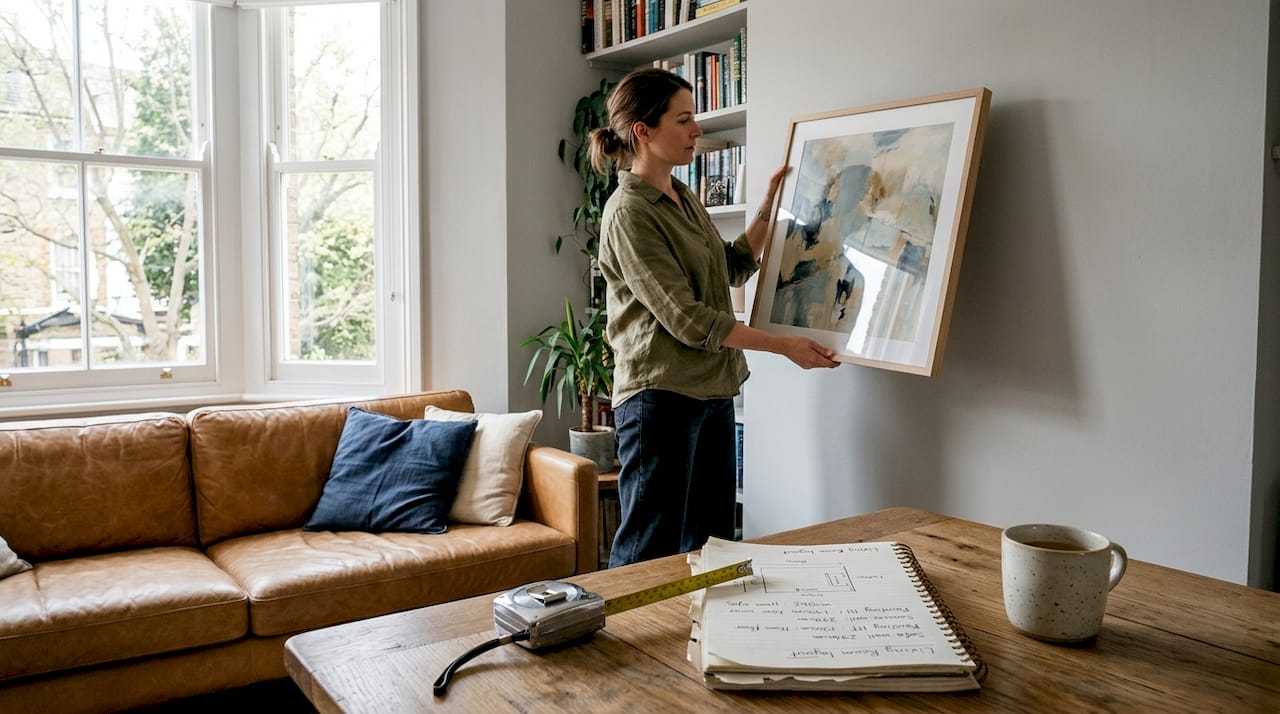
Selecting appropriate size requires balancing wall dimensions with viewing distance. A print should occupy 50% to 75% of available wall width to create presence without overwhelming the space. Measure your wall, then calculate this range before browsing options. A 240cm wide wall suits prints between 120cm and 180cm wide. Smaller prints disappear; larger ones cramp the composition.
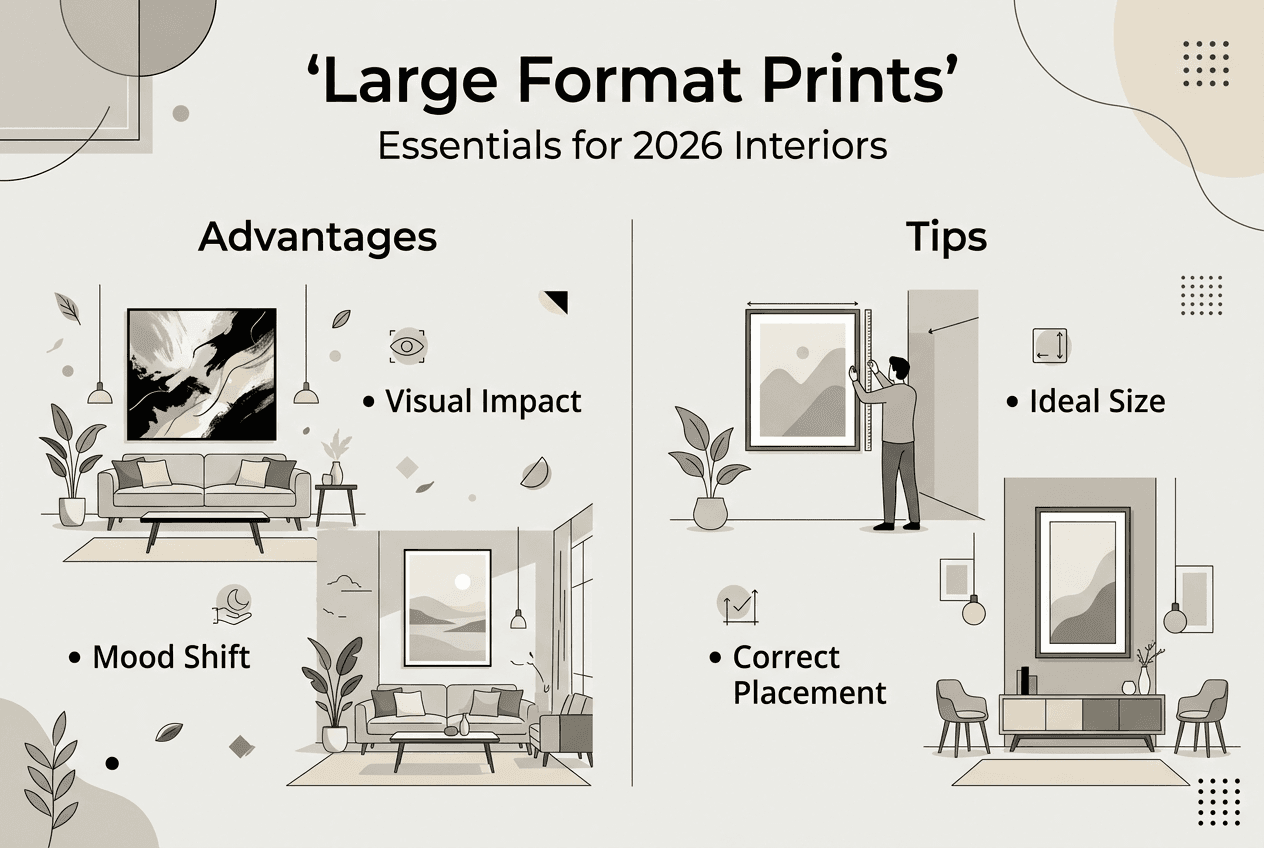
Viewing distance determines comfortable scale. Stand where you’ll typically view the print and extend your arm. Your print should span roughly the width of your extended arms. This natural proportion ensures you can appreciate the entire composition without excessive head movement. Pairing large prints with lighting and framing customisation enhances visual appeal and can increase investment value.
Lighting transforms how colours and details appear. Natural light brings out true colours but risks UV damage without protective glazing or coatings. LED track lighting offers controllable accent illumination that highlights textures in canvas prints. Position lights at 30 degree angles to minimise glare on glossy surfaces. Dimmable systems let you adjust intensity for different times of day or moods.
Installation requires proper preparation to protect both wall and artwork:
- Measure and mark the exact centre point where your print will hang
- Locate wall studs using a stud finder for secure mounting of heavy prints
- Use appropriate hardware rated for your print’s weight plus 50% safety margin
- Level the print carefully using a spirit level before final tightening
- Step back regularly during installation to verify positioning from viewing distance
- Adjust lighting angles after installation to eliminate unwanted reflections
Customisation opportunities extend far beyond size selection. You can incorporate brand colours for commercial spaces, adjust cropping to emphasise specific image elements, or add text overlays for thematic installations. Why customise wall art explores how personalisation creates unique pieces that reflect individual taste or corporate identity.
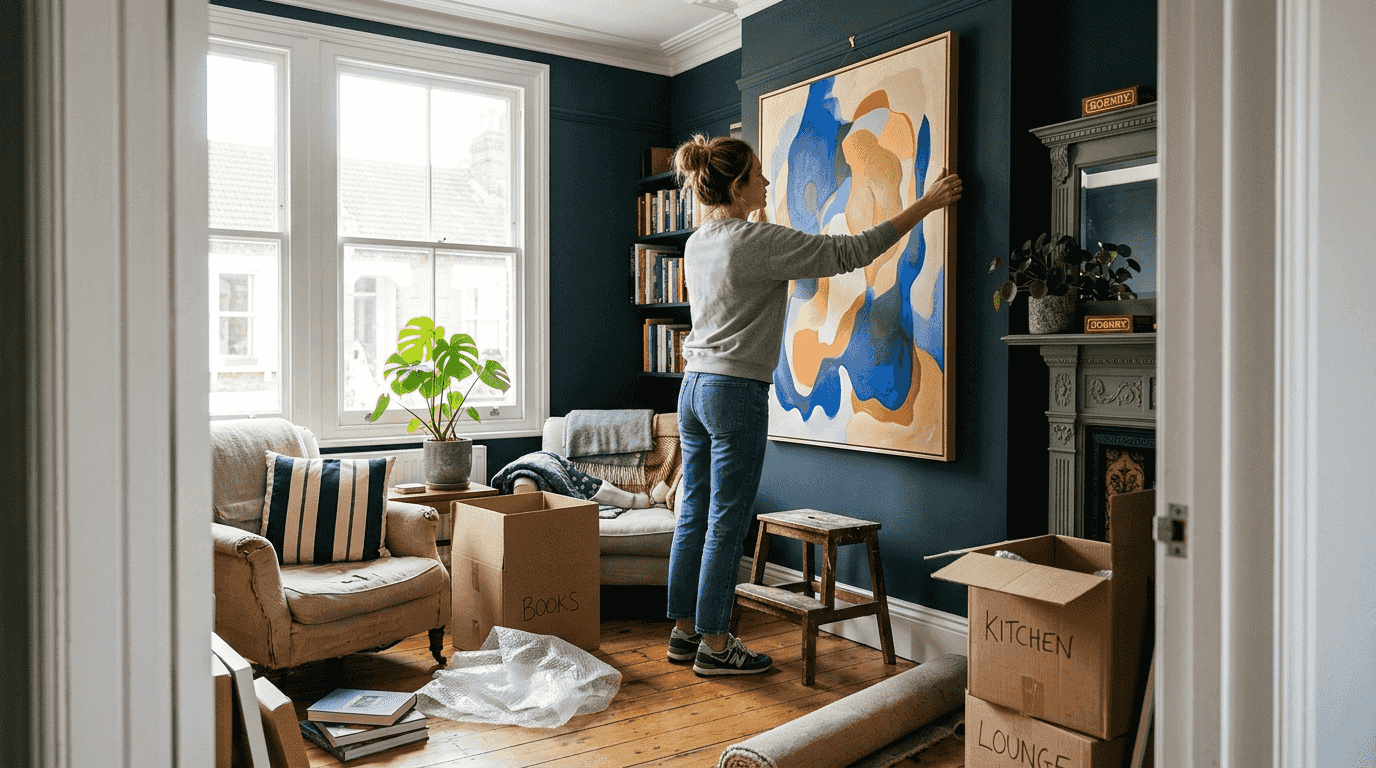
Pro Tip: Photograph your wall with furniture in place, then use image editing software to overlay potential prints at actual size to visualise the final result before ordering.
For commercial projects, consider how your large format print supports business objectives. Reception areas benefit from imagery that communicates brand values. Conference rooms work well with abstract pieces that stimulate creativity without distracting from presentations. Retail environments use large prints to establish atmosphere and guide customer flow through spaces.
Understanding large format art home impact helps residential clients appreciate how strategic placement affects daily life. A calming landscape in a bedroom promotes relaxation. Bold abstracts in living areas energise social gatherings. The same print creates different effects depending on context and surrounding elements.
Maintenance preserves your investment over decades. Dust canvas prints monthly with a soft, dry cloth using gentle strokes. Clean acrylic with microfibre cloths and non ammonia glass cleaner. Never spray directly onto prints; mist the cloth instead. Avoid hanging prints in direct sunlight or near heating vents where temperature fluctuations accelerate deterioration.
Discover custom large format prints at FrameTheWorld
Transforming your vision into reality requires a partner who understands both technical excellence and design aesthetics. FrameTheWorld specialises in bespoke large format printing services tailored precisely to your interior design needs, whether you’re enhancing a home or executing a commercial project. Our custom print service gives you complete control over dimensions, media selection, and finishing details.
Explore curated collections that suit diverse aesthetic preferences. The wabi sabi wall art collection embraces organic imperfection and natural textures, perfect for creating serene, contemplative spaces. For bold, energetic environments, browse our pop art wall art selection featuring vibrant colours and graphic impact. Each piece can be customised to your exact specifications, ensuring perfect integration with your design scheme.
Why use large format prints: frequently asked questions
What resolution is ideal for large format prints?
For prints viewed at normal distances, 150 DPI produces excellent results at large sizes because viewers stand further back. Smaller prints require 300 DPI for close viewing. AI upsampling can enhance lower resolution files to meet these standards without visible quality loss.
Can large format prints be customised for commercial branding?
Absolutely. Custom printing allows you to incorporate brand colours, logos, and messaging into artwork that reinforces corporate identity. You can adjust every element from colour profiles to finishing treatments to align with brand guidelines whilst maintaining artistic appeal.
How do I maintain and clean large prints to preserve quality?
Dust canvas prints monthly with a soft, dry cloth. Clean acrylic surfaces using microfibre cloths with non ammonia glass cleaner applied to the cloth, never directly on the print. Avoid direct sunlight and temperature extremes to prevent fading and material degradation.
Are large format prints a good investment for reselling?
Limited edition prints on archival materials appreciate over time, particularly when properly documented and maintained. Standard prints have minimal resale value. Premium materials, artist signatures, and edition numbering significantly enhance investment potential.
What are the best lighting conditions for displaying large prints?
LED track lighting at 30 degree angles provides excellent accent illumination without heat damage. Natural light shows true colours but requires UV protective glazing. Avoid direct sunlight on unprotected prints. Dimmable systems offer flexibility for different viewing conditions and times of day.

Leave a comment
This site is protected by hCaptcha and the hCaptcha Privacy Policy and Terms of Service apply.