
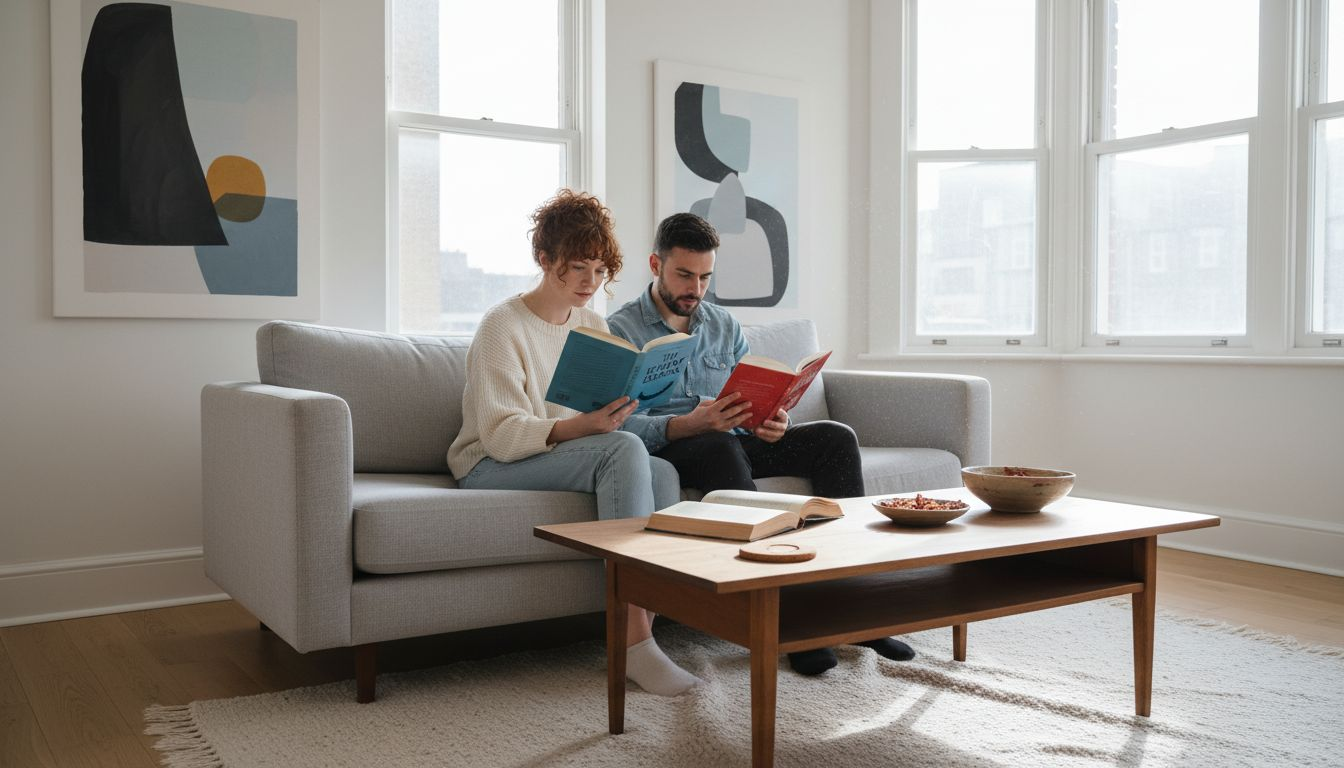
Struggling to create a home that feels both stylish and uniquely yours? Minimalist art offers homeowners in urban settings a way to express individuality through bold simplicity and geometric precision. Rooted in a chiefly American movement from New York City in the late 1960s, this artistic style strips back decoration to its core elements. Discover how embracing this reductionist philosophy can transform your living space into a sanctuary of calm and purposeful beauty.
Table of Contents
- Minimalist Art Defined: Core Principles And Origins
- Major Forms Of Minimalist Art In Contemporary Spaces
- Key Characteristics Of Minimalist Artworks Explained
- Common Misconceptions About Minimalist Art Aesthetics
- How Minimalist Art Transforms Home And Commercial Decor
Key Takeaways
| Point | Details |
|---|---|
| Defining Minimalism | Minimalist art focuses on simplicity and geometric precision, rejecting emotional expression in favour of objective visuals. |
| Forms of Minimalism | It encompasses various mediums, including painting, sculpture, and installation art, emphasising clean lines and material honesty. |
| Transformative Impact | Minimalist art enhances residential and commercial spaces by promoting spatial clarity and psychological calm, creating intentional environments. |
| Common Misconceptions | Minimalism is often misunderstood as simplistic; in reality, it demands deep conceptual engagement and skilled execution. |
Minimalist art defined: Core principles and origins
Minimalist art emerged as a radical departure from traditional artistic expression, representing a philosophical approach that strips creative work down to its most essential elements. Originating in the late 1960s, this movement fundamentally challenged existing artistic conventions by rejecting elaborate, emotionally charged representations.
The core principles of Minimalist art are grounded in profound simplicity and geometric precision. Artists embraced a reductionist philosophy that eliminated unnecessary decorative elements, focusing instead on pure form, fundamental shapes, and objective visual experiences. Key characteristics include:
- Extreme simplification of visual components
- Emphasis on geometric shapes and clean lines
- Rejection of personal emotional expression
- Use of industrial materials and standardised production techniques
- Prioritisation of visual perception over symbolic meaning
Historically, Minimalism developed as a direct response to Abstract Expressionism, which dominated the art world in the mid-20th century. Where Abstract Expressionists celebrated spontaneous, highly personal artistic gestures, Minimalist creators sought objectivity and universal visual language. They were influenced by earlier avant-garde movements like Russian Constructivism and the geometric abstractions of artists such as Kasimir Malevich.
Here is a comparison of Minimalist art and Abstract Expressionism to highlight their distinct philosophies:
| Aspect | Minimalist Art | Abstract Expressionism |
|---|---|---|
| Artistic Focus | Pure geometric form | Emotional gesture |
| Material Use | Industrial, standardised | Mixed, expressive |
| Visual Approach | Objective and universal | Highly personal |
| Colour Palette | Monochromatic or limited | Varied and dynamic |
| Viewer Experience | Contemplation and clarity | Emotional impact and spontaneity |
Minimalism represents art stripped to its most fundamental visual grammar, where every element serves a precise intentional purpose.
Pro tip: When incorporating Minimalist art into your decor, focus on pieces that demonstrate clean lines, monochromatic colour schemes, and deliberate geometric compositions.
Major forms of minimalist art in contemporary spaces
Minimalist art spans multiple creative disciplines, transforming contemporary artistic expression through purposeful simplification and geometric precision. This artistic approach manifests across various mediums, each sharing a commitment to essential visual language and material honesty.
The primary forms of minimalist art in contemporary spaces include:
-
Painting: Large canvas works featuring
- Monochromatic colour palettes
- Geometric shapes
- Precise, clean contours
- Unmodulated colour fields
-
Sculpture: Three-dimensional pieces characterised by
- Industrial materials like steel, fibreglass
- Geometric, simplified forms
- Emphasis on spatial relationships
- Minimal ornamental elements
-
Installation Art: Spatial experiences that
- Encourage viewer interaction
- Use repetitive geometric structures
- Explore architectural relationships
- Challenge traditional artistic boundaries
Influential artists like Donald Judd and Agnes Martin pioneered these approaches, creating works that stripped artistic expression to its most fundamental visual components. Their sculptures and paintings challenge viewers to appreciate pure form, spatial relationships, and material essence.
Minimalist art transforms spaces by reducing visual complexity, inviting contemplation through deliberate, essential design.
Contemporary minimalist art continues to evolve, using industrial materials and geometric forms to create powerful, understated visual experiences that transcend traditional decorative approaches.
Pro tip: When selecting minimalist art for your space, prioritise pieces with clean lines, neutral colour schemes, and deliberate geometric compositions that create visual breathing room.
Key characteristics of minimalist artworks explained
Minimalist artworks represent a profound artistic philosophy that reduces visual expression to essential elements. These pieces deliberately strip away unnecessary complexity, focusing on fundamental geometric forms, material integrity, and pure visual experience.
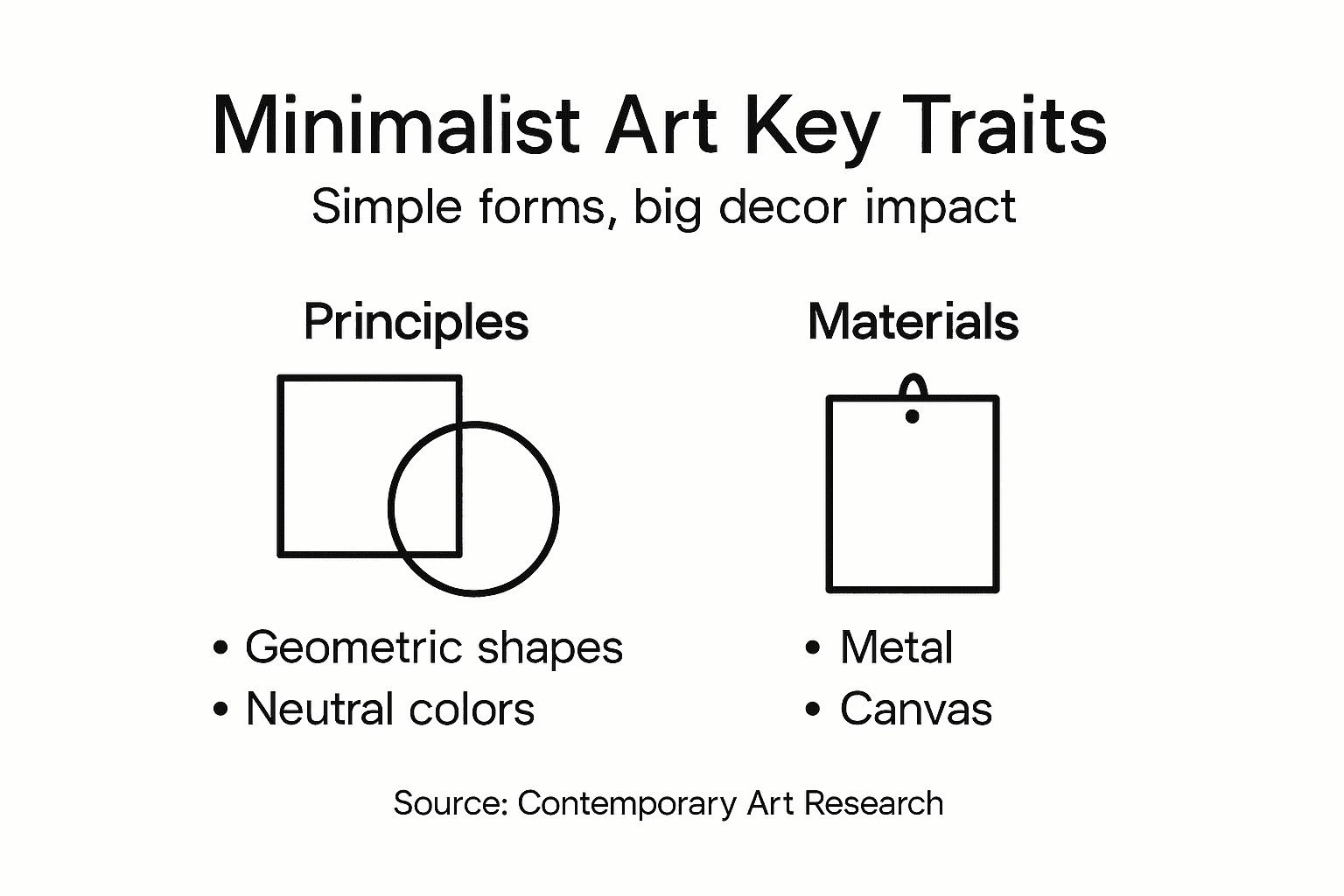
The core characteristics of minimalist artworks include:
-
Geometric Precision
- Predominant use of simple shapes
- Squares and rectangles as primary forms
- Strict geometric configurations
- Mathematically calculated proportions
-
Material Honesty
- Transparent presentation of materials
- Industrial materials like steel, concrete
- Unadorned surface textures
- Emphasis on inherent material qualities
-
Colour and Composition
- Limited, often monochromatic palettes
- Unmodulated, flat colour fields
- Precise, hard-edged boundaries
- Elimination of decorative elements
Spatial Engagement is another critical aspect of minimalist artworks. These pieces prioritise immediate visual response over symbolic representation, encouraging viewers to experience the artwork’s physical presence and spatial relationships.
Minimalist art transforms perception by removing narrative, leaving only pure form and material essence.
By rejecting emotional expression and external references, minimalist artworks create a direct, unmediated visual experience that challenges traditional artistic conventions.
Pro tip: When appreciating minimalist art, focus on the artwork’s spatial presence, material qualities, and geometric relationships rather than seeking narrative or emotional meaning.
Common misconceptions about minimalist art aesthetics
Minimalist art is frequently misunderstood, with many people incorrectly perceiving it as simplistic. Far from being shallow, this artistic approach demands profound intellectual and visual engagement that challenges traditional artistic expectations.
Common misconceptions about minimalist art include:
-
Misconception: Lack of Complexity
- Assumption: Art must be intricate to be meaningful
- Reality: Intentional reduction reveals deeper truths
- Minimalism requires sophisticated conceptual understanding
- Simplicity is a deliberate artistic choice
-
Misconception: Emotional Emptiness
- Assumption: Absence of narrative means no emotional content
- Reality: Provokes contemplation through pure form
- Invites personal interpretation and emotional response
- Challenges viewer’s perceptual expectations
-
Misconception: Lack of Artistic Skill
- Assumption: Simple designs require less artistic talent
- Reality: Precise geometric configurations demand exceptional skill
- Requires deep understanding of spatial relationships
- Mathematically calculated compositions
Minimalist artists deliberately reject narrative complexity to create works that explore fundamental relationships between object, space, and viewer. This approach demands active intellectual engagement rather than passive observation.
Minimalist art is not about removing meaning, but about distilling experience to its most essential visual language.
By challenging traditional artistic conventions, minimalist art invites viewers to experience pure form, material integrity, and spatial relationships with unprecedented clarity and depth.
Pro tip: When encountering minimalist art, approach it with curiosity and openness, allowing yourself to explore the subtle nuances of form, material, and spatial composition.
How minimalist art transforms home and commercial decor
Minimalist art revolutionises contemporary design by creating purposeful visual environments that transcend traditional decorative approaches. By emphasising spatial clarity and intentional design, minimalist artworks transform both residential and commercial spaces into sophisticated, psychologically harmonious settings.
Key transformative elements of minimalist art in decor include:
-
Spatial Clarity
- Reduces visual clutter
- Creates sense of openness
- Enhances psychological calm
- Promotes mindful interaction with environment
-
Material Authenticity
- Highlights inherent material qualities
- Uses industrial materials strategically
- Celebrates structural integrity
- Eliminates unnecessary ornamentation
-
Psychological Impact
- Supports mental decluttering
- Reduces sensory overwhelm
- Promotes intentional living
- Encourages contemplative experiences
Consumer minimalism fundamentally reshapes interior design by prioritising functional simplicity over decorative excess. This approach transforms spaces from mere aesthetic environments to carefully curated experiences that reflect deeper lifestyle philosophies.
Minimalist art turns spaces into statements of intentional living, where every element serves a deliberate purpose.
By integrating minimalist art, designers and homeowners can create environments that are not just visually striking, but psychologically supportive and deeply meaningful.
This reference table summarises how minimalist art influences different decor settings:
| Setting | Impact of Minimalist Art | Resulting Atmosphere |
|---|---|---|
| Residential | Enhances spatial clarity | Calm and serene |
| Commercial | Promotes intentional design | Sophisticated and uncluttered |
| Public Spaces | Invites mindful interaction | Contemplative and open |
Pro tip: When incorporating minimalist art, focus on pieces that create visual breathing room and promote a sense of calm through deliberate, thoughtful placement.
Elevate Your Space with Authentic Minimalist Art
Minimalist art transforms interiors by focusing on essential forms, material honesty, and spatial clarity as highlighted in the article. If you seek to reduce visual clutter and create a calming atmosphere through purposeful design, finding artworks that embody geometric precision and monochromatic palettes is vital. Many struggle to curate pieces that truly resonate with minimalist principles without losing emotional depth or sophistication.
Discover a curated selection of contemporary minimalist artworks at Contemporary Minimalist Art | Modern Hand Painted Wall Art crafted to bring deliberate simplicity and profound impact into your home or commercial space. At Frametheworld.co.uk, you can browse, customise, or commission pieces tailored to your specific spatial and aesthetic goals. Explore how minimalist art can declutter your environment and foster a mindful, inviting experience. Start transforming your space today with art that speaks the universal language of minimalism.
Frequently Asked Questions
What is minimalist art?
Minimalist art is an artistic movement that emerged in the late 1960s, characterised by extreme simplification and geometric precision. It focuses on stripping away unnecessary elements to highlight pure form and visual experience.
How does minimalist art differ from Abstract Expressionism?
Minimalist art emphasizes pure geometric form and objective visual experiences, whereas Abstract Expressionism is centred on emotional gestures and personal expressions. Minimalism seeks clarity, while Abstract Expressionism values emotional impact.
What are the key characteristics of minimalist artworks?
Key characteristics of minimalist artworks include geometric precision, material honesty, limited colour palettes, and spatial engagement. They focus on simple shapes and inherent material qualities to create impactful visual experiences.
How can minimalist art enhance home decor?
Minimalist art enhances home decor by creating spatial clarity, promoting psychological calm, and using materials authentically. It transforms spaces into sophisticated environments that reflect intentional living and reduce visual clutter.


Leave a comment
This site is protected by hCaptcha and the hCaptcha Privacy Policy and Terms of Service apply.