
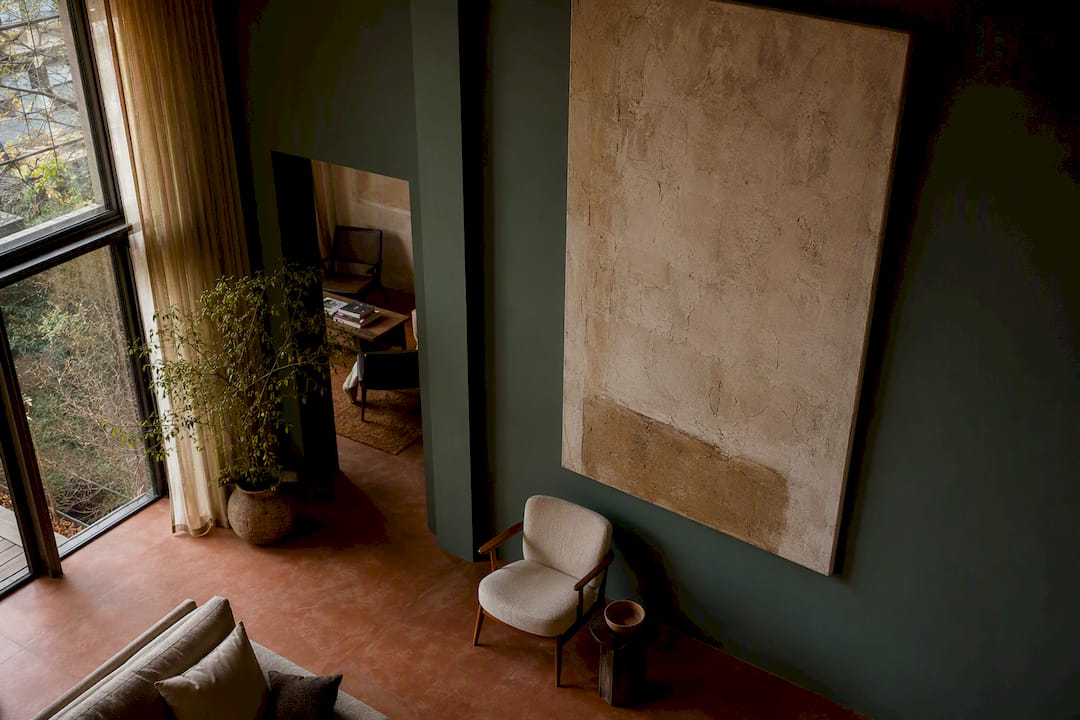
A single oversized artwork or a tightly composed vertical gallery is the fastest route to a high-ceiling wall that looks finished rather than empty. Tapestries, mirrors, and full-height murals all work as strong alternatives when a framed piece isn’t right. Get the scale correct first (the sizing section below covers exact measurements), then move on to installation, which has its own safety rules once you’re working above ladder height.
TL;DR:
- Oversized single-piece art works best on clear, unbroken walls behind furniture, avoiding spaces with doors or radiators that break the flat surface.
- Gallery walls or triptychs are ideal for stairwells and double-height rooms, with consistent framing and spacing to maintain visual coherence.
- Art sized at roughly four to six feet in height is recommended for ceilings over 10 feet, with width about two-thirds of the furniture below.
- Proper installation requires mapping fixing points, using wall fixings rated for weight, and employing safety equipment like scaffold for large or heavy pieces.
- For rooms with hard floors and bare walls, textiles, panels, or mirrors can improve acoustics and aesthetics better than framed art.
Table of Contents
- Best approaches for art for high ceilings
- How big should art be for a high-ceiling room?
- Planning a gallery wall or ascending display
- Textiles, panels and mirrors as alternatives to framed art
- How to hang art safely on a tall wall
- Lighting and styling large art correctly
- When standard sizes don’t fit: bespoke commissions
- Getting the scale right matters more than the style
- Find large-format art for your space
- Sources
Best approaches for art for high ceilings
Tall walls punish small art. A 40cm print that looks generous above a console table in a standard room reads like an afterthought on a wall that runs 4 metres to the cornice. The fix isn’t always one enormous canvas, though that’s the obvious starting point.
- Oversized single-piece art: works best on a clear, unbroken wall behind a sofa, bed, or dining table, and gives an instant anchor with minimal decision fatigue. It struggles on walls broken up by doors, windows or radiators, where there simply isn’t the flat run needed.
- Vertical gallery walls or triptychs: ideal for stairwells, double-height living rooms and landings, where a single canvas would be awkward to hang or transport. Grouped frames read as one visual mass when the spacing and framing stay consistent.
- Tapestries and heavyweight textiles: bring warmth and softness, plus a genuine acoustic benefit in rooms with hard floors and bare walls.
- Mirrors: bounce light up a tall wall and visually widen a narrow room, particularly useful in stairwells with limited natural light.
- Murals, wallpaper and millwork: skip the framing question entirely and treat the whole wall as the canvas.
Big, bold statement pieces or grouped gallery walls consistently outperform scattered small frames on tall walls, according to design guides that catalogue tall-wall solutions across dozens of real rooms.
How big should art be for a high-ceiling room?
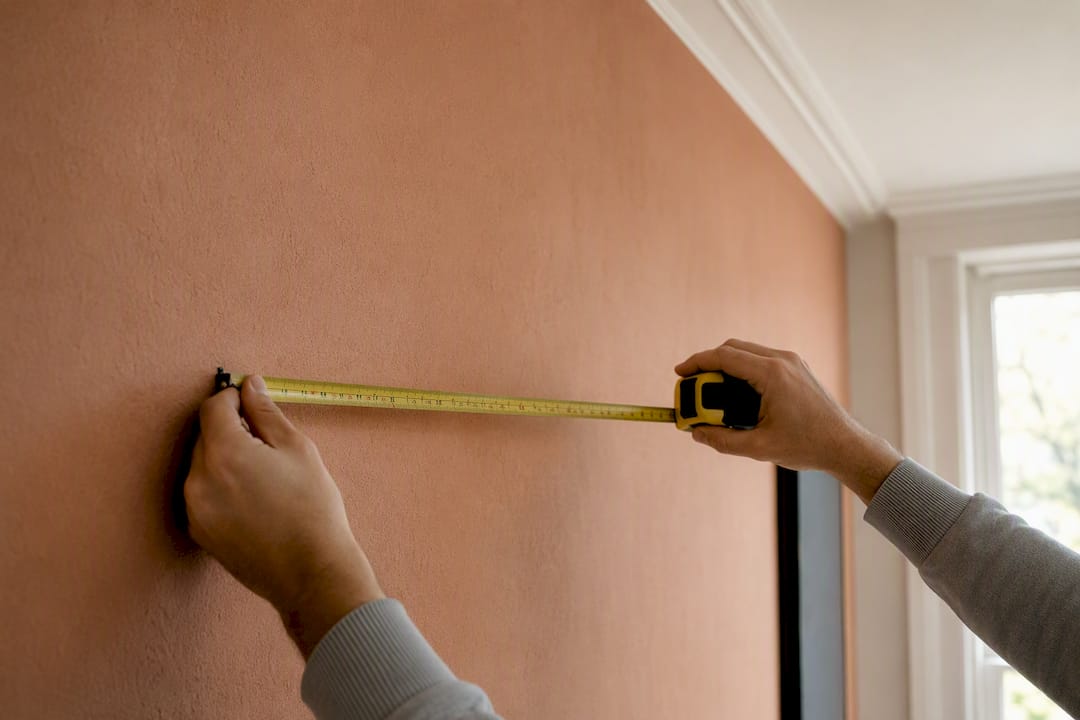
There’s a formula behind this, not just instinct. Designers recommend an artwork height of roughly 4 to 6 feet for ceilings above 10 feet, with width sitting at about two-thirds of the furniture it hangs above, whether that’s a sofa, sideboard, or headboard. Below that ceiling height, the same ratio still applies, just at a smaller scale.
Viewing distance matters too. A piece you’ll only glance at from across a hallway can sit smaller than one you’ll be looking at from a sofa 3 metres away, where a bigger canvas actually reads as more comfortable, not more overwhelming.
| Ceiling height | Suggested art height | Notes |
|---|---|---|
| 10 ft | 4 ft | Pair with furniture-width rule for sofas and consoles |
| 10 ft | 5 ft | Consider a triptych to fill width without one huge panel |
| above 10 ft | 6 ft or full-height mural | Gallery walls or wallpaper murals often work better than a single frame |
If you’re buying online rather than in a gallery, use an AR preview tool or a stylist consultation before committing. It catches the classic mistake of ordering something that looks right on screen and arrives looking undersized on the wall. Our own guide to selecting art size for your home walks through the same measuring process in more detail.
Planning a gallery wall or ascending display
Composition matters as much as size once you’ve settled on a multi-piece approach. Get the spacing wrong and even beautiful individual prints look like clutter.
- Fix your gaps first. Leave 5 to 8cm between frames in a grid; anything tighter looks cramped, anything wider breaks the visual connection between pieces.
- Anchor to a centreline. For a staircase, align the centre point of each frame along the pitch of the stairs rather than levelling every frame horizontally.
- Build ascending displays in odd numbers. Three or five frames climbing a stairwell reads more deliberately than an even, symmetrical run.
- Centre a triptych on the furniture below it, not on the wall itself, so the composition ties visually to the sofa or bed rather than floating independently.
- Leave generous negative space around the whole arrangement. A grid crammed edge to edge with no breathing room looks busy no matter how good the individual pieces are.
Our gallery wall styling guide breaks this down further with layout templates you can trace directly onto your wall.
Textiles, panels and mirrors as alternatives to framed art
Framed canvas isn’t the only answer, and sometimes it isn’t the best one.
- Heavyweight textile hangings soften hard-floored, echoey rooms in a way that glass-fronted frames simply can’t.
- Sculptural or three-dimensional panels add shadow and depth, which reads well from a distance in a way flat prints sometimes don’t.
- Large mirrors need proper wall fixings rated for their weight; a mirror over 1.2 metres tall should go on a stud or a rated anchor, never adhesive strips.
- Full-height mural wallpaper, available in dimensions as large as 208 by 132 inches, suits a wall you want to treat as one immersive surface rather than a frame you hang on it.
Pro Tip: If a room has bare floors and a lot of hard surfaces, choose a fabric-backed hanging over a framed print in at least one spot. It genuinely cuts down on echo, not just visual clutter.
How to hang art safely on a tall wall
Reach is the real constraint here, not taste. A domestic stepladder tops out well below the point where most double-height walls need attention, and that’s where people get hurt or damage a piece trying to improvise.
- Map your fixing points before you buy. French cleats distribute weight along a batten rather than a single hook, which matters for anything over roughly 15kg.
- Use a picture rail system for flexibility if you expect to rearrange pieces later, since it avoids repeated wall damage.
- Rule out ladders above roughly 3.5 metres. Scaffold towers or podium steps with proper safety rails are the standard here, not a taller ladder.
- Book a site survey for anything oversized or unusually heavy. An installer can confirm wall construction (masonry, stud, or lath and plaster all take fixings differently) before the piece arrives.
- Check door and stairwell clearance in advance if you’re bringing in a large panel; getting a 2 metre canvas up a narrow staircase is a genuinely common failure point people don’t plan for.
Installation guides consistently flag that scaffold and pulley systems, not tall ladders, are the professional standard for heavy or double-height pieces, largely because a secured platform lets an installer work with both hands free rather than balancing.
Lighting and styling large art correctly
Big art needs light that matches its scale, or it disappears into shadow the moment the sun moves. Picture lights mounted just above the frame work well for single statement pieces; track lighting angled at 30 degrees gives more even coverage across a gallery wall or triptych.
- Warm white bulbs (around 2700K) flatter most paint palettes and hand-painted textures better than cool daylight bulbs.
- Position seating to face the artwork directly, turning it into the room’s visual centre rather than something glimpsed sideways.
- Use a contrasting wall colour, or a curtain treatment that frames rather than competes, to stop a large piece from blending into the wall behind it.
Pro Tip: Test lighting after dark before committing to fixture positions. A picture light that looks perfect at noon can throw an odd shadow once the room’s ambient light drops. If you’re also reworking window treatments in the same room, this guide to layering curtains and texture pairs well with large-scale wall art without fighting it for attention.
When standard sizes don’t fit: bespoke commissions
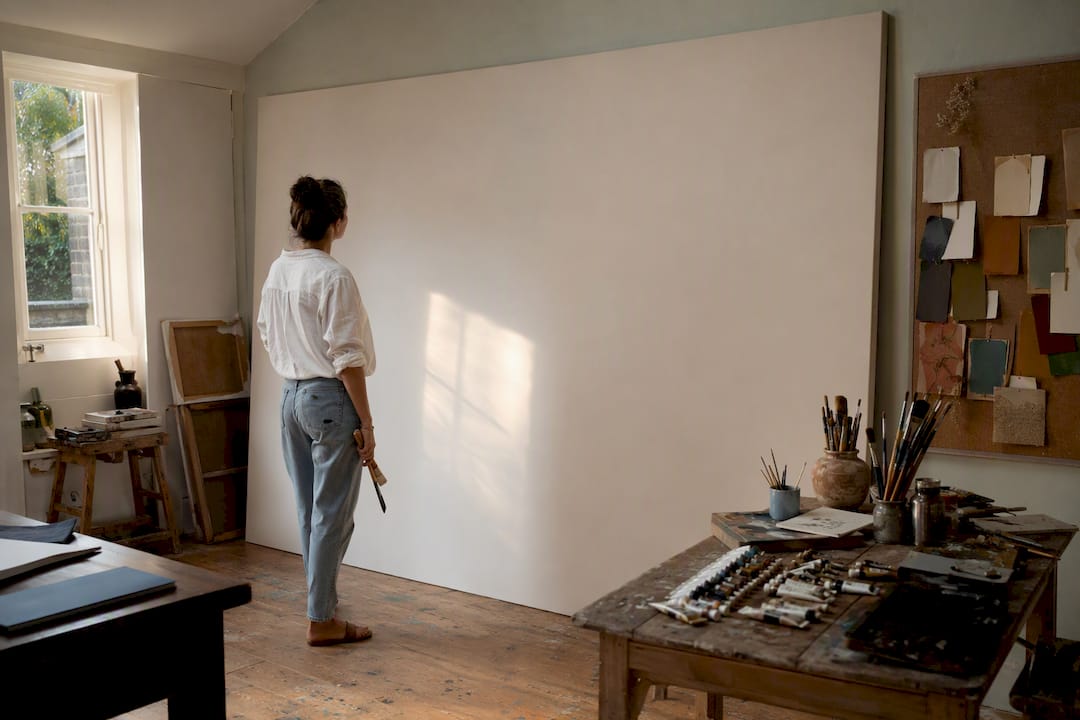
Not every high-ceiling wall matches a stock canvas size, and forcing one to fit rarely looks intentional. Frametheworld builds hand-painted pieces to the exact dimensions a room needs, which solves the awkward gaps that off-the-shelf art can’t. That matters most on double-height stairwells, vaulted living rooms, or unusually proportioned walls where a standard 120 by 90cm print leaves visible dead space on either side.
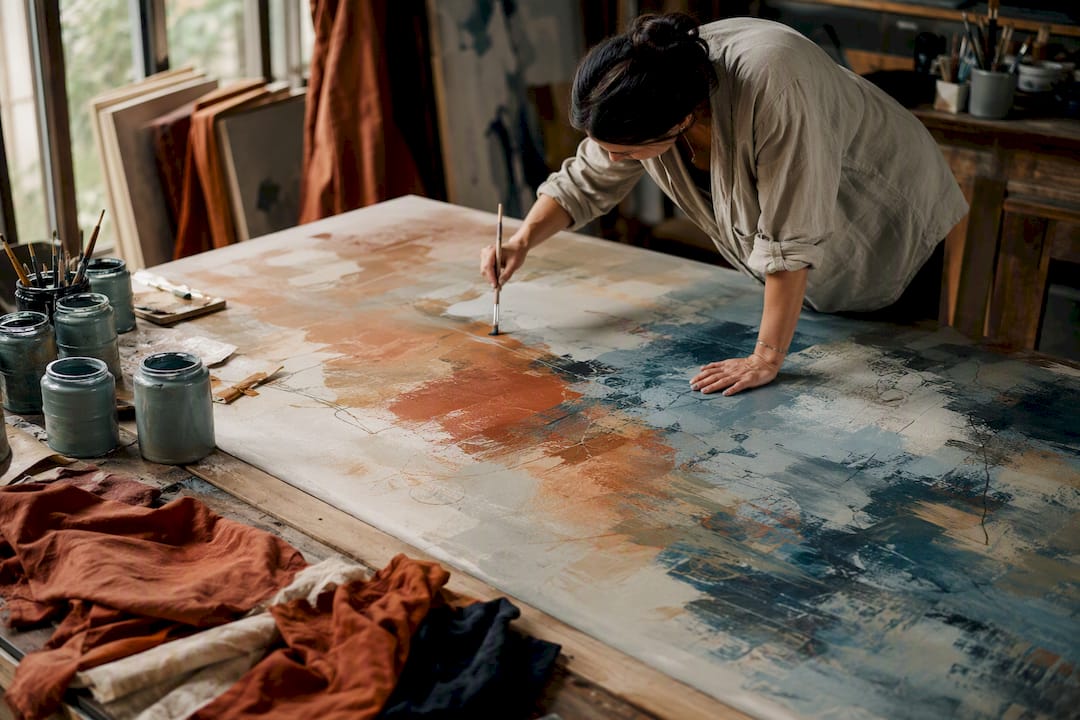
Standard oversize prints are the right call when a wall is a common size and budget matters more than an exact match. Bespoke work earns its cost on the walls where nothing standard quite fits, or where the room calls for a specific colour palette tied to existing furnishings.
Getting the scale right matters more than the style
Most rooms with high ceilings don’t need more art choices, they need the existing choice sized correctly. The single mistake I see most often is buying at a size that felt bold in a shop or on screen, then watching it shrink once it’s on the wall. Measure the wall and the furniture below it first, and if nothing standard fits, ask for a bespoke quote before compromising.
— Lennard
Find large-format art for your space
If oversized canvas or vertical galleries are the direction you’re leaning, Frametheworld’s Wabi Sabi collection offers hand-painted, texture-rich pieces built at the kind of scale a tall wall actually needs, while the Pop Art collection suits rooms wanting something bolder and more graphic. Both are genuine alternatives to the wallpaper murals and mirror solutions covered earlier, without the transport headaches that come with panel-sized wallpaper rolls.
Where a stock size still leaves a gap, Frametheworld’s commissioning process builds artwork to your wall’s exact dimensions, colour palette, and style brief, so measure your wall, note your ceiling height, and get in touch for a bespoke quote or an install site survey. Browse the full collection if you’re still narrowing down a direction.
Sources
- 30 Beautiful Ideas on How to Decorate Tall Walls | Remodelaholic
- Large Wall Art Ideas | Minted
- Hillrise Mural Wallpaper, 208" x 132"

Leave a comment
This site is protected by hCaptcha and the hCaptcha Privacy Policy and Terms of Service apply.