
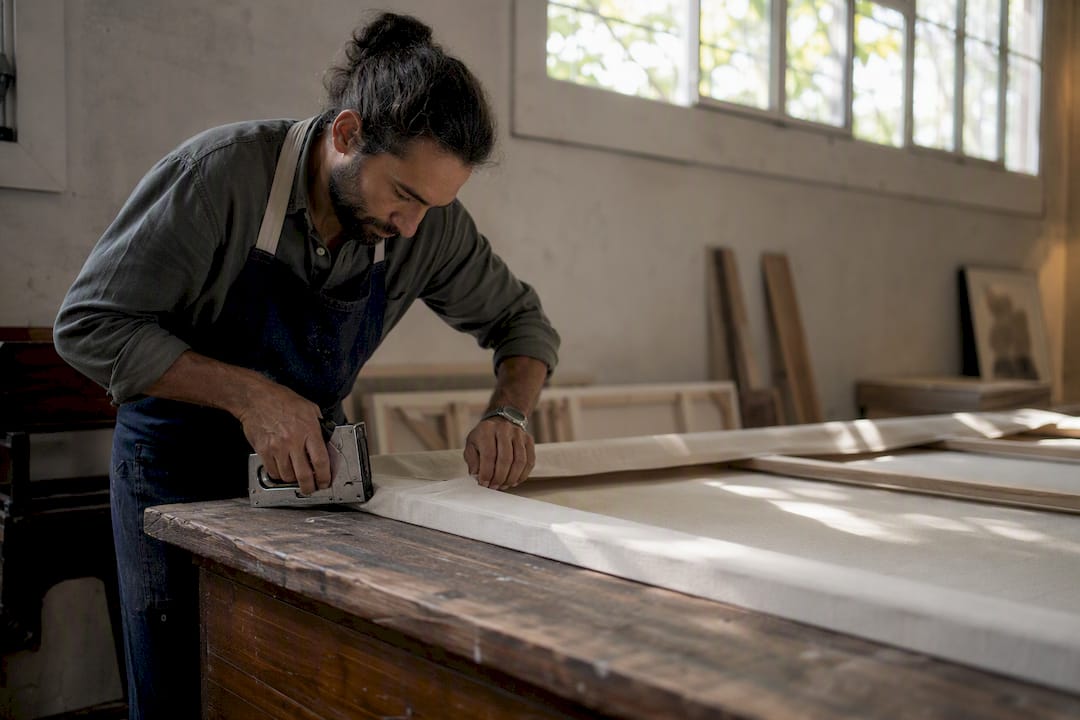
A gallery wrap is a canvas printed or painted and stretched over deep stretcher bars so the image continues around the sides, with no visible staples and no frame needed. It hangs straight off the wall, ready to go. The trade-off worth knowing before you order or make one: most gallery wraps use bars of typical depths around a little over one inch, though some use thinner or thicker bars varying up to a couple of inches, and whatever sits within that wrapped depth either disappears or gets duplicated onto the side.
- Frameless, modern presentation
- Image or paint extends around the stretcher sides
- Typical depth: 1.25 inches, with a range up to 2.4 inches on some builds
Key Takeaways
A gallery wrap canvas delivers a frameless, contemporary finish only when deep stretcher bars, hand-stretching, and proper curing are all present together.
| Point | Details |
|---|---|
| Definition matters | A gallery wrap wraps canvas around stretcher bars with staples hidden at the back, no frame required. |
| Depth affects the look | Standard depths run around 1.25 inches, with some builds reaching 2.4 inches for a bolder presence. |
| Edge treatment is a real choice | Mirrored, cloned, solid-colour, or blurred edges each suit different compositions, choose before printing. |
| Quality checklist beats guesswork | Check stretcher material, canvas gsm, curing, UV coating, and hand-stretching before buying. |
| Professional finish for larger or valuable pieces | Frametheworld hand-stretches custom gallery wraps with UV-finish options for lasting colour and flat tension. |
Table of Contents
- How is a gallery wrap canvas made?
- How does gallery wrap differ from studio wrap, museum wrap, and framed canvas?
- What edge and finish options work best?
- How do you spot a high-quality gallery wrap?
- Can you stretch a gallery wrap canvas yourself?
- How should you care for a gallery wrap canvas?
- When does a hand-stretched commission actually earn its price?
- Get a custom gallery wrap made properly, the first time
- Frequently asked questions
- Sources
How is a gallery wrap canvas made?
The canvas gets pulled taut over a wooden stretcher frame and folded around the back, where staples or tacks hold it in place, invisible from the front or sides. That’s the whole trick: everything unsightly ends up out of sight. Gallery wrap, as defined on Wikipedia, describes exactly this method, and it’s why the format reads as frameless rather than unfinished.
Stretcher depth matters more than most buyers realise. A shallow 0.75 inch bar gives a slim, almost floating look; a 1.5 to 2 inch bar gives real presence on a wall and reads better from across a large room, as seen in this media wall installation example for modern homes. Deeper bars also resist warping better over time.
- Canvas weight (measured in gsm) affects both texture and how crisply detail prints
- Museum-grade cotton canvas holds ink better than poly-cotton blends but costs more
- Solid pine or kiln-dried hardwood stretcher bars resist warping; thin softwood bars don’t
- Wrapping consumes image area, so mirroring, cloning, or adding a solid-colour border are the standard fixes
How does gallery wrap differ from studio wrap, museum wrap, and framed canvas?
The terms get used loosely, which causes real confusion at checkout. Here’s the practical distinction: “studio wrap” and “gallery wrap” often mean the same construction, but studio wrap sometimes uses shallower, cheaper bars, while gallery wrap implies the deeper, gallery-quality build with a finished edge. “Museum wrap” usually means the image stops at the front and the sides are left blank or painted a solid colour, a cleaner look for minimalist interiors. Framed canvas, by contrast, sits inside a traditional wooden or metal moulding, which hides the stretched edge entirely and suits ornate or classical settings.
- Gallery wrap and studio wrap: near-identical construction, watch for bar depth and staple placement
- Museum wrap: solid-colour or blank sides, no continued image
- Framed canvas: needs a frame, hides the wrap, works for heavier or period decor
- Rule of thumb: choose gallery wrap for a contemporary, frameless look, choose framed canvas when the room calls for a defined border
A floating frame sits somewhere between the two, adding a thin border that doesn’t touch the image, useful when a gallery wrap feels too bare for the wall it’s going on.
What edge and finish options work best?
Four approaches dominate: mirrored (or continued) image, cloned border, solid colour, and a soft blurred edge. Mirrored wraps reflect the image back on itself around the side, which suits landscapes and panoramic shots where the edge content is fairly uniform. Cloned edges duplicate a strip of nearby pixels, a safer bet for portraits or tight crops where mirroring would look distorted. Solid-colour sides give the cleanest, most gallery-like finish and work well for graphic or high-contrast pieces. Framers at Rosenbaum Framing note that a cloned or wrapped edge preserves the frontal composition better than a hard, unadjusted crop.
- Mirrored: best for panoramas and textured backgrounds
- Cloned: best for portraits and tight crops
- Solid colour: cleanest, most contemporary finish
- Blurred edge: softens a busy background without duplicating detail
Pro Tip: If your subject sits close to the frame edge, print with an extra 3 to 5cm of margin on each side. That buffer lets your framer choose the edge treatment after the fact, rather than being forced into cloning by a tight crop.
How do you spot a high-quality gallery wrap?
Quality shows up in details most buyers never think to check. Run through this before you commit to a supplier or a finished piece:
- Stretcher depth and material. Solid pine or hardwood bars, not thin plywood strips that flex under tension.
- Canvas weight. Heavier gsm canvas holds detail and resists sagging better than thin, budget stock.
- Cured inks and UV coating. Ask whether prints are cured before stretching and finished with UV protection; reputable labs build multi-day curing and UV coats into their process rather than rushing straight to delivery.
- Hand-stretched vs machine-stretched. Hand-stretching with proper canvas pliers gives finer, more even tension control, particularly on larger sizes where machines can leave slack corners.
- Corner finish. Tidy, flat folded corners without bunching signal a careful stretch; puckered corners often mean rushed or uneven tension.
Warning signs to walk away from: visible staples on the front-facing edge, a canvas that feels loose or drum-tight to the point of stress, or a supplier who can’t tell you curing times. Ask directly about lead times, return policy, and whether framing options are available later if you change your mind.
On cost, expect gallery wraps to sit above standard framed prints of the same size once you account for deeper stretcher bars, more canvas, and hand-finishing labour. Size, canvas grade, and whether the work is hand-painted or printed all move the price, and a bespoke commission naturally costs more than an off-the-shelf print.
Can you stretch a gallery wrap canvas yourself?
You can, and it’s a satisfying weekend project if the piece isn’t irreplaceable. Here’s what you need and how it goes.
Tools and materials: stretcher bars (pine or kiln-dried hardwood), canvas pliers, a staple gun with rust-resistant staples, and a print with at least 3 to 5cm of extra margin on every side.
- Assemble the stretcher frame and check it sits square.
- Lay the canvas face-down and centre the print, using your margin allowance to line up the image correctly.
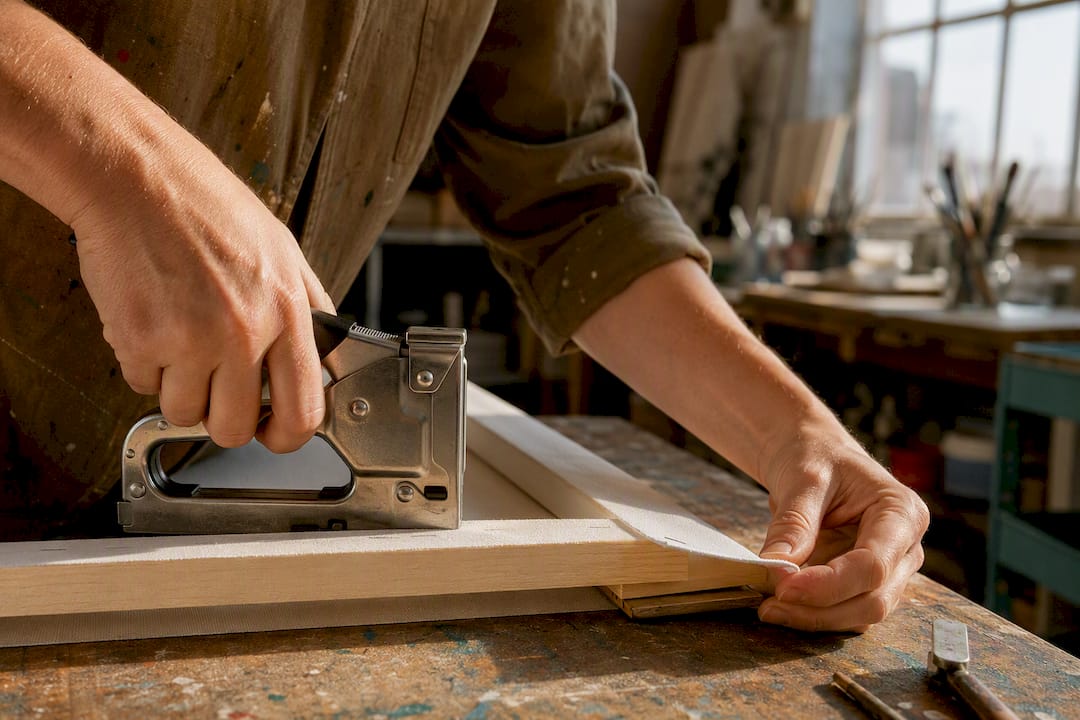
- Pull the canvas taut over one side and staple the centre, then repeat on the opposite side.
- Work outward from the centre staples in thirds, alternating sides to keep tension even, the same staged method professional stretchers use to avoid diagonal warping.
- Fold the corners neatly, mitring the excess fabric, and secure with final staples.
- Inspect the front for ripples, loose spots, or visible staples before hanging.
Common mistakes: over-tensioning, which can tear canvas or bow the stretcher bars over time, and skipping the curing period on printed canvas, which risks ink cracking once the fabric flexes into shape. For anything large, archival, or simply too valuable to risk, commissioning a professional hand-stretch is the safer call, particularly for large-format pieces where uneven tension shows most.
Pro Tip: Staple in thirds and alternate sides rather than working straight across. It’s the single biggest factor separating an amateur stretch from one that hangs flat for years.
How should you care for a gallery wrap canvas?
Keep it out of direct sunlight, which fades pigment and can dry the canvas unevenly, and avoid rooms with fluctuating humidity or grease in the air, kitchens and bathrooms are the usual culprits. A stable, moderate environment does more for longevity than any coating.
- Dust gently with a soft, dry cloth or a low-suction brush attachment
- Avoid liquids or cleaning sprays; a damp cloth only if genuinely necessary, and never on painted or heavily inked areas
- Minor dents or slack can sometimes be corrected by adjusting the stretcher’s internal wedges, a job best left to a framer
- Curing time and UV coating during production matter here too, they’re what stop colours shifting or cracking years down the line
- For valuable or inherited pieces showing damage, get proper conservation advice rather than attempting a fix
If you’re building out a wall composition rather than hanging a single piece, styling a gallery wall properly also protects individual canvases from bumps and uneven light exposure.
When does a hand-stretched commission actually earn its price?
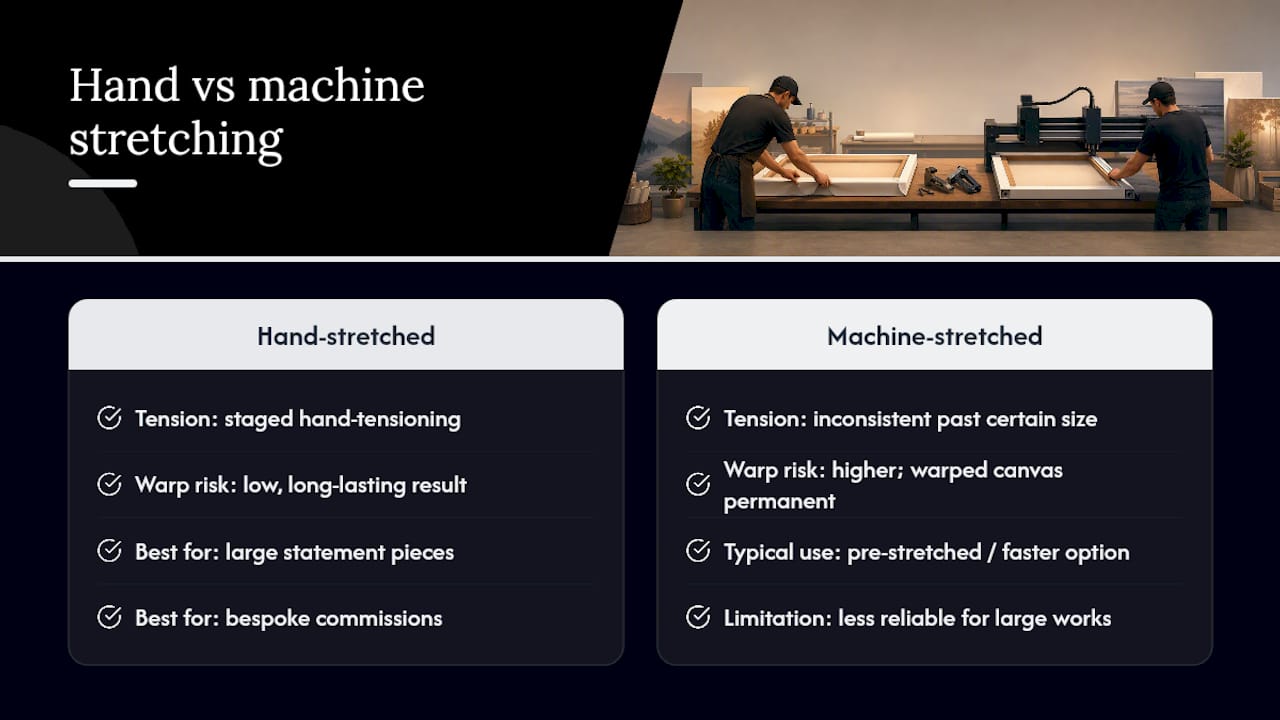
Frametheworld leans towards hand-stretching for one straightforward reason: machine tension is inconsistent past a certain size, and a warped canvas is a permanent flaw, not a cosmetic one. For large statement pieces, bespoke commissions, and anything painted rather than printed, the staged hand-tensioning method gives a flatter, longer-lasting result than a rushed pre-stretched frame. That’s the case for most bespoke and larger commissions coming through, where the wall, not the budget, sets the size.
Get a custom gallery wrap made properly, the first time
If you’d rather skip the pliers and staple gun altogether, Frametheworld builds custom gallery wraps to order, hand-stretched over solid stretcher bars with UV-finish options for durability. That’s the practical difference over a DIY attempt or a mass-market print: no risk of uneven tension on a large piece, no guessing on curing times, and a finish built to hang flat for years rather than months.
- Custom sizes to fit your exact wall space
- Hand-stretching with staged, even tension control
- Optional UV protective coating for lasting colour
Browse the Wabi Sabi collection for hand-painted textured pieces suited to bespoke gallery-wrap commissions, or explore Pop Art wall art if you want something bold and ready to order now. Either way, get in touch for a quote and Frametheworld will talk you through sizing, depth, and edge options before anything goes to production.
Frequently asked questions
What does gallery wrap mean exactly? It means the canvas is stretched over stretcher bars deep enough that the sides become part of the display, with the image or paint continuing around them and staples hidden on the back.
Is gallery wrap better than a framed canvas? Neither is universally better. Gallery wrap suits a modern, frameless room; framed canvas suits period interiors or anyone wanting a defined border around the piece.
What stretcher depth should I choose? Around 1.25 inches works for most rooms and sizes. Go deeper, up to 2 inches or more, for large statement pieces that need to hold visual weight from across a room.
Can I turn any printed image into a gallery wrap myself? Only if you printed it with extra margin, roughly 3 to 5cm per side. Without that allowance, the wrap will crop or distort key parts of the image.
How long does a professional gallery wrap take to make? Lead times vary by supplier, but factor in printing, a multi-day curing period, UV coating, and hand-stretching, rushing any of these stages risks cracked ink or uneven tension later.
Sources
For deeper technical grounding, the Wikipedia entry on gallery wrap covers the method’s origins and standard construction. Yellow Lab Imaging’s production notes detail curing and UV-coating practice, and Rosenbaum Framing’s guide breaks down edge-treatment trade-offs for photographers and artists alike.
- Gallery wrap — Wikipedia
- Canvas Gallery Wraps – Premium Online Photo Printing | Yellow Lab Imaging
- Guide to Gallery Wraps - Rosenbaum Framing


Leave a comment
This site is protected by hCaptcha and the hCaptcha Privacy Policy and Terms of Service apply.