
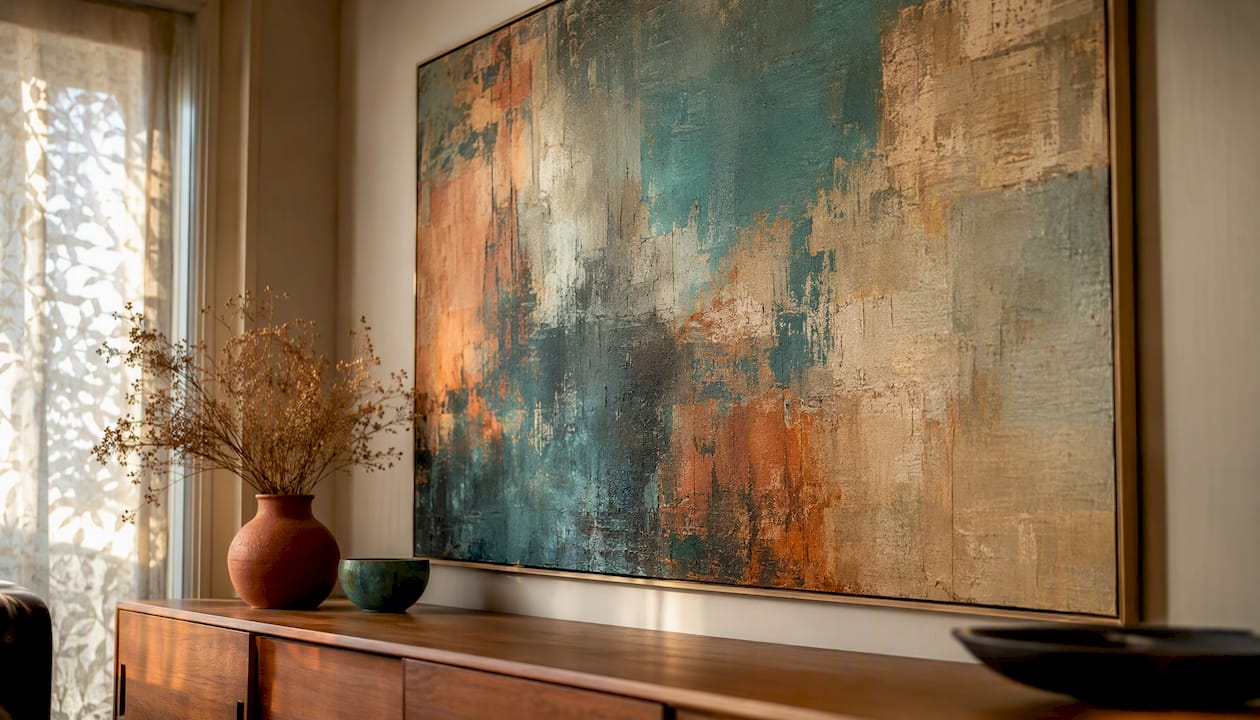
If you want a single piece to define a room, choose a large-format canvas or commission a bespoke hand-painted original. That is the short answer. Scale and material quality do the heavy lifting: a 120 cm × 150 cm hand-painted canvas on a plain wall will anchor an entire living room in a way that a cluster of small prints simply cannot.
Where to start right now:
- Browse ready-made options at Frametheworld’s Wabi Sabi collection for hand-painted textured abstracts available in multiple sizes
- Submit a commission enquiry at Frametheworld for a bespoke piece sized to your exact wall
- Ready-made canvas prints typically start from around £80–£150 for smaller formats; mid-range gallery-wrapped canvases run £150–£400; bespoke hand-painted originals generally begin at £300–£600 and rise with scale and complexity
- Lead times: ready-made pieces usually ship within 3–7 working days; bespoke commissions typically take 3–6 weeks from brief approval to delivery
Key takeaways
Choosing the right bold art statement piece comes down to three decisions: format, scale, and whether you buy ready-made or commission bespoke.
| Point | Details |
|---|---|
| Size to the furniture, not the wall | Artwork should span roughly two-thirds of the anchor furniture’s width as a starting point. |
| Format determines longevity | Hand-painted originals with varnish outlast unprotected prints; gallery-wrapped canvas needs no frame and suits most UK rooms. |
| Commission takes 3–6 weeks | Bespoke hand-painted originals require a clear brief, deposit, and approval stage before production begins. |
| Check access before ordering | Measure door widths and stairwell turns for any piece over 120 cm in either dimension. |
| Frametheworld for ready-made and bespoke | The Wabi Sabi collection offers hand-painted abstracts in multiple sizes; custom commissions are available with UK-wide insured delivery. |
Table of Contents
- What formats are available for bold art statement pieces?
- How do you size a statement piece for your wall?
- How do you choose the right bold piece?
- How does commissioning a bespoke statement piece work?
- How do you style a bold piece in your interior?
- Hanging, care, and longevity for different materials
- Why does large-scale art make such a strong interior statement?
- An experienced selector’s perspective on choosing bold art
- Frametheworld: hand-painted statement art, ready to buy or commission
- Sources
What formats are available for bold art statement pieces?
The format you choose shapes everything: how the piece looks on the wall, how long it lasts, and how much you can customise it. Here is a quick breakdown of the main options.
Giclée prints are high-resolution inkjet prints on fine art paper or canvas using archival inks. They reproduce colour with exceptional fidelity and are the most affordable route to a large-format piece. The trade-off is that they are reproductions, not originals, so they carry less uniqueness.
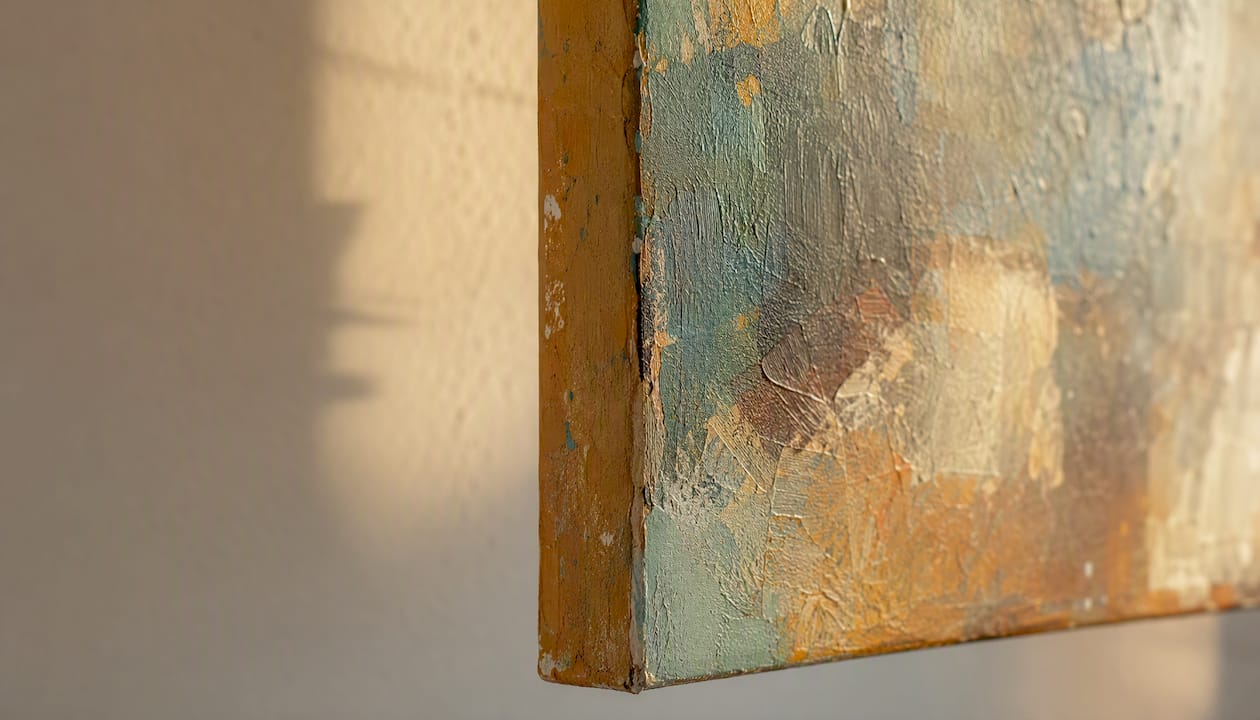
Gallery-wrapped canvas takes a giclée or hand-painted surface and stretches it over a deep wooden frame so the image wraps around the edges. No frame required, and the depth adds a sculptural quality that flat prints lack. This is the most popular format for dramatic art pieces in UK homes.
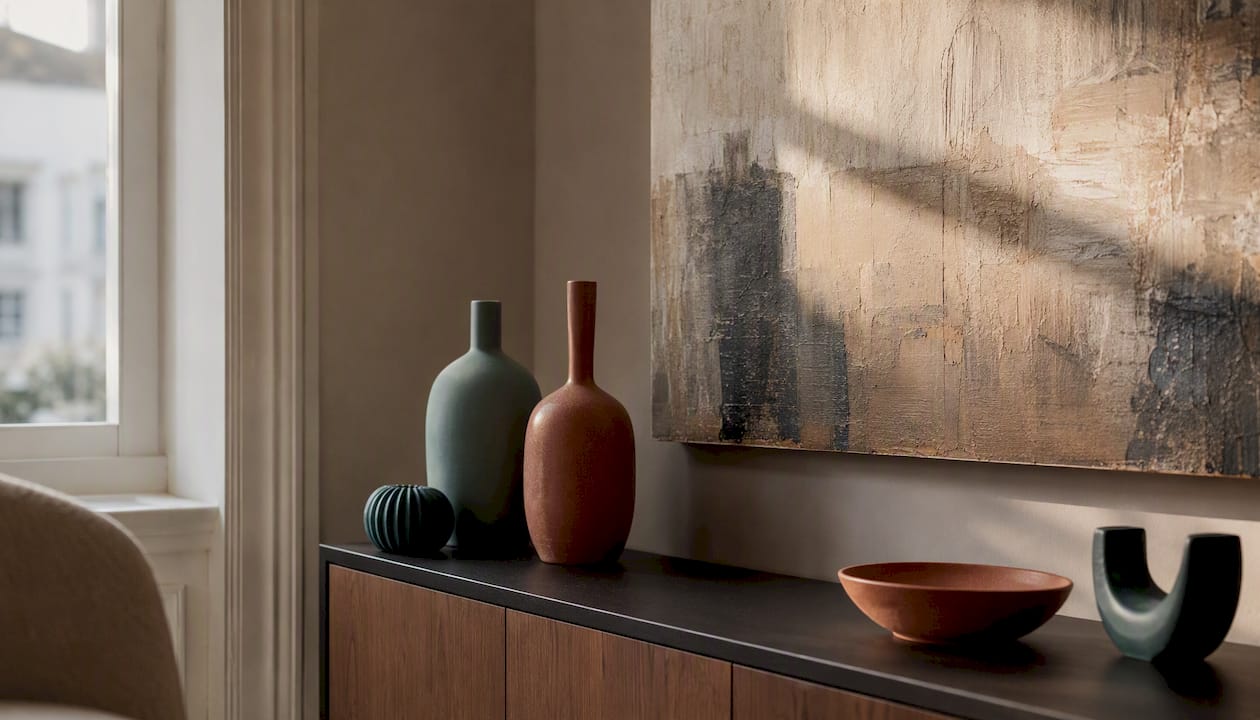
Hand-painted originals are exactly what they sound like: paint applied by hand, layer by layer, on canvas or board. Texture, impasto marks, and subtle colour variation make each one genuinely one-off. Frametheworld’s Wabi Sabi collection demonstrates this well: hand-painted textured abstracts where the physical surface is part of the visual impact.
Limited-edition prints and multi-panel works (diptychs, triptychs) let you achieve a large-scale impression while keeping individual panels light enough to ship and hang without specialist equipment. A triptych across 180 cm of wall reads as a single statement but arrives in three manageable parcels.
Sculptural wall art — fused glass panels, layered paper constructions, mixed-media reliefs — sits at the premium end. Fused glass work, for instance, involves hand-cutting and kiln-fusing dozens of individual pieces, which makes it labour-intensive and considerably heavier than flat formats. Expect specialist fixings and longer lead times.
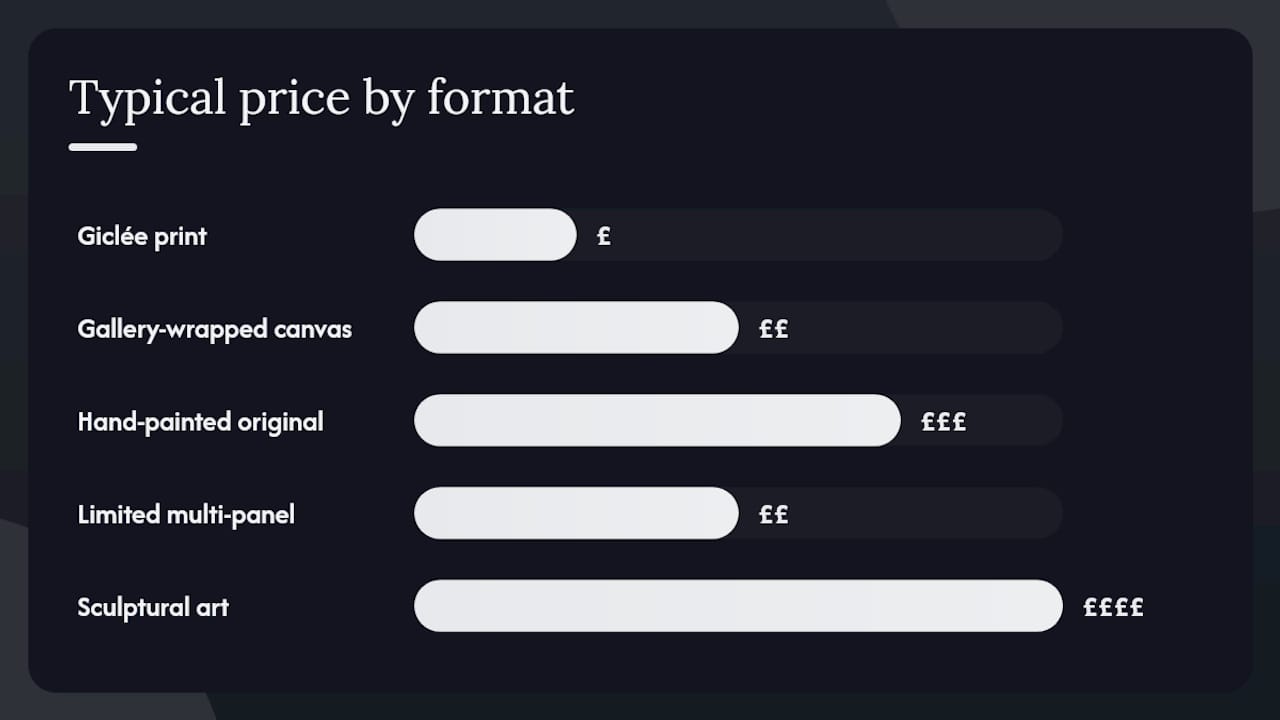
| Format | Visual impact | Durability | Large-scale suitability | Customisation | Typical price band |
|---|---|---|---|---|---|
| Giclée print (paper) | High | Moderate (UV-sensitive) | Good | Limited | £ |
| Gallery-wrapped canvas | High | Very good | Excellent | Moderate | ££ |
| Hand-painted original | Very high | Excellent with varnish | Excellent | Full | £££ |
| Limited-edition / multi-panel | High | Good | Very good | Low–moderate | ££ |
| Sculptural (glass, mixed-media) | Exceptional | Excellent | Moderate | Variable | ££££ |
Pro Tip: For rooms with strong directional lighting or south-facing windows, choose a satin varnish finish over gloss. Gloss catches hotspots and creates distracting reflections; satin diffuses light evenly and lets the colour read true from any angle.
How do you size a statement piece for your wall?
Get the dimensions wrong and even a beautiful piece looks lost or cramped. The good news: a few simple rules cover most situations.
The starting rule: artwork above a sofa should span roughly two-thirds of the sofa’s width. For a sofa 240 cm wide, that means a canvas at least 160 cm across.
Worked example — living room sofa wall:
- Measure your sofa width: say 220 cm.
- Multiply by 0.67: target artwork width of approximately 147 cm.
- Check ceiling height: in a standard UK room (240 cm ceiling), a canvas 100–120 cm tall sits comfortably above the sofa without crowding the ceiling.
- Leave 15–25 cm between the top of the sofa and the bottom of the artwork.
- Centre the piece horizontally over the sofa, not over the wall, unless the sofa is centred on the wall.
Measurement checklist before you order:
- Wall width and height (floor to ceiling)
- Width of anchor furniture (sofa, bed, console)
- Position of light switches, sockets, and radiators
- Viewing distance from the main seating position
- Door width, stairwell width, and any tight turns on the delivery route
That last point catches people out. A 180 cm canvas is straightforward in a ground-floor flat with a wide hallway; getting it up a narrow Victorian staircase is a different matter. Check access before you order anything over 120 cm in either dimension.
For a bedroom, the same two-thirds rule applies above the headboard. The Frametheworld wall art selection guide covers measuring in more detail if you want a step-by-step walkthrough.
How do you choose the right bold piece?
A checklist keeps the decision rational when you are drawn to something emotionally. Work through these before committing:
| Evaluation dimension | What to check |
|---|---|
| Scale | Does the piece span at least two-thirds of the anchor furniture? |
| Colour palette | Does it work with existing wall colour and upholstery, or will you redecorate around it? |
| Focal point role | Is this the room’s single focal point, or a supporting piece in a gallery wall? |
| Lighting compatibility | Is there a light source that can be directed at it, or will it sit in ambient light only? |
| Room function | Does the mood of the piece match how the room is used (calm bedroom vs energetic kitchen)? |
| Format and material | Print, canvas, or original — and does the finish suit the humidity and light levels of the room? |
| Customisation | Can the size or colour be adjusted if the standard option is slightly off? |
| Delivery and returns | Is there a clear returns window, and is the piece insured in transit? |
Questions to ask the seller or artist before buying:
- What are the exact finished dimensions, including any frame depth?
- What materials are used, and are the inks or paints archival quality?
- Is a certificate of authenticity or artist statement available?
- What is the returns policy, and who covers return shipping costs?
- Is the piece insured during delivery, and how is damage on arrival handled?
Red flags when buying online: vague dimensions listed as “approximately,” no named artist or studio, absent or unlinked returns policy, no material specification beyond “canvas,” and no way to contact the seller directly. Legitimate sellers — including Frametheworld — list materials, dimensions, and contact details clearly.
When commissioning, photograph your wall with a piece of furniture in shot for scale reference. Send the photo alongside your colour palette and any reference images. A seller who cannot work from this information is unlikely to deliver what you have in mind.
How does commissioning a bespoke statement piece work?
Commissioning takes longer than buying off the shelf, but the result is a piece built around your exact wall, palette, and brief. The typical workflow runs like this:
- Submit a brief. Describe the room, the wall dimensions, the mood you want, and any colour constraints. Attach reference images and your wall photograph.
- Receive a moodboard or concept sketch. The artist or studio proposes a direction. This is the moment to push back on colour or composition before any paint is applied.
- Confirm size, substrate, and finish. Agree the exact canvas dimensions, whether you want a gallery wrap or framed finish, and the varnish type.
- Sign a contract and pay a deposit. A reputable UK studio will provide written terms covering copyright, reproduction rights, payment schedule, and what happens if either party needs to cancel.
- Review progress images. Most studios share photographs at one or two stages during production. Request this if it is not offered automatically.
- Approve the finished piece. Final sign-off before shipping. Confirm the delivery address and any access constraints at this point.
- Delivery and installation. Insured courier for most canvas work; specialist art handlers for very large or fragile pieces.
When commissioning, ask for an artist statement alongside the finished work: one to two paragraphs describing the intention and materials. It adds provenance and is useful if you ever sell or insure the piece.
For inspiration on briefing a unique commission, browsing curated examples of custom artwork can help you articulate what you want before you write your brief.
| Order type | Typical UK lead time | Sample price band |
|---|---|---|
| Ready-made print (standard size) | 3–7 working days | £80–£150 |
| Mid-range gallery-wrapped canvas | 5–10 working days | £150–£400 |
| Large hand-painted original (bespoke) | 3–6 weeks | £300–£600 |
Commission checklist:
- Copyright and reproduction rights (who owns them after purchase?)
- Payment schedule (deposit percentage, balance due on approval or delivery?)
- Framing and installation: is it included, or quoted separately?
- Delivery insurance and proof-of-condition photography before dispatch
- What happens if the finished piece differs significantly from the approved sketch?
How do you style a bold piece in your interior?
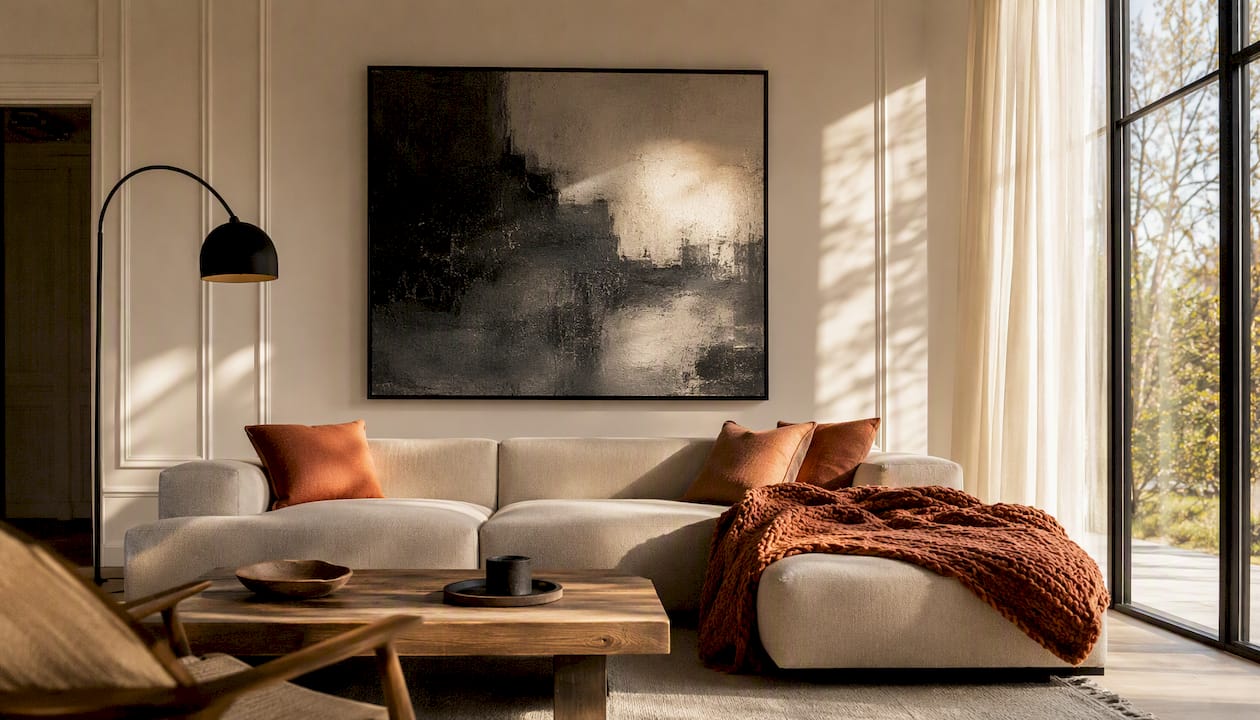
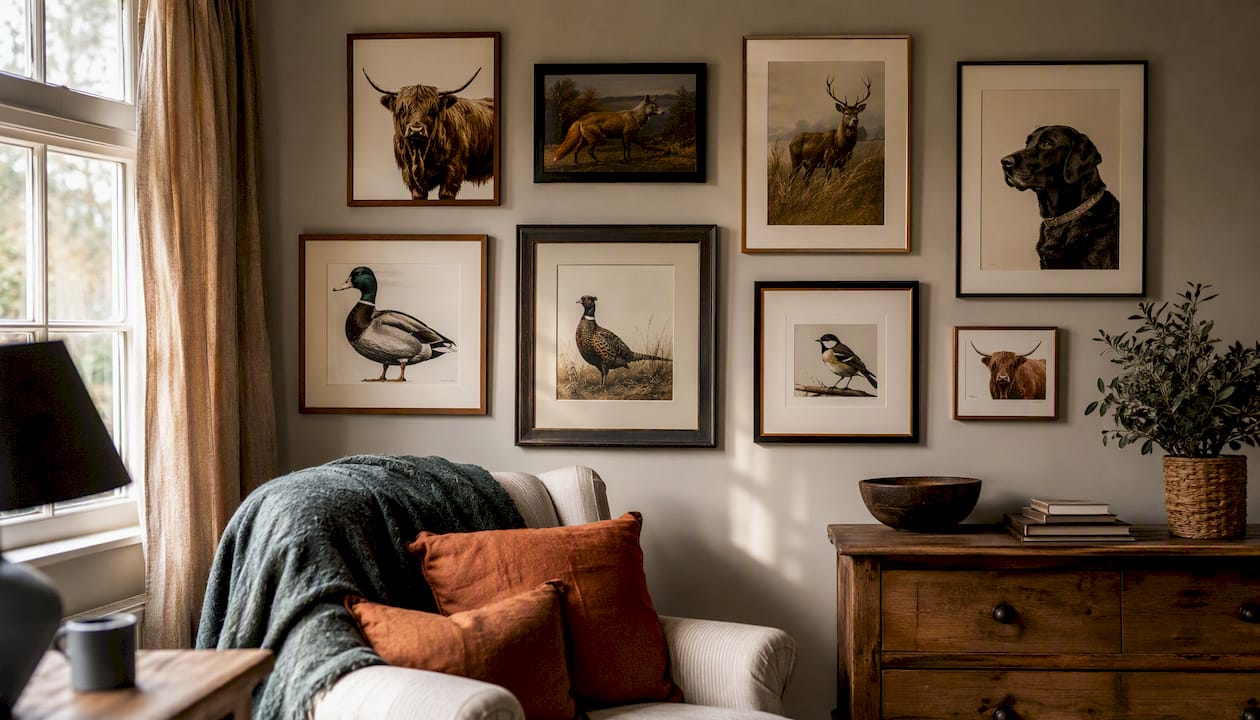
A single large-format work almost always outperforms a cluster of smaller pieces when the goal is a strong focal point. Statement wall art creates a natural visual anchor that organises the rest of the room around it. Grouped arrangements work well in corridors, stairwells, and rooms where no single wall is large enough to carry one oversized piece.
Styling checklist:
- Centre the artwork over the anchor furniture, not the wall, unless they align
- Leave breathing room: negative space around a bold piece amplifies its presence
- Pull one colour from the artwork into a cushion, rug, or throw to tie the room together
- Avoid competing focal points: a bold canvas and a large patterned rug in the same sightline fight each other
Lighting makes or breaks a statement piece. A picture light or adjustable track spotlight directed at a 30–45 degree angle from the wall brings out texture and depth in a hand-painted canvas. Avoid positioning a piece directly opposite a window: daytime glare washes out colour, and a gloss varnish will mirror the window back at you.
For a neutral modern interior, a large monochrome abstract in warm grey or off-white adds weight without disrupting a calm palette. In a cosy traditional room, a richly coloured oil-effect canvas in ochre or deep teal reads as a collected piece rather than a decoration. For a maximalist scheme, a bold mixed-media work with layered textures and unapologetic colour becomes the room’s centrepiece rather than one element among many.
Statement art also responds to the other architectural features in a room. When doors and built-in joinery are themselves a design feature, the artwork needs to hold its own against them rather than compete on the same visual plane. Thinking about how interior doors and art interact in a room’s layout is worth doing before you finalise placement.
Pro Tip: Before committing to a position, tape out the artwork’s dimensions on the wall with masking tape and live with it for a day. What looks right in the morning light often shifts by evening, especially with hand-painted pieces where texture catches directional light differently.
For more ideas on pairing bold works with contemporary interiors, Frametheworld’s urban interior wall art guide is worth browsing.
Hanging, care, and longevity for different materials
Maintenance at a glance by material:
- Giclée prints on paper: frame behind UV-filtering glass; keep away from direct sunlight and high humidity; dust with a dry, soft brush only
- Gallery-wrapped canvas: no glass needed; dust with a barely damp cloth; avoid kitchens and bathrooms where grease and steam accelerate deterioration
- Hand-painted originals with varnish: wipe gently with a slightly damp cloth; re-varnish every 5–10 years if the surface dulls; keep out of direct sunlight
- Multi-panel and layered paper works: hang each panel level and at equal spacing; avoid humid rooms; do not clean with any liquid
- Sculptural and fused glass pieces: clean glass surfaces with a non-abrasive glass cleaner; check fixings annually as weight stress can loosen wall anchors over time
Installation by weight:
- Up to 5 kg: standard picture hooks into plasterboard are usually sufficient
- 5–15 kg: use wall plugs and screws into masonry, or specialist plasterboard fixings rated for the load
- Over 15 kg (large originals, sculptural glass): fix into wall studs or masonry only; consider professional installation
For anything over 10 kg, locate the studs or masonry before ordering fixings. A stud finder costs under £20 and prevents a costly mistake. Hang at eye level for the primary viewer: 145–150 cm from floor to the centre of the piece is the standard gallery height, though above furniture you adjust for the furniture’s height.
Shipping and returns for UK buyers: check that the seller photographs the piece before dispatch and that the courier provides insurance to the full value. On delivery, photograph the outer packaging before opening it. If damage is visible, note it on the delivery receipt and contact the seller within 24 hours. Reputable UK sellers will have a clear returns window stated at checkout; for bespoke commissions, the contract should specify what constitutes a valid reason for return.
Multi-panel works like diptychs and triptychs are worth considering specifically because they keep individual parcel sizes manageable, which reduces both shipping risk and the access problems that come with very large single canvases.
Why does large-scale art make such a strong interior statement?
Large-scale art creates a focal point that organises a room’s visual hierarchy. Everything else in the room reads in relation to it: furniture scale, colour palette, and even the perceived size of the space.
The mechanism is straightforward. A room without a focal point feels unresolved; the eye moves around without settling. A single oversized canvas stops that drift. It gives the room a centre of gravity. Interior designers have relied on this principle for decades, and it holds across styles from spare Scandi minimalism to layered maximalism.
Scale also amplifies emotional tone. A large abstract in deep indigo and charcoal reads as calm and weighty; the same composition at A3 size reads as decorative. The physical presence of a large canvas changes how a colour is perceived. Vivid abstracts in warm reds and oranges generate energy in a dining room or studio; oversized monochrome works anchor a bedroom without demanding attention.
Negative space matters too. A bold piece on an otherwise bare wall reads more powerfully than the same piece surrounded by competing objects. This is why interior designers often clear a wall entirely before hanging a statement canvas, rather than fitting it around existing shelves or mirrors.
Frametheworld’s guide to statement art walls explores this in more depth, including how Lennard approaches selection for different room types and scales.
An experienced selector’s perspective on choosing bold art
The most useful thing I can tell you is this: trust scale over taste when in doubt. Buyers consistently undersize their first statement purchase, then wish they had gone larger. The piece that feels slightly too big in the shop is almost always right on the wall.
One practical example: a client briefed a neutral abstract for a double-height hallway, initially requesting 100 cm × 80 cm. The wall was 3.2 metres high. We sized the final piece at 140 cm × 110 cm. On the wall, it looked considered rather than overwhelming, and the hallway finally had a reason to exist as a space rather than a corridor.
For provenance and testimonials, the case studies and customer reviews on Frametheworld’s site are worth reading before you commission. They show real rooms, real dimensions, and the decisions behind them.
Frametheworld: hand-painted statement art, ready to buy or commission
Frametheworld offers hand-painted canvases and bespoke commissions shipped across the UK, with customisation available on size, colour, and finish. The Wabi Sabi collection is the clearest starting point for buyers who want a ready-made abstract with genuine texture and presence: pieces are hand-painted, available in multiple sizes, and can be adjusted to fit a specific wall.
For buyers who need something built to exact dimensions or a particular palette, the commission route delivers a one-off original with a defined brief, approval stages, and insured UK delivery. Customer testimonials and Lennard’s editorial guidance are available on the site, alongside a full returns policy and material specifications for every piece.
Browse the collection or submit a commission enquiry at Frametheworld to get a quote and confirm lead times for your project.
Sources
- Statement Wall Art Ideas: Bold Pieces That Make Your Room Pop
- 28+ Unique Art Ideas 2026 - Custom Unique Artwork & Inspiration | 99designs

Laat een reactie achter
Deze site wordt beschermd door hCaptcha en het privacybeleid en de servicevoorwaarden van hCaptcha zijn van toepassing.