

TL;DR:
- A framing-specialist e-commerce platform like Frametheworld offers quick, cost-effective, bespoke wall art options for UK buyers. It provides custom commissions, curated collections, and transparent pricing, making it ideal for home and small commercial projects. Buyers should clarify dimensions and approval stages to avoid costly revisions and ensure timely delivery.
For most UK buyers, a framing-specialist e-commerce platform is the fastest, most cost-effective replacement for Artienda.co.uk — and Frametheworld is the recommended in-category option, offering hand-painted bespoke commissions, custom sizing, and curated collections without the gallery markup.
Three general routes cover the full range of what Artienda.co.uk similar sites offer:
- Art consultant or gallery — a managed, relationship-led service for large commercial or hospitality projects where curation, site visits, and installation are all handled for you.
- Commission marketplace — an open platform connecting buyers directly with independent artists; best for one-off pieces where you want to choose the maker yourself.
- Framing-specialist e-commerce — an online shop offering curated collections, bespoke commissions, and custom framing; the right call for home buyers, interior designers, and smaller commercial projects where speed and price transparency matter.
When to pick each:
- Choose a consultant or gallery when your project spans multiple rooms, requires Arts Council England or Contemporary Art Society procurement guidance, or involves a significant public installation budget.
- Choose a commission marketplace when you have a specific artist in mind, want to compare portfolios across dozens of makers, and can manage the brief and delivery yourself.
- Choose a framing-specialist e-commerce platform when you need a bespoke or ready-made piece delivered quickly, with clear pricing, and without a long consultancy engagement.
Table of Contents
- How do the main Artienda.co.uk alternatives compare?
- What does each alternative type actually provide?
- How do you pick the right alternative for your project?
- What do commissions and framing typically cost in the UK?
- Step-by-step: from brief to hung artwork
- Two examples of how a replacement supplier handles real projects
- Which alternative should you choose?
- Key takeaways
- Why the “managed service” assumption catches buyers out
- Frametheworld: bespoke wall art without the consultancy overhead
- Useful sources and further reading
How do the main Artienda.co.uk alternatives compare?
A comparison of three alternative types of art procurement services highlights differences in service model, typical client use cases, costs, lead times, geographic coverage, commissioning flexibility, and delivery arrangements, without stating precise cost or timeframe figures.
A few points worth clarifying:
- “Typical starting cost” for consultancy covers the initial engagement fee, not the artwork itself. Total project costs rise significantly once framing, installation, and artist fees are added.
- Marketplace lead times assume the artist is available and the brief is clear from the outset. Revision rounds add one to two weeks per cycle.
- Framing-specialist e-commerce platforms vary widely in bespoke capability. Frametheworld handles custom sizing, colour matching, and full commissions rather than simply selling prints.
What does each alternative type actually provide?
Art consultant or gallery
A consultant manages the entire procurement process: initial brief, artist sourcing, framing specification, delivery logistics, and on-site installation. Artienda itself operated on this model, offering home visits in London and working with a curated list of UK and international artists. A replacement consultant will typically start with a discovery call or site visit, produce a written proposal with artist options, and manage every handoff from there.
The commissioning flow runs roughly as follows:
- Initial brief and site visit (dimensions, palette, budget, style)
- Artist longlist and proposal document with indicative costs
- Sample or maquette approval
- Contract signed with deposit (usually 40–50%)
- Production and framing
- Delivery and installation appointment
- Final sign-off and balance payment
Commission marketplace
Marketplaces let you browse artist portfolios, filter by style or medium, and contact makers directly. You write the brief, agree terms with the artist, and manage delivery yourself. The upside is choice and price transparency. The downside is that framing, installation, and project management sit entirely with you.
Framing-specialist e-commerce (Frametheworld)
Frametheworld sits in this category and goes further than a standard print shop. The platform offers hand-painted originals, bespoke commissions, and custom sizing across a range of styles — from Wabi Sabi abstract textures to bold Pop Art canvases. Interior designers and property developers use it for both single pieces and larger fit-out orders, with colour and size specified at the point of commission.

The ordering flow is straightforward: browse or brief, specify dimensions and finish, confirm the commission, and receive a tracked delivery with hanging guidance. For professionals comparing supplier capabilities and commissioning workflows, the combination of ready-made stock and genuine bespoke capability is the practical differentiator.
Pro Tip: When briefing any framing specialist or artist, specify the final hanging dimensions (not canvas size), your acceptable colour tolerance, preferred materials, and a named approval point for finish before production begins. Skipping this step is the single most common cause of costly revisions.
How do you pick the right alternative for your project?
Evaluation checklist
Before shortlisting any supplier, run through these criteria:
- Portfolio fit — does their existing work match your project’s style, scale, and medium?
- Lead time — can they deliver within your programme? Ask for a written timeline, not a verbal estimate.
- Installation capability — do they offer in-house installation, a named partner, or delivery only?
- Sample or approval stage — is there a colour proof, maquette, or framing sample before full production?
- Insurance and guarantees — is the artwork insured in transit? What is the returns or damage policy?
- References — can they provide a recent client contact or a verifiable case study?
Tools like BrandSwitch let you search ranked alternatives across thousands of UK brands quickly, which is useful for building an initial longlist before you start making calls.
Questions to ask in your first supplier conversation
- Do you conduct site visits, and is there a fee for them?
- How many revision rounds are included in the commission price?
- What materials and substrates do you use, and can you provide a specification sheet?
- How is the artwork packaged and insured during shipping?
- Who handles installation, and what wall types and fixings do you work with?
- What is your policy if the finished piece differs from the approved proof?
Red flags to watch for
- No written proposal or contract — a verbal agreement is not sufficient for a bespoke commission.
- Inconsistent sizing information across email, invoice, and delivery note.
- Vague installation terms such as “we can arrange something” with no named installer or method.
- No clear approval stage before production begins.
What do commissions and framing typically cost in the UK?
Price transparency is one area where the market has historically been poor. The table below gives realistic bands based on current UK market practice.
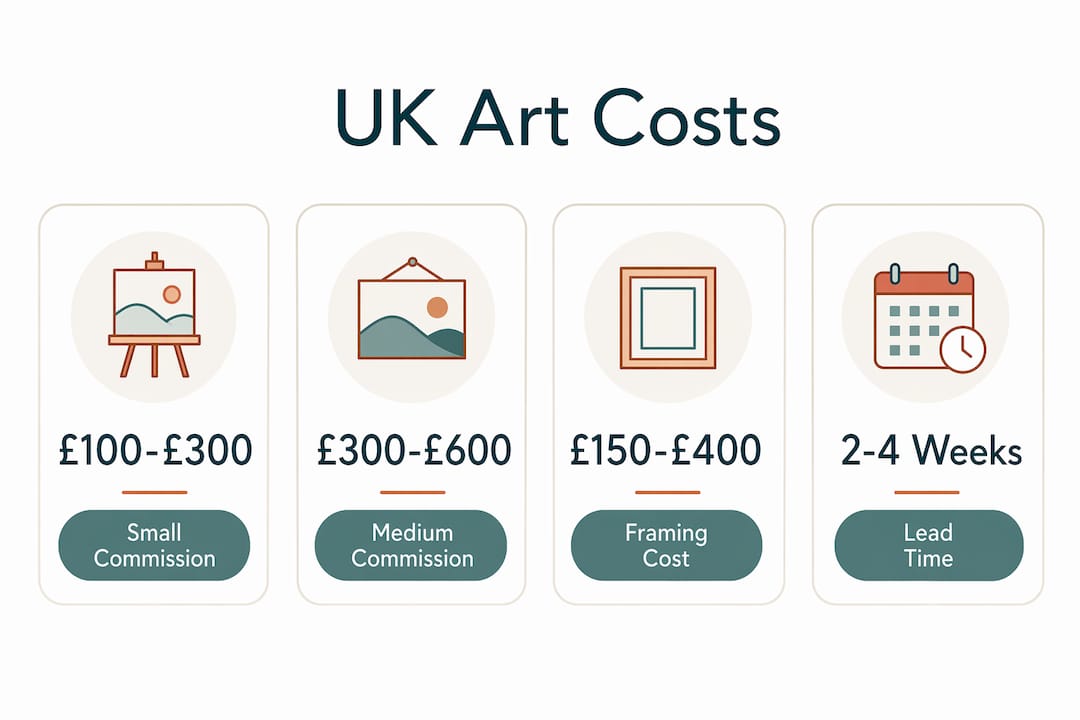
Typical pricing and lead times vary widely depending on project type and size. Costs generally increase with larger formats, specialist materials, artist fees, and site visits. Payment terms often include an upfront deposit with balance due before dispatch; for larger projects, staged payments linked to approval milestones may be negotiated. It is advisable to budget for contingencies to cover revisions, reframing, or installation complications. Custom framing choices affect both the final cost and the longevity of the piece, so treat the framing specification as part of the brief, not an afterthought.
Step-by-step: from brief to hung artwork
Commissioning checklist
- Write a clear brief: dimensions, style references, colour palette, medium, and intended room.
- Request written proposals from at least two suppliers, including itemised costs and timeline.
- Review portfolio samples or request a colour/finish proof before committing.
- Sign a contract covering scope, deliverables, payment schedule, revision rounds, and warranty.
- Pay the agreed deposit and confirm the production start date in writing.
- Approve the proof or maquette at the specified checkpoint — do not skip this stage.
- Confirm delivery date, packaging method, and insurance cover before dispatch.
- Book the installation appointment and confirm site access, wall type, and fixing method in advance.
- Inspect the piece on delivery before the installer leaves; note any damage in writing immediately.
- Make the final payment only after satisfactory installation and sign-off.
What a written proposal should include
- Scope of work and deliverables (artwork description, framing spec, installation method)
- Itemised costs and payment schedule
- Production and delivery timeline with named milestones
- Number of revision rounds included
- Warranty or guarantee terms
- Returns and damage policy
- Insurance cover during transit and installation
Installation preparation checklist
- Confirm wall substrate (plasterboard, solid brick, stud wall) and share this with the installer in advance.
- Mark mounting points and check for concealed electrics or pipework before drilling.
- Ensure clear site access on the day, including parking and lift availability for large pieces.
- Nominate an on-site contact who can make decisions if issues arise.
- Protect flooring and adjacent surfaces before installation begins.
For projects where art sits alongside upholstery or soft furnishings, coordinating the two trades early avoids clashes in colour and finish. Abstract artistic textiles are worth specifying at the same stage as the artwork brief so the palette reads consistently across the room.
Two examples of how a replacement supplier handles real projects
Case study 1: residential living room commission
Brief: A homeowner wanted a large abstract canvas (120×90 cm) in muted earth tones to anchor a newly decorated open-plan living room. Budget: £700 including framing. Timeline: six weeks before a planned photoshoot.
What was delivered: A hand-painted bespoke canvas in a Wabi Sabi-influenced palette, custom-sized to specification, with a slim natural wood float frame. The piece arrived in week five, packaged in a double-walled crate with corner protection.

Outcome: Timeline met with one week to spare. The client approved the colour proof at week two with no revisions required, which kept the project on schedule.
Lesson: A clear approval checkpoint at week two prevented the revision cycle that typically adds two to three weeks to a bespoke commission.
Case study 2: commercial hospitality fit-out
Brief: A boutique hotel required twelve coordinated pieces across three room types, each in a consistent palette with varying sizes. Budget: £4,200 for artwork and framing. Timeline: ten weeks to opening.
What was delivered: Twelve hand-painted canvases across three size formats, colour-matched to the interior designer’s specified RAL references, with uniform gallery-wrap framing. Delivered in two batches to align with the fit-out programme.
Outcome: All twelve pieces installed on schedule. Batched delivery reduced on-site storage requirements and simplified the installation sequence.
Lesson: For multi-room projects, batched delivery tied to the fit-out programme is worth specifying in the contract rather than leaving logistics to the supplier’s default schedule.
Which alternative should you choose?
For the majority of UK buyers searching for top Artienda.co.uk competitors, a framing-specialist e-commerce platform covers the brief: bespoke capability, transparent pricing, and nationwide delivery without a consultancy engagement fee. Frametheworld is the recommended option in this category, handling everything from single custom pieces to multi-room commercial orders.
- Choose a consultant or gallery when your project is large-scale, requires site visits and managed installation, or involves public procurement guidance from bodies such as Arts Council England.
- Choose a commission marketplace when you want to select a specific independent artist, have time to manage the brief yourself, and do not need framing or installation support.
- Choose a framing-specialist e-commerce platform (Frametheworld) when you need bespoke or ready-made work delivered quickly, with clear pricing, custom sizing, and no long-term engagement.
Next steps: request a written proposal from your shortlisted supplier, ask to see a recent portfolio piece in your preferred style, and confirm lead times in writing before committing a deposit.
Key takeaways
For most UK interior buyers, a framing-specialist e-commerce platform is the fastest and most cost-effective alternative to Artienda.co.uk, combining bespoke commissions, custom sizing, and transparent pricing without a consultancy fee.
| Point | Details |
|---|---|
| Best alternative type | Framing-specialist e-commerce covers most briefs: bespoke work, custom sizing, and nationwide delivery. |
| Lead times | Stock pieces arrive in 1–4 weeks; bespoke commissions take 3–6 weeks; consultancy projects run 8–16 weeks. |
| Selection criteria | Check portfolio fit, written proposal, approval stage, insurance, and installation capability before committing. |
| Frametheworld | Offers hand-painted bespoke commissions, curated collections, and custom sizing for home and commercial projects. |
Why the “managed service” assumption catches buyers out
Most buyers searching for alternatives to Artienda.co.uk assume they need a like-for-like replacement: a consultant who visits the site, sources the art, and manages installation end to end. That assumption is worth questioning.
Artienda’s model made sense for a specific type of client: London-based, time-poor, and willing to pay a premium for a fully managed experience. For everyone else, the consultancy layer adds cost and lead time without adding proportionate value. A well-briefed bespoke commission from a platform like Frametheworld, with a clear approval stage and a named installer booked separately, delivers the same outcome at a fraction of the cost and in half the time.
The gap the market has consistently underestimated is briefing quality, not supplier type. The buyers who get the best results are the ones who arrive with dimensions, a colour reference, and a named approval point — regardless of whether they use a consultant, a marketplace, or an e-commerce platform. The wall art selection process for interior designers is less about finding the right supplier category and more about being a clear client. Suppliers at every price point perform better when the brief is specific.
The practical implication: before you spend time evaluating supplier types, spend thirty minutes writing a proper brief. It will save you weeks.
Frametheworld: bespoke wall art without the consultancy overhead
If you want the quality and customisation Artienda.co.uk offered but without the engagement fee or the London-centric site-visit model, Frametheworld is the direct route. The platform handles hand-painted bespoke commissions, custom sizing, colour matching, and curated collections — all orderable online, with nationwide delivery and clear lead times from the outset.
The most relevant services for interior buyers and designers:
- Bespoke commissioned artworks (custom sizes, colours, and styles)
- Curated ready-made collections including Wabi Sabi wall art and bold Pop Art canvases
- Custom sizing for both residential and commercial projects
- Framing options and project management for larger orders
Browse the collections or submit a commission brief directly on the site. For a bespoke project, the clearest next step is to send dimensions, a style reference, and your timeline — and get a written quote back within a few working days.
Useful sources and further reading
- Arts Council England — the primary public body for arts funding and commissioning guidance in England. Useful for public procurement requirements and grant eligibility for art in public spaces.
- Contemporary Art Society — supports public collections and advises institutions on acquiring contemporary art. Relevant for buyers working on public or institutional projects.
- House & Garden: 50 best independent design shops in the UK — a curated editorial list of independent UK design retailers, useful for finding regional specialists and boutique framing shops.
- Frametheworld blog: Quintessa alternatives — a practical editorial comparison of wall art supplier types, useful for buyers still shortlisting options.
- Frametheworld blog: custom framing benefits — explains how framing choices affect finish, longevity, and cost; worth reading before specifying a frame.
- Frametheworld blog: wall art for interior designers — targeted guidance for professional buyers on selection criteria, supplier capabilities, and installation considerations.


Leave a comment
This site is protected by hCaptcha and the hCaptcha Privacy Policy and Terms of Service apply.