
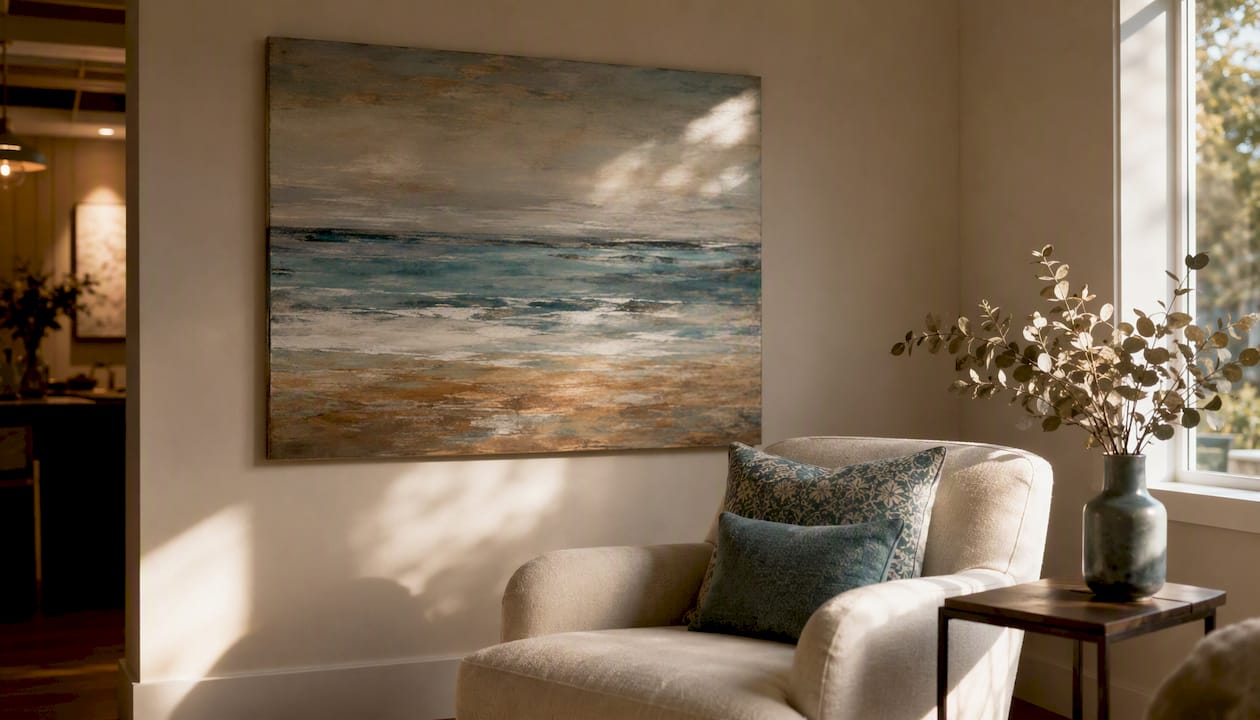
Choose durable, calming centrepieces alongside a curated mix of accessible accents, and commission bespoke pieces wherever a site-specific work will deliver the greatest impact on atmosphere and resident wellbeing.
- This week: measure your main lounge wall (width and height in centimetres) and note the dominant upholstery colours.
- Pick a style direction from the families below (landscapes, abstracts, botanicals, typographic, or local-identity photography) before approaching any supplier.
- Contact a supplier with a brief that states your wall dimensions, preferred palette, material requirements, and any fire-safety or accessibility constraints. Frametheworld handles both ready-made hand-painted pieces and fully bespoke commissions, making it a practical first port of call for projects of any scale.
Key takeaways
Choosing art for residents’ lounges means balancing durability, scale, and atmosphere from the outset, with bespoke commissions delivering the greatest long-term value when the brief is clear and the timeline is realistic.
| Point | Details |
|---|---|
| Scale and placement | Centre artwork at 120–130 cm from the floor for seated residents; art width should be 50–75% of the wall or sofa width. |
| Material choice | Canvas with UV varnish or panel murals with a protective clear coat offer the best durability and cleanability for communal spaces. |
| Commissioning timeline | Allow 6–8 weeks minimum for mid-size bespoke pieces; large murals or multi-room programmes need 3 to 5 months. |
| Fire safety and fixings | All artworks must comply with the Regulatory Reform (Fire Safety) Order 2005; specify tamper-resistant fixings for unsupervised areas. |
| Frametheworld | Offers ready-made hand-painted canvases and fully bespoke commissions with framing guidance, suited to residents’ lounge projects of any scale. |
Table of Contents
- What styles of art work best in residents’ lounges?
- How do you choose the right art for a communal lounge?
- How to measure walls and plan artwork layouts for communal lounges
- Which materials and finishes hold up best in shared spaces?
- How to commission bespoke art in the UK: process, timeline and budget
- Real examples of art transforming communal spaces
- Installation, fixing and ongoing care for lounge artworks
- Where to start: a practical checklist for your sourcing project
- Why curated and bespoke art pays back in residents’ lounges
- Frametheworld: ready-made and bespoke art for communal spaces
- Sources
What styles of art work best in residents’ lounges?
The most reliable style families for communal lounge art share one quality: they invite looking without demanding interpretation. Residents with varying cognitive and visual abilities should be able to engage with the work on their own terms.
Calming landscapes remain the most consistently successful choice. Soft coastal scenes, rolling countryside, and woodland views in muted greens, blues, and warm ochres create a settled atmosphere without feeling clinical. Pair a large landscape canvas with oatmeal or sage upholstery and warm-white pendant lighting, and the room reads as genuinely restful rather than decorated by committee.
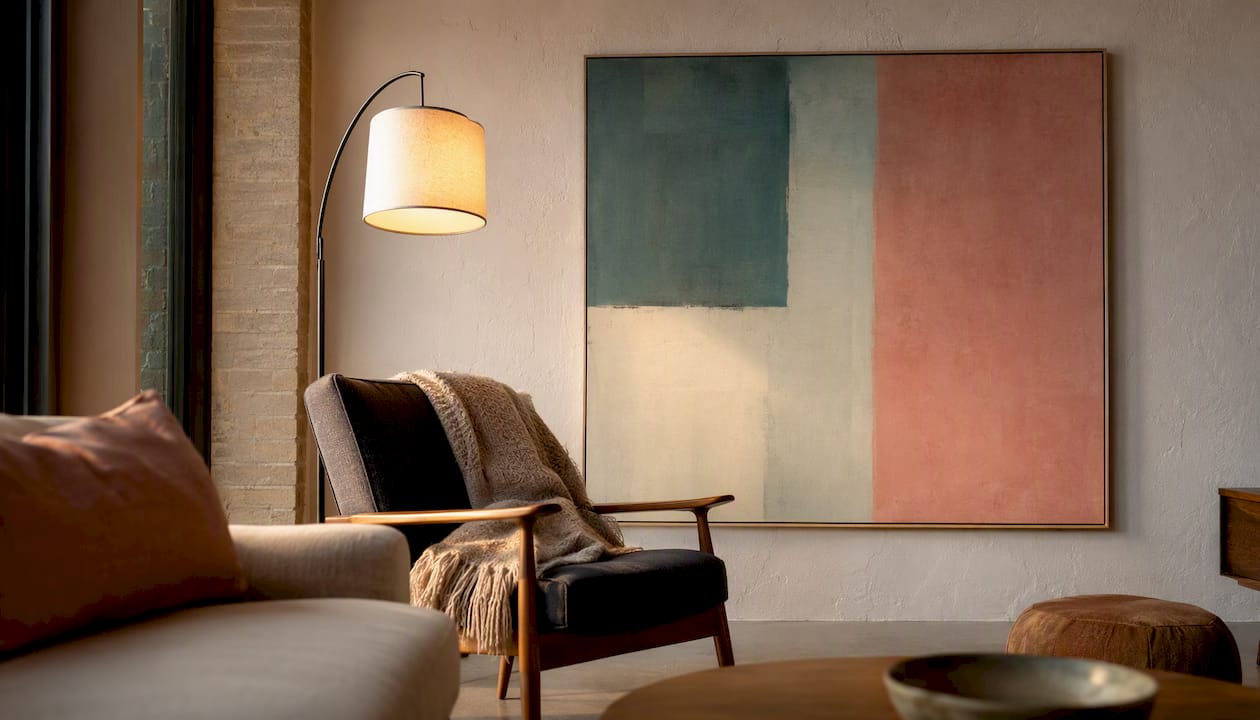
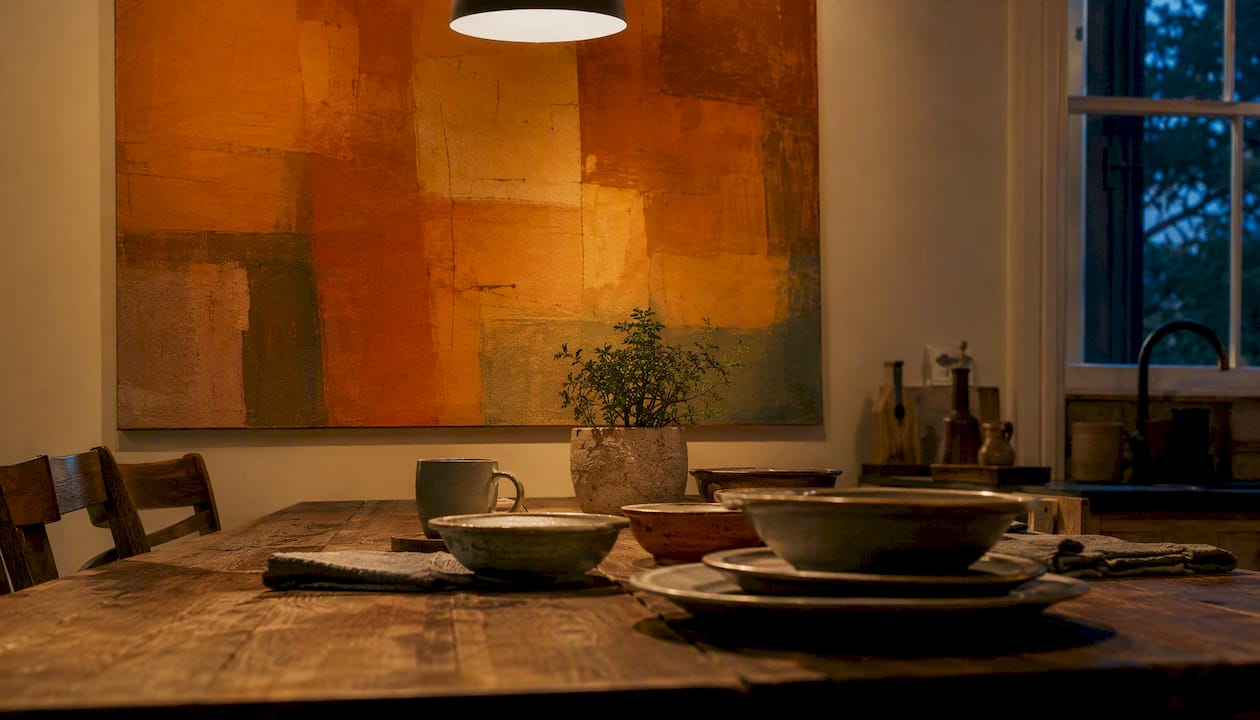
Abstract colour-fields work particularly well as feature-wall anchors. A large-format abstract in terracotta, dusty rose, and off-white sits comfortably against mid-century or Scandi-influenced furniture. Add a floor lamp with a warm bulb and the piece becomes the room’s focal point without overwhelming quieter residents.
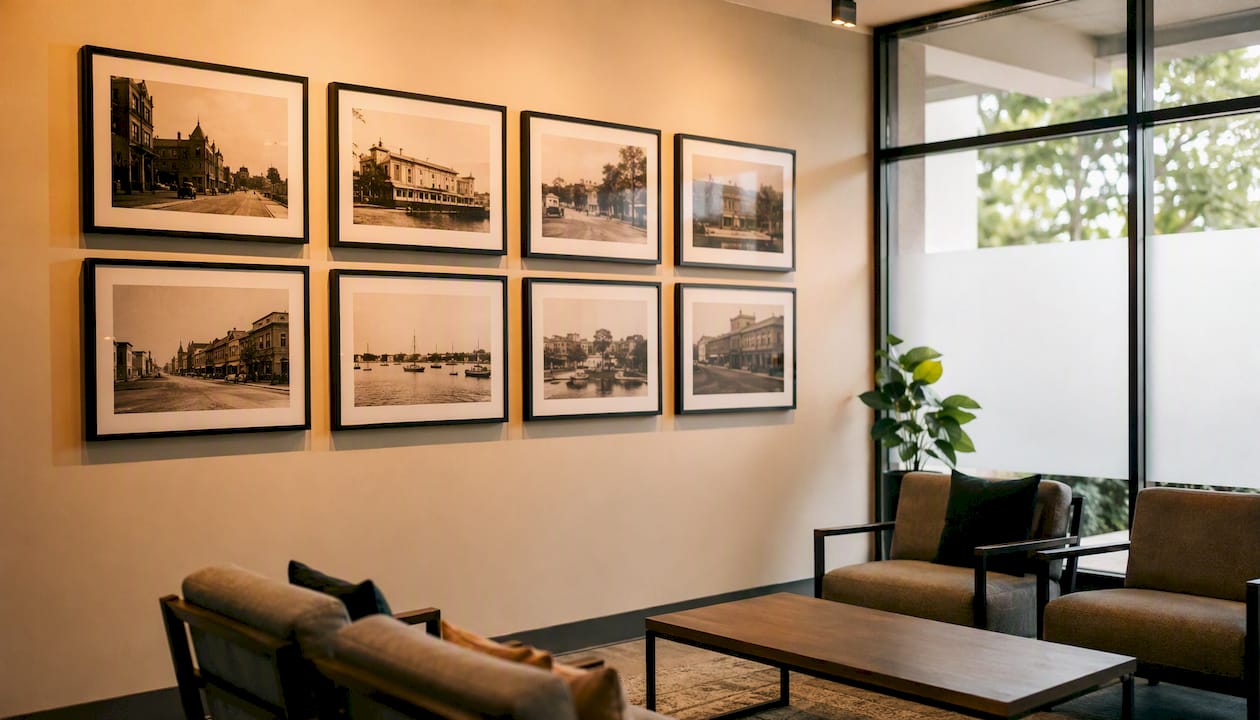
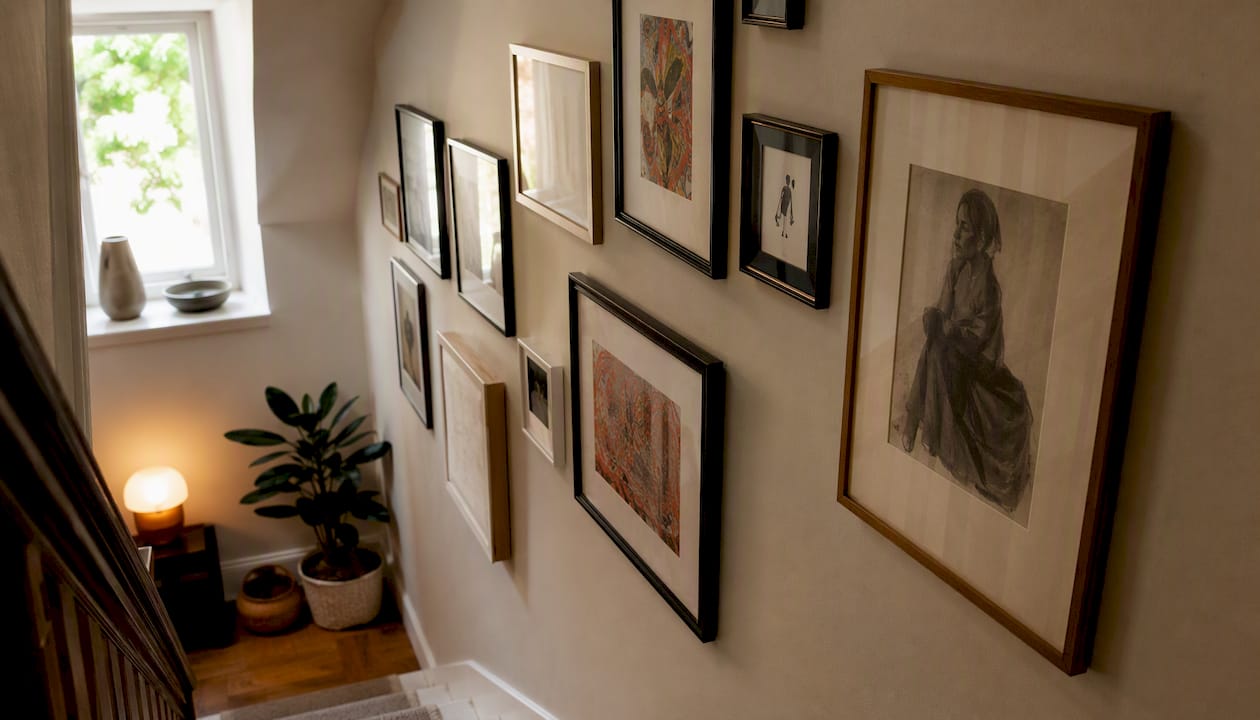
Local-identity photography is underused and often the most meaningful choice. Framed archival prints of the surrounding town, neighbourhood landmarks, or regional landscapes give long-term residents an immediate point of connection. Combine them with simple black or natural-oak frames and neutral walls for a gallery feel that does not require explanation.
Botanical motifs printed on canvas or as giclée prints bring organic warmth to spaces that can otherwise feel institutional. They pair well with rattan or wicker furniture accents and soft green or terracotta cushions.
Typographic pieces with short, warm phrases work in social areas adjacent to the main lounge, though they need careful editing: avoid anything that reads as motivational-poster cliché. A single word in a considered typeface, or a line from a well-known poem, lands with more dignity.
“Bold, positive symbolism in large-format painted installations can transform a communal space from a functional room into a place people actively want to spend time.” This is the principle behind works like Morag Myerscough’s large-scale painted installations, where colour and symbol combine to make shared spaces feel genuinely uplifting and playful.
The current trend worth noting is oversized single-image prints, particularly abstract botanicals and soft-focus nature photography at 100 cm wide and above. At lounge scale, one confident large piece reads better than three smaller ones competing for attention.
How do you choose the right art for a communal lounge?
A clear selection framework saves time and prevents expensive mistakes. Use this checklist before approaching any supplier.
Selection criteria:
- Durability: will the surface withstand occasional contact, cleaning, and humidity? Canvas and acrylic-faced prints outperform paper-based works in high-traffic areas.
- Cleanability: can the surface be wiped with a damp cloth or mild detergent? Request written confirmation from the supplier.
- Colour and mood: does the palette complement existing upholstery and flooring without clashing? Bring fabric swatches or a colour reference to any briefing conversation.
- Scale: is the piece proportionate to the wall and the room? See the sizing section below for specific rules.
- Accessibility: can seated residents see the work comfortably? Centre height matters more in a lounge than in a gallery.
- Anti-glare glazing: for framed works near windows or under directional lighting, specify anti-reflective acrylic rather than standard glass.
- Fire safety: all artworks in communal residential areas must comply with the relevant provisions of the Regulatory Reform (Fire Safety) Order 2005. Confirm that frames, backing boards, and fixings meet fire-safety requirements with your building manager before installation.
- Anti-theft and tamper resistance: in unsupervised communal areas, specify tamper-resistant fixings rated for public spaces.
Questions to ask any supplier:
- What protective finish is applied, and how long is it expected to last?
- What fixings do you recommend, and can you supply tamper-resistant options?
- What is the lead time from order to delivery, and do you offer installation support?
- Is there a warranty on colour fastness or structural integrity?
- What cleaning method do you recommend, and will it void any warranty?
Red flags to watch for: no written materials specification; vague answers about fixings or installation; no mention of fire-safety compliance; pieces described as “uninsurable originals” with no reproduction or replacement option.
The art selection checklist for interior design from Frametheworld covers space type, material, and maintenance needs in a format that adapts well to residents’ lounge procurement.
How to measure walls and plan artwork layouts for communal lounges
Scale is where most lounge art decisions go wrong. A piece that looks generous online can disappear on a large lounge wall, while a piece chosen without measuring can overwhelm a modest alcove.
The core measurement rules:
- Art width should sit between 50% and 75% of the wall width it occupies, or between 50% and 75% of the sofa or seating unit it hangs above.
- Centre height for a single piece: 145–150 cm from the floor to the artwork’s centre, which places the visual midpoint at comfortable eye level for a standing adult. For seated residents, lower this to 120–130 cm from the floor to the artwork’s centre.
- In a gallery grouping, maintain 5–8 cm gaps between frames for a cohesive look; wider gaps make groupings read as separate pieces rather than a curated set.
For accessibility in residents’ lounges specifically, the inclusive home upgrades guidance recommends considering sight-lines for wheelchair users and residents who spend most of their time seated. Hanging art lower than the standard gallery height is not a compromise; it is simply correct specification for the audience.
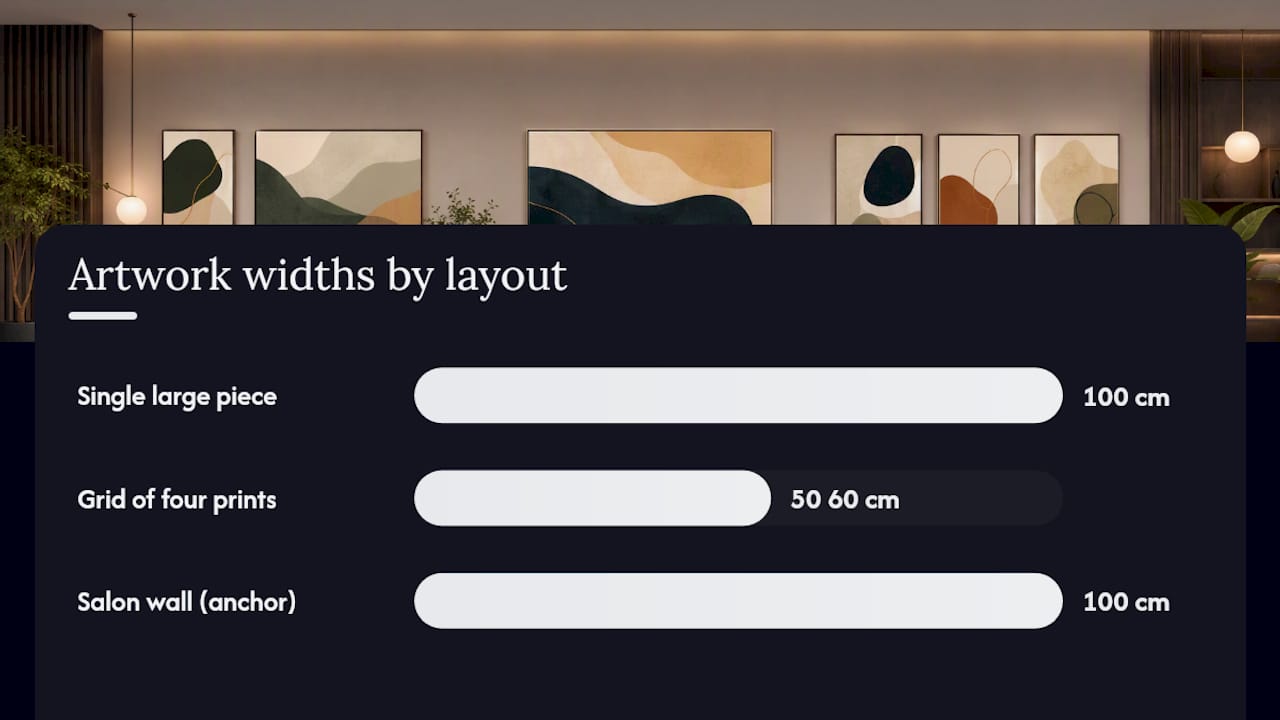
Three example configurations for typical lounge walls:
| Configuration | Suggested dimensions | Best for |
|---|---|---|
| Single large focal piece | 100 cm wide | Feature wall behind main seating; calming landscapes or bold abstracts |
| Grid of four mid-size prints | Each 50–60 cm wide, 6 cm gaps | Longer walls; local photography or botanical series |
| Salon wall (mixed sizes) | Anchor piece 100 cm wide | Alcoves or reading corners; eclectic or themed collections |
A note on cognitive accessibility: high-contrast framing (dark frame on a light wall, or vice versa) helps residents with visual impairment locate and engage with artworks. Avoid highly reflective glazing in rooms with strong natural light, as glare can cause discomfort for residents with light sensitivity.
Which materials and finishes hold up best in shared spaces?
The format you choose determines how much maintenance the artwork will need over its lifetime, and how safely it can be displayed in a communal setting.
Canvas (stretched or gallery-wrapped): the most practical format for most lounge applications. A quality canvas with a UV-resistant varnish resists fading, can be dusted with a dry cloth, and carries no glazing risk. The absence of glass or acrylic makes it lighter and safer in high-traffic areas. The main vulnerability is surface scuffing if the canvas is placed at elbow height in a corridor; in a lounge, this is rarely a problem.
Giclée prints (framed): museum-quality inkjet prints on archival paper or canvas, typically framed behind anti-reflective acrylic. Giclée prints offer exceptional colour accuracy and are the right choice when reproducing photographic or highly detailed works. Specify anti-reflective acrylic rather than glass: it is lighter, shatter-resistant, and reduces glare under artificial lighting. Request low-VOC sealants and tamper-resistant fixings rated for public spaces when ordering framed works for communal areas.
Acrylic face-mounted prints: the image is printed on photographic paper and bonded directly to a clear acrylic sheet. The result is vivid, contemporary, and highly durable. Cleaning is straightforward: a damp microfibre cloth removes most marks. The main consideration is weight; larger pieces need robust wall fixings and professional installation.
Vinyl murals: printed or hand-painted murals applied directly to the wall or on removable panels offer the most dramatic visual impact at the lowest per-square-metre cost. Panel-mounted murals are particularly practical: murals painted on panels with high-quality acrylics and a protective clear coat extend longevity and simplify maintenance compared with raw painted walls, and panels can be replaced individually if damaged.
For communal spaces with high footfall or residents who may touch wall surfaces, panel-mounted murals with a protective clear coat are the most cost-effective long-term solution. They can be wiped clean, replaced in sections, and do not require repainting the entire wall if one section is damaged.
Maintenance by format:
- Canvas: dust monthly with a dry, soft brush; spot-clean with a barely damp cloth if needed; avoid direct sunlight.
- Framed giclée (acrylic-glazed): wipe acrylic face with a microfibre cloth; clean frame with a damp cloth; check fixings annually.
- Acrylic face-mount: damp microfibre cloth; avoid abrasive cleaners; check wall fixings every six months.
- Panel mural (clear-coated): wipe with mild soapy water; inspect clear coat annually; recoat every three to five years as needed.
Safety note: always specify toughened acrylic rather than glass for glazed works in communal areas. Broken glass in a residents’ lounge is a serious hazard. Tamper-resistant fixings are standard practice for unsupervised communal spaces and should be specified in the brief, not added as an afterthought.
How to commission bespoke art in the UK: process, timeline and budget
Commissioning is not complicated, but it does require a clear brief and realistic timelines. Rushed commissions produce compromised results; a well-managed process produces work that lasts decades.
The commissioning process, step by step:
- Write a brief covering wall dimensions, intended audience (seated or ambulatory residents), colour palette, subject or mood, material requirements, fire-safety constraints, and budget band.
- Share the brief with two or three suppliers and request concept sketches or mood boards. A clear brief that includes cleaning regimes, desired lifespan, and budget band accelerates commissioning and reduces revision rounds.
- Review concepts and request mock-ups overlaid on photographs of the actual space. This step prevents scale surprises.
- Approve the final concept in writing, including the agreed specification for materials, protective finishes, fixings, and delivery.
- Production and quality check: for hand-painted works, request progress photographs at key stages.
- Delivery and installation: confirm whether the supplier includes installation support or whether you need to arrange a separate installer. Agree a snagging period in writing.
Typical lead times:
| Commission size | Description | Typical lead time |
|---|---|---|
| Small | Single canvas or framed print, ready-made or minor customisation | 1–3 weeks |
| Medium | Bespoke hand-painted canvas or series of prints, custom size and palette | 6–8 weeks |
| Large | Multi-panel mural, gallery-scale installation, or multi-room programme | 3 to 5 months |
For projects with fixed opening dates, plan for at least six to eight weeks for concept, approval, and production on mid-size commissions. Large murals or complex multi-room installations need considerably more lead time; build in a buffer of at least four weeks for unexpected revisions or delivery delays.
Budget bands (indicative, UK market):
- Entry level: £150–£500 per piece for ready-made hand-painted canvases or quality giclée prints, including basic framing.
- Mid-range bespoke: £500–£2,000 per piece for custom hand-painted works in specified sizes and palettes, including protective finish.
- Large-scale or multi-room commissions: £2,000–£10,000+ depending on surface area, complexity, and installation requirements.
- Installation: budget £50–£150 per piece for professional installation with tamper-resistant fixings; more for heavy acrylic face-mounts or panel murals.
- Ongoing maintenance: minimal for well-specified works; budget for an annual inspection and occasional cleaning supplies.
For housing associations, care providers, or charitable organisations, ask suppliers whether they can provide a written specification suitable for a procurement or tender process. References from comparable projects are a reasonable request and any reputable supplier should provide them readily.
Real examples of art transforming communal spaces
The evidence for investing in considered art programmes in residential settings is not theoretical.
At the EHPAD des Signolles care home in France, large-scale mural art and integrated artistic signage were used to create a calming, navigable environment for residents. The murals functioned simultaneously as sensory experiences, wayfinding tools, and emotional reassurance for residents who might otherwise find institutional corridors disorienting. The outcome was a measurably more legible and welcoming environment, with staff reporting that residents engaged more readily with communal areas after the installation.
Mural art and integrated signage can act as indirect care tools in residential settings, supporting wayfinding, emotional reassurance, and a sense of identity for residents — not simply decoration, but an active part of the care environment.
At Modena Reserve retirement community in the United States, a curated art collection spanning multiple floors mixed commissioned pieces, local artists, and museum-quality works to create a sophisticated, conversation-driven environment. Commissioned artworks were completed in eight weeks to meet an opening deadline, demonstrating that rapid-turn bespoke commissions are achievable with the right supplier and a clear brief. The collection created immediate points of connection for new residents and gave staff natural conversation starters during activities.
For Sage Living in Wyoming, nature-themed murals celebrating local flora and fauna were commissioned specifically to foster familiarity and a sense of place. The works used acrylic on panels with a protective clear coat, a specification that has since proved its value: the panels remain easy to clean and have not required significant maintenance. The local subject matter gave residents an immediate emotional anchor to the space.
Frametheworld’s experience with commercial interior art projects, including hotel lobbies and hospitality spaces, translates directly to residents’ lounge briefs: the same considerations around durability, scale, and atmosphere apply, and the commissioning process is comparable.
Installation, fixing and ongoing care for lounge artworks
Good installation is what separates a piece that looks considered from one that looks like an afterthought. In communal spaces, it also has a direct bearing on resident safety.
Installation checklist:
- Confirm wall type (plasterboard, solid masonry, or stud) before selecting fixings; the wrong fixing in plasterboard is a safety risk for heavy pieces.
- Use tamper-resistant picture fixings (security screws or anti-theft hanging systems) for all works in unsupervised communal areas.
- For pieces heavier than 5 kg, engage a professional installer; do not rely on standard picture hooks.
- Check that no fixings penetrate electrical conduits or pipework; use a stud and cable detector before drilling.
- Photograph the installation on completion, noting fixing type, wall location, and the artwork’s provenance details.
Cleaning schedule:
- Monthly: dust canvas works with a dry, soft brush; wipe acrylic-glazed frames with a dry microfibre cloth.
- Quarterly: wipe frame surfaces with a barely damp cloth; inspect fixings for any movement.
- Annually: check all fixings for security; inspect protective coatings on murals or panel works; photograph works for insurance records.
Insurance and inventory: photograph every piece on installation, record the supplier, purchase price, and any provenance documentation, and store this information in a central asset register. Check that your building or contents insurance policy covers artworks in communal areas; some policies exclude works above a certain value unless specifically listed. For bespoke commissioned works, ask the supplier for a certificate of authenticity and keep it with the asset record.
Where to start: a practical checklist for your sourcing project
Moving from idea to purchase is straightforward when the brief is clear.
Starter checklist:
- Measure every wall you are considering (width × height in centimetres).
- Note the dominant colours in upholstery, flooring, and window treatments.
- Set a total budget, including purchase, framing, installation, and a small contingency.
- Choose a style direction (landscape, abstract, botanical, typographic, local photography).
- Shortlist two or three suppliers and request their portfolio of communal or commercial projects.
One-page brief template outline:
- Project name and location
- Wall dimensions (each wall, with photographs)
- Audience (age range, mobility, cognitive considerations)
- Style preference (mood board or reference images)
- Colour palette (RAL or Pantone references, or fabric swatches)
- Material requirements (canvas, framed print, mural panel, etc.)
- Fire-safety and fixings requirements
- Budget band (per piece and total)
- Lead time required (installation date)
- Maintenance regime (who cleans, how often, with what)
Pro Tip: For housing associations or care providers running a formal procurement process, ask every supplier for a written materials specification, a sample cleaning protocol, and at least two references from comparable communal or residential projects. This protects you during any future audit and ensures the works perform as specified.
The art selection checklist for interior design and the communal spaces planning guide from Frametheworld are both worth bookmarking before you start briefing suppliers.
Why curated and bespoke art pays back in residents’ lounges
The standard objection to investing in quality art for communal spaces is cost. The standard counter-argument is that cheap, generic prints get ignored, fade within two years, and do nothing for the atmosphere that residents actually experience every day.
That argument is correct, but it understates the real case. The more interesting point is that art in a residents’ lounge is not decoration in the way a vase of flowers is decoration. It is a permanent feature of the environment that residents encounter multiple times a day, often during moments of quiet or social interaction. A piece that generates conversation, provides a point of orientation, or simply makes a room feel less institutional is doing genuine work. The Les Signolles case is instructive precisely because the murals were not chosen for their aesthetic appeal alone; they were specified as part of the care environment, with wayfinding and emotional reassurance as explicit outcomes.
Bespoke commissions pay back most clearly in three situations: when the space has a distinctive architectural feature that a standard-size print cannot address; when the resident community has a strong local identity that generic art cannot reflect; and when the project has a fixed opening date that requires a supplier who can deliver to a confirmed timeline. A site-specific mural or a series of locally themed canvases does something a mass-produced print catalogue cannot: it tells residents that the space was made with them in mind.
The practical implication is to treat the art budget as part of the interior specification, not as a discretionary add-on. Specifying the right piece at the right scale, in a durable format with a clear maintenance protocol, costs less over a ten-year period than replacing cheap prints every two to three years.
Frametheworld: ready-made and bespoke art for communal spaces
Frametheworld offers hand-painted canvases and bespoke commissions that are well suited to residents’ lounge projects, with options across a range of sizes, palettes, and subjects. Ready-made collections include calming abstracts, textured wabi-sabi canvases ideal for feature walls, and bold, vibrant hand-painted pieces for social spaces that need energy and warmth.
For bespoke projects, Frametheworld works from a written brief to produce custom pieces in specified dimensions, palettes, and finishes, with framing and installation guidance included. The process is straightforward: share your wall measurements, style preference, and material requirements, and the team will advise on format, lead time, and budget before any commitment is made.
To start a project or browse the portfolio, visit Frametheworld and use the enquiry form to send your brief directly.
Sources
- The Nursing Home of Les Signolles : a poetic metamorphosis through mural art and artistic signage - Atelier MÉTAMORPHOZE. Fresque, vitrophanie, signalétique décorative
- Modena Reserve Retirement Community
- Senior Living Murals – Sage Living, Jackson WY

Laat een reactie achter
Deze site wordt beschermd door hCaptcha en het privacybeleid en de servicevoorwaarden van hCaptcha zijn van toepassing.