

TL;DR:
- Oversized art exceeds 36 to 40 inches in width or height and acts as the primary design element in a room. It improves spatial perception and emotional mood by establishing visual hierarchy and proportion. Proper placement at eye level and scaling according to the room enhances both visual harmony and wellbeing.
Oversized art is defined as wall art that exceeds 36–40 inches in width or height, and it functions as the primary design element that transforms spatial perception and mood in a room. The role of oversized art in rooms goes far beyond decoration. A single large-scale piece anchors furniture, orders the eye, and establishes a room’s emotional tone in a way that a gallery wall of smaller prints simply cannot. Research confirms that visual structure in oversized art significantly improves spatial legibility and restorative capacity, with results significant at p<0.001. For homeowners and renters alike, understanding this principle is the difference between a room that feels finished and one that feels scattered.
What is the role of oversized art in rooms?
Oversized art serves as the room’s centre of gravity. It gives the eye a place to land, which in turn makes the rest of the space feel intentional. Without a dominant focal point, furniture and accessories compete for attention, and the room reads as busy rather than considered.
Large single artworks reduce visual clutter and create hierarchy more effectively than multiple smaller pieces arranged together. That hierarchy matters because it tells the brain where to look first, second, and third. The result is a room that feels calmer and more legible, even when it contains the same number of objects.
Scale also communicates confidence. A piece that fills a wall signals that the space was designed with intention. Proportion rules such as the Sofa Rule, which states that artwork should span 60%–75% of the sofa’s width, exist precisely because designers recognised that undersized art makes a room feel unresolved. Getting the scale right is not a stylistic preference. It is a structural decision.
How does oversized art enhance spatial perception and room flow?
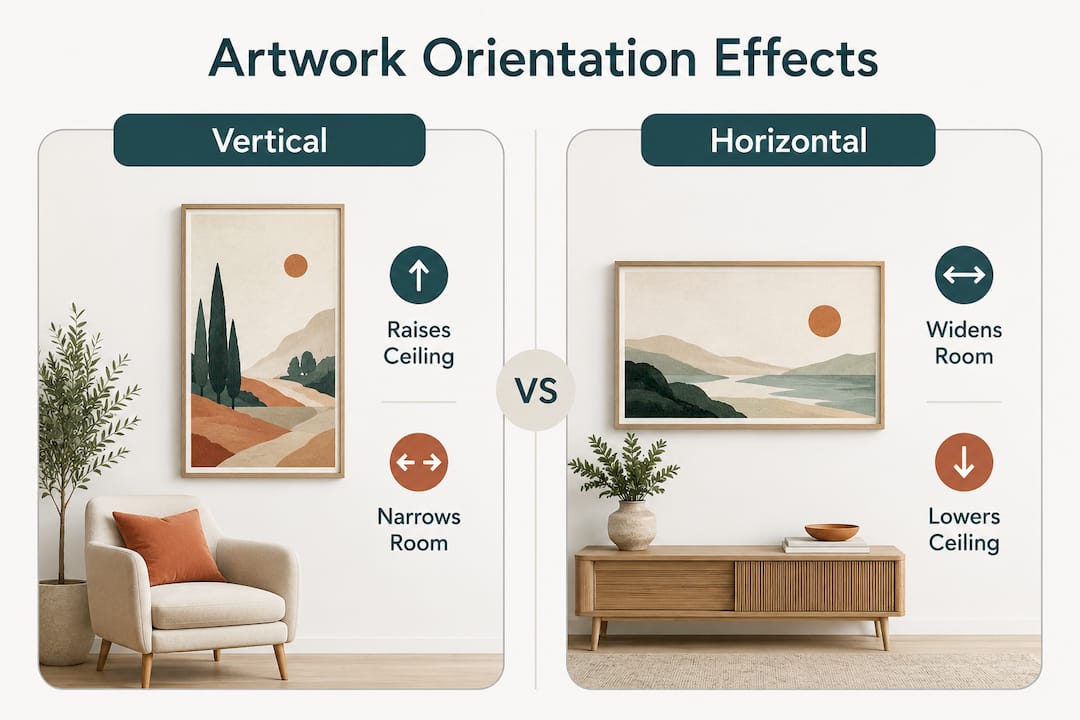
Large-scale art actively changes how you perceive the dimensions of a room. A tall, vertically oriented piece draws the eye upward, making ceilings feel higher. A wide, horizontal composition pulls the gaze across the wall, making a narrow room feel broader. These are not optical illusions. They are predictable outcomes of how human vision processes scale and line.
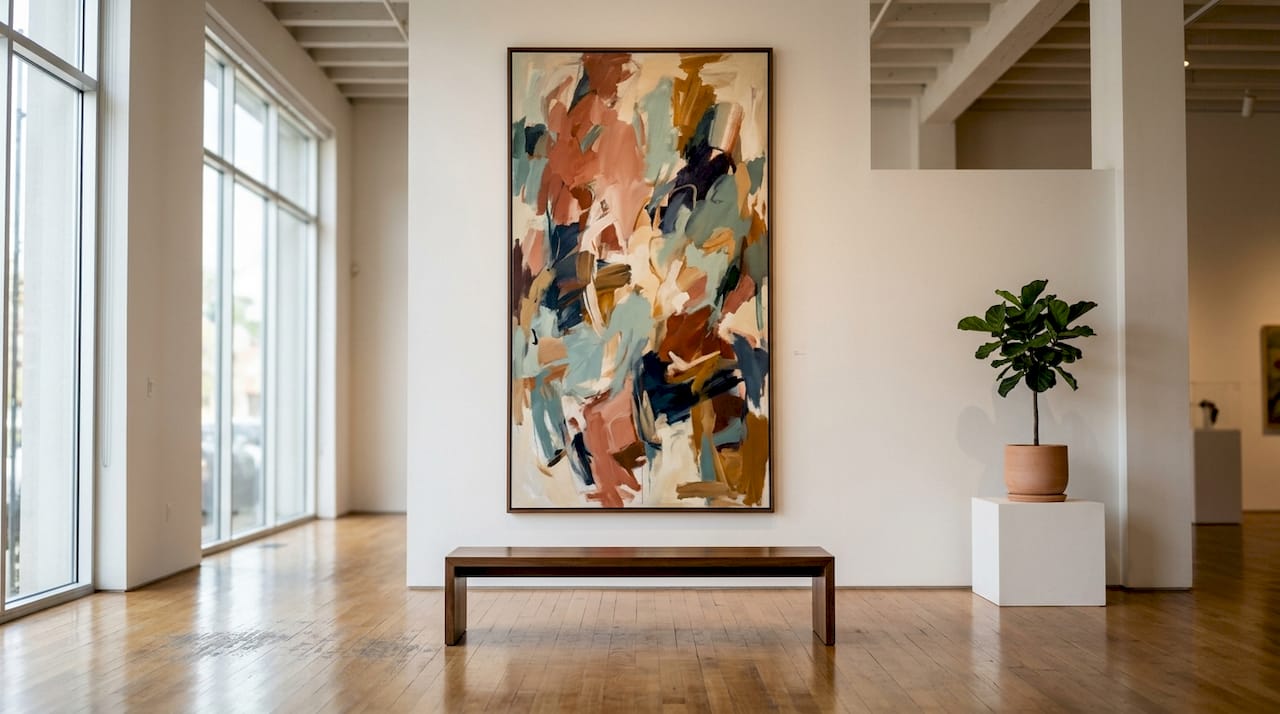
Research into public art interventions confirms that visual structure in large-scale art improves both spatial legibility and restorative capacity at a highly significant level (p<0.001). Spatial legibility is the ease with which you read and navigate a space. When a room is legible, it feels comfortable and purposeful rather than confusing or cramped.
Composition within the artwork also guides behaviour. Strong diagonal lines in a painting can direct movement toward a seating area. A calm, centred composition encourages stillness. Interior designers use this principle deliberately, choosing artwork whose internal structure reinforces how they want occupants to move through and inhabit the space.
Pro Tip: Hang oversized art so its centre sits at 57–60 inches from the floor. This is the standard eye-level position used by galleries worldwide, and it works equally well in domestic rooms.
The table below summarises how orientation and scale affect spatial perception.
| Artwork orientation | Perceived effect on the room |
|---|---|
| Vertical (portrait) | Raises apparent ceiling height |
| Horizontal (landscape) | Widens a narrow room |
| Square, centred | Creates balance and stillness |
| Oversized abstract with movement | Adds energy and dynamism |
Why oversized art suits contemporary interior design
The dominant residential design movement of the mid-2020s is Warm Minimalism. It favours clean lines, natural materials, and a restrained palette, but it rejects the coldness of earlier minimalism by introducing texture, warmth, and one or two powerful statement pieces. Oversized art is the natural centrepiece of this approach.
A single large canvas does the work that a dozen accessories would otherwise attempt. It introduces colour, texture, and personality without adding visual noise. This is why oversized decor in living spaces has become the default choice for interior designers working in contemporary homes.
The key design principles that make oversized art effective are:
- Hierarchy. One dominant piece tells the eye where to start. Everything else in the room becomes secondary, which creates order rather than chaos.
- Proportion. The Sofa Rule (60%–75% of sofa width) and the Eye-Level Rule (centre at 57–60 inches) are the two most reliable guides for getting scale right.
- Breathing space. Leave at least 6–8 inches between the bottom of the artwork and the top of any furniture beneath it. This gap prevents the piece from feeling crowded.
- Restraint. One oversized piece per wall. Placing two large works on the same wall cancels out the focal point effect entirely.
The most common mistake homeowners make is choosing art that is too small. A piece that looks large in a shop or online often disappears against a full wall. When in doubt, go larger. The second most common mistake is hanging art too high, which disconnects it from the furniture below and makes the room feel fragmented.
Pro Tip: Before buying, cut paper to the exact dimensions of the artwork and tape it to the wall. Live with it for a day. This simple test reveals proportion problems that are impossible to spot on a screen.
Styling and placement strategies for oversized art
Placement is as important as the artwork itself. A well-chosen piece hung incorrectly loses most of its impact. The following principles apply across living rooms, bedrooms, and dining spaces.
Positioning and height
Centre the artwork at 57–60 inches from the floor to the midpoint of the piece. Above a sofa, leave a gap of 6–8 inches between the sofa back and the bottom edge of the frame. Above a fireplace, the artwork should not extend beyond the width of the mantelpiece, and the bottom edge should sit no more than 4–6 inches above the mantel surface.
Matching scale to the room
A piece that is correctly proportioned for the wall should cover roughly two thirds of the available wall width. In a large open-plan living area, this might mean a canvas of 60 inches or more. In a smaller bedroom, 40–48 inches may be sufficient. The room’s ceiling height also matters. Taller ceilings can carry taller pieces without the artwork feeling oppressive.
Colour and lighting
Oversized art introduces large areas of colour into a room. Choose a piece whose dominant tones either echo or deliberately contrast with the existing palette. Warm neutrals in the artwork complement linen sofas and timber floors. A single bold colour in the artwork can anchor an otherwise neutral room without overwhelming it.
Lighting transforms the impact of large artwork. A picture light mounted above the frame or a directional spotlight from the ceiling draws attention to the piece after dark and adds depth to texture and brushwork. Natural light works well during the day, but avoid direct sunlight on original prints or canvases, as UV exposure causes fading.
- Measure the wall width and calculate 60%–75% of that figure. This is your target artwork width.
- Mark the centre point of the wall at 57–60 inches from the floor with a pencil.
- Use paper templates to test scale before committing to a purchase.
- Hang the piece, then step back to the room’s main entry point and assess the view.
- Adjust lighting to highlight texture and depth, particularly in the evening.
What is the emotional and psychological impact of large-scale artworks?
Art does not just change how a room looks. It changes how you feel inside it. Sustained interaction with integrated artistic environments reduces depression symptoms in 78% of participants and anxiety symptoms in 74% over a 12-month period. That is a clinically meaningful outcome from an environmental intervention that most homeowners can implement without professional help.
“Exposure to biophilic art incorporating natural elements leads to stress reduction through parasympathetic activation, with measurable reductions in cortisol levels, heart rate, and blood pressure.”
The mechanism behind this effect is Stress Reduction Theory, which holds that natural imagery and organic forms trigger the parasympathetic nervous system. This is the system responsible for rest and recovery. Art that incorporates natural curves, botanical forms, or textured surfaces activates this response more reliably than geometric or purely abstract work.
Figurative art produces a greater restorative effect than abstract forms, scoring higher by 0.280 points on perceived restorativeness scales (p<0.001). This does not mean abstract art is ineffective. It means that for homeowners prioritising calm and mental recovery, figurative or biophilic imagery is the stronger choice. For those seeking energy and stimulation, bold abstract work serves a different but equally valid purpose.
Oversized art amplifies these effects simply through scale. A large piece occupies more of your visual field, which means the psychological response is stronger and more sustained. A small print in the corner of a room barely registers. A canvas that fills the wall becomes part of the environment itself. You can read more about creating a calming atmosphere at home through art and environmental design.
Key takeaways
Oversized art is the single most effective design tool for transforming room aesthetics, spatial perception, and emotional atmosphere in a home.
| Point | Details |
|---|---|
| Scale defines the room | Artwork spanning 60%–75% of sofa width creates proportion and visual order. |
| Placement determines impact | Centre the piece at 57–60 inches from the floor for correct eye-level alignment. |
| Art improves wellbeing | Sustained art exposure reduces depression symptoms in 78% and anxiety in 74% of participants. |
| Orientation shapes space | Vertical art raises perceived ceiling height; horizontal art widens a narrow room. |
| One piece per wall | A single oversized work creates hierarchy; two large pieces on the same wall cancel each other out. |
Why I think most homeowners are still thinking too small
The single most consistent mistake I see in residential interiors is undersized art. Homeowners choose a piece they love, hang it on a large wall, and then wonder why the room still feels unfinished. The answer is almost always scale. The artwork is doing its job aesthetically but failing structurally because it is too small to anchor the space.
The shift in thinking required is this: stop treating art as decoration and start treating it as architecture. A well-chosen oversized piece is as structural as a sofa or a rug. It defines zones, sets proportions, and tells every other element in the room where it belongs. When you approach styling large wall art with that mindset, the decisions become much clearer.
The psychological evidence reinforces this. A piece large enough to occupy your visual field genuinely changes how you feel in a room. That is not a marketing claim. It is a measurable outcome from peer-reviewed research. Homeowners who invest in one well-proportioned, well-placed oversized work consistently report that the room feels more resolved, more calming, and more personal than any arrangement of smaller pieces achieved.
My advice is to be bold with scale and restrained with quantity. One large, considered piece will always outperform a wall covered in smaller works. And if you are unsure about proportion, the paper template test costs nothing and removes all the guesswork.
— Lennard
Frametheworld’s oversized art collections for your home
Frametheworld offers a curated range of hand-painted large wall art through its Wabi Sabi collection, which features textured, abstract pieces designed specifically for contemporary interiors. Each work is produced to order, which means you can request specific dimensions to match the proportion rules covered in this guide. The collection suits Warm Minimalism interiors particularly well, with its emphasis on natural imperfection, organic texture, and restrained colour. Frametheworld also offers bespoke commissions for homeowners who want a piece built precisely for their wall. Browse the full range to find artwork scaled and styled for your space.
FAQ
What size counts as oversized wall art?
Oversized wall art exceeds 36–40 inches in width or height. In large living rooms, pieces of 60 inches or more are common and often necessary to achieve correct proportion.
How do I know if oversized art will suit my room?
Apply the Sofa Rule: the artwork should span 60%–75% of the sofa’s width. Cut paper to the target dimensions and tape it to the wall to test scale before purchasing.
Does oversized art make a small room feel larger?
A horizontally oriented oversized piece makes a narrow room feel wider by drawing the eye across the wall. Vertical pieces raise the perceived ceiling height in rooms with low ceilings.
Can oversized art genuinely improve my mood at home?
Research shows that sustained exposure to integrated art environments reduces anxiety symptoms in 74% of participants and depression symptoms in 78%. Biophilic and figurative art produce the strongest restorative effects.
How high should I hang oversized art?
Hang oversized art so its centre sits at 57–60 inches from the floor. Above furniture, leave a gap of 6–8 inches between the top of the piece below and the bottom of the frame.

Leave a comment
This site is protected by hCaptcha and the hCaptcha Privacy Policy and Terms of Service apply.