
TL;DR:
- Art in schools enhances learning, social skills, and emotional well-being through arts-based interventions. Proper arts integration involves dual-objective assessment, which deepens understanding of both subject and art. Implementing art at home and in classrooms is cost-effective with teacher training and deliberate activity choices.
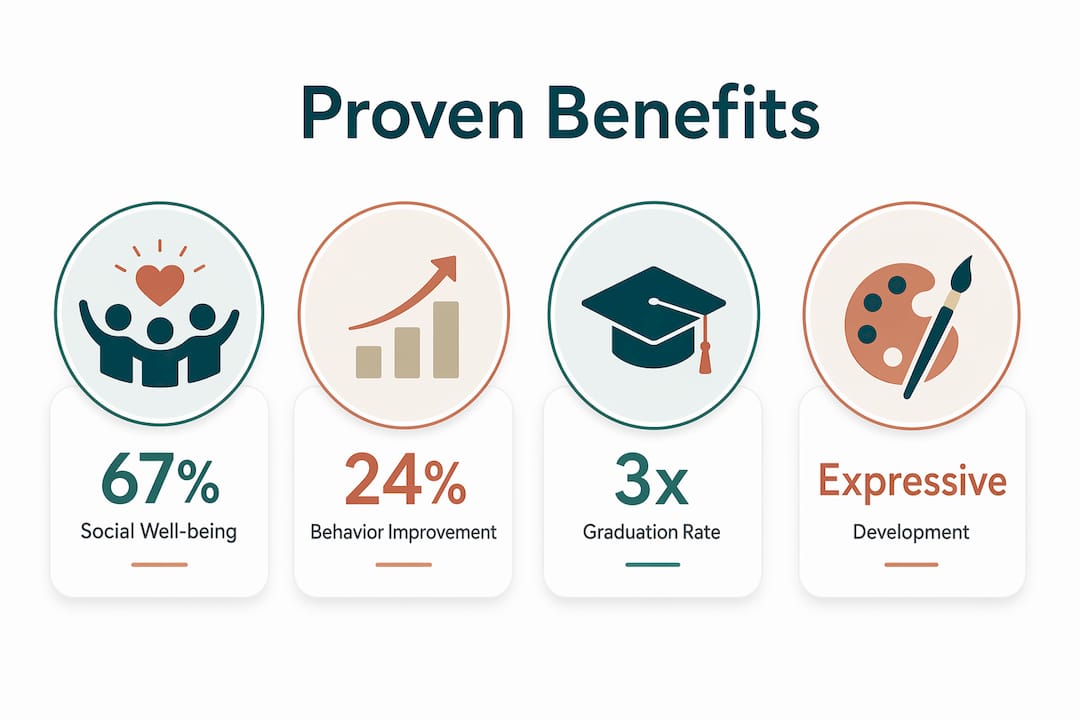
Art in educational settings is defined as the deliberate use of creative disciplines, including visual art, drama, music, and dance, to support learning, personal development, and academic achievement. This goes well beyond painting on a Friday afternoon. 67% of studies confirm that arts-based interventions improve students’ social well-being, emotional control, and interpersonal skills. That figure represents a body of evidence, not an outlier. Students with consistent access to arts education are three times more likely to graduate and perform better across core subjects. The role of art in educational settings is, by any measure, central rather than supplementary.
How does art integration differ from traditional arts education?
Arts integration and traditional arts education are not the same thing. Traditional arts education treats art as a standalone subject: a pupil attends a drama lesson or a painting class, develops artistic skills, and moves on. Arts integration, by contrast, weaves artistic methods into the teaching of other subjects, so that a pupil might use tableau vivant to explore a historical event or create a scaled diagram in the style of a botanical illustration to learn fractions.
The defining feature of arts integration is its dual objective. Dual-objective assessment, as defined by the Kennedy Center’s CETA programme, requires that both the academic content and the art form are assessed simultaneously. This is what separates genuine integration from decoration. A science lesson where pupils draw a cell is not arts integration unless the quality of the observational drawing is also taught and assessed.
Practical examples of arts integration include:
- Science and visual art: Pupils sketch biological specimens using cross-hatching and shading techniques, learning both cell structure and observational drawing.
- Mathematics and music: Pupils use rhythmic notation to understand fractions and ratios, connecting numerical patterns to sound.
- History and drama: Role-play and scripted dialogue help pupils internalise cause and effect in historical events.
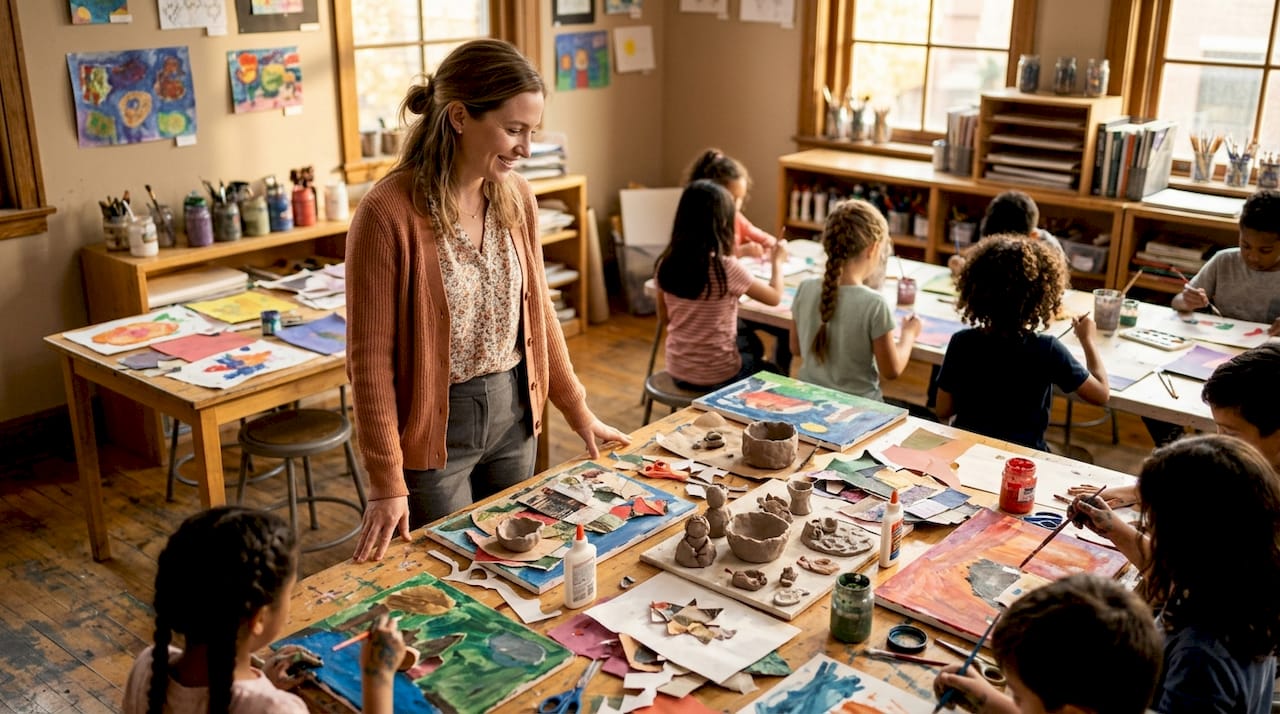
- English and collage: Pupils construct visual narratives from cut imagery, developing sequencing and inference skills alongside composition.
Pro Tip: When planning an integrated lesson, write two learning objectives: one for the academic content and one for the art skill. If you cannot write both, the lesson is not yet truly integrated.
The distinction matters because arts integration, done properly, does not dilute either subject. It deepens both.
What are the proven benefits of incorporating art in learning environments?
The evidence for arts inclusion in schools is substantial and spans cognitive, behavioural, social, and emotional outcomes.
Structured arts integration programmes produce a 15% increase in mastery of core skills and a 24% reduction in classroom disruptions. Those two numbers together tell a clear story: when pupils are engaged through creative methods, they learn more and behave better. The reduction in disruptions alone has significant implications for school administrators managing behaviour policies.
“Expressive arts should be an educational entitlement, with participation deeply supporting learning across subjects and integration of knowledge.” — Chartered College of Teaching and NAfME
The Arts Education Capabilities Framework identifies agency and personal development as core outcomes of arts education. This is particularly significant for pupils who struggle within traditional academic structures. Art provides an alternative pathway to demonstrating intelligence, effort, and growth. A pupil who cannot yet express an idea in writing may express it powerfully through sculpture or movement.
| Benefit | Evidence |
|---|---|
| Improved social well-being | 67% of studies confirm positive outcomes at follow-up |
| Core skill mastery | 15% increase in arts integration schools |
| Reduced classroom disruptions | 24% reduction in integrated programmes |
| Graduation likelihood | Three times higher with consistent arts access |
| Agency and personal development | Identified by the Arts Education Capabilities Framework |
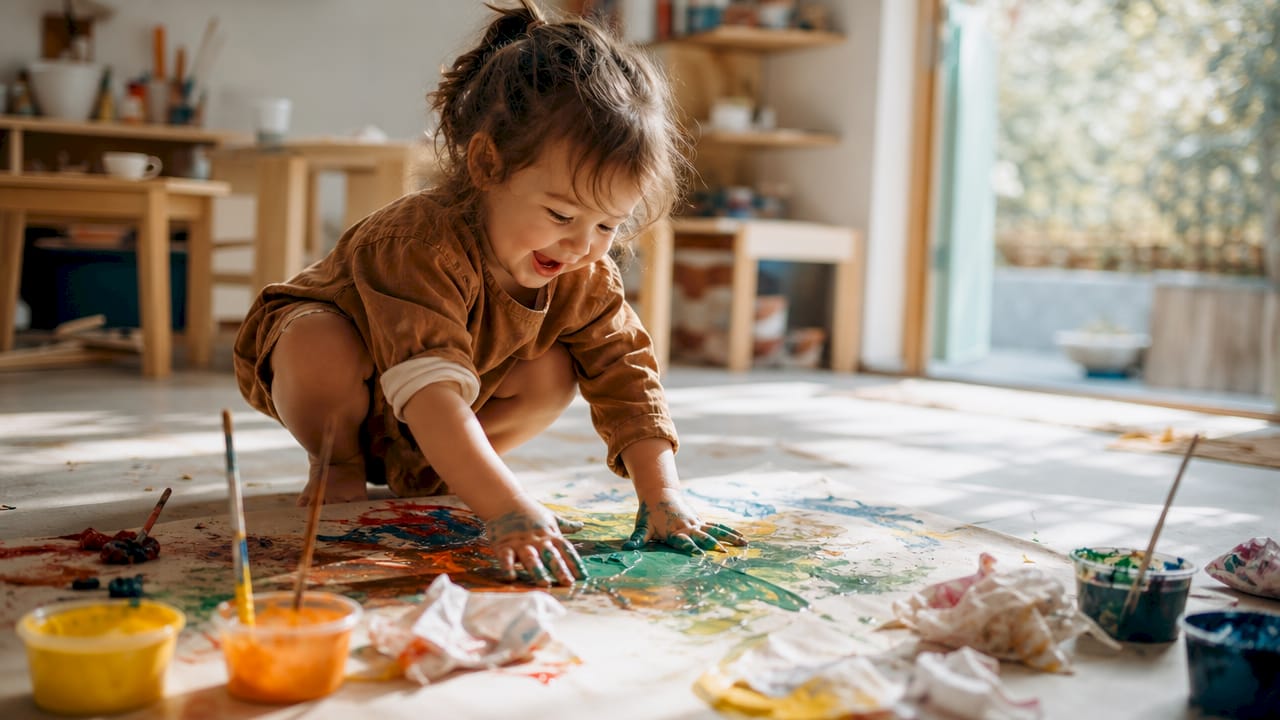
Process art, as defined by NAEYC, focuses on material exploration rather than finished products. This approach significantly fosters expressive language and critical thinking in young children. A child who is free to mix colours without being told what to make is practising decision-making, observation, and self-expression simultaneously. These are foundational cognitive skills, not soft extras.
The Chartered College of Teaching describes expressive arts participation as a vital educational entitlement that enhances critical thinking, communication, and confidence. That framing shifts the conversation from “should we include art?” to “what are we denying pupils when we do not?”
How can educators and parents implement art in schools and at home?
Practical implementation does not require large budgets. The evidence points clearly toward teacher training and pedagogical shift as the primary investment.
- Invest in teacher training first. An Oklahoma elementary school’s arts integration programme demonstrated that after initial training, ongoing costs were minimal because the approach became embedded in how teachers planned and delivered lessons. The shift is cognitive, not material.
- Use process art in early years settings. Remove the template. Provide open-ended materials: clay, paint, fabric, natural objects. Observe what children create and use their choices as starting points for language development and discussion.
- Integrate art into existing lesson plans. Identify one lesson per week where an art form can serve a dual objective. Start with subjects where visual or physical representation is already useful, such as geography, biology, or history.
- Display pupil artwork deliberately. Displaying children’s artwork at home supports emotional and social development. The act of displaying work communicates to a child that their creative output has value. This applies equally in classrooms: a curated display is an assessment tool as much as a decoration.
- Connect home environments to learning. Parents who think carefully about art in the home create visual environments that normalise creative thinking. A home where art is present and discussed is a home where curiosity is modelled.
Pro Tip: For parents unsure where to begin, choose one piece of art for a shared family space and make a habit of talking about it. Ask children what they see, what they feel, and what they think the artist intended. This simple practice builds visual literacy and critical thinking.
Sustainability is the most common concern raised by school administrators. The Oklahoma case study addresses this directly: arts integration does not require ongoing material expenditure once teachers have internalised the approach. The cost is front-loaded in training, not in supplies.
How do you measure the impact of art in educational settings?
Assessment is where many arts programmes fall short. Without clear measurement, art risks being treated as a pleasant addition rather than a rigorous learning tool.
Dual-objective assessment is the standard set by the Kennedy Center’s CETA programme. Each integrated lesson must assess both the academic content and the art form. This prevents art from becoming what researchers call “decorative,” where it is present in a lesson but not genuinely taught or evaluated.
Practical assessment approaches include:
- Formative observation: Teachers note how pupils engage with materials, make decisions, and articulate their choices during process art activities.
- Dual rubrics: A single assessment sheet covers both the academic learning objective and the art skill objective, with separate criteria for each.
- Portfolio documentation: Pupils collect work over time, allowing teachers and parents to track development in both creative and academic domains.
- Peer dialogue: Structured discussion about artwork develops communication skills and provides evidence of critical thinking and comprehension.
- Follow-up assessment: Arts-based interventions show their strongest outcomes at follow-up intervals, not immediately. Build in reassessment points several weeks after a unit ends.
The most common mistake is assessing only the finished product. A pupil who produces a technically weak drawing may have demonstrated exceptional reasoning during the process. Formative measures capture what a final piece cannot. School administrators who want to make the case for arts funding need this kind of evidence: documented, consistent, and tied to academic outcomes.
Key takeaways
Arts integration, assessed through dual objectives for both academic content and artistic skill, is the most evidence-backed method for using art to improve learning outcomes, behaviour, and pupil wellbeing.
| Point | Details |
|---|---|
| Arts integration vs arts education | Integration requires dual-objective assessment; standalone art lessons do not achieve the same academic outcomes. |
| Behaviour and attainment | Structured programmes produce a 15% skills increase and a 24% reduction in classroom disruptions. |
| Graduation and access | Pupils with consistent arts access are three times more likely to graduate. |
| Process art for young children | Open-ended material exploration builds expressive language and critical thinking more effectively than product-focused tasks. |
| Display and home environment | Displaying children’s artwork at home actively supports emotional and social development. |
Art in education: what the evidence taught me
I have spent years watching schools treat art as the subject that gets cut when exam pressure rises. The logic seems reasonable on the surface: prioritise literacy and numeracy, and art can wait. The evidence says the opposite is true.
What strikes me most is the graduation statistic. Three times more likely to graduate is not a marginal effect. That is a structural difference in life outcomes. And yet arts programmes remain among the first casualties of budget pressures. The Oklahoma case study matters precisely because it dismantles the cost argument. Once teachers are trained, the approach sustains itself. The barrier is not money. It is institutional will.
The dual-objective assessment principle is the insight I wish more educators would take seriously. It is the difference between art that teaches and art that decorates. When a science teacher assesses both the accuracy of a diagram and the quality of the observational drawing, they are respecting both disciplines. That respect is what makes integration work.
For parents, the message is simpler. You do not need a studio or a gallery. You need to put art on the wall, talk about it, and let your children make things without telling them what the result should look like. The research on art theme selection for home spaces shows that the choices you make about what surrounds your children matter more than most parents realise.
The schools and families that treat art as central, not supplementary, are producing more curious, more resilient, and more capable young people. That is not an opinion. It is what the data shows.
— Lennard
Art that inspires learning, at home and beyond
Environments shaped by art do more than look appealing. They signal to children that creativity has a place in daily life. Frametheworld offers a collection of Wabi Sabi wall art featuring hand-painted abstract textures that bring warmth, depth, and visual interest to any space. These pieces work particularly well in learning environments, home offices, and children’s rooms where a calm, considered aesthetic supports focus and creative thinking. Each piece is available in multiple sizes and formats, making it straightforward to find something that fits your space. For those interested in how open-plan spaces can be arranged to support both creativity and learning, thoughtful art placement is a practical starting point.
FAQ
What is arts integration in schools?
Arts integration is a teaching approach where an art form is used to teach academic content, with both the art skill and the academic subject assessed simultaneously. It differs from traditional arts education, which treats art as a standalone subject.
How does art improve student behaviour?
Structured arts integration programmes produce a 24% reduction in classroom disruptions. Engagement through creative methods reduces the conditions that typically lead to disruptive behaviour.
Is arts education linked to graduation rates?
Students with consistent access to arts education are three times more likely to graduate and perform better across core subjects, according to 2026 research linking arts access to academic outcomes.
What is process art and why does it matter?
Process art focuses on material exploration rather than producing a finished product. NAEYC research shows it significantly builds expressive language and critical thinking in young children.
How can parents support arts education at home?
Displaying children’s artwork at home supports emotional and social development. Talking about art, providing open-ended materials, and choosing art for shared spaces all reinforce the creative habits that schools are working to build.

Laat een reactie achter
Deze site wordt beschermd door hCaptcha en het privacybeleid en de servicevoorwaarden van hCaptcha zijn van toepassing.