

TL;DR:
- Art themes are recurring ideas within artworks that reveal deeper meanings beyond the surface image. Identifying these themes involves analyzing visual motifs, cultural codes, and contextual factors, separating subject matter from underlying concepts. A multi-dimensional approach combining formal, social, and emotional analysis produces the most credible interpretations of art.
Art themes are the central recurring ideas and concepts within an artwork that reveal deeper meanings beyond the surface image. Explaining art themes, known more formally as thematic analysis, means identifying those ideas and tracing how they operate through visual motifs, cultural codes, and compositional choices. A thematic analysis in art goes beyond describing what you see to uncovering what an artwork communicates about human experience. Artists such as Frida Kahlo and Paula Rego built entire bodies of work around themes of identity, power, and the body, making their art inseparable from its thematic content.
How to identify themes in artworks: visual and subject analysis
The first step in explaining art themes is separating subject matter from theme. Subject matter is what the painting literally depicts: a woman seated at a window, a storm at sea, a bowl of fruit. Theme is the underlying idea that subject matter serves, such as isolation, the sublime, or mortality. Confusing the two is the most common error beginners make, and it produces descriptions rather than interpretations.
Iconography is the discipline that bridges this gap. It involves identifying the visual motifs, symbols, and attributes that carry conventional meanings within a given cultural tradition. A lily in a Renaissance painting signals purity. A skull in a Dutch still life signals the passage of time. A broken column in a Frida Kahlo self-portrait signals physical and psychological fracture. These are not personal readings; they are coded meanings that art historians have mapped across centuries of production.
Genre identification also provides strong thematic clues. History paintings typically address themes of heroism, sacrifice, or political power. Portraits explore identity, status, and social role. Landscapes carry themes ranging from national pride to spiritual transcendence, depending on the period and cultural context. Recognising genre narrows the interpretive field considerably before you examine a single brushstroke.
A structured analytical workflow begins with what the painting shows, moves to identifying period-specific symbols, and then connects those symbols to cultural codes relevant to the artist’s era. This sequence prevents the common mistake of leaping to interpretation before the visual evidence is properly catalogued.
- Identify the subject matter first: figures, objects, setting, and action
- Note any symbolic attributes: colours, animals, objects with conventional meanings
- Identify the genre: portrait, landscape, history painting, still life, or genre scene
- List recurring motifs across the composition
- Ask what idea or condition these elements collectively point toward
Pro Tip: Pay close attention to light, colour, and composition as thematic signals. A painter who floods a scene with golden light is making a thematic statement about divinity or hope just as deliberately as one who chooses a skull as a prop.
How does cultural and historical context shape theme interpretation?
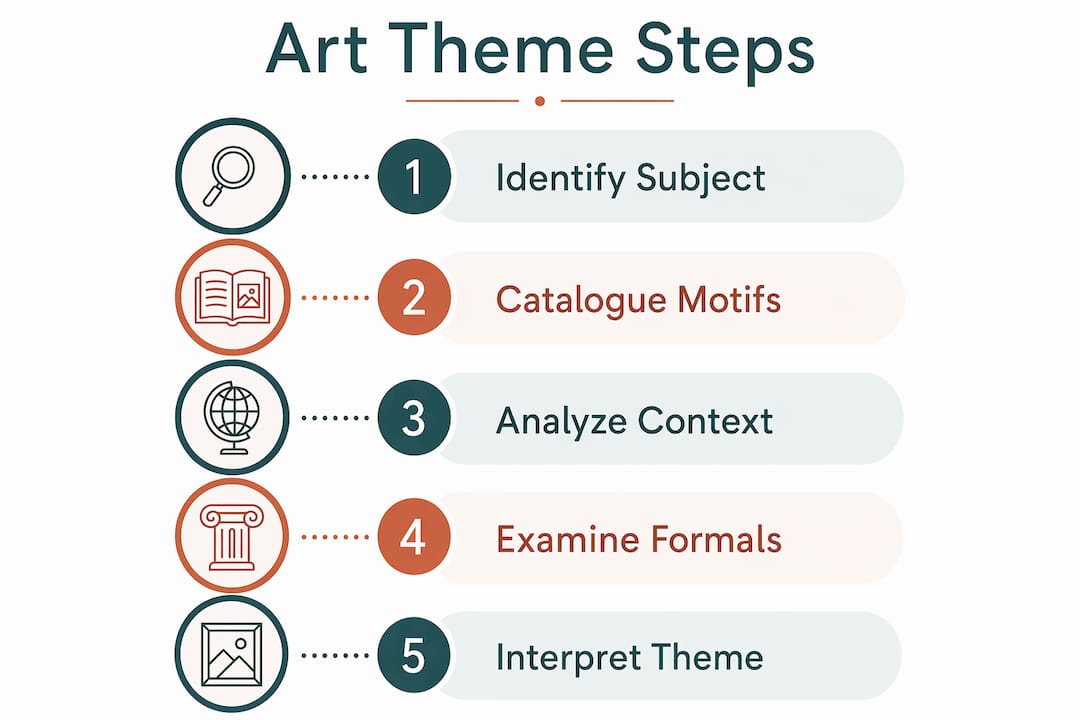
Identifying visual motifs is only half the work. The second half is iconology, which interprets those motifs within the broader cultural, social, and historical conditions that produced them. The art historian Erwin Panofsky formalised this distinction in the twentieth century, and it remains the backbone of serious thematic interpretation today.
Context transforms meaning. A painting of a chained figure in ancient Greece carries a different thematic weight than the same image produced during the transatlantic slave trade or in a contemporary gallery. The motif is identical; the theme shifts entirely depending on who commissioned the work, when it was made, and for what audience. Ignoring this produces confident but inaccurate readings.
Follow these steps to build a credible contextual interpretation:
- Research the artist’s biography, nationality, and the period in which the work was produced.
- Identify the patron or commissioner, since patronage often dictates thematic content directly.
- Investigate the political or social climate of the era, particularly any movements the artist engaged with.
- Check whether the work belongs to a series or cycle, since cycles reinforce themes across multiple pieces.
- Cross-reference your symbolic readings against period-specific iconographic conventions rather than modern associations.
The 2026 Whitney Biennial demonstrated how thematic unification operates even without a declared theme. Critics identified strong recurring threads of social history, family, and urban life across dozens of independent works. This shows that themes emerge from shared cultural conditions as much as from individual artistic intention.
Semiotics offers another useful lens. Artworks function as semiotic systems where visual elements act as signs, and mapping those signs to their cultural meanings produces theme-level interpretations. This approach, rooted in the work of Ferdinand de Saussure, treats the painting as a language with its own grammar and vocabulary.

Pro Tip: Avoid imposing personal assumptions without contextual evidence. If you cannot point to a culturally specific convention that supports your reading, treat it as a hypothesis rather than a conclusion.
What role do formal elements play in conveying art themes?
Formal elements are not decorative additions to thematic content. They are the primary means by which themes are communicated. Elements of art and design principles, including line, shape, colour, texture, space, balance, emphasis, and rhythm, structure visual communication and direct the viewer’s attention toward the ideas the artist intends to foreground.
Colour is perhaps the most immediate thematic carrier. Red signals danger, passion, or sacrifice across many Western traditions, but carries associations of luck and celebration in Chinese cultural contexts. This variability means colour readings must always be anchored in the specific cultural and historical frame of the work. A formal analysis that ignores this produces readings that are technically accurate but thematically misleading.
The following table shows how specific formal elements and design principles connect to thematic effects in practice.
| Formal element or principle | Thematic effect |
|---|---|
| Diagonal lines | Tension, instability, or dynamic conflict |
| Warm colour palette | Intimacy, danger, or spiritual warmth depending on context |
| Asymmetrical balance | Unease, modernity, or psychological complexity |
| Strong central emphasis | Authority, divinity, or heroic status |
| Fragmented or broken forms | Trauma, disruption, or the passage of time |
Composition reinforces theme at the structural level. A figure placed at the margins of a canvas communicates social exclusion or psychological isolation far more powerfully than a caption could. A painter who uses rhythm to repeat a motif across a canvas is building thematic insistence into the very architecture of the image. Understanding these choices is what separates a description of a painting from a genuine thematic explanation.
Applying a multi-dimensional approach to art theme analysis
The most credible thematic interpretations combine three distinct modes of analysis: formal and visual, social and historical, and subjective and emotional. Relying on only one produces partial readings. Incorporating all three enriches both the credibility and the depth of any theme interpretation.
Paula Rego’s Dog Woman series from 1994 illustrates this well. A purely formal reading notes the compressed space, the animalistic postures, and the confrontational gaze. A contextual reading connects these choices to Rego’s engagement with feminist politics and her response to the defeat of Portugal’s abortion referendum. An emotional reading acknowledges the visceral discomfort the works produce and asks what that discomfort reveals about the viewer’s own assumptions regarding gender and power. Each layer adds something the others cannot supply alone.
Subjective emotional response is often dismissed as insufficiently rigorous, but it is a legitimate analytical tool when handled carefully. The key is to treat your emotional reaction as data rather than conclusion. Ask why the work produces that response, then trace the formal and contextual mechanisms that generate it. This turns personal feeling into interpretive evidence.
Practical guidance for applying this approach:
- Write a formal description first, without any interpretive claims
- Add a contextual paragraph that situates the work in its historical and cultural moment
- Record your emotional response honestly, then interrogate its causes
- Look for points where all three layers converge, since convergence signals a strong thematic reading
- Revise your theme statement to reflect all three dimensions, not just the most obvious one
Understanding how art shapes the mood of a room follows the same logic. The themes embedded in a work carry emotional charge that operates in domestic spaces just as it does in gallery contexts.
Common pitfalls when explaining art themes
The most frequent error in art theme analysis is theme-chasing: selecting an appealing idea and then working backwards to find evidence for it. Credible thematic analysis requires testing whether themes are supported by culturally specific symbols and conventions, not by personal associations. If the evidence does not hold up under scrutiny, the theme claim must be revised.
A second common error is misidentifying symbolic attributes. Iconographic conventions are precise. A palm branch and a laurel wreath are both plants, but they carry entirely different meanings in classical and Christian iconographic traditions. Confusing them produces thematic claims that are factually wrong, not merely interpretively different.
For aspiring artists, themes act as lenses/02%3A_Developing_a_Unified_Body_of_Work/2.04%3A_Themes_of_Art) that shape both subject matter and formal decisions across a body of work. Choosing a theme such as memory, identity, or time gives every compositional and material choice a purpose beyond aesthetics.
| Pitfall | Recommended strategy |
|---|---|
| Theme-chasing without evidence | Test every theme claim against period-specific iconographic conventions |
| Ignoring cultural context | Research patronage, era, and social climate before interpreting symbols |
| Relying on emotional response alone | Use emotional reaction as a starting point, then verify with formal and contextual evidence |
| Inconsistent formal choices | Align compositional decisions with your stated theme throughout the work |
Pro Tip: Think like a curator when making or analysing art. A strong exhibition unifies theme and composition so that every work reinforces the central idea. Apply the same discipline to a single canvas.
Key takeaways
Explaining art themes requires combining iconographic identification, cultural contextualisation, and formal analysis to produce credible, multi-layered interpretations.
| Point | Details |
|---|---|
| Separate subject from theme | Subject matter describes what is depicted; theme reveals the underlying idea it serves. |
| Use iconography before iconology | Identify visual motifs accurately before interpreting their cultural meanings. |
| Anchor readings in context | Research the artist’s era, patronage, and social climate to validate thematic claims. |
| Formal elements carry themes | Line, colour, composition, and balance communicate thematic content as directly as symbols do. |
| Combine three analytical modes | Formal, contextual, and emotional analysis together produce the most credible theme explanations. |
Why theme explanation changed how I look at every artwork
There is a moment that most art enthusiasts recognise: standing in front of a painting that clearly means something, but not quite knowing how to articulate what. For years I treated that gap as a personal failing. What I eventually understood is that it is a methodological gap, not an aesthetic one. Once you have a structured approach to thematic analysis, that silence fills quickly.
What surprised me most was how much formal elements do the thematic work. I had always treated colour and composition as aesthetic choices. Realising they are argumentative choices, that a painter uses asymmetry the way a writer uses a subordinate clause, changed how I read every work I encountered afterwards. The painting stops being a picture and becomes a position.
The multi-dimensional approach I described above is not just academically sound. It is genuinely more interesting. A purely formal reading of Rego’s Dog Woman is competent. Adding the political context and then sitting with the emotional discomfort it produces is revelatory. That combination is what turns art appreciation into something closer to a conversation with the artist across time.
For emerging artists, I would say this: understanding art thematic elements in the work of others is the fastest route to developing thematic clarity in your own. You cannot choose a theme deliberately until you can see how themes operate in practice.
— Lennard
Explore thematic art for your home with Frametheworld
Understanding themes in visual art transforms how you choose artwork for your living spaces. When you know what a work is communicating, you can select pieces that genuinely reflect your values and aesthetic sensibility rather than simply filling a wall. Frametheworld offers curated collections built around thematic depth, from Wabi Sabi wall art that embodies imperfect beauty and quiet contemplation, to bold colourful canvases that carry themes of energy and joy. Every piece is hand-painted, meaning the formal choices you now know how to read were made deliberately by a working artist. Browse by theme, style, or format to find work that speaks to you with intention.
FAQ
What is the difference between subject matter and theme in art?
Subject matter is what an artwork literally depicts, such as a figure, landscape, or object. Theme is the underlying idea or concept that the subject matter expresses, such as mortality, identity, or social power.
How do I start explaining art themes in a painting?
Begin by identifying the subject matter and genre, then catalogue any symbolic motifs using iconographic conventions. Research the cultural and historical context before drawing thematic conclusions, and check that your formal observations support your theme claim.
What is iconography and why does it matter for art theme analysis?
Iconography is the study and identification of visual symbols and their conventional meanings within a cultural tradition. It matters because accurate symbol identification is the foundation of any credible thematic interpretation.
Can emotional response be part of a valid thematic analysis?
Yes. Emotional response becomes analytically valid when you interrogate its causes rather than treating it as a conclusion. Tracing why a work produces a particular feeling leads back to the formal and contextual mechanisms the artist deployed, which strengthens rather than weakens a thematic argument.
How do themes in visual art guide an artist’s creative decisions?
Themes guide both subject direction and formal elements/02%3A_Developing_a_Unified_Body_of_Work/2.04%3A_Themes_of_Art) in a body of work, shaping compositional choices, colour palettes, and material decisions so that every element reinforces the central idea.



Laat een reactie achter
Deze site wordt beschermd door hCaptcha en het privacybeleid en de servicevoorwaarden van hCaptcha zijn van toepassing.