
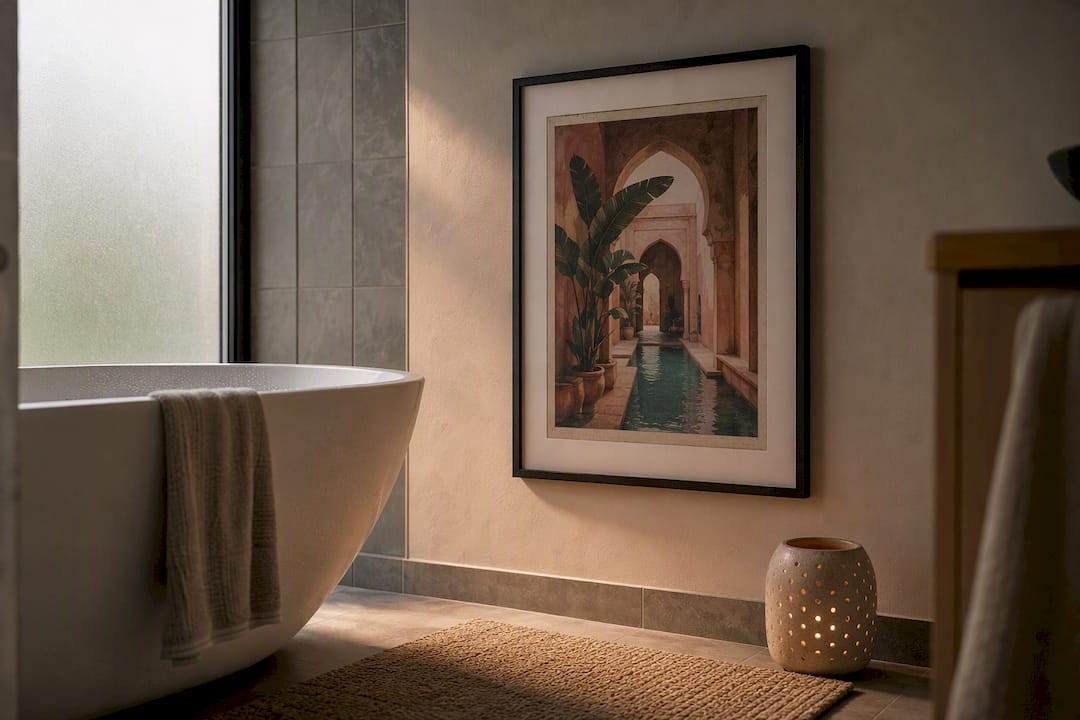
Choose humidity-tolerant formats first, style second. Sealed frames with acrylic glazing, stretched canvas, or laminated prints all shrug off steam far better than a bare paper print in a basic clip frame. The single rule that matters most: keep art out of direct water contact, whether that means a sensible distance from the shower spray or a protective layer of glazing between the paper and the air.
- Sealed frames with acrylic glazing, canvas, or laminated prints for anywhere near steam
- Keep art away from direct splash zones, not just “somewhere in the bathroom”
- Save your favourite, irreplaceable prints for drier rooms; use inexpensive or sentimental pieces here instead
Key Takeaways
Humidity-tolerant materials and safe placement, not price or trend, determine whether bathroom art lasts.
| Point | Details |
|---|---|
| Pick the right substrate | Canvas, laminated prints, or acrylic-glazed paper resist warping better than glass-framed paper. |
| Keep water at a distance | Hang art at least 12 inches from shower spray or direct splash zones. |
| Match scale to the wall | Aim for artwork sized proportionally to the width of the vanity, generally a majority of the width, centred around 145 to 155 centimetres high. |
| Use renter-friendly fixings | Bathroom-rated strips, shelves, and tile-safe hooks avoid drilling into tiled walls. |
| Consider bespoke sizing | Frametheworld offers hand-painted canvases with humidity-aware framing built to your exact wall dimensions. |
Table of Contents
- Which art styles suit a bathroom best?
- Can you actually put art in a bathroom safely?
- How big should bathroom art be and where should it go?
- What’s the best way to hang art without damaging tiles?
- Where can you buy or commission bathroom-ready prints?
- What do designers actually say about bathroom art?
- A stylist’s honest note on hanging art in wet rooms
- How Frametheworld makes bathroom art low-risk
- Sources
Which art styles suit a bathroom best?
The mood you’re chasing should decide the style before you even think about frames. A spa-like bathroom wants calm: botanical line drawings, watery coastal scenes, or a single large leaf photograph in soft green tones. Contemporary bathrooms, especially ones with a lot of tile and chrome, tend to suit muted abstracts or black-and-white photography, since anything too busy fights with the hard surfaces. Powder rooms are the one place in the house where you can be genuinely playful. A bold typographic print or a retro pop-art piece works there precisely because you’re not spending twenty minutes a day staring at it in the bath.
Colour matching matters more than most people expect. Pull one or two tones directly from your towels, tiles, or tapware and echo them in the print, rather than choosing art that clashes and then hoping accessories will fix it. Nature-inspired themes, muted abstracts, and monochrome photography consistently rank among the most versatile bathroom art choices, largely because they flatter almost any existing palette.
- Small bathrooms: one strong focal piece or a tight pair, not a scattered mix
- Powder rooms: bolder colour, pattern, or typography works well precisely because the room is small and used briefly
- Larger family bathrooms: room for a modest gallery grouping without it feeling crowded
Can you actually put art in a bathroom safely?
Yes, and design writers have moved well past the old advice to keep bathrooms art-free. Homes & Gardens points out that art genuinely enriches a bathroom, provided you choose moisture-resistant framing and a substrate suited to a humid room. The risk isn’t the room itself. It’s putting the wrong materials in it.
Paper behind ordinary glass is the combination to be wary of. Trapped moisture between glass and paper causes cockling, foxing, and eventually mould spotting that no amount of cleaning removes. Canvas fares noticeably better once it’s properly stretched and sealed, because there’s no glazing to trap condensation against the surface, and the acrylic or varnish coating sheds humidity rather than absorbing it.
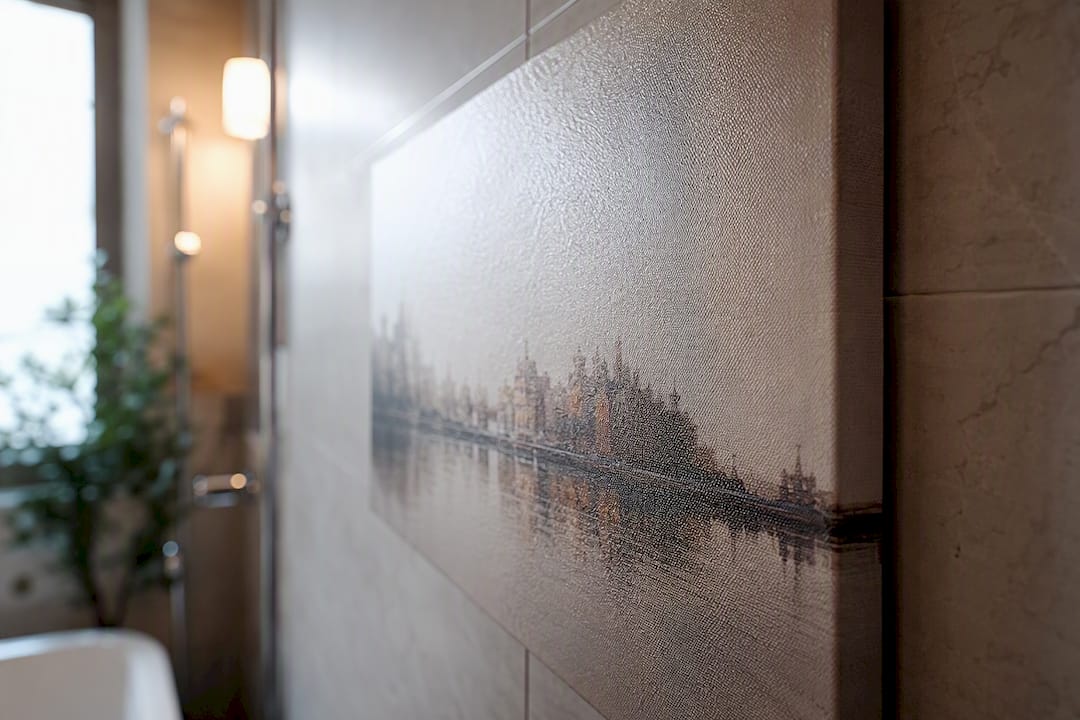
Acrylic glazing beats standard glass in a bathroom for three reasons: it’s lighter, it won’t shatter if it slips off a hook above a hard tiled floor, and it tolerates humidity swings without the fogging that glass sometimes shows. Look for sealed frame backs, foil-backed mounts, and moisture-rated hanging hardware rather than the standard fittings that come with cheap frames.
Pro Tip: Skip heavily textured watercolour or cotton-rag paper in a steamy en suite. It absorbs ambient moisture faster than smooth stock, even behind glazing, and can ripple within a season.
- Avoid: unsealed MDF frames, unbacked paper prints, anything irreplaceable
- Favour: canvas, laminated prints, or paper sealed behind acrylic glazing
- Check mat board quality if you’re using a mount. Acid-free, moisture-resistant board holds up longer than a bargain mount
Frametheworld’s guide to framing options for humid rooms goes deeper on glazing choices if you want the technical side spelled out.
How big should bathroom art be and where should it go?
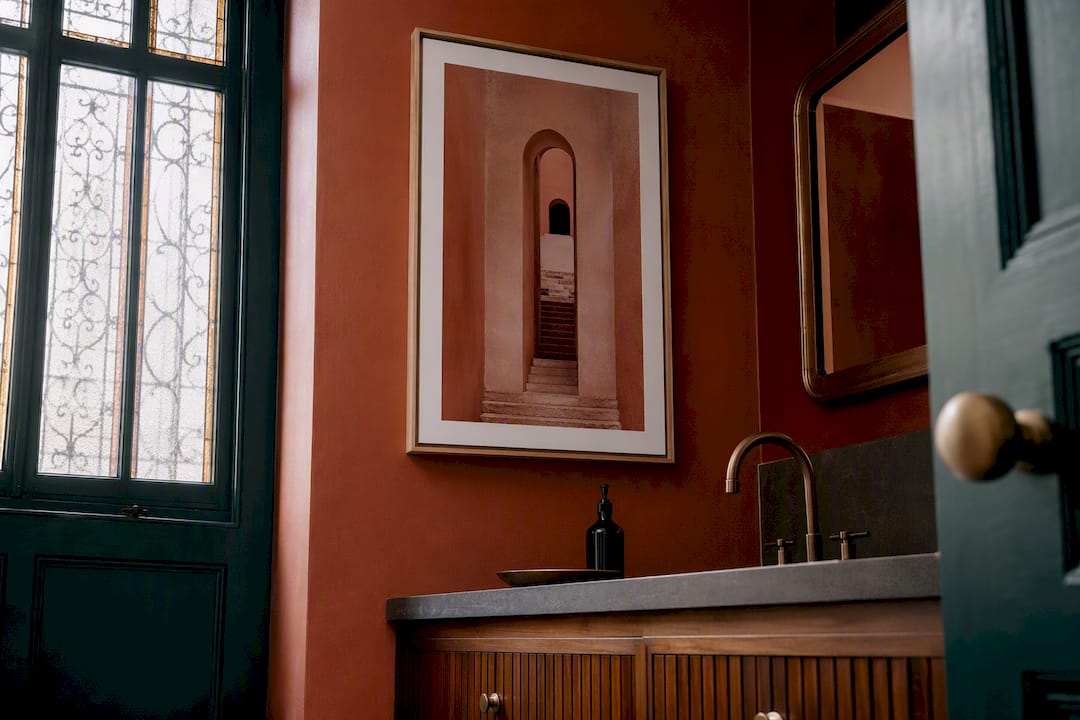
Scale is where most bathroom art goes wrong, usually by going too small, so consulting The Best Interior Doors for Your Bathroom guide for door and art placement can help balance the space naturally. That’s a guideline rather than a formula, but it stops the common mistake of a postage-stamp frame lost above a wide countertop.
Height follows the same logic as anywhere else in the house: aim for the centre of the artwork to sit around 145 to 155 centimetres from the floor, adjusting for very high or low ceilings. Keep the piece out of direct spray. Installers commonly recommend at least 12 inches from any shower head or water source, and that distance is worth treating as a minimum rather than a target.
For grouping, three approaches cover most bathrooms:
- A single focal piece above the bath or vanity, sized generously rather than timidly
- A matching pair flanking a mirror, using identical or closely related frames
- A small gallery cluster on a wall away from water, kept coherent with consistent mat colour, frame finish, and spacing between pieces
Houzz and other design galleries note that small bathrooms are actually one of the better places to experiment with a gallery wall, since the compact scale makes it easy to keep the arrangement tight and deliberate rather than sprawling.
What’s the best way to hang art without damaging tiles?
If you’re drilling into solid wall outside the tiled zone, use corrosion-resistant fixings and picture rails rather than standard steel hooks, which can rust in a humid room within a year or two.
Renters and anyone avoiding tile damage have solid alternatives. Bathroom-rated picture hanging strips hold reasonably light frames without a single hole, and narrow shelves let you lean multiple frames and swap them seasonally with zero commitment. Ideal Home lists stick-on hooks designed for tiled surfaces as a genuine option too, though always check the manufacturer’s weight limit before trusting one with anything heavier than a small print.
- Check load ratings before hanging anything with strips or adhesive hooks
- Lean, don’t hang, in very small or fully tiled bathrooms
- Keep every fixing at least a sensible distance from taps and shower heads
Where can you buy or commission bathroom-ready prints?
Budget doesn’t have to mean boring. Market stalls, small print shops, and even a well-chosen photo from your own camera roll printed at home can all work, especially once framed consistently. Thrifted frames rehung with a new print are one of the cheapest ways to get a considered look, and Frametheworld’s guide to budget wall art options covers several low-cost routes worth trying first.
Commissioning makes more sense once you want a precise colour match or a genuine focal point rather than a filler print. Bespoke sized canvases and hand-painted pieces solve the classic problem of a print that’s almost, but not quite, the right size for an awkward alcove above a bath.
Before buying anything, run through a short checklist: confirm the substrate (paper or canvas), check what glazing is included, read the return policy for moisture-sensitive items, and ask whether framing services are available if the piece arrives unframed.
What do designers actually say about bathroom art?
Texture does more work than most people credit. Canvas, fabric wall hangings, or a tactile framed piece soften the acoustics of a room full of tile and chrome, and House & Garden notes this directly, pointing out that textured art stops bathrooms feeling cold and clinical.
Personal pieces often outperform generic “bathroom art.” Designer Annie Elliott has argued that art in a bathroom needn’t be expensive or rare; a framed postcard or an early print from your own collection can feel far more meaningful than a mass-produced canvas, provided humidity risk is managed sensibly.
Repeat one accent colour from your towels or shower curtain within the art itself. It’s a small trick, but it turns a random print into something that reads as designed rather than added as an afterthought.
Pro Tip: If you’re torn between two prints, pick the one with more texture. It’ll read better under bathroom lighting, which tends to be harsher and more direct than in other rooms.
A stylist’s honest note on hanging art in wet rooms
Styling bathrooms for clients taught me that the humidity question scares people more than it should. Choose the right materials, respect the water zone, and a bathroom becomes one of the most rewarding rooms to decorate. Frametheworld’s framing process guide reflects exactly the approach worth following.
How Frametheworld makes bathroom art low-risk
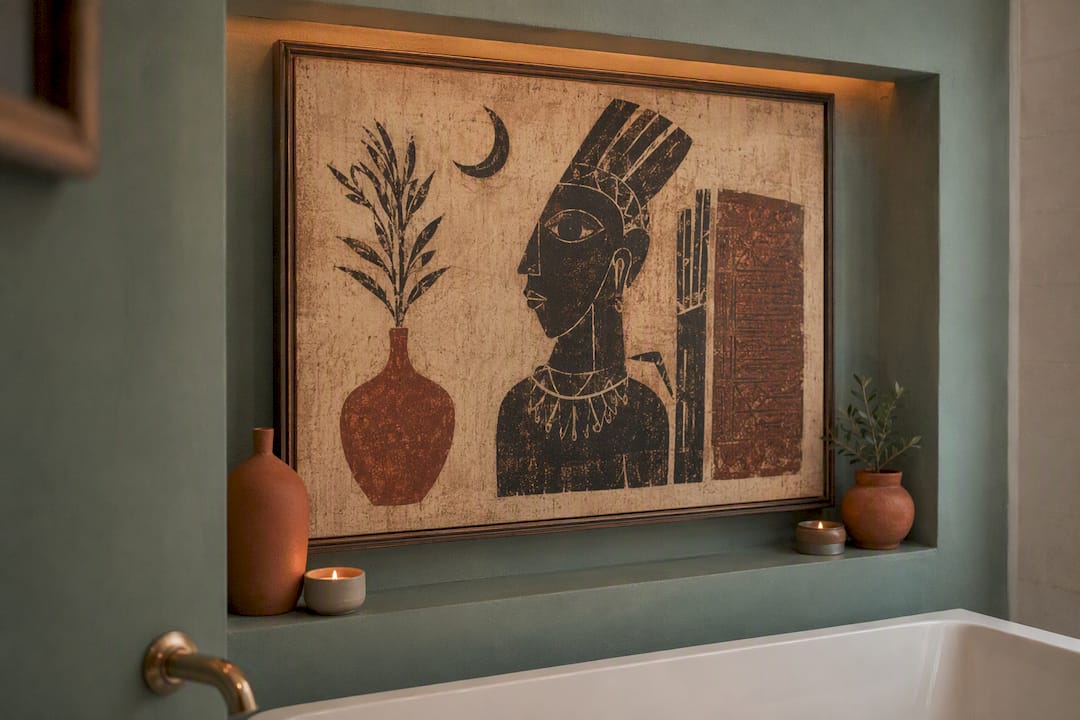
You don’t need to gamble on whether a print survives your shower’s steam. Frametheworld builds humidity-aware framing into its hand-painted canvases as standard, and every piece can be commissioned to the exact size your alcove or vanity wall actually needs, rather than settling for the nearest stock dimension. That matters more in a bathroom than almost any other room, where an inch too wide or too narrow is the difference between a considered focal point and an awkward afterthought.
For texture and colour depth that hold up against tile and chrome, the Wabi Sabi wall art collection offers hand-painted abstract canvases built with exactly this kind of durability in mind. If your bathroom leans playful rather than serene, the pop art collection gives powder rooms and smaller spaces a bolder option with the same protective framing approach. Browse either collection and request a bespoke size if your wall doesn’t match the standard options.
Sources
- 121 bathroom ideas to inspire a refresh | House & Garden
- Should you display art in a bathroom? Here is what to consider | Homes and Gardens
- How to Decorate a Bathroom: 10 Steps for a Designer Look

Laat een reactie achter
Deze site wordt beschermd door hCaptcha en het privacybeleid en de servicevoorwaarden van hCaptcha zijn van toepassing.