
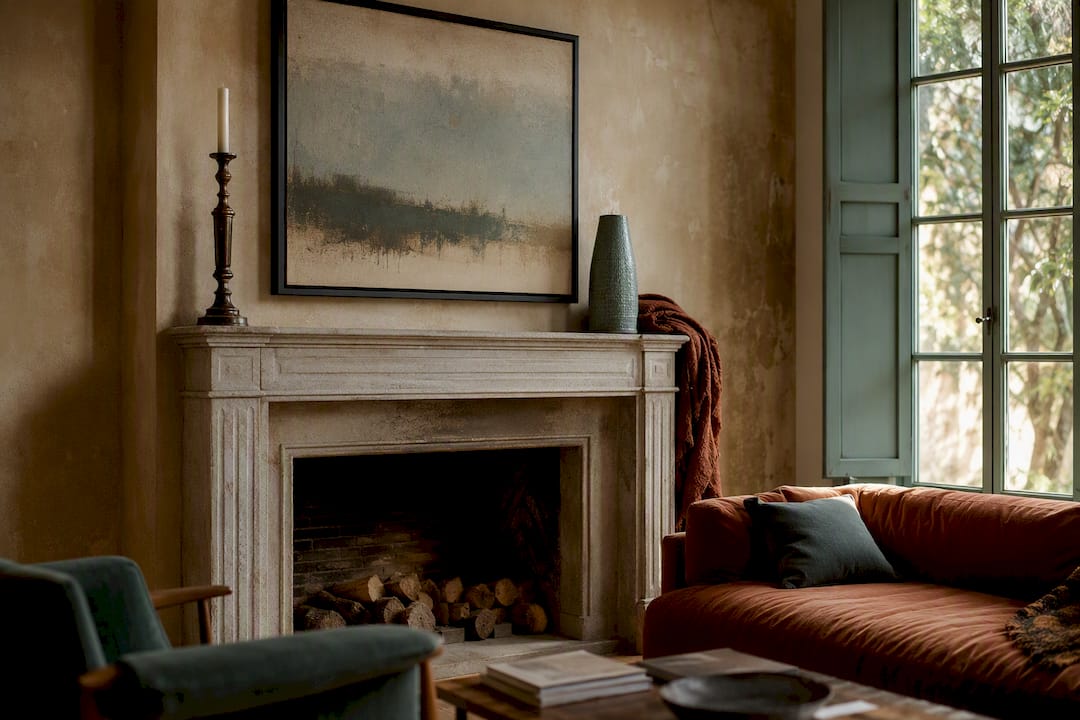
One large statement piece, or a tight cluster sized as one visual block, works better above a fireplace than a small painting hung in isolation. For hanging height, the centre of the piece typically lands around eye level, adjusted upward for high ceilings or a deep mantel surround.
If you want somewhere to start today, three options rarely disappoint:
- A single oversized canvas that spans that two-thirds width
- A triptych, which reads as one piece but gives you flexibility in framing
- A large round mirror layered with smaller leaning prints for depth
Everything else in this guide is about adapting that starting point to your actual room.
Key Takeaways
The most reliable art above a fireplace is a single statement piece or coordinated cluster sized to roughly two-thirds of the mantel width, hung with a 10 to 30 centimetre gap above the shelf.
| Point | Details |
|---|---|
| Use the two-thirds rule | Size artwork width at roughly two-thirds of your mantel width for a balanced first attempt. |
| Match style to mantel formality | Simple frames suit ornate stone surrounds; bold sculptural pieces suit plain mantels. |
| Layer the shelf in three passes | Anchor first, then mid-height objects, then one or two small accents only. |
| Protect against heat and humidity | Leave clearance above working fires and choose canvas or tempered glass over thin paper prints. |
| Commission when sizes don’t fit | Frametheworld offers bespoke, hand-painted pieces resized to unusual mantel proportions. |
Where to read more on fireplace art styling
- House & Garden’s overmantel guide explains matching artwork format to wall shape.
- Better Homes & Gardens’ mantel ideas shows layered mirror-and-print styling in practice.
- Frametheworld’s guide to styling large wall art covers choosing scale for oversized pieces.
- HideRugs’ living room styling advice pairs texture and rugs with mantel displays.
Table of Contents
- Eight art above fireplace examples worth copying
- What sizing and placement rules should you actually use?
- How do you style the mantel shelf beneath the art?
- Does the heat from a fireplace damage artwork?
- How do you choose between ready-made art and a bespoke piece?
- Frequently asked questions
- Sources
Eight art above fireplace examples worth copying
Every fireplace wall has quirks. Here are eight layouts that solve for most of them.
- The single oversized statement piece. One large canvas, roughly two-thirds the mantel width, works best on a plain mantel with a strong colour or subject that can carry the wall alone. Keep the shelf below almost bare; two candlesticks maximum.
- The triptych. Three panels of equal size, hung with narrow gaps, suit wide walls above long mantels and read as a single composition rather than three separate decisions.
- The gallery cluster. A grid or asymmetric arrangement of five to nine smaller frames fits low ceilings where one huge piece would feel cramped. Add a small vase or clock to the shelf to anchor the eye downward.
- The large round mirror. A mirror reflects light back into the room and works especially well on stone or brick surrounds where a painting would compete with texture. Pair it with a single leaned print in front for contrast.
- The leaner arrangement. Instead of hanging anything, lean a large framed piece directly against the wall behind the mantel shelf. This suits low, wide mantels and rented homes where drilling isn’t an option.
- The sculptural wall piece. A textured, dimensional artwork, in wood, plaster, or woven fibre, replaces flat art entirely and suits minimalist mantels with little else on the shelf.
- The framed map or diagram triptych. Three matching frames showing maps, botanical studies, or architectural drawings give a formal, collected look that flanks built-in shelving particularly well.
- The staggered off-centre composition. Two or three different-sized frames, deliberately unaligned, work on asymmetric mantels where the fireplace itself sits off-centre in the wall.
Pro Tip: If your mantel is narrower than most (under 120 centimetres), skip the single statement piece and go for a triptych or cluster instead. Three smaller frames read as generous where one small canvas reads as an afterthought.
What sizing and placement rules should you actually use?
The two-thirds rule is the fastest way to size art for a fireplace: measure your mantel’s width, multiply by 0.66, and that’s roughly your target artwork width. For ornate stone or marble surrounds, size the artwork narrower than the mantel’s outer jambs instead, since an elaborate mantel benefits from a simpler, contained frame rather than a piece that fights the stonework.
Hanging height typically places the visual centre of the piece near eye level, with a small gap between the mantel shelf and the bottom of the frame to maintain balance.
- Mantel width 150 cm → artwork width ≈ 100 cm
- Mantel width 200 cm → artwork width ≈ 133 cm
- Mantel width 120 cm → artwork width ≈ 80 cm
Retailers commonly cite artwork widths between 90 and 125 centimetres as the sweet spot for typical living-room mantels, which lines up neatly with the table above for most standard homes.
How do you style the mantel shelf beneath the art?
Layering the shelf works in three passes, and skipping the order is the most common styling mistake.
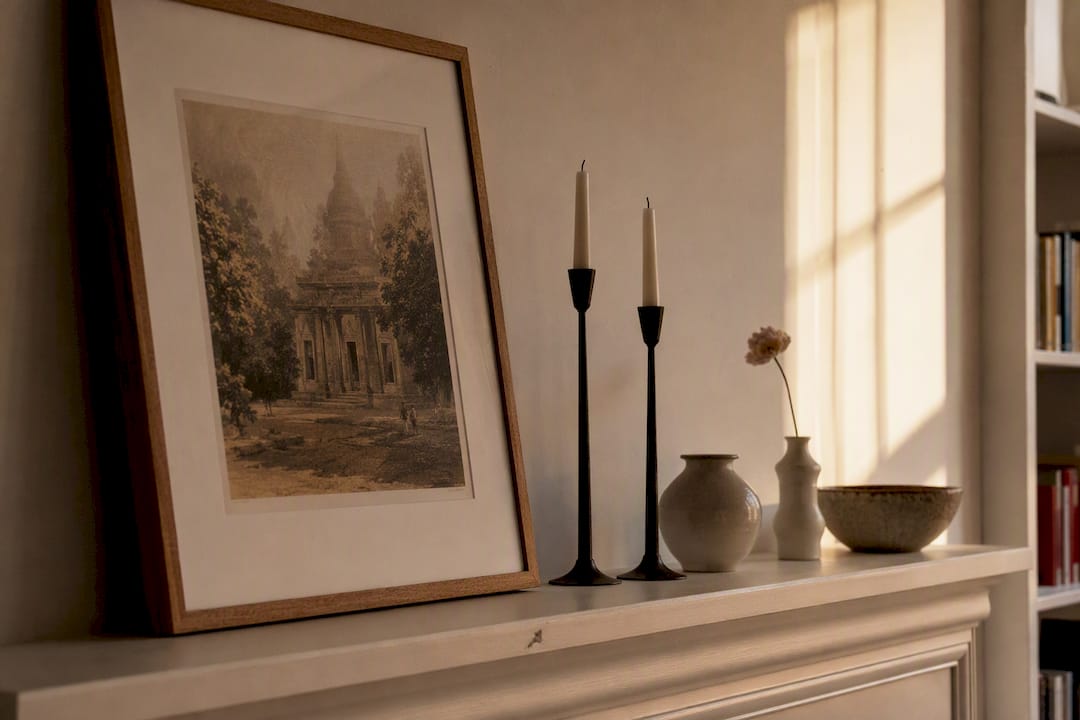
Start with the anchor: something tall enough to sit level with or slightly below the bottom edge of your artwork, whether that’s a large mirror, a leaned print, or a single sculptural object. Next comes mid-height support: candlesticks, a stack of books, or a small vase, placed to one side rather than dead centre. Finish with small accents, like a single stem in a vase or a textured bowl, kept to no more than two or three items.
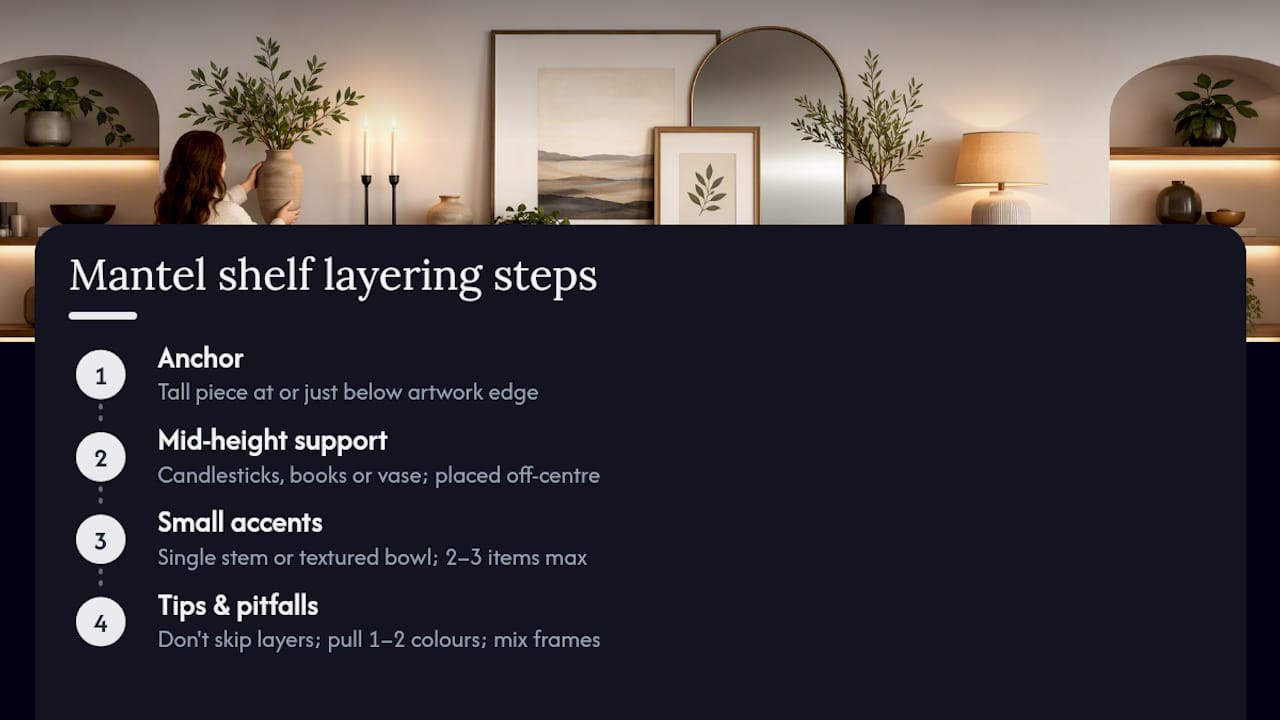
Balance depends on your art choice. A large single canvas wants a nearly bare shelf; a gallery cluster can carry more texture and clutter beneath it because the wall above is already busy. Layering a mirror with a leaned smaller piece and a couple of accents creates depth without visual noise, which is a safer default than guessing at symmetry.
Pull one or two colours from the artwork’s palette into your mantel accessories. If the room feels flat, painting the wall above the mantel in an accent colour can make even modest art stand out far more than a bigger frame would.
Pro Tip: Mixing frame finishes, say, a black frame with a natural wood one, reads as curated rather than mismatched, provided the artwork inside shares a colour or theme.
Does the heat from a fireplace damage artwork?
Yes, in some circumstances. Radiant heat, soot, and rising humidity from an open or working fireplace can warp thin canvases, yellow paper prints, and loosen delicate frame joints over time. Direct sunlight through a nearby window compounds the fading risk on top of any heat exposure.
Practical protections that actually help:
- Leave at least 90 to 120 centimetres of vertical clearance above a working fire.
- Choose canvas or heavier stretched materials over unframed paper prints.
- Use tempered or UV-filtering glass if framing anything delicate.
- Avoid unvented gas or wood fires directly beneath fragile antique pieces.
If a television sits above the hearth, a digital art display can present artwork whenever the screen is idle, which solves the tech-versus-art dilemma without sacrificing the wall’s look. Whatever you hang, check wall anchors are rated for the frame’s weight, since heat and vibration from a working fireplace can loosen fixings faster than on a cooler wall elsewhere in the room.
How do you choose between ready-made art and a bespoke piece?
Start with measurements, not preferences: wall width, mantel width, ceiling height, and the colours already in the room. Decide what mood you want the piece to set, calming, dramatic, or simply cohesive with the furniture, before you start browsing.
- Measure the wall and mantel, and note surround material (stone, brick, painted).
- List the room’s dominant colours and lighting direction.
- Set a budget and a realistic timeline if commissioning.
- Ask any maker whether the piece can be resized, what framing is heat-safe, and what the lead time and delivery process look like.
When a standard size genuinely won’t fit, an odd mantel width, an unusually tall chimney breast, Frametheworld’s hand-painted, resizable pieces solve the proportion problem that off-the-shelf prints can’t. For fireplace walls specifically, a gallery-wrapped canvas without glass reduces glare and heat-related condensation risk compared with glazed framing.
Why the overmantel is the room’s real test of restraint
The space above a fireplace forgives almost no mistakes, because it’s the one wall everyone’s eye returns to. What separates a good overmantel from a great one is usually what got left off the shelf, not what got added to the wall. A single well-scaled piece, like Frametheworld’s seascape works, can carry an entire room precisely because it doesn’t compete with anything beneath it.
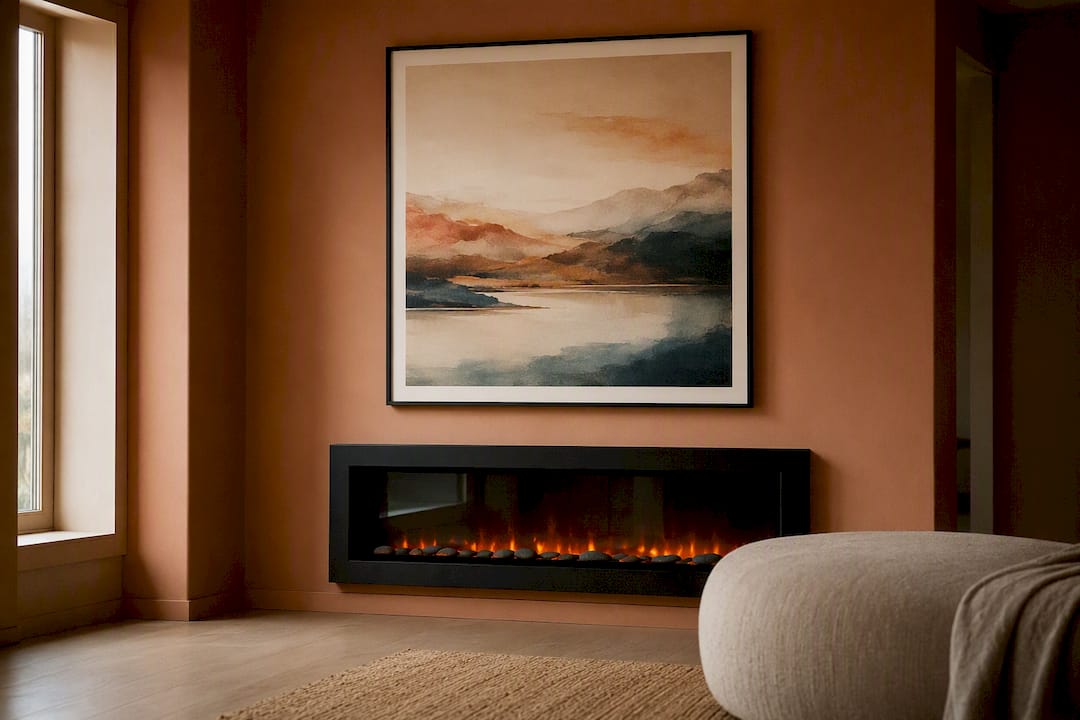
Get a hand-painted piece sized to your exact mantel
Frametheworld solves the one problem no ready-made print can: a mantel that doesn’t match a standard frame size. Rather than compromising on proportion or settling for a print that’s ten centimetres too narrow, you commission a piece painted to your measurements from the start.
- Bespoke sizing to your exact mantel width and wall height
- Frame and canvas options chosen for fireplace environments, including glare-free gallery wraps
- Professional delivery and hanging available for larger commissions
- A clear timeline and direct contact route from enquiry to installation
If your mantel is an awkward width, or you simply want something no one else’s living room has, start with Frametheworld’s Wabi Sabi collection for textured, tactile pieces that suit an overmantel particularly well, or get in touch directly to discuss a custom size.
Frequently asked questions
How big should art be above a fireplace? Aim for roughly two-thirds of your mantel’s width, centred, with a 10 to 30 centimetre gap between the mantel shelf and the bottom of the frame.
Can I hang art directly above a working fireplace? Yes, provided you leave adequate vertical clearance, generally 90 to 120 centimetres for open fires, and choose canvas or heat-resistant framing rather than delicate paper prints.
Should I hang art or lean it against the wall above the mantel? Both work. Leaning suits low, wide mantels and rental properties; flush hanging suits taller walls and heavier pieces that need secure wall anchors.
What if my TV is above the fireplace, can I still add art? Digital art displays let you show artwork whenever the screen is off, giving you both technology and a changing gallery on the same wall.
Is a mirror a good substitute for art above a fireplace? Yes, particularly on stone or brick surrounds, since a large mirror reflects light and pairs well with a smaller leaned piece in front for depth.
Sources
- The art of the overmantel (and how to do it well) | House & Garden
- Fireplace Dimensions Guide for Mantel Decorations | Balsam Hill
- 70 mantel decor ideas that make your fireplace a focal point | Better Homes & Gardens
- 26 fireplace mantel ideas to warm your home | ELLE Decor
- Art above a fireplace: size guide & recommendations | Arthouse SF


Laat een reactie achter
Deze site wordt beschermd door hCaptcha en het privacybeleid en de servicevoorwaarden van hCaptcha zijn van toepassing.