

For most living rooms and bedrooms, acrylic wins on practicality and colour punch. For a study, dining room or anywhere you want depth that rewards a second look, oil is the better call. Commercial and hospitality projects almost always favour acrylic, because it dries fast, tolerates traffic, and installs on a schedule a contractor can actually plan around.
The reasoning is simple. Acrylic reads bright and immediate from across a room, which suits open-plan, well-lit spaces. Oil reads layered and atmospheric, which rewards the closer, slower viewing you get in a hallway, snug or formal dining space.
- Homeowners furnishing a bright, lived-in space: acrylic, for colour clarity and low fuss.
- Interior designers briefing a considered scheme: oil for feature walls with controlled lighting, acrylic for high-traffic or naturally lit rooms.
- Commercial clients: acrylic almost every time, for drying speed and durability under public use.
Frametheworld supplies both as ready-made pieces or bespoke commissions, including a featured Impasto & Palette Knife collection for buyers who want oil’s texture without a long design brief.
Key Takeaways
Matching medium to room light, viewing distance and traffic level matters more than personal preference for oil or acrylic.
| Point | Details |
|---|---|
| Match medium to light | Bright, daylit rooms suit acrylic; controlled or warm lighting lets oil’s depth show. |
| Plan for drying time | Acrylic commissions can finish in 3 to 5 weeks; oil often needs 8 to 12 weeks with varnish curing. |
| Prioritise durability where needed | Acrylic resists humidity and fading better, making it the safer pick for busy or damp rooms. |
| Ask suppliers direct questions | Confirm ground, varnish type, lead time and framing before committing to a commission. |
| Frametheworld covers both routes | Offers ready-made collections and bespoke commissions in acrylic and oil, including Impasto & Palette Knife pieces. |
Table of Contents
- Oil vs acrylic painting: the practical head-to-head
- How do you choose the right medium for your space?
- What’s the realistic timeline from brief to install?
- Where does each medium perform best long term?
- How do designers actually choose between the two?
- How Frametheworld helps you commission or buy the right piece
- Frequently asked questions
- Sources
Oil vs acrylic painting: the practical head-to-head
Acrylic paintings tend to read bright, crisp and immediate. Oil paintings tend to read rich and layered, with more presence up close than at a glance. That single difference explains most of the buying decision.
- Look and texture: acrylic gives flat, saturated colour with occasional light texture; oil supports heavy impasto and palette knife work, where paint sits proud of the canvas and catches light physically, not just optically.
- Colour clarity: acrylic colours stay closer to how they looked wet, since the paint doesn’t yellow with age the way some oil mediums can.
- Distance behaviour: acrylic holds up from across an open-plan room; oil often improves the closer you get, which is why it suits reading nooks and dining tables more than entrance halls.
- Mood: acrylic feels contemporary and energetic; oil feels considered and slow, an effect designers use deliberately rather than by accident.
| Factor | Acrylic | Oil |
|---|---|---|
| Look | Bright, flat, immediate | Layered, atmospheric |
| Texture/impasto | Light to moderate | Heavy impasto possible |
| Drying/install readiness | Fast, ready within days | Slower, needs a longer window |
| Typical commissioning cost shape | Often lower for equivalent size | Often higher for equivalent size |
| Durability/maintenance | Low maintenance, humidity-tolerant | Needs varnish care over time |
| Custom finish options | Matt, satin, gloss varnish | Satin varnish common, some matt |
| Commercial suitability | Strong | Limited by drying/handling time |
Finish choice changes perception as much as medium does, a consideration that also relates closely to your choice of interior door style given how finishes interact in a room. A satin varnish for acrylic paintings softens glare under spotlights, while gloss sharpens colour saturation but shows more reflection near windows. Matt suits rooms with strong ambient light where you want the paint surface, not the sheen, to do the talking.
How do you choose the right medium for your space?
Start with how the room is used, not which medium you prefer on principle. A wall behind a sofa in a bright, south-facing living room behaves very differently to a shadowed stairwell.
- Assess viewing distance. A hallway or entrance piece gets glanced at; a dining or study piece gets studied. Closer viewing favours oil’s texture.
- Check the light. Strong, changeable daylight suits acrylic’s stable, fade-resistant surface. Controlled or warm artificial light lets oil’s depth show properly.
- Weigh durability needs. Family rooms, kitchens and rentals benefit from acrylic’s resilience to humidity and knocks.
- Set the budget band. Compare like-for-like sizes rather than assuming one medium is always cheaper. Bigger canvases in either medium push cost up regardless.
- Decide ready-made versus bespoke. Commissioning removes the size limits of stock inventory when you need an exact fit or palette match.
Before you brief an artist or supplier, ask direct questions:
- What ground or primer is used, and is it archival quality?
- Which varnish will be applied, and is a low-VOC varnish for art available for occupied spaces?
- What’s the realistic lead time from brief to delivery?
- Is framing and installation hardware included, or priced separately?
- Can you see a sketch, palette study or comparable finished piece first?
Treat the absence of a materials list, a lead time, or any sample offer as a warning sign. A serious supplier will always give you all three without being pushed.
Sample brief in five lines: wall dimensions (height x width), primary viewing distance (close/mid/far), two or three palette reference images, finish preference (matt, satin, gloss), and target install date.
What’s the realistic timeline from brief to install?
Commission timelines cluster around 5 to 8 weeks for mid-size original work, though the published range across artists runs roughly 3 to 14 weeks depending on scale and complexity.
- Brief and sketch stage (3 to 7 days): palette, composition and reference images agreed.
- Painting stage: acrylic pieces often move fast here since layers dry within hours; oil pieces need days between layers for proper blending.
- Drying and varnish window: acrylic can typically be varnished and shipped within a week or two of completion; oil often needs several weeks before a stable varnish coat can go on.
- Framing and delivery: add several days to a couple of weeks depending on frame complexity and shipping distance.
A fast acrylic commission for a home office or bedroom can land in roughly 3 to 5 weeks end to end. A medium-scale oil commission for a dining room or lobby feature wall more realistically sits at 8 to 12 weeks once drying and varnish curing are factored in. Build in that buffer before you commit to an install date, especially for commercial fit-outs with fixed opening dates.
Where does each medium perform best long term?
Acrylic and oil age differently, and that difference should drive where you hang each one.
- Cleaning: dust both gently with a soft, dry brush; avoid solvents on either surface.
- Humidity: acrylic tolerates humidity swings well, making it the safer choice for kitchens, bathrooms-adjacent hallways and coastal properties.
- UV exposure: both benefit from being kept out of direct sun; acrylic resists fading better over time, while oil varnish can yellow slightly if it’s an older or lower-grade formulation.
- Varnish touch-ups: oil paintings sometimes need a fresh varnish coat after some years to restore surface protection; acrylic varnish tends to last with less intervention.
For commercial projects, factor in hard-wearing finishes, modular panel systems for large installations, and any fire or safety spec checks your building insurer requires before the piece goes up.
Pro Tip: If the wall sits behind a desk used for video calls, favour a matt or satin finish over high gloss. Glossy surfaces bounce studio and camera lighting straight into the lens, while a textured or matt piece photographs consistently whatever the light does.
How do designers actually choose between the two?
Ask a working designer why they picked oil over acrylic for a particular wall, and the answer is rarely about paint chemistry. It’s about what the client wants to feel when they walk into the room. A bright acrylic piece front-loads its impact; you get the full effect from the doorway. Oil asks for patience, and that’s exactly why it earns its place in a formal dining room or a quiet study where people linger.

The practical tip I’d pass on: match medium to the light source before you match it to the wall colour. Spotlit galleries and dimmer switches favour oil’s glaze depth; open, daylight-flooded rooms favour acrylic’s flatness and brightness. That’s consistent with what designers report: acrylic delivers contemporary energy on first glance, oil delivers atmosphere that unfolds slowly. Neither is the “better” medium. They’re doing different jobs.
How Frametheworld helps you commission or buy the right piece
Choosing between acrylic and oil is only half the job. The other half is finding a supplier who’ll actually deliver the size, palette and finish you specified, on a timeline you can plan around. Frametheworld handles both ends: bespoke commissions built to your wall dimensions and palette references, and ready-made collections for buyers who don’t want to wait through a full brief-to-install cycle.
Services include custom commissions in either medium, curated ready-made canvases, professional framing, and dedicated trade support for designers and commercial procurement teams managing multiple rooms or sites. If heavy texture and palette-knife surfaces suit your brief, the Impasto & Palette Knife collection is worth browsing first. For bright, acrylic-led interiors, the Pop Art collection shows the colour clarity acrylic does best.
Start by requesting a quote through Frametheworld with your wall dimensions and finish preference, and you’ll get a realistic lead time back before you commit to anything.
Frequently asked questions
Is acrylic or oil better for a large canvas? Acrylic is usually the more practical choice for large-scale work. It dries fast enough to manage across a big surface without the extended waiting time oil needs between layers, and it’s lighter to handle during framing and installation.
Do acrylic paintings need varnish? Yes. Varnish protects the surface from dust and UV exposure and lets you choose a matt, satin or gloss finish. A satin varnish for acrylic paintings is the most common middle-ground choice, balancing protection with a natural, non-reflective look.
Which is more suitable for commercial interiors, oil or acrylic on canvas? Acrylic, in most cases. Its fast drying and stable surface make installation scheduling far easier for hospitality and office fit-outs, and it copes better with variable lighting and higher foot traffic than oil.
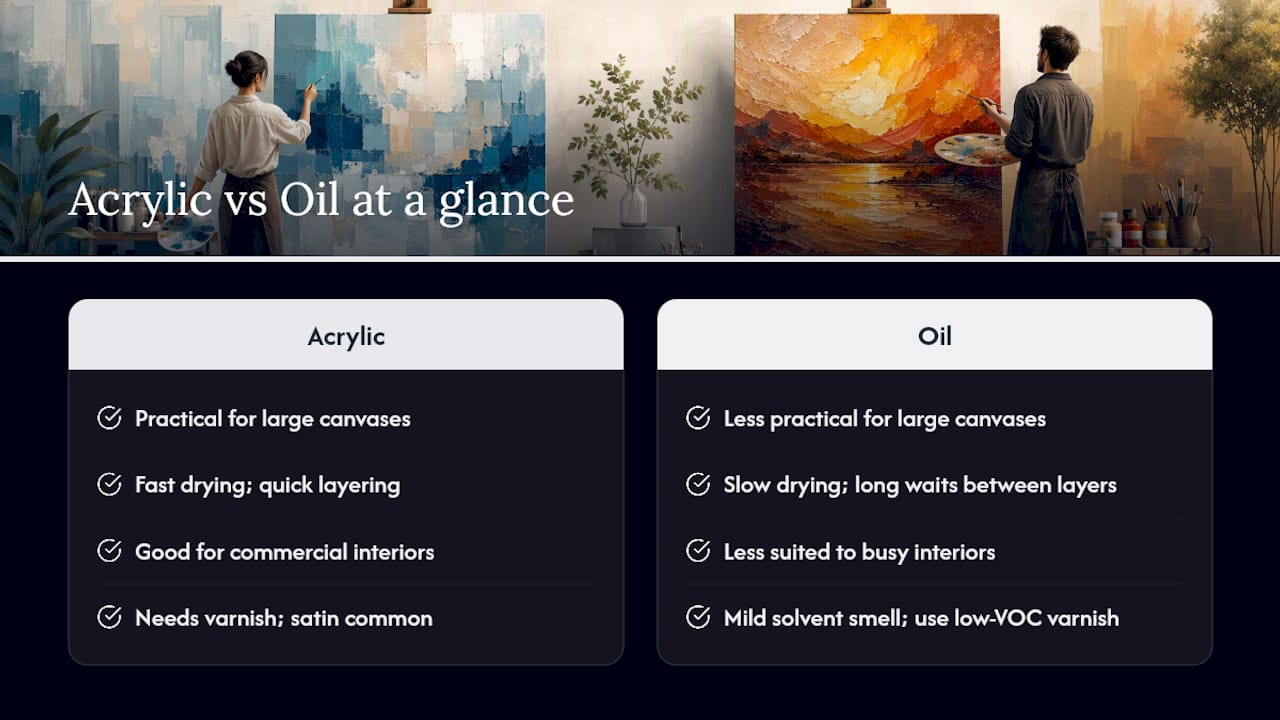
Are oil paintings safe indoors, given the smell of oil paint? Fresh oil paintings can carry a mild solvent smell while curing, which fades as the piece dries fully. Choosing a low-VOC varnish for the final finish reduces lingering odour and is a reasonable ask when briefing a supplier, particularly for enclosed commercial spaces.
Sources
- Comparing Acrylic and Oil Paintings: Which is Right for You - Journal Post Today
- Acrylic paint vs oil paint compared (Vaessen Creative blog)
- Commissioning Custom Art: A Trade Guide for Designers
- Complete Guide to Commissioning Custom Artwork for Your Space (2026)
- Acrylic vs. Oil Paintings: Which One is Best for You


Laat een reactie achter
Deze site wordt beschermd door hCaptcha en het privacybeleid en de servicevoorwaarden van hCaptcha zijn van toepassing.