
TL;DR:
- Digital art offers scalable, immersive, and flexible solutions for large spaces, transforming how venues engage audiences. It enables instant content updates, cost efficiency, and active participation through advanced hardware and real-time software. Proper planning and collaboration are essential for successful large-scale digital installations and long-term audience impact.
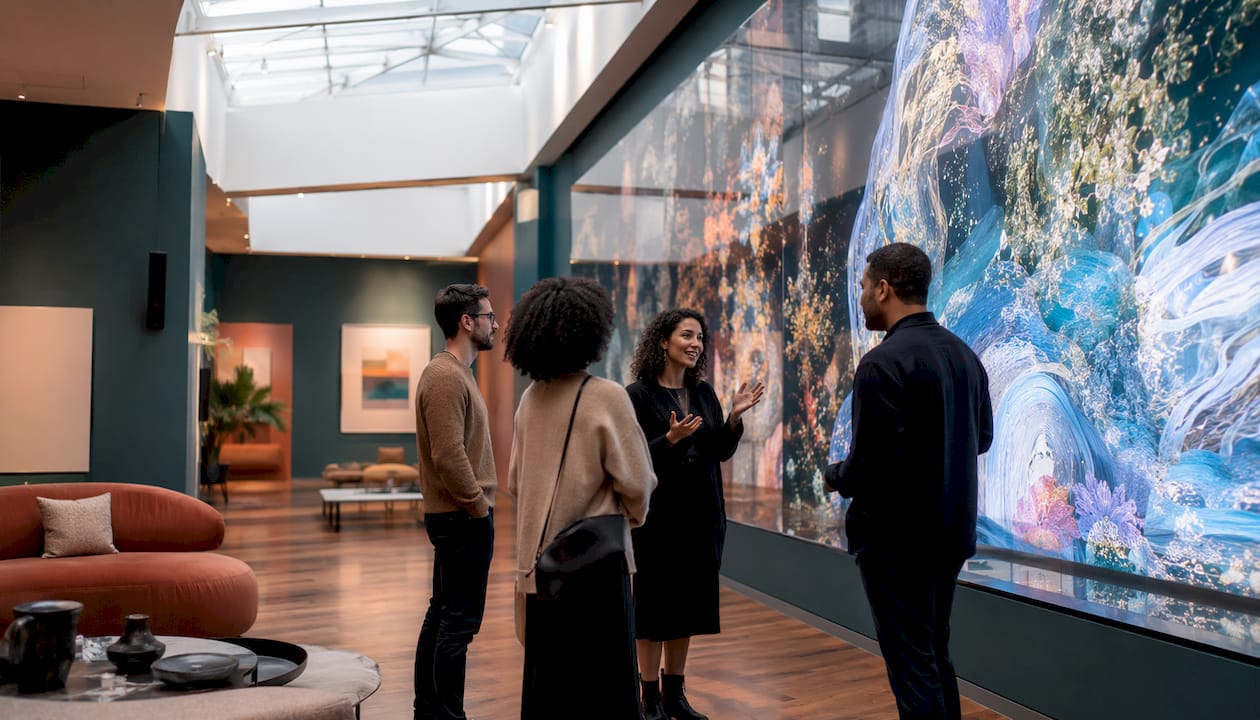
Large spaces have always posed a design challenge: how do you fill them without making them feel cold, static, or simply over-furnished? Digital art solves that problem in ways traditional media cannot. It scales to any surface, changes with the season or the hour, and turns a corridor, atrium, or gallery into something people actually stop and look at.
The core reasons to use digital art in large spaces come down to four things:
- Dynamic scalability. A single artwork can fill very large walls and ceiling areas without losing visual coherence, as demonstrated by the Theatre of Digital Art in Dubai, where high-definition projections cover extensive surfaces.
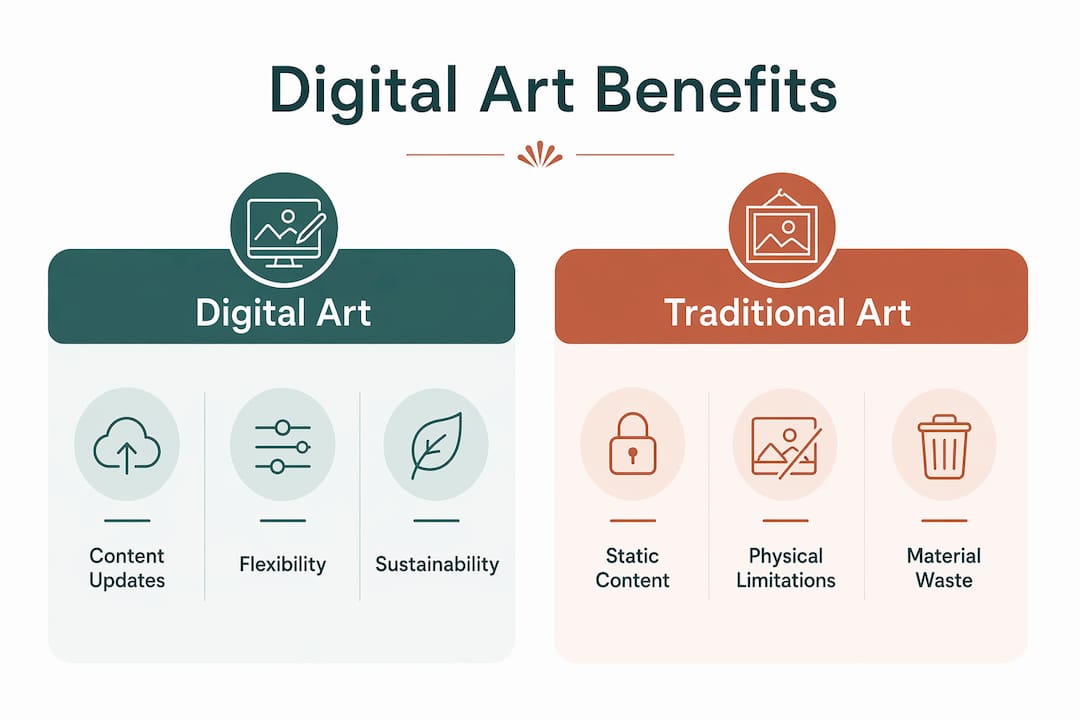
- Content flexibility. Artwork updates happen instantly, with no removal crews, no reframing, and no downtime.
- Immersive impact. Floor-to-ceiling visuals combined with spatial soundscapes engage audiences on a level that a framed canvas simply cannot reach.
- Long-term cost efficiency. High upfront hardware costs are offset by the ability to refresh content indefinitely, making digital installations particularly attractive for commercial venues that need frequent updates.
For interior designers and brand managers working on large UK venues, hotels, or public buildings, these advantages are not theoretical. They are already reshaping how spaces are conceived and experienced.
How digital art and immersive installations evolved
The story begins in the 1960s, when artists first started treating technology as a medium rather than a tool. Gustav Metzger, a British pioneer, developed auto-destructive art using projected light and chemical reactions, arguing that technology could be both the creator and destroyer of form. Around the same time, Yayoi Kusama’s Infinity Mirror Rooms at the Hirshhorn Museum demonstrated that a room itself could become the artwork, a concept that sits at the heart of every immersive installation built today.
The 1990s brought digital projection into galleries. Olafur Eliasson’s large-scale environmental works, including his celebrated weather installations, showed how light and atmosphere could transform institutional spaces. By the 2000s, advances in LED technology and multi-projector software made it feasible to cover entire buildings, not just rooms.
Three developments accelerated the shift to what we now call immersive digital art:
- High-brightness projectors capable of maintaining image quality in ambient light, making large-venue installations practical outside darkened galleries.
- LED panel miniaturisation, which allowed seamless floor-to-ceiling displays without visible bezels or gaps.
- Real-time rendering software, enabling artworks to respond to live data, visitor movement, or environmental inputs rather than playing on a fixed loop.
The result is a medium that has moved from experimental gallery practice to mainstream interior design, with UK museums, hotels, and commercial developers all commissioning permanent or rotating digital installations.
Notable immersive digital art installations worth knowing
The most instructive examples share a common trait: the technology disappears, and the experience takes over.
Dataland, Los Angeles. Co-founded by media artist Refik Anadol, Dataland is the world’s first fine arts space dedicated entirely to AI-driven work. Its largest room uses 84 synchronised Epson projectors generating over 700 square metres of pixels, paired with a complex multi-channel spatial soundscape produced in collaboration with L-Acoustics. The AI model underpinning the work was trained on a vast ecological dataset and numerous images, plus continuous live data feeds. Visitors do not observe the art; they alter it. LiDar sensors and health trackers feed real-time data back into the generative system, so every visit produces a genuinely different experience.
Theatre of Digital Art (ToDA), Dubai. ToDA covers 1,800m² with HD projections across walls and ceiling, combining multimedia exhibitions, contemporary installations, and virtual reality into a single walk-through space. It functions simultaneously as an art venue, an education hub, and an entertainment destination, a model increasingly relevant to UK cultural institutions looking to broaden their audiences.
Pro Tip: When evaluating an immersive installation for a large interior, ask the technical team for the pixel density per square metre at the intended viewing distance. A visually impressive render can look pixelated at close range if the hardware specification was not matched to the room’s proportions.
| Installation | Scale | Key technology | Distinctive feature |
|---|---|---|---|
| Dataland, LA | — | Epson projectors, COB LED, LiDar | AI trained on a vast ecological dataset |
| Theatre of Digital Art, Dubai | 1,800m² | HD projection, surround sound | First immersive art theatre in the UAE |
| Kusama Infinity Rooms, Hirshhorn | Room-scale | Mirror, LED, water | Pioneered the “room as artwork” concept |
Why digital art is particularly strong for interior design in large spaces
The benefits of large-scale art for interior projects are well established, but digital formats extend those benefits considerably.
Flexibility without physical disruption. A hotel lobby can display calm botanical imagery during the day and shift to something more dramatic for an evening event, with no physical intervention. Brands can synchronise content across multiple locations, maintaining visual cohesion whether the space is in Manchester or Edinburgh.
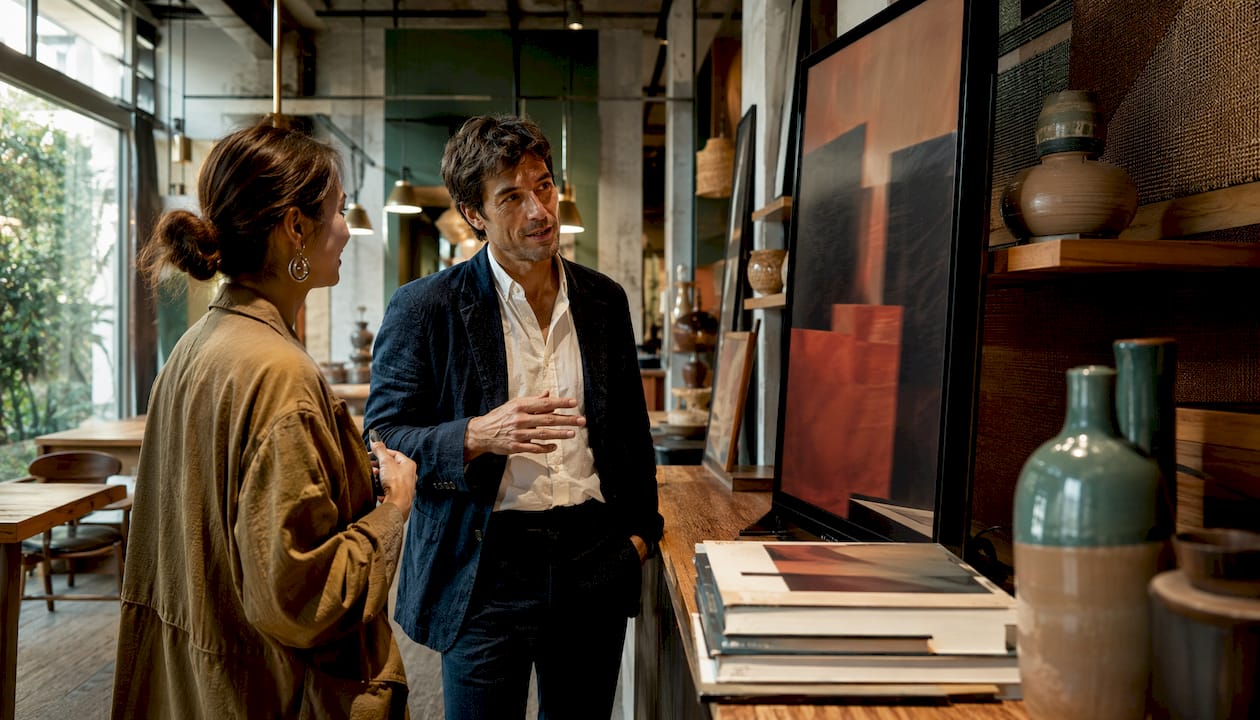
Atmosphere at scale. Large rooms often feel impersonal. A floor-to-ceiling digital installation changes the emotional register of a space in a way that even a very large canvas cannot, because it moves, responds, and fills peripheral vision.
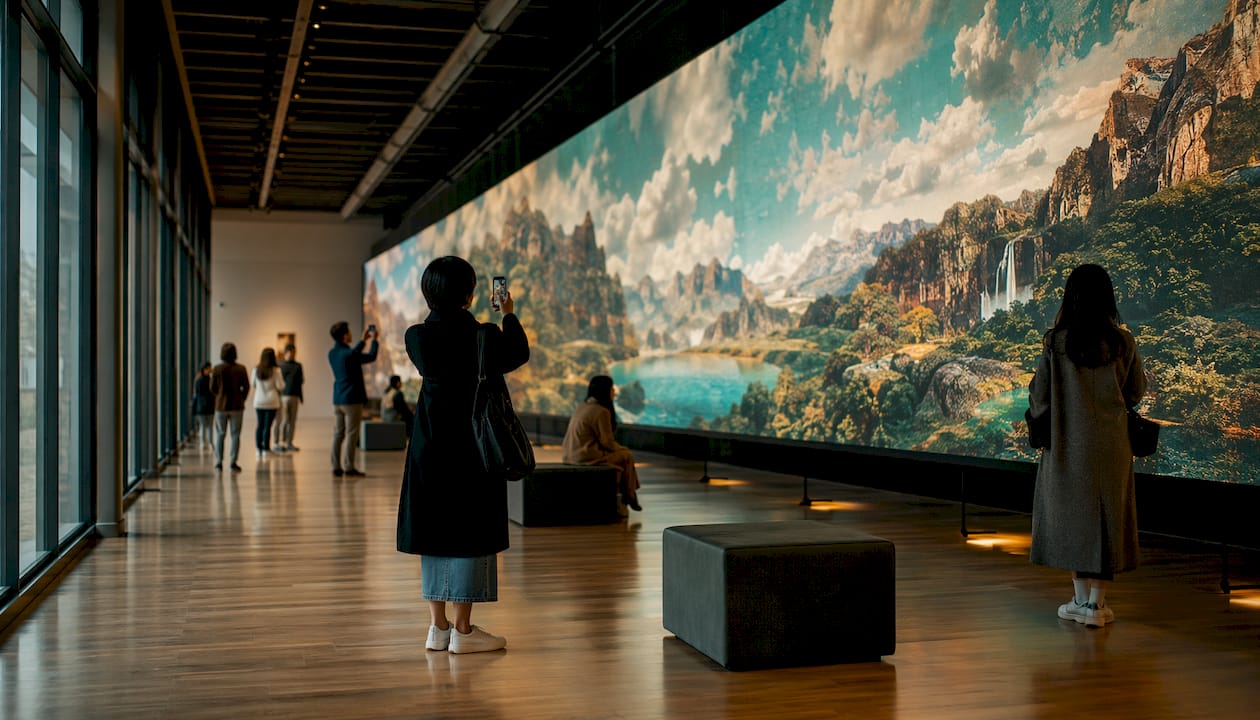
Sustainability. Digital art reduces waste compared to traditional media: no paper, no discarded paint tubes, no materials to dispose of when the brief changes. Corrections are a digital undo command rather than a physical discard.
Cost profile over time. The upfront hardware investment is real, but long-term operational efficiency increases for commercial projects that need frequent updates. A traditional commission requires a new artist fee and installation costs every time the brief changes; a digital installation does not.
Pro Tip: Plan the digital infrastructure during the architectural design phase, not after. Concealing cabling, mounting points, and cooling systems is far easier when the walls are open. Retrofitting is expensive and often compromises the aesthetic result.
| Factor | Digital art | Traditional large-format art |
|---|---|---|
| Content updates | Instant, no physical work | Requires removal, reframing, reinstallation |
| Sustainability | Minimal material waste | Paint, canvas, framing materials discarded |
| Long-term cost | Lower after initial hardware outlay | Ongoing commission and installation fees |
| Atmosphere | Dynamic, responsive, immersive | Static, fixed mood |
| Brand synchronisation | Possible across multiple sites | Not feasible at scale |
What technology makes large-scale digital art possible?
The hardware and software stack behind a large installation is more complex than it appears from the visitor’s side.
- COB LED displays. Chip-on-Board technology embeds LED chips directly onto the circuit substrate, producing a surface that is significantly more durable and smoother than traditional panel displays. At Dataland, COB LED technology provides the visual backbone across architecturally complex surfaces, including a floor screen designed to be walked across.
- Multi-projector synchronisation. Maintaining pixel density and visual alignment across dozens of projectors requires careful calibration. A single miscalibrated unit breaks the illusion of a continuous surface.
- Interactive sensor systems. LiDar sensors map visitor movement in real time; biosensors can track physiological responses. Together, they allow the artwork to respond to its audience rather than simply playing in front of them.
- Real-time rendering and content management software. This is what separates a digital installation from a video loop. Software platforms allow operators to update content remotely, run A/B versions, and schedule changes by time of day or event.
- Thermal management. High-powered LED arrays generate significant heat. Without adequate cooling infrastructure, hardware degrades faster and the risk of failure during operation increases.
Pro Tip: For UK venues with listed building status or heritage constraints, transparent LED mesh displays offer a way to introduce digital art without permanent structural modification. They can be removed without trace.
The integration of digital art into a space requires collaboration between architects, AV engineers, and the creative team from the earliest planning stage. The technology only disappears when every component has been specified and installed correctly.
How large-scale digital art changes audience behaviour
The shift from passive viewing to active participation is the most significant change digital art brings to large spaces. Traditional gallery visitors move through a space and look at things. In an immersive digital environment, they become part of what they are looking at.
Multisensory feedback loops deepen the connection between art and audience in ways that are measurable. Visitors at Dataland reported dancing, conducting, and physically interacting with AI-generated visuals, behaviours you simply do not see in front of a framed painting. The combination of spatial sound, responsive visuals, and floor-level haptic feedback creates an experience that is genuinely difficult to leave.
For commercial spaces, longer dwell time translates directly into commercial value. A hotel guest who spends twenty minutes in a lobby installation is having a different relationship with that brand than one who walks through in thirty seconds. For modern home design and residential projects, the same principle applies at a smaller scale: a well-chosen digital installation in a large living space or entrance hall becomes a talking point, not just a decoration.
Visitors at Dataland become co-creators of evolving AI-driven artworks, not merely spectators. That shift from one-to-many broadcasting to a genuinely one-to-one experience is what distinguishes the best large-scale digital installations from a glorified screen.
What the research tells us about immersive digital experiences
The data from large-scale installations supports what designers have observed qualitatively. Dataland’s projection space converts 1,800 square metres of exhibition area into a fully immersive environment using 360-degree projections on walls and ceilings, a scale that makes the physical architecture effectively invisible.
| Metric | Finding | Source context |
|---|---|---|
| Projection coverage | 1,800m² walls and ceiling | Theatre of Digital Art, Dubai |
| Pixel generation | over 700 square metres of pixels | 84 synchronised projectors, Dataland LA |
| Sound channels | a complex multi-channel spatial soundscape | Dataland LA, L-Acoustics collaboration |
| AI training data | a vast ecological dataset | Dataland’s own AI model |
The educational dimension is equally compelling. ToDA in Dubai functions as an art, education, and entertainment hub simultaneously, a model that UK cultural institutions and commercial venues are beginning to adopt. When an installation is built on live data, as Dataland’s is, it never shows the same content twice. That perpetual novelty sustains repeat visits in a way that a fixed exhibition cannot.
Challenges to consider before installing digital art at scale
None of this comes without real complexity, and anyone planning a large-scale digital installation in the UK should go in clear-eyed about what is involved.
Upfront cost. The hardware alone for a serious installation runs to significant investment. COB LED panels, high-brightness projectors, and the computing infrastructure to drive real-time rendering are not cheap. The long-term operational savings are genuine, but the initial outlay requires committed budget planning.
Technical coordination. Effective deployment requires collaboration among architects, structural engineers, and digital specialists. Cabling routes, mounting points, and cooling systems all need to be resolved before a single panel goes up. Retrofitting any of these into a finished space is expensive and rarely looks as clean.
Maintenance and longevity. LED panels degrade over time, and synchronisation across multiple projectors requires regular recalibration. A maintenance contract with the installation team is not optional; it is part of the true cost of ownership.
Content management. The hardware is only as good as the content running on it. Large venues need either an in-house team or a retained creative partner to keep the artwork fresh and technically current. A static loop on a dynamic system defeats the purpose entirely.
Acoustic integration. Spatial soundscapes are a core part of the immersive experience, but sound design for large irregular spaces is a specialist discipline. Poor acoustic planning can undermine even a visually spectacular installation.
For designers planning their first large-scale project, the expert tips for large space art available from Frametheworld offer practical guidance on specification and implementation.
Frametheworld’s collection of Wabi Sabi wall art offers a considered starting point for large interior spaces where the brief calls for texture, depth, and a sense of deliberate imperfection, qualities that translate beautifully at scale whether you are working with print or digital formats.
Key takeaways
Digital art in large spaces works because it combines visual scale, content flexibility, and genuine audience participation in ways that static media cannot replicate.
| Point | Details |
|---|---|
| Scale and immersion | Installations can cover 1,800m² with HD projections, making the architecture itself invisible. |
| Technology backbone | COB LED displays and multi-projector synchronisation are the foundation of any serious large-scale installation. |
| Audience participation | LiDar sensors and biosensors convert visitors from passive observers into active contributors to the evolving artwork. |
| Long-term cost case | High upfront hardware costs are offset by operational efficiency gains for venues needing frequent content updates. |
| Plan infrastructure early | Concealing cabling, mounts, and cooling systems is far easier during the build phase than as a retrofit. |



Laat een reactie achter
Deze site wordt beschermd door hCaptcha en het privacybeleid en de servicevoorwaarden van hCaptcha zijn van toepassing.