

TL;DR:
- Thematic art is built around a central idea or message that elevates a piece beyond its visual elements. Understanding themes allows viewers to interpret artworks as meaningful statements about human experience and social issues.
Thematic art is defined as artwork built around a central idea or message that elevates the piece beyond visual depiction into a complex statement about human experience. That theme acts as the semantic layer of artistic communication, pulling viewers from passive observation into active interpretation. Understanding what is thematic art means recognising that a painting of a storm is rarely just a storm. It is grief, power, or the sublime. Themes give art its staying power, and they are the reason a canvas can feel personally significant to someone standing in front of it for the first time.
What is thematic art and how does it work?
Thematic art is the practice of organising an artwork around one or more core conceptual ideas that shape its meaning, composition, and emotional impact. The theme is not the subject. A portrait of a soldier is the subject. The futility of war is the theme. That distinction is the foundation of thematic art meaning.

Artists use every tool available to reinforce a theme. Colour, scale, symbol, and composition all serve the central idea. Francisco Goya’s The Third of May 1808 depicts an execution, but its theme is the horror of state violence. Mark Rothko’s colour field paintings have no figurative subject at all, yet their themes of existential solitude are unmistakable. Thematic art concepts operate across every medium, from oil on canvas to digital installation.
The California Learning Resource Network describes themes as the framework that transforms passive viewers into active participants, fostering shared emotional and intellectual experience. That transformation is the whole point. When you understand the theme, you stop looking at a picture and start reading it.
How are themes identified and categorised in art?
Themes in art are identified through three primary signals: subject matter, symbolic elements, and compositional choices. A recurring motif of clocks and melting forms, as in Salvador Dalí’s The Persistence of Memory, signals a theme of time’s instability. A composition that isolates a single figure against vast empty space communicates themes of alienation or freedom. Learning to read these signals is what thematic analysis is built on.
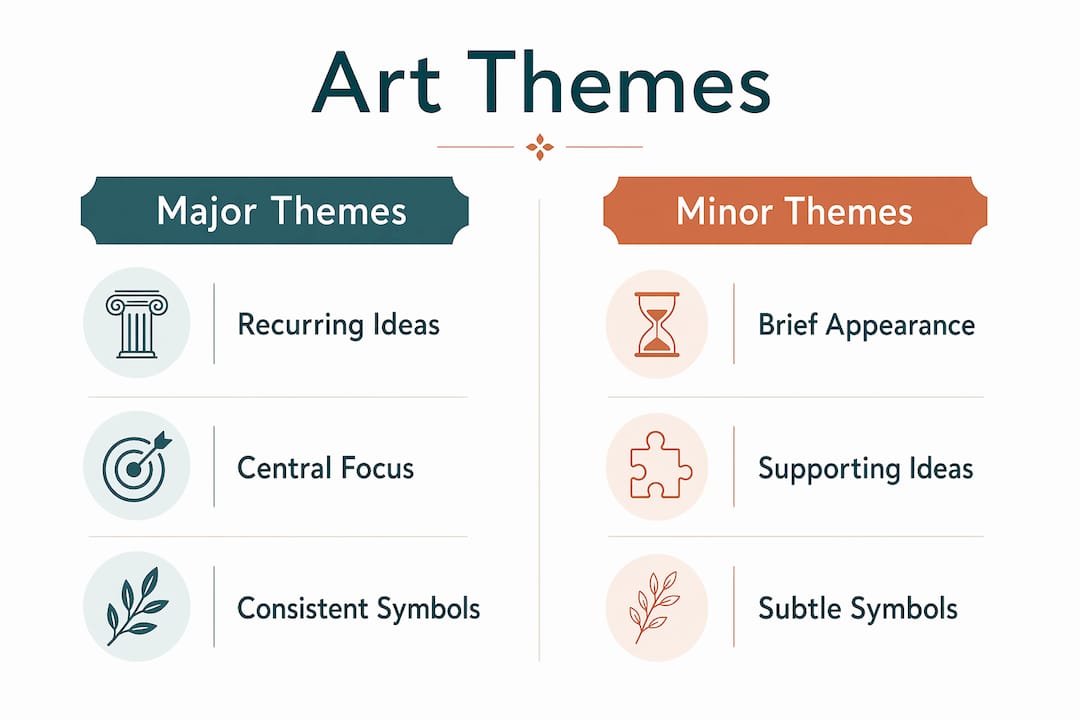
Major themes vs minor themes
Themes are categorised into major themes, which recur consistently throughout a work, and minor themes, which appear briefly to support and add nuance to the major ones. The distinction matters because it prevents misreading a passing symbol as the central argument.
| Aspect | Major theme | Minor theme |
|---|---|---|
| Frequency | Recurs throughout the work | Appears briefly or partially |
| Function | Defines the central message | Adds context and depth |
| Example in painting | Social justice as the primary subject | Sacrifice as a supporting motif |
| Example in literature | Moral corruption as the core argument | Guilt as a secondary thread |
| Visual signal | Dominant compositional element | Recurring but subordinate symbol |
A single artwork can carry multiple coexisting themes. In Käthe Kollwitz’s war prints, the major theme is collective grief, while minor themes of maternal love and political resistance run beneath it. Both levels are present simultaneously, and recognising them both deepens the reading considerably.
Pro Tip: When analysing an artwork, ask yourself what idea appears most often across the composition, colour palette, and symbolic choices. That repetition almost always points to the major theme.
Common thematic categories found across art history include:
- Identity and selfhood: explored through portraiture, self-portraiture, and body-focused work
- Power and politics: present in history painting, propaganda art, and social realism
- Nature and the environment: central to Romanticism, landscape painting, and ecological contemporary art
- Time and mortality: recurring in Vanitas still life, memento mori traditions, and conceptual work
- Spirituality and transcendence: dominant in Byzantine iconography, Symbolism, and abstract expressionism
What are common thematic art styles and examples?
Artists use themes like nature, time, science, and spirituality not merely as subjects but as conceptual frameworks for exploring human existence. The style an artist chooses is almost always in service of the theme. Understanding that relationship is the key to reading thematic art with confidence.
Here are the most widely encountered thematic categories, with the stylistic strategies artists use to reinforce them:
- Nature: Organic forms, earthy palettes, and asymmetrical compositions signal a nature theme. Artists like Claude Monet used light and dissolution of form to suggest nature’s impermanence rather than its solidity.
- Time and mortality: Stark contrasts between light and shadow, decaying objects, and hourglass motifs characterise this theme. Dutch Golden Age Vanitas paintings are the clearest historical example.
- Science and technology: Futuristic motifs, geometric precision, and high contrast are the visual language of science-themed art. The Italian Futurists, including Umberto Boccioni, used fragmented forms to express speed and mechanical energy.
- Spirituality: Gold leaf, vertical compositions, and radiant light sources have signalled spiritual themes from Byzantine mosaics through to James Turrell’s immersive light installations.
- Social justice: Bold, confrontational imagery, documentary realism, and text-based elements define this category. Artists like Barbara Kruger and Banksy use graphic directness to make social themes impossible to ignore.
Symbolic elements and compositional strategies are not decorative additions. They are the mechanism through which a theme becomes felt rather than merely understood. A viewer who knows that a skull in a 17th-century still life signals mortality reads the painting completely differently from one who does not.
Pro Tip: When you encounter an unfamiliar artwork, identify the three most prominent visual elements first. Then ask what idea connects all three. That connecting idea is almost certainly the theme.
If you want to go further with selecting art by theme for your own space, understanding these categories gives you a practical starting point.
How does thematic analysis deepen art appreciation?
Thematic analysis in art involves three steps: identifying patterns in subject matter and symbols, analysing through artist and historical context, and interpreting the thematic significance in relation to wider social or cultural issues. Each step builds on the last, converting surface observation into nuanced meaning.
Here is how the process works in practice:
- Identify: Scan the artwork for recurring symbols, dominant colours, and compositional patterns. Note what appears most frequently or most prominently.
- Analyse: Research the artist’s background, the historical period, and the cultural context in which the work was made. Context changes everything. Picasso’s Guernica reads differently once you know it was painted in direct response to the Nazi bombing of a Basque town.
- Interpret: Connect what you have identified and analysed to broader human questions. What does this work say about power, loss, beauty, or time? This is where personal meaning enters.
| Step | Action | Outcome |
|---|---|---|
| Identify | Spot recurring symbols and dominant visual elements | A working list of potential themes |
| Analyse | Research artist biography and historical context | Informed understanding of intent |
| Interpret | Connect themes to wider social or cultural questions | Personal and critical meaning |
Engagement with thematic art enriches understanding by connecting the artwork to the artist’s background, cultural context, and social issues. That connection is what separates a glance from a genuine encounter with a work. The Jerwood Visual Arts methodology confirms that identifying and interpreting themes allows nuanced appreciation well beyond surface aesthetics.
Pro Tip: Read the wall label or exhibition notes before you look at the work, not after. Knowing the context first means you will see the theme operating in real time as you look.
For a broader guide to understanding art themes, Frametheworld’s own resource covers both the theory and the practical application for enthusiasts at every level.
What role does thematic art play in contemporary expression?
Contemporary artists deliberately use thematic art to address current social and cultural issues, employing themes as a means to communicate and connect with audiences on deeper levels. Thematic art is not a historical category. It is the dominant mode of serious artistic practice right now.
Several trends define contemporary thematic work:
- Climate and ecology: Artists like Olafur Eliasson use large-scale installations to make environmental themes physically felt rather than intellectually noted.
- Identity and intersectionality: Painters such as Kehinde Wiley and photographers like Zanele Muholi use portraiture to challenge dominant narratives around race, gender, and visibility.
- Digital existence: Artists working across NFT platforms and digital media explore themes of surveillance, data, and the fragmentation of identity in networked life.
- Wabi-sabi and imperfection: Rooted in Japanese aesthetics, this theme celebrates natural imperfection, transience, and the beauty of the unfinished. It has become a significant force in contemporary interior art and decorative practice.
- Pop culture and consumerism: Following the legacy of Andy Warhol and Roy Lichtenstein, contemporary artists continue to interrogate mass media, celebrity, and commercial culture through bold, graphic thematic work.
Thematic art also plays a structural role in how collections and exhibitions are organised. Major institutions including Tate Modern and the Museum of Modern Art in New York regularly curate by theme rather than by period or medium. That shift reflects a broader recognition that themes are the most direct route to audience connection. When you walk into a room labelled “Power and Protest,” you already know how to engage with what you are about to see.
Key takeaways
Thematic art is the practice of building an artwork around a central idea, and understanding that idea is the single most effective way to move from looking at art to genuinely experiencing it.
| Point | Details |
|---|---|
| Thematic art definition | Artwork organised around a core idea that elevates it beyond visual depiction into a meaningful statement. |
| Major vs minor themes | Major themes recur throughout a work; minor themes add supporting nuance and contextual depth. |
| Three-step analysis | Identify symbols, analyse context, then interpret the theme’s broader cultural or social significance. |
| Style serves theme | Colour, composition, and symbolic choice are all tools artists use to reinforce the central thematic idea. |
| Contemporary relevance | Themes like ecology, identity, and imperfection define current artistic practice and curatorial thinking. |
Why I think most people underestimate thematic art
Most visitors to a gallery spend about 30 seconds in front of a painting. I understand why. Without a framework, art can feel like a test you have not revised for. But thematic art is actually the most forgiving entry point into serious art appreciation, because the theme is always there to guide you.
The common misunderstanding is that themes are hidden, reserved for critics and academics. They are not. Artists use every visual tool at their disposal to make the theme legible. The challenge is learning the vocabulary, not cracking a code. Once you know that a skull signals mortality, that a single figure in a vast landscape signals existential solitude, and that fragmented forms signal modernity’s chaos, you are already reading thematic art fluently.
What I find most rewarding is the moment a theme connects a 17th-century Dutch painting to something you felt last week. That is thematic art doing exactly what it was designed to do. It is not about the past. It is about the permanent questions that every generation returns to. The artists change. The themes do not.
— Lennard
Explore thematic art collections at Frametheworld
Understanding thematic art changes how you choose art for your home. When you know that a wabi-sabi composition speaks to impermanence and natural beauty, or that a bold pop art print channels energy and cultural commentary, you are selecting with intention rather than instinct. Frametheworld curates collections organised by theme, making it straightforward to find work that resonates with both your space and your sensibility. Browse the wabi-sabi wall art collection for hand-painted pieces rooted in texture and imperfection, or explore the pop art collection for bold, graphic thematic expression. Both collections are available in multiple sizes and formats, with bespoke options for larger projects.
FAQ
What is the thematic art definition in simple terms?
Thematic art is artwork built around a central idea or message that goes beyond visual depiction to communicate something about human experience. The theme is the “why” behind every compositional and stylistic choice the artist makes.
What are the main types of thematic art?
Common thematic categories include nature, time and mortality, spirituality, social justice, and identity. Each category has recognisable stylistic conventions that artists use to reinforce the theme visually.
How do you analyse thematic art?
Thematic analysis follows three steps: identify recurring symbols and visual patterns, analyse the artist’s context and historical period, then interpret how those elements connect to broader social or cultural questions.
What is the difference between a subject and a theme in art?
The subject is what is depicted, for example a landscape or a figure. The theme is the idea the depiction communicates, such as freedom, loss, or the passage of time. One subject can carry multiple themes simultaneously.
Why does thematic art matter for home decoration?
Choosing art by theme means every piece you display carries intentional meaning that connects to the mood and purpose of the space. A wall art selection guide can help you match thematic categories to specific rooms and environments.



Laat een reactie achter
Deze site wordt beschermd door hCaptcha en het privacybeleid en de servicevoorwaarden van hCaptcha zijn van toepassing.