
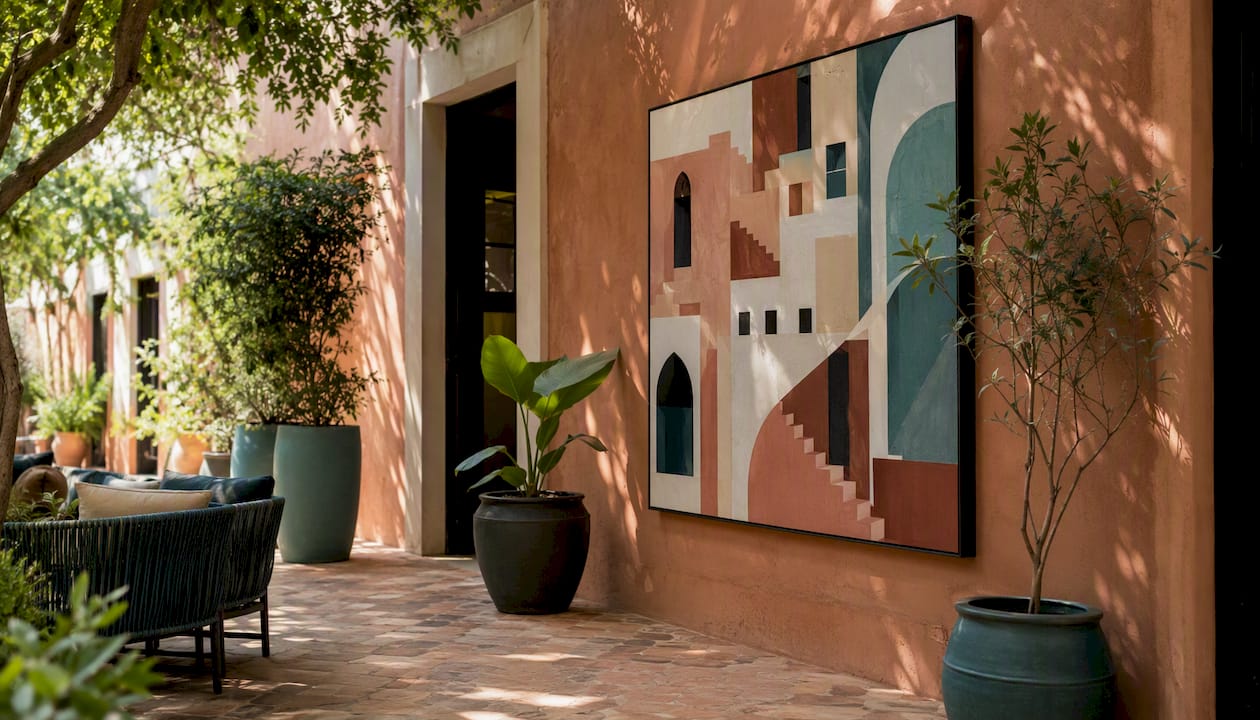
For most interior projects, a large-format giclée print or gallery-stretched canvas of architectural facades is the safest choice. Reach for a bespoke hand-painted commission when the wall is an awkward size, the colour scheme has to match a specific interior scheme exactly, or the piece needs to work as a centrepiece in a showhome or reception. Art for building facades, meaning artwork that depicts architecture and cityscapes for interior walls, works best when scale and colour are treated as design decisions, not afterthoughts.
Three reasons drive that recommendation:
- Scale control matters more than colour. Designers report that the most common reason for commissioning rather than buying ready-made is a wall with no suitable stock size available, not a colour mismatch.
- Commissioned pricing scales in your favour. Larger custom pieces tend to cost less per square inch than smaller ones, because studio setup costs spread across the surface, according to trade pricing data from Berta Art.
- A structured brief shortens the process. Studios such as Frametheworld work fastest when given accurate photos and measurements at the outset.
Your next step: measure the wall (height, width, obstructions), photograph it from the main viewing angle, and either browse a ready-made collection or send that brief to a studio for a commission quote.
Key Takeaways
Bespoke commissions suit non-standard walls and exact colour matching, while ready-made canvases suit standard sizes and faster timelines.
| Point | Details |
|---|---|
| Measure before you brief | Take exact wall dimensions and photos from the main viewing angle first. |
| Match format to context | Choose prints for speed and budget, canvas for scale, hand-painted for a one-off centrepiece. |
| Budget for logistics separately | Large commissions cost less per square inch but add crating and installation costs. |
| Plan for 5 to 14 weeks | Mid-size commissions take 5–8 weeks; complex pieces can take 8–14 weeks. |
| Use Frametheworld for trade projects | Frametheworld offers curated collections, bespoke sizing and commissioning support for developers and designers. |
Table of Contents
- How do you choose the right façade artwork for a room?
- Which formats and materials suit façade-themed art?
- How does commissioning a bespoke façade piece work?
- Specifying façade art for developments and commercial fit-outs
- Should you buy ready-made or commission bespoke work?
- How should façade art be hung and maintained?
- What do prints, canvases and commissions typically cost?
- Why has art on building façades mattered historically?
- What techniques define exterior façade art?
- What legal issues apply to exterior façade artwork?
- How is exterior façade art weatherproofed?
- How does façade art work with architecture and lighting?
- Does façade art shape community identity?
- Studio perspective: how Frametheworld approaches façade commissions
- How can Frametheworld help with your façade art project?
- Sources
How do you choose the right façade artwork for a room?
Start with how the piece will actually be seen, not how it looks on a screen. A hallway glimpsed for two seconds needs bold, legible shapes. A dining room wall viewed from six feet away for an hour at a time can carry fine architectural detail, texture and subtle tonal shifts that would be wasted in a corridor.
Lighting changes the calculation too. North-facing rooms with cool, even light suit warmer terracotta and ochre facade studies, while south-facing rooms flooded with direct sun need a finish that resists fading and glare, which points towards a matte varnish over gloss.
Sizing follows a few reliable rules of thumb:
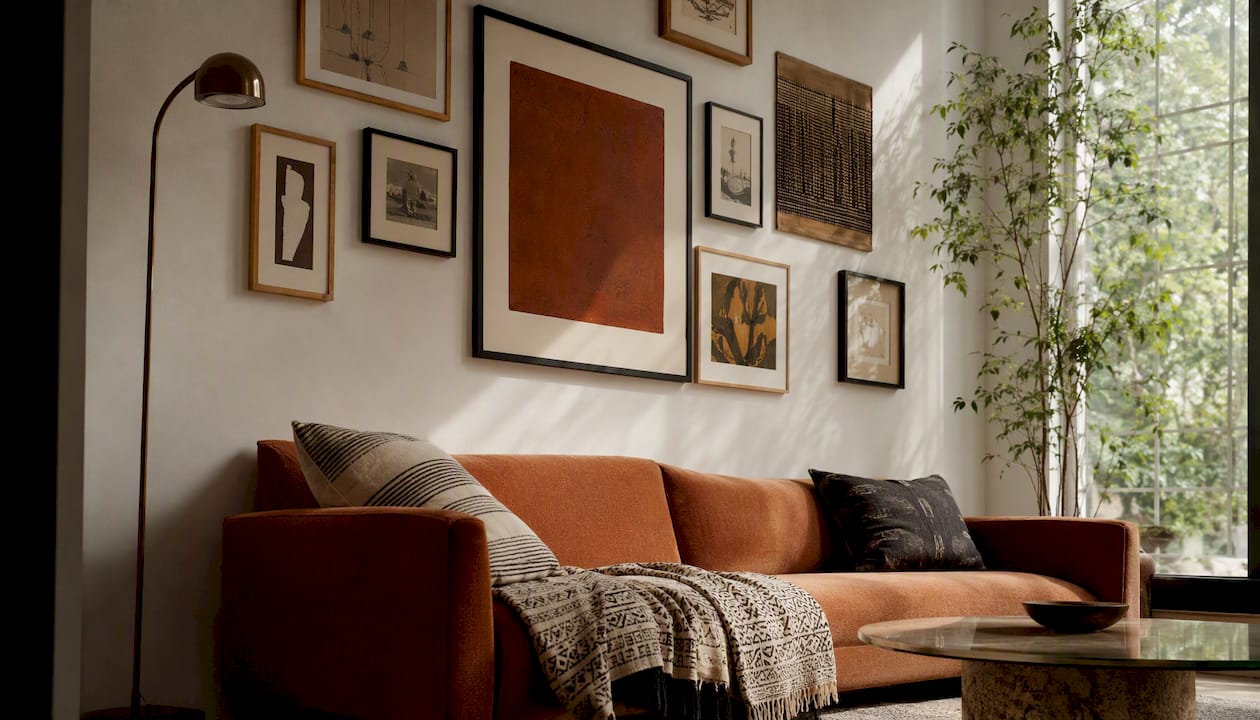
- Above a sofa or console, the artwork should span roughly 60 to 75% of the furniture’s width.
- On an open wall, allow the piece to occupy about two thirds of the available space rather than centring a small print in a large expanse.
- Hang so the centre of the artwork sits at eye level, typically 145 to 155cm from the floor.
Style choice depends on mood as much as architecture. Photographic facades suit a documentary, editorial feel. Architectural studies (line-led, tonal, almost technical) suit studies and offices. Stylised illustrations and abstracted facade motifs soften period buildings into something more textural, which works well in bedrooms and living rooms where you want warmth rather than precision.
On budget: a ready-made canvas is the right call when a standard size fits the wall and the palette is flexible. A commission earns its premium when the wall is non-standard, the colour has to match a specific fabric or paint reference, or the piece needs to read as bespoke within a development’s marketing story.
Pro Tip: Send the studio a photo of the empty wall taken straight-on, the exact height and width in millimetres, and a fabric or paint swatch if colour-matching matters. Trade guidance on custom commissions confirms this single step cuts revision rounds more than any other input.
Which formats and materials suit façade-themed art?
Four formats dominate this category, and each solves a different problem. Fine-art giclée prints on archival paper give the sharpest detail and the lowest cost per piece, which suits smaller runs or budget-conscious rooms. Gallery-stretched canvas gives a frameless, contemporary look and handles large scale well without the weight or cost of framing. Hand-painted canvases add texture and brushwork that no print can replicate, and they are the only route to a genuinely one-off piece. Framed prints add formality and protection, useful in period interiors or where glazing is needed to guard against moisture.
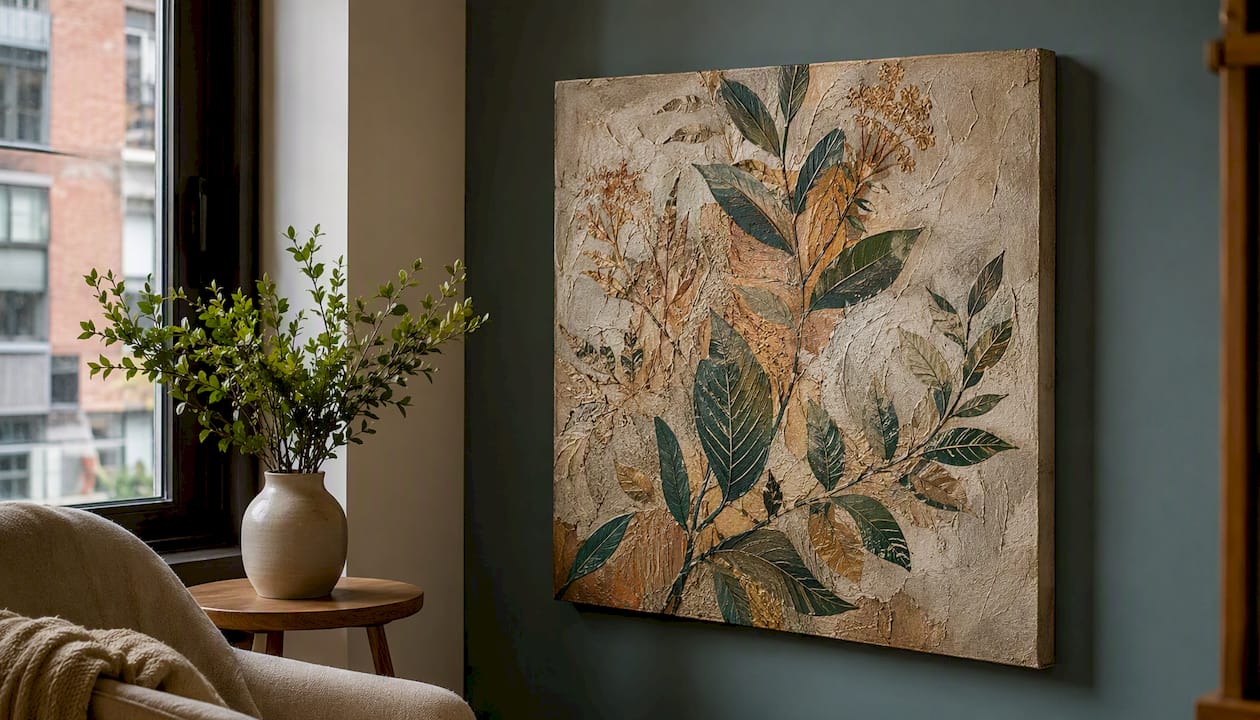
Durability comes down to three specifications worth asking for by name: pigment-based archival inks rather than dye inks (they resist UV fading far longer), a cotton or poly-cotton canvas blend rated for longevity, and a UV-protective varnish if the piece will sit in direct or reflected sunlight. Bathrooms and kitchens near steam need a sealed, wipeable finish rather than raw canvas.
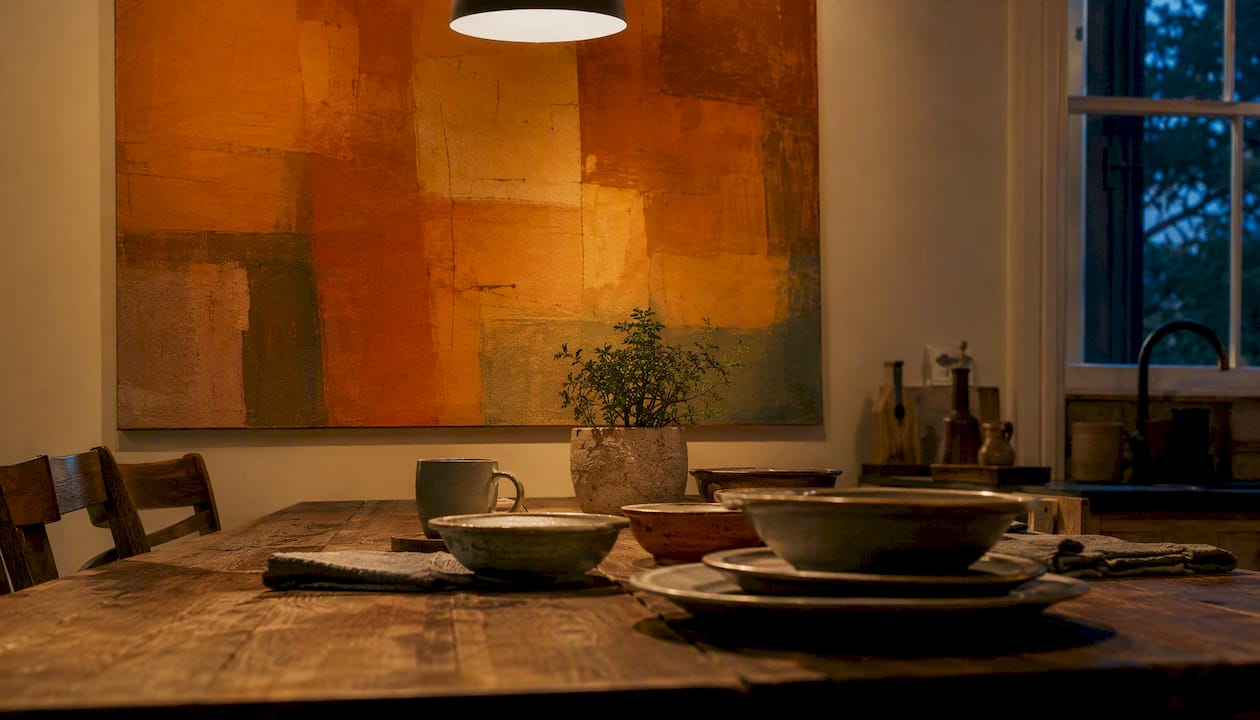
Finish changes how colour reads. A gloss varnish deepens contrast and saturates terracotta and teal tones but shows glare under strong lighting. A matte finish softens colour slightly but reads well from multiple angles, which matters in open-plan spaces. Textured or heavily worked surfaces (built up with palette-knife or impasto technique) catch raking light beautifully but need careful positioning away from direct sun to avoid uneven fading across the texture.
- Prints: cheapest, fastest, least tactile, easiest to reorder for multi-unit projects.
- Stretched canvas: good scale-to-cost ratio, minimal maintenance, occasional light dusting only.
- Hand-painted work: highest cost, most distinctive result, needs conservator-level care if damaged.
- Framed prints: best protection, adds cost and weight, ideal for high-value or heritage interiors.
How does commissioning a bespoke façade piece work?
A bespoke commission follows a fairly consistent sequence, whether the client is a homeowner or a property developer managing a multi-unit rollout.
- Brief. Share wall dimensions, room photos, colour references and the intended mood.
- Moodboard. The studio proposes reference imagery and composition direction.
- Scale mock-up. A digital or printed mock-up shows the piece in situ before paint touches canvas.
- Colour approval. Swatches or a small test panel confirm palette accuracy.
- Production. The main painting or print production phase begins.
- Framing. Mounting, stretching or framing is finalised to the agreed spec.
- Transit and installation. The piece is crated, delivered and hung on site.
A typical mid-to-large commission timeline looks like this:
That schedule reflects a corporate-scale commission; simpler residential pieces often complete in 5 to 8 weeks, with complex work stretching to 8 to 14 weeks, a timeframe drawn from broader commissioning lifecycle benchmarks.
Your contract should nail down:
- Exact dimensions, materials and edition status (one-off or limited run).
- Payment schedule, usually a deposit plus milestone payments.
- Reproduction and display rights, since the artist typically retains copyright unless the contract states otherwise.
- Insurance cover during transit and installation.
- Maintenance obligations and a de-installation or relocation clause if the piece may move sites later.
On pricing: per-square-inch rates fall as scale increases, but large pieces can add non-linear costs for crating, heavy framing and site installation, so budget for logistics as a separate line rather than assuming the discount curve covers everything.
Specifying façade art for developments and commercial fit-outs
A written specification for a showhome or commercial fit-out needs more precision than a single residential brief, because procurement teams and contractors are working from the document without direct artist contact.
Include scope (how many pieces, which rooms), mounting and hanging standards (fixing type, height from floor, weight limits per wall type), sightline requirements from entry points, and a finish and cleaning regime that facilities teams can follow after handover. For multi-unit rollouts, specify batch consistency tolerances for colour and finish, and commission a single pilot piece before full production runs.
A structured approach to art sourcing treats the process as strategy, curation, commissioning, production, framing, procurement and installation, because commercial briefs carry constraints a single residential commission never faces, such as multi-site consistency and facilities handover.
That framing comes from guidance on sourcing custom art for commercial projects, and it holds particularly well for sales suites, where artwork does double duty as branding and as a buyer-perception tool, especially when paired with new designer doors that rediscover home to enhance interior design schemes.
- Order a test panel before committing to a full batch for multiple units.
- Build in a stakeholder approval workflow (developer, sales team, interior designer) before production starts.
- Confirm lead times against launch dates; bulk orders often need six or more weeks of buffer beyond a single-piece timeline.
- Ask about quantity discounts once you’re ordering more than five or six matched pieces.
Developers researching this in more depth can look at dedicated advice on choosing artwork for new developments and on how wall art supports sales in showhomes.
Should you buy ready-made or commission bespoke work?
Ready-made stock wins on speed and cost predictability. A curated print or canvas can ship within days and suits standard wall sizes and flexible colour schemes. Bespoke work wins on fit: it solves non-standard walls, exact colour-matching and one-off branding needs that stock simply can’t.
For a single piece, the ordering flow is straightforward: browse or brief, confirm size and finish, pay a deposit if custom, approve a proof, then receive and install. For bulk or multi-site rollouts, add a pilot-piece stage and a written batch-tolerance spec before full production, a step recommended specifically to avoid costly reprints across multiple sites.
Before committing to any supplier, ask:
- What is the realistic lead time from deposit to delivery?
- How many proofing or revision rounds are included before production locks?
- Is there a sample or swatch policy for colour matching?
- Are framing and mounting handled in-house or outsourced?
- Is the piece insured during transit and installation?
- What reproduction rights come with the purchase if the artwork will feature in marketing material?
Not every commercial brief needs custom work. An experienced advisor can often tell you when curated existing pieces suffice and a full commission would be over-specifying the brief. Frametheworld handles both ends of that decision, from curated collections through to trade commissioning support, which is worth knowing before you assume bespoke is the only serious option.
How should façade art be hung and maintained?
Hanging weight and wall type dictate the fixing. Plasterboard needs cavity anchors rated for the piece’s weight; masonry can usually take a simple screw and wall plug, but always check the actual weight of a stretched canvas or framed print before fixing, since large hand-painted works can be heavier than they look. Position the centre of the piece at eye level and check sightlines from the main seating or entry point before finalising the fixing height.
A basic maintenance schedule keeps colour and condition intact:
- Dust monthly with a soft, dry microfibre cloth.
- Avoid liquid cleaners on unvarnished canvas entirely.
- For varnished surfaces, a barely damp cloth is acceptable; test on a corner first.
- Call a conservator for any tear, mould spot or significant colour shift rather than attempting a home fix.
Avoid direct sun on unvarnished pieces, steam exposure in bathrooms without a sealed finish, and abrasive cleaning products of any kind. If a piece is damaged in transit or during installation, photograph it immediately and raise it with the supplier’s insurance process before moving or attempting repair.
What do prints, canvases and commissions typically cost?
| Option | Typical price range | Typical lead time |
|---|---|---|
| Ready-made print | Lower cost, fixed sizes | Days to two weeks |
| Gallery-stretched canvas | Mid-range, scales with size | One to three weeks |
| Bespoke hand-painted commission | Higher cost, sliding per-area rate | 5–8 weeks (mid-size), 8–14 weeks (complex) |
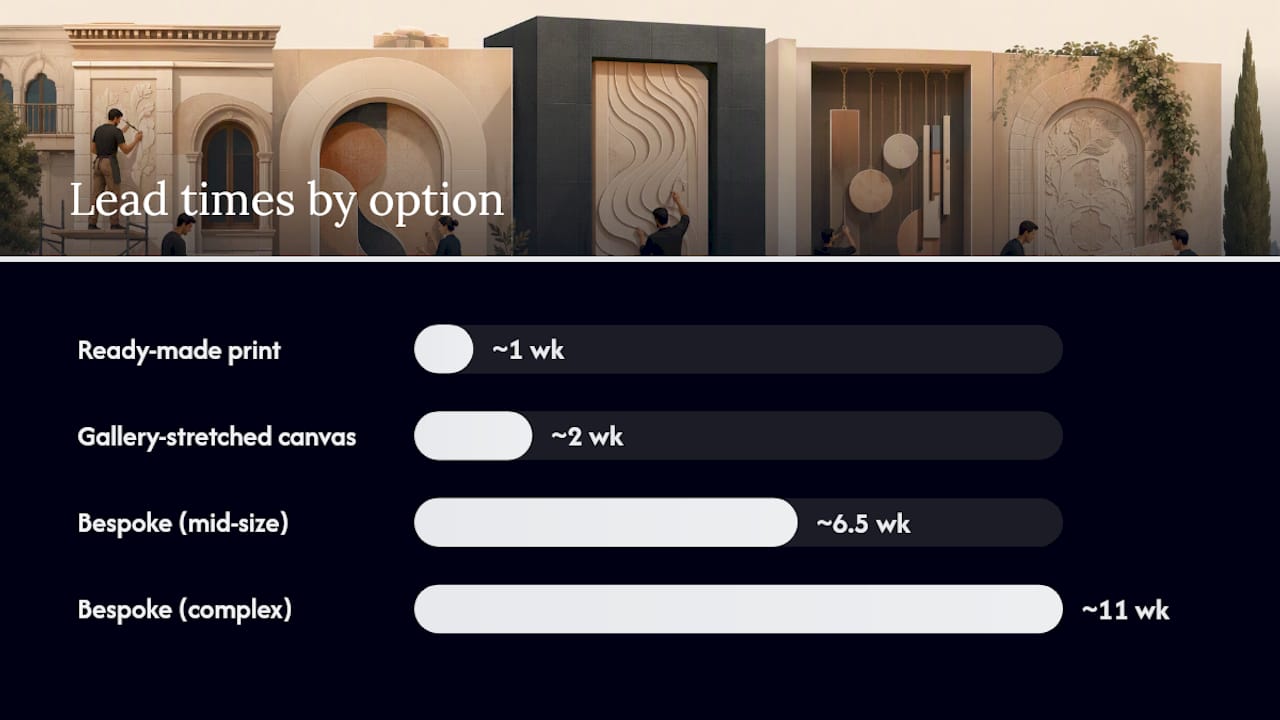
Those commission timelines and the falling per-square-inch pricing on larger work both come from trade pricing benchmarks for custom art. The most common bottlenecks are framing lead time, proofing delays where multiple approval rounds are needed, and shipping for large or heavy crated pieces.
For developer-scale or bulk orders, expect a deposit norm of around 30 to 50% at brief sign-off, with the balance due on approval or delivery. Discounts typically appear once you’re ordering matched sets of five or more, though the saving is usually structured against total order value rather than a flat percentage.
Why has art on building façades mattered historically?
Facade decoration has carried civic and religious meaning for centuries, from painted friezes on Renaissance palazzos to tiled mosaics on Islamic architecture and carved reliefs on Gothic cathedrals. These weren’t decoration in the modern sense; they told stories, signalled status and communicated a building’s purpose to people who couldn’t read.
That symbolic weight is exactly why facade imagery translates so well into interior art today. A painted study of a historic terrace or a stylised cityscape carries a sense of permanence and craft that abstract art often doesn’t, which is part of why the genre has found a strong following among homeowners and designers looking for pieces with a narrative behind them.
What techniques define exterior façade art?
Exterior facade art spans several distinct techniques, each with its own visual language. Murals use paint directly on masonry or render, often large-scale and narrative. Mosaics build imagery from small tiles, glass or stone, prized for extreme durability. Reliefs carve or cast three-dimensional imagery into or onto the surface itself, adding shadow and depth that shifts with the time of day.
Each technique produces a different reference point for interior artwork inspired by it. A painting referencing mural style tends to favour bold blocks of colour and flat perspective. A canvas referencing mosaic technique often uses fragmented, tessellated brushwork. A piece inspired by architectural relief leans on strong directional lighting and tonal contrast to suggest carved depth on a flat surface.
What legal issues apply to exterior façade artwork?
Anyone installing exterior facade art faces a different set of rules to someone buying interior artwork, and the two shouldn’t be confused. Exterior work on a building’s outside surface typically requires planning permission or listed building consent depending on the structure, local authority sign-off in conservation areas, and clear agreement on copyright, since the artist usually retains rights to the image even after installation.
Interior artwork depicting facades, the focus of this guide, avoids almost all of that regulatory burden. The one area worth clarifying in any commission contract is reproduction rights: if you plan to photograph the piece for marketing, brochures or a sales suite, confirm that licence in writing at the outset, since copyright defaults to the artist rather than the purchaser.
How is exterior façade art weatherproofed?
Exterior facade art faces UV exposure, rain, frost and pollution, all of which demand specialist coatings, anti-graffiti sealants and regular inspection cycles that interior artwork never encounters. Maintenance schedules for exterior work are typically annual or biannual, with recoating cycles running several years apart depending on climate and orientation.
None of that applies directly to interior facade-themed art, but the contrast is worth knowing if a client asks about protecting an interior piece near a large window. In that scenario, the answer is UV-filtering glazing or window film plus a UV-resistant varnish on the artwork itself, not exterior-grade weatherproofing.
How does façade art work with architecture and lighting?
Facade-themed interior art performs best when it’s treated as part of the room’s architecture rather than an object hung after the fact. Aligning a piece with a window’s proportions, a fireplace’s width or a run of skirting creates a sense that the art belongs to the space.
Lighting makes or breaks that integration. Picture lights angled at roughly 30 degrees reduce glare on varnished surfaces, while warm-white LED strips behind a canvas frame can lift a hand-painted piece after dark without washing out its colour. Cool white lighting tends to flatten the warm terracotta and ochre tones common in facade studies, so warm-temperature bulbs (around 2700 to 3000 Kelvin) generally suit the palette better.
Does façade art shape community identity?
At a civic scale, facade art has repeatedly proven its ability to shift how people feel about a place, turning overlooked streets into destinations and giving residents a visual marker of local identity. That same principle scales down into property development: a striking facade-themed piece in a shared lobby or sales suite gives residents and buyers a sense of place before they’ve even seen a flat.
Developers increasingly use this deliberately, commissioning artwork that references the local area’s own architecture so the interior feels connected to its surroundings rather than generic. It’s a small design decision with an outsized effect on how a development is remembered.
Studio perspective: how Frametheworld approaches façade commissions
Facade-themed commissions live or die on two things: getting the scale right the first time, and matching colour to a room the client hasn’t fully described yet. Frametheworld’s process leans hard on the mock-up stage for exactly that reason. A digital scale mock-up placed against the client’s own room photo catches sizing problems long before paint goes on canvas, and it’s far cheaper to adjust a mock-up than to repaint a finished piece.
Sample panels do similar work for colour. Rather than relying on a client’s screen (which never renders terracotta or teal accurately), a small painted swatch sent ahead of full production settles the palette question early and removes most of the guesswork that causes delays elsewhere in the trade.
One recurring pattern from trade projects is that developers who commission a single strong architectural piece for a show apartment’s main sightline consistently get more engagement from viewings than those who fill several walls with smaller, unrelated prints. The guide on wall art for property developers covers this pattern in more depth, including how scale and placement affect buyer perception during viewings.
How can Frametheworld help with your façade art project?
Frametheworld offers curated facade-themed collections ready to order, custom sizing on existing designs, and fully bespoke hand-painted commissions for walls that need something exact. For trade clients, that means procurement support across single pieces or multi-unit rollouts, including pilot panels, batch consistency checks and installation coordination, so a developer or designer isn’t managing five separate suppliers for one project.
A trade consultation typically starts with your wall measurements and room photos, moves to a scale mock-up and colour proof, and ends with a fixed quote before production begins. That’s the same structured process outlined earlier in this guide, just run by people who do it daily.
If you’re browsing rather than briefing, the Wabi Sabi collection offers hand-painted, texture-rich canvases that suit large architectural walls without a full bespoke commission. For bolder colourways, the Pop Art collection works well in commercial and showhome settings where the piece needs to draw attention.
Measure your wall, gather a couple of room photos, and send them across for a quote. It’s the fastest way to find out whether a ready-made piece will do the job or whether the space genuinely needs a bespoke commission.
Sources
- Corporate Art Commissions Guide 2025 🎨
- Commissioning Custom Art: A Trade Guide for Designers
- How to Source Custom Art for Commercial Design Projects
These sources cover the commissioning milestones, pricing logic and procurement steps referenced throughout this guide, and the Frametheworld pages let you see current collections and trade-focused examples before requesting a quote.

Laat een reactie achter
Deze site wordt beschermd door hCaptcha en het privacybeleid en de servicevoorwaarden van hCaptcha zijn van toepassing.