
Set your art budget for interiors at 5 to 15% of your total furniture and decor spend, weighted toward two or three prints and one investment original rather than an all-original room. Frametheworld sees this mix work across most projects; Houzz and Architectural Digest both point buyers toward the same blended approach, and the FF&E allocation method used by professional designers backs it up.
TL;DR:
- Most interior art budgets should allocate 5 to 15 percent of the total decor expenses, with 5 to 7 percent for art and accessories, depending on visual needs.
- Using the 3-5-7 rule or the 70/30 split helps determine whether to focus on smaller, safer pieces or invest in a large statement artwork.
- Framing costs can significantly increase the overall art budget, especially for conservation or bespoke frames, with edge-finished canvases reducing framing expenses.
- Buying art from emerging artists or local markets and utilizing staged payments can substantially lower costs without sacrificing quality.
- Larger single artworks tend to be more cost-effective than multiple small pieces once framing and installation costs are included.
Table of Contents
- What percentage of your budget should go on art?
- Where should you buy art at different price points?
- What does framing actually add to your art budget?
- How does size affect your art budget?
- How do you build a step-by-step art budgeting plan?
- What are the smartest ways to cut art costs without cutting quality?
- Why Frametheworld makes hitting your art budget easier
- What homeowners consistently get wrong about art budgets
- Sources
What percentage of your budget should go on art?
Most designers treat art as its own line item within furniture, fixtures and equipment (FF&E), rather than an afterthought once the sofa and rug are paid for. Design allocation tools that break spending down room by room typically place art somewhere in the 5 to 15% range of the total decor budget, depending on how much visual weight the room needs to carry.
Two heuristics make this easier to apply without overthinking it.
- The 3-5-7 rule. Spend roughly 3% of a room’s decor budget on accessories, 5% on art specifically, and 7% if art is doing the heavy lifting as the room’s focal point (a large piece above a fireplace, say, or the anchor of an open-plan living space).
- The 70/30 split. Put 70% of your art budget into “safe”, lower-cost pieces (prints, smaller canvases, decorative pieces you’re confident about) and 30% into one statement piece you’re willing to stretch for.
A worked example helps more than the percentages alone. Scale that logic across a whole-house project and a £60,000 renovation might reasonably carry £3,000 to £6,000 in art across every room, front hall included.
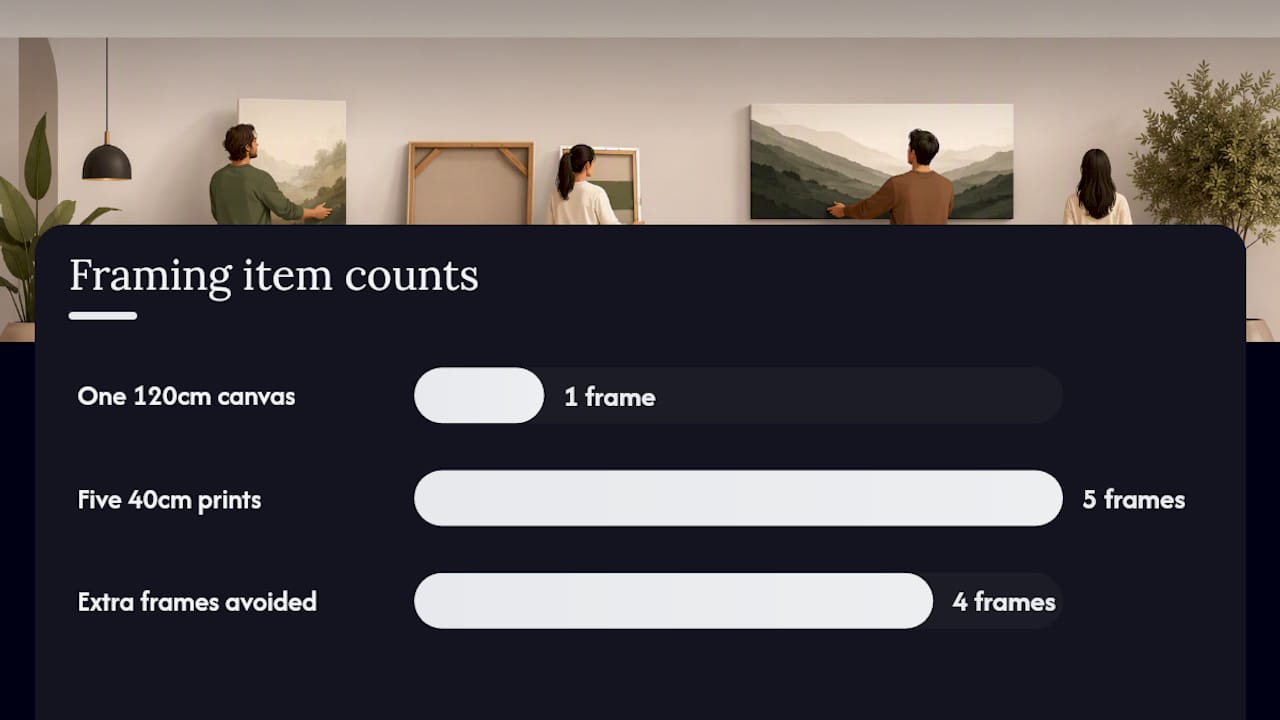
The maths shifts again once you’re deciding between one large piece and several smaller ones. A single 120cm canvas often costs less overall than five 40cm prints once you’ve added framing to each, because framing and mounting costs multiply per item, not per square metre. If your budget is tight and you need visual impact, one larger piece frequently beats a scattered collection on cost per visual impact alone.
Luxury renovation budgets tell a cautionary tale here: original art in a high-end interior project can run into the tens of thousands, which is exactly why most homeowners budget the category deliberately rather than letting one gallery visit blow the plan apart.
Where should you buy art at different price points?
Your budget determines your channel more than your taste does. Originals, limited editions and open-edition prints occupy genuinely different price worlds, and shopping in the wrong one wastes time and money.
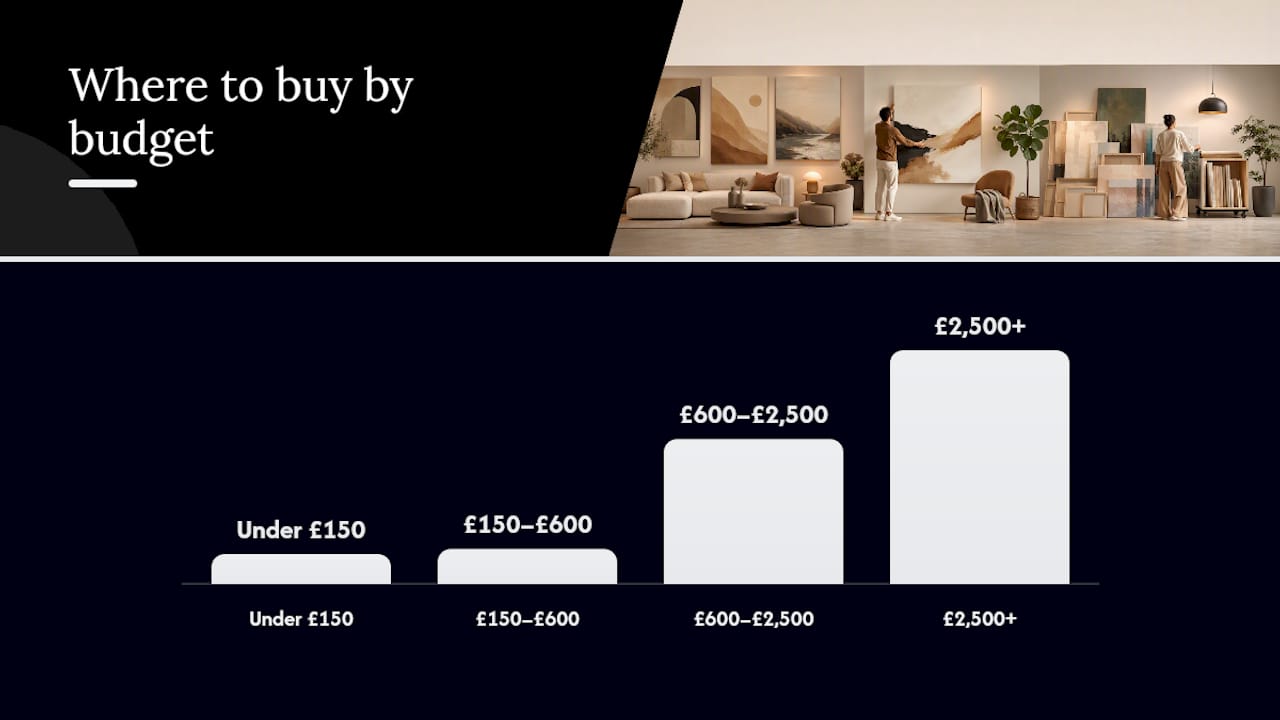
- Under £150: open-edition prints, poster shops, museum shop reproductions and marketplaces like Etsy, all of which give reliable quality at low risk.
- £150 to £600: limited-edition prints, small original works from emerging artists, and curated online retailers offering framed or ready-to-hang pieces.
- £600 to £2,500: established limited editions, mid-career original paintings, and hand-painted canvases from platforms like Frametheworld that let you customise size and style without commissioning from scratch.
- £2,500 and up: gallery originals, bespoke commissions and larger-scale statement pieces, often with advisory support built into the purchase.
Student degree shows and local artist open studios sit slightly outside this ladder because pricing there is genuinely negotiable. Buying directly from an artist before their reputation is established is one of the oldest tricks in the book, and it usually comes with more room to ask about payment terms than a gallery would ever offer.
Marketplaces and print retailers rarely negotiate on price, but they increasingly offer something better for a budget-conscious buyer: staged payments. Payment plans and advisory services are now common enough among online retailers that stretching for one higher-priced piece no longer means paying it all upfront. Curated lists of affordable art sources consistently point to the same pattern: prints and framed kits give the best value per pound, while galleries and commissions reward patience and a direct relationship.
What does framing actually add to your art budget?
Framing is routinely the single most expensive part of buying art, sometimes exceeding the cost of the artwork itself once you factor in glass, matting and a bespoke frame. Budget for it as its own line, not an afterthought bolted onto the purchase price.
A standard ready-made frame for a mid-size print typically sits at the lower end of the cost scale. Conservation framing, using UV-protective glazing and acid-free mounts, costs considerably more and is worth it mainly for original works or anything on paper you want to preserve for decades. Bespoke large frames for statement pieces are the most expensive category by far, and costs climb sharply once a frame exceeds standard stock sizes.
- Standard ready-made frame (small to mid-size print): lower cost, widely available
- Conservation framing (UV glazing, acid-free mounting): mid to high cost, worth it for originals
- Bespoke large frames (oversized or unusual dimensions): highest cost, often made to order
Edge-finished canvases sidestep most of this entirely. A canvas finished at the edges can be hung directly, with no frame required, which is exactly why hand-painted canvas ranges have become such a popular budget lever for homeowners who want a gallery look without a framer’s invoice.
Installation carries its own costs too. Standard hanging is cheap or free if you’re doing it yourself, but oversized pieces often need specialist fixings, and white-glove delivery for large or fragile works adds a line you should budget for rather than discover at checkout.
Framing quotes almost always come in higher than the initial estimate once matting and glazing choices are finalised.
How does size affect your art budget?
Scale decisions drive cost in ways that catch first-time buyers out. Get the proportions wrong and you either overspend on an oversized piece the room didn’t need, or underspend on something too small to register.
- Match width to furniture, not wall space. A piece hung above a sofa or console should span roughly two-thirds of that furniture’s width. Going wider than the sofa itself usually looks accidental rather than intentional.
- Compare true cost, not sticker price. One large statement piece at 150cm often costs less overall than a five-piece gallery wall of 40cm prints, once each smaller piece needs its own frame, mount and hanging hardware.
- Factor scale into shipping and installation. Anything over roughly 100cm in either dimension typically needs specialist packaging and, for hand-painted canvases, careful crating that adds to the delivery cost.
- Let ceiling height set the ceiling on cost. A room with 2.4-metre ceilings rarely justifies a piece large enough to need bespoke framing, so measure before you fall for something oversized.
Getting this right the first time saves more money than any single negotiating tactic, because reworking a badly-scaled piece (reframing it smaller, or buying a second piece to compensate) costs more than planning properly at the outset. A closer look at how to select art size for your home walks through the wall-to-furniture ratios in more depth if you want the fuller version of rule one.
How do you build a step-by-step art budgeting plan?
Start with your total FF&E figure for the room or project, then work down.
- Take your total furniture and decor budget and allocate 5 to 15% to art, using the 3-5-7 or 70/30 heuristic to decide where in that range you sit.
- Rank rooms by priority. Living rooms and entryways usually earn a larger art allocation than bedrooms or utility spaces.
- Build a purchase schedule across two or three phases rather than buying everything at once. Spring and January sales periods often bring discounts from print retailers and galleries alike.
- Hold back 10% of the total art budget as contingency for framing surprises or a piece you fall in love with mid-project.
A simple room-by-room table keeps the plan honest as you go:
This mirrors the FF&E allocation approach professional designers use, where art sits alongside lighting and textiles as its own tracked category rather than a leftover. Frametheworld’s own art selection checklist for interior design gives a fuller shortlist template if you want to formalise this before you start buying.
What are the smartest ways to cut art costs without cutting quality?
Cost control and design intent aren’t opposites if you’re strategic about where you save.
- Buy high-quality prints for supporting walls and reserve original or hand-painted pieces for the one room that needs a genuine focal point.
- Choose edge-finished canvases wherever the room allows, since skipping the frame is the single biggest saving available on any piece.
- Stagger purchases across a full year rather than buying everything before moving day, when sale periods and artist availability both work in your favour.
- Visit student degree shows and local artist markets before browsing galleries; prices there are lower and far more open to negotiation.
- Ask about payment plans on anything over your immediate comfort level. Many retailers now offer them, and staging payments often gets you a better piece than settling for a cheaper one outright.
- Rotate pieces between rooms every year or two instead of buying new. A living room piece that’s lost its shine can do fresh work in a hallway.
Pro Tip: Keep receipts and framing invoices for every piece. If you ever want to remat or reframe for a new room, having the original specs saves a second measuring visit and often a second delivery charge.
Interior designers consistently recommend seeing plenty of art in person before committing, prioritising pieces you genuinely love over anything chasing a trend that won’t age well against your walls.
Why Frametheworld makes hitting your art budget easier
Custom sizing changes the maths on your art budget in a way off-the-shelf pieces can’t. When you choose your dimensions directly, you avoid paying for a bespoke frame to fit an awkward standard size, and Frametheworld’s hand-painted canvases are made to the measurements your wall actually needs rather than the nearest size a supplier happened to stock.
The hand-painted range gives you that one investment-grade anchor piece for a fraction of a gallery original, while staged commissioning options mean you’re not paying the full cost upfront. Browse the Wabi Sabi collection for texture-led statement pieces, or the colourful hand-painted canvases if you want fixed pricing you can plan against immediately. Anyone leaning toward bold graphic impact should also look at the pop art collection, which works well as the single statement piece in the 70/30 split described earlier.
Start by getting a quote on the size and finish your room actually needs at Frametheworld, and let the custom sizing do the budget work that a bespoke frame would otherwise cost you.
What homeowners consistently get wrong about art budgets
Most people treat art as the last line item, the thing that gets whatever’s left after furniture, lighting and rugs have eaten the budget. That’s backwards, and it’s why so many finished rooms feel unfinished. Art is the cheapest way to make a room look considered, but only if you plan for it at the same time as everything else rather than reacting to an empty wall six months after moving in; how to make your house look expensive often starts with art placement and finishing touches that elevate the entire space.
The bigger mistake is assuming a tight budget means compromising on impact. It doesn’t. It means being deliberate about where you spend: one larger, well-chosen piece will outperform five scattered smaller ones on both visual weight and total cost, once framing is factored in. Homeowners who get this right aren’t the ones with the biggest budgets. They’re the ones who decided on their percentage and their mix before they started browsing, so a beautiful original doesn’t derail three months of careful planning.
Buying on impulse at full retail price is the single most avoidable cost in this whole category. Sales periods exist, payment plans exist, and student shows exist precisely because the art world knows most buyers are working within limits. Use them.
— Lennard
Sources
- Let’s put a price on art: your guide to art costs and buying | Houzz
- Where to buy affordable art online: 34 stores for sophisticated artwork, prints, and more | Architectural Digest
- FF&E budget allocator: plan interior design budgets room by room | Design Interiorspaces
- The 19 best online sources for the art‑lover on a budget | Apartment Therapy

Laat een reactie achter
Deze site wordt beschermd door hCaptcha en het privacybeleid en de servicevoorwaarden van hCaptcha zijn van toepassing.