
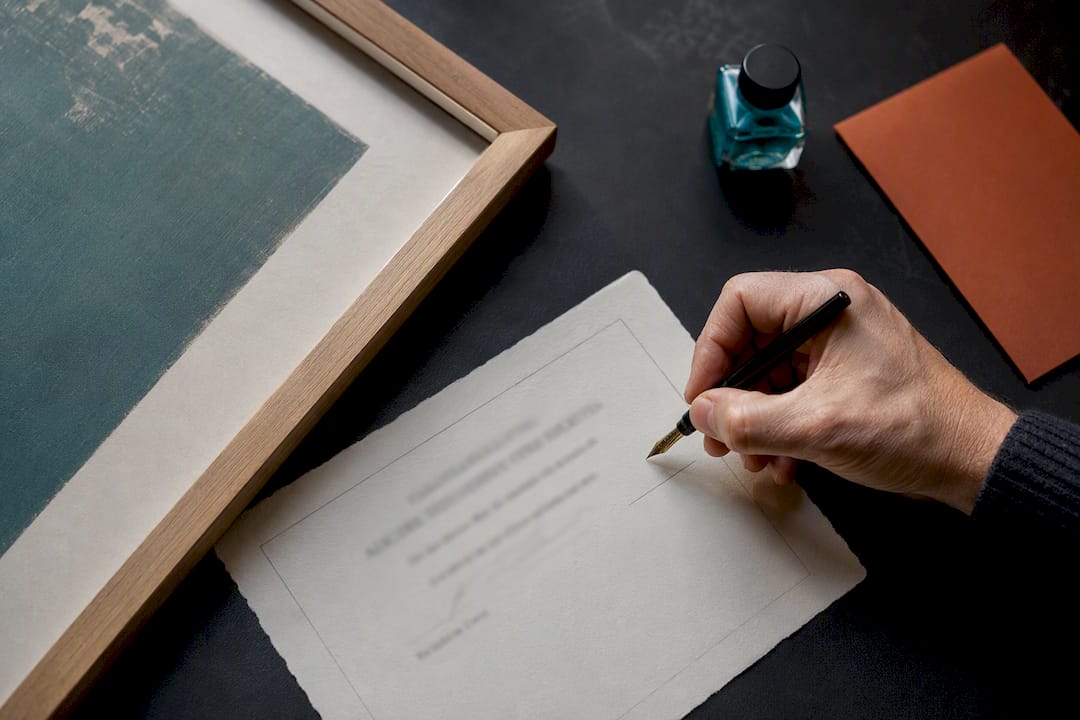
A certificate of authenticity (COA) is a signed document that ties one specific artwork to its maker, recording exactly what it is, who made it, and when. It matters because it underpins insurance claims, resale value, and gallery transfers years after the paint has dried. Every artist and seller should issue one with each sale or commission, without exception.
TL;DR:
- Use a signed, handwritten certificate with clear contact details issued by the artist or authorized gallery for maximum credibility.
- Include precise details such as the artist’s full name, artwork title, medium, exact dimensions, creation date, and a verified photograph.
- Store digital copies securely in cloud storage and match cryptographic codes on both the certificate and artwork to prevent forgery.
- Print COAs on acid-free, archival materials with a unique code, and consider NFC tags or holograms for high-value pieces.
- Rely on consistent templates and accurate, detailed descriptions to ensure legal strength and long-term traceability of provenance records.
Table of Contents
- What to include on a certificate of authenticity for paintings
- How do you create and issue a COA?
- Who can issue a COA and does it carry legal weight?
- Printing, materials and simple ways to stop forgery
- Where should you store COAs and provenance records?
- When does a COA actually matter?
- What common mistakes weaken a COA?
- How Frametheworld documents bespoke commissions
- Why most COA advice misses the point
- Get documentation with your next Frametheworld piece
- Sources
What to include on a certificate of authenticity for paintings
A weak COA is often worse than none at all, because it signals carelessness rather than care. The strongest certificates read like a technical specification sheet crossed with a signed promise, and each field earns its place by answering a question a future buyer, insurer, or auctioneer will eventually ask.
Fields to treat as non-negotiable:
- Artist’s full name exactly as used professionally, avoiding nicknames or inconsistent spellings across works.
- Title of the work, matching any inventory system or gallery record.
- Medium, stated precisely (oil on canvas, acrylic on board, mixed media on panel).
- Exact dimensions, given in both centimetres and inches to satisfy UK and international buyers alike.
- Date of creation, not the date of sale.
- Edition details, where relevant (e.g. “3/25”) for prints or limited runs.
- Unique inventory number, cross-referenced against your own sales log.
- A photograph of the work, ideally colour-accurate and taken against a neutral background.
- Issuer contact details, so the certificate can be verified decades later.
- A handwritten signature and date, never a printed or stamped facsimile.
Optional but valuable additions include a short provenance line, a conservation note if the piece has been treated, and confirmation of edition limits. These fields build the kind of certificate that VanArtHub describes as usable by an auctioneer or insurer matching document to object years after the sale.
How do you create and issue a COA?
Build one master template once, then reuse it for every sale. Keep an editable file (Word or a design tool) and export a clean PDF for each artwork, so formatting never drifts between certificates.
- Fill in every mandatory field consistently, checking spelling of the title and dimensions against your own notes.
- Insert a clear photograph of the finished piece, cropped tight, before framing obscures any edge detail.
- Sign and date the certificate by hand. A scanned signature undermines the whole document.
- Print the COA on decent stock and pack it with the artwork, whether it ships or is collected.
- Scan the signed original and store the file against the same inventory number in your records.
- Log the sale, buyer name, and date in a simple spreadsheet or studio-management tool.
This mirrors the process Saatchi Art requires of its sellers, who must include a signed certificate inside every shipment and retain a copy for their own files.
Pro Tip: Number your COAs sequentially against your master inventory, not against the buyer’s order number. Orders get cancelled and refunded; inventory numbers shouldn’t have to change with them.
Who can issue a COA and does it carry legal weight?
The most credible issuers are the living artist, the artist’s estate, an authorised gallery representing the artist, or a recognised scholar with specific expertise in that body of work. A certificate from anyone outside that chain carries far less authority, however official it looks.
Wording matters more than most sellers realise. A COA can function as an express warranty under commercial law, meaning inaccurate claims about authorship or medium expose the issuer to real liability. Say only what you can stand behind.
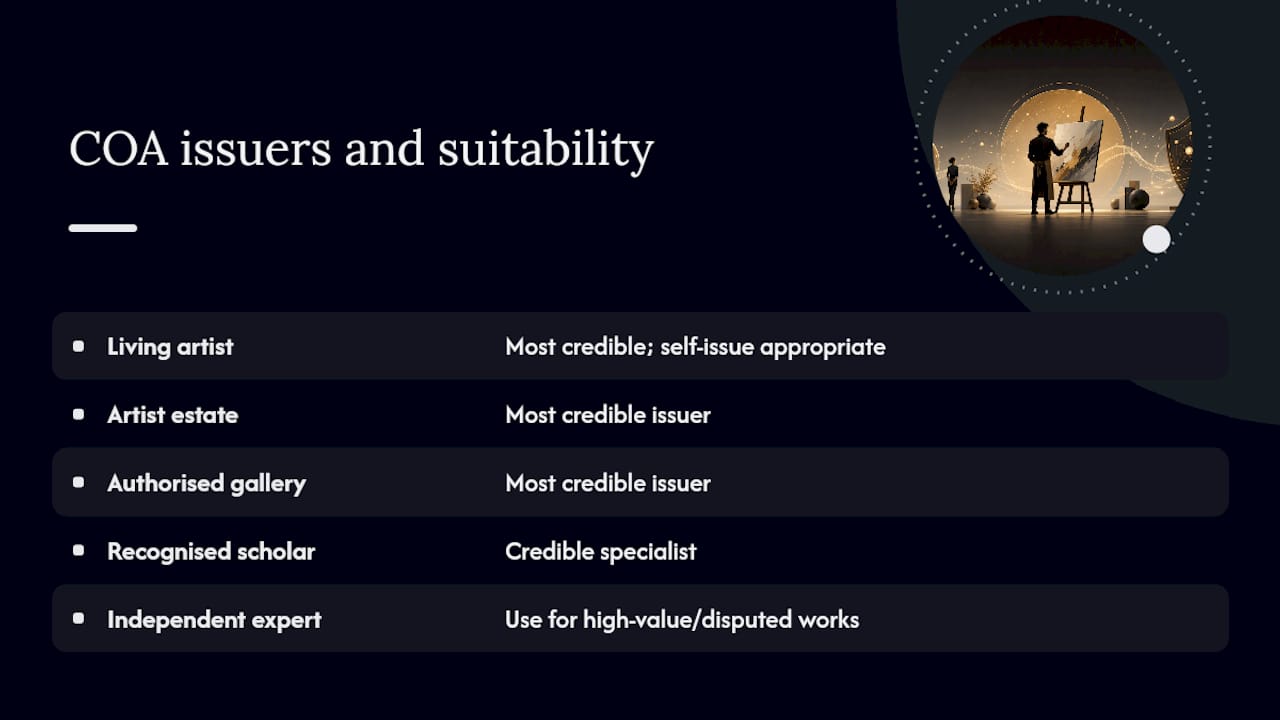
For high-value or disputed works, particularly anything changing hands for a substantial sum or lacking a clear paper trail, independent authentication from a specialist becomes worth the cost. A self-issued COA is entirely appropriate for a working artist’s own output; it is not a substitute for expert opinion on contested attribution.
Printing, materials and simple ways to stop forgery
Print certificates on acid-free card rather than standard printer paper, which yellows and degrades within a few years. Slip the finished document into an archival, pH-neutral sleeve before it travels anywhere near a frame or a shipping box.
- Use acid-free card stock and archival sleeves for anything intended to last decades.
- Match a unique alphanumeric code on the COA to a small label on the reverse of the canvas or panel.
- Consider a hologram sticker or an NFC tag for higher-value commissions, giving buyers a way to cross-check the physical object against the paperwork by using technologies to verify authenticity and preserve history.
- Avoid adhesives that touch the painted surface; use rust-proof staples on stretcher bars instead.
Pro Tip: A matching code on both the COA and the artwork’s reverse label does more to deter forgery than any amount of fancy printing. It’s the cross-reference that counts, not the paper stock.
Where should you store COAs and provenance records?
Treat the scanned master as the permanent record and the printed copy as the version that travels with the buyer. A simple sales log, even a spreadsheet, does most of the heavy lifting here.
- Keep a scanned PDF of every signed COA, filed by inventory number.
- Maintain a sales log recording buyer name, date, price, and inventory reference.
- Store the work’s photograph alongside its COA record, not in a separate folder.
- Back up digital files to cloud storage with version history, so nothing is lost to a failed hard drive.
Tools built for this exact purpose, such as Artwork Archive’s certificate generator, can automate much of this workflow for artists managing more than a handful of pieces a year. Including full contact details on the certificate itself matters just as much as the archive behind it, since that’s what lets a future owner trace the work back to you.
When does a COA actually matter?
Insurers and auction houses lean on COAs when assessing claims and establishing provenance, particularly where no other paper trail exists. Galleries and secondary-market buyers expect a certificate to travel with the work at every transfer of ownership, treating it, as Artquest describes, as a kind of passport for the piece.
A signed COA is usually adequate for a straightforward sale between a living artist and a private buyer. It becomes insufficient once significant sums, disputed attribution, or a long ownership gap are involved. At that point, a fuller provenance file or a professional appraisal takes over.
What common mistakes weaken a COA?
Vague descriptions are the most frequent failure: “oil painting, various sizes” tells a buyer nothing verifiable. Printed or stamped signatures, missing contact details, and dimensions that don’t match the physical object all raise the same red flag.
- Avoid generic wording; describe the specific work, not a category of works.
- Never substitute a printed signature for a handwritten one.
- Always list contact details that will still work in ten years, not a temporary email address.
- Double check dimensions against the actual framed piece before printing.
Counterfeit certificates remain a recognised problem across the art market, which is precisely why traceable issuer details matter so much. If a certificate is lost, reissue it using your scanned master and note the reissue date clearly, rather than backdating it to the original sale.
How Frametheworld documents bespoke commissions
Frametheworld pairs every bespoke hand-painted commission with a certificate covering the artist’s name, title, medium, exact dimensions, and date of completion, alongside a photograph of the finished piece. Documentation ships with the framed artwork rather than as a separate afterthought, so buyers receive both in one delivery.
For commercial and interior projects, that same certificate supports the kind of transfer-of-ownership record galleries and designers routinely request. It’s a straightforward extension of a workflow any independent artist can replicate at their own scale.
Why most COA advice misses the point
Most guides obsess over the certificate’s appearance, embossed borders, gold foil, holograms on a print run of one, and barely mention what actually protects an artist: consistency. A scrappy but accurate COA, filled in the same way every time and backed by a real scanned archive, beats an elaborate one issued inconsistently.
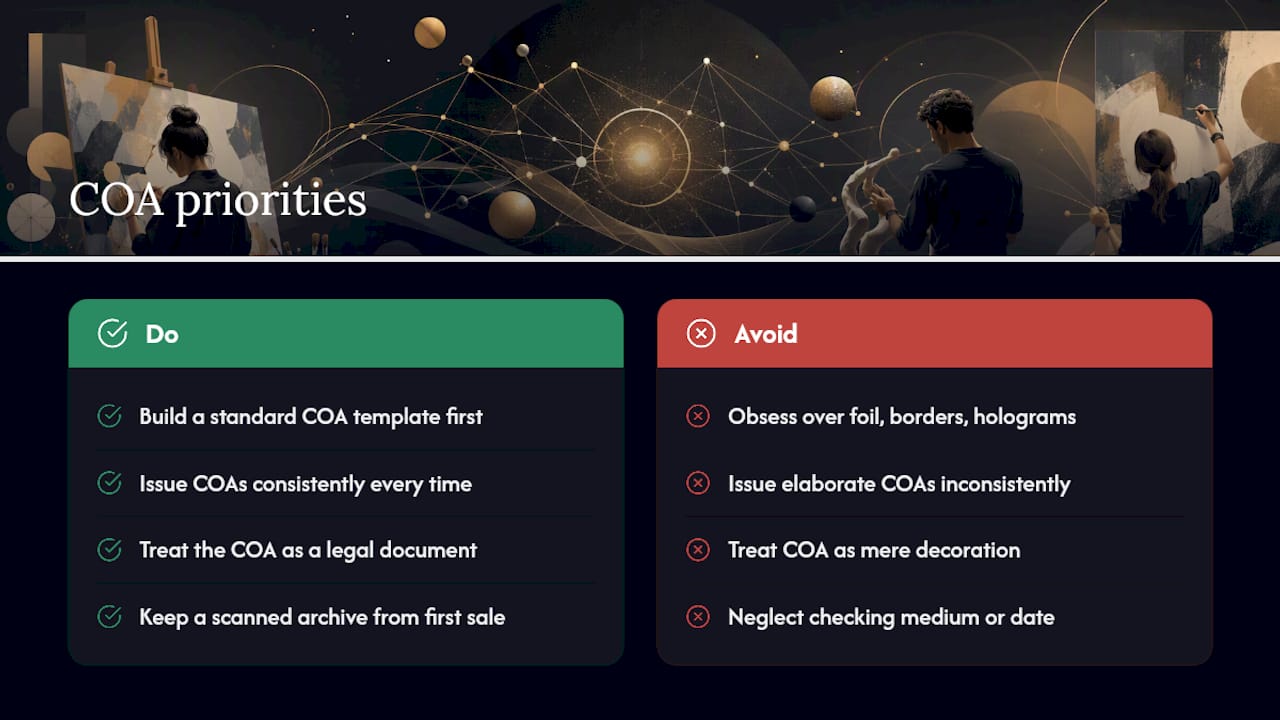
The conventional advice also underplays the legal side. Treating a COA as decoration rather than a document with warranty implications is how sellers end up exposed when a claim about medium or date turns out to be wrong. Get the facts right before worrying about the card stock.
If there’s one priority for artists starting from nothing, it’s this: build the template first, then make issuing it as automatic as writing an invoice. The artists who keep clean archives from their very first sale are the ones whose provenance nobody ever questions ten years later.
— Lennard
Get documentation with your next Frametheworld piece
Frametheworld includes documentation options with bespoke commissions and selected ready-made pieces, so buyers of hand-painted work leave with more than just a canvas. That matters for anyone building a collection with future resale or insurance in mind, not just galleries and designers.
Browse the Wabi Sabi wall art collection for hand-painted textured pieces suited to considered, long-term collecting, or explore bold pop art canvases if you want something with more presence on a feature wall. Either way, start by browsing the full collection and requesting documentation alongside your order.
Sources
- Certificate of Authenticity: How It Works and Legal Weight - LegalClarity
- Authenticity Certificates - Artquest
- Certificate of Authenticity – Help Center - Saatchi Art
- Generating a Certificate of Authenticity | Artwork Archive

Leave a comment
This site is protected by hCaptcha and the hCaptcha Privacy Policy and Terms of Service apply.