
A large canvas, for this article’s purposes, is any oversized ready-to-hang or bespoke canvas built to work as a single statement piece rather than one item in a gallery wall. In practice that means anything from around 40 inches upward on its longest side, though scale depends on your wall as much as the tape measure.
The decision rule is simple. Buy ready-made when you need speed, a fixed price and something you can see before you commit. Commission when your wall has awkward dimensions, you want a specific palette, or nothing off-the-shelf does the job. Frametheworld covers both routes: a curated collection of hand-painted canvases you can order today, and a commission service for walls that need something built to fit.
- Ready-made: fastest option, fixed price, see-it-before-you-buy
- Commission: exact dimensions, tailored palette, unique provenance
- Both: available through Frametheworld’s collections and bespoke enquiry process
Key Takeaways
Choosing between ready-made and commissioned canvas comes down to whether your wall’s dimensions and palette already exist in stock collections or need to be built to order.
| Point | Details |
|---|---|
| Define large correctly | Treat anything from roughly 40 inches upward as a candidate for single-statement treatment, not gallery-wall filler. |
| Avoid scale misjudgement | Size the canvas to cover about two-thirds of the furniture or wall it sits above, then mock it up with tape before ordering. |
| Choose commission for awkward walls | Commission when dimensions, palette or mood have no ready-made match; expect 3 to 14 weeks depending on complexity. |
| Brief with full context | Send exact measurements, room photos, swatches and lighting conditions to cut down on revision rounds. |
| Start with Frametheworld | Browse ready-made collections like Wabi Sabi and Pop Art for speed, or request a commission brief for walls that need a tailored fit. |
Table of Contents
- Why a single large canvas beats a cluster of small pieces
- How do you get the size and proportion right?
- Should you commission a piece or buy one ready-made?
- What do you need to send an artist before commissioning?
- What materials hold up best for oversized canvas art?
- How should you actually hang something this size?
- How do you keep a large canvas looking its best?
- What goes wrong when hanging large canvases, and how do you fix it?
- The commission-first mindset most guides get backwards
- Ready to put a large canvas on your wall?
- Frequently asked questions
- Sources
Why a single large canvas beats a cluster of small pieces
A large canvas does one job that a gallery wall struggles to do: it gives the eye a single place to land. Where five or six small frames force a room to compete for attention, one substantial piece resolves the wall and calms everything around it. That’s not decoration by volume, it’s decoration by decision.
Certain spaces reward this instantly:
- Feature walls behind sofas or beds, where the canvas sets the tone for the whole room
- Double-height living spaces and stairwells, where scale needs to match the architecture, not just the furniture
- Reception areas and lobbies, where a single work signals intent faster than a curated cluster ever could
Designers see the same mistake repeatedly. Alessandra Wood, an interior designer, calls scale misjudgement the most common error when buyers choose large artwork, and her advice is blunt: a big piece should read as one substantial statement, not a slightly larger version of a small print. If a piece looks like it needs company to fill the wall, it was probably too small to begin with.
That said, large canvases aren’t universal. A small, busy room already crowded with furniture and pattern will fight an oversized piece rather than showcase it. Scale only works when the room has room to give it.
How do you get the size and proportion right?
Getting scale right is less about guesswork and more about testable rules. A few proportional checks will save you from either a canvas that disappears or one that overwhelms the room.
- Use the two-thirds rule. A canvas hung above a sofa, console or bed should cover roughly two-thirds of that furniture’s width. Go much narrower and it looks like an afterthought; go much wider and it fights the furniture for authority.
- Match vertical scale to the ceiling, not the furniture. In double-height spaces or stairwells, the canvas needs to answer to the architecture above it. A piece that would suit a standard eight-foot wall can look stranded on a twelve-foot one.
- Consider modular panels for very large or awkward walls. A triptych or multi-panel piece is easier to transport, easier to hang through doorways and staircases, and gives you rhythm across a wide wall that a single canvas sometimes can’t.
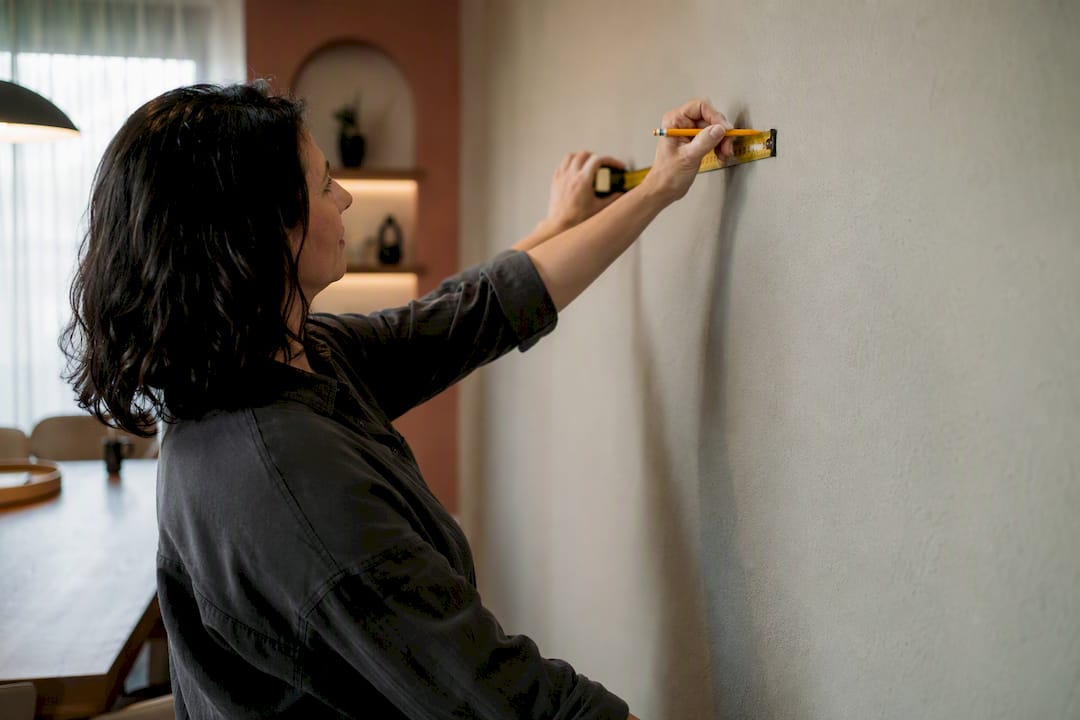
- Mock it up before you commit. Painter’s tape marking the exact outline on the wall, or a scaled printout pinned in place, tells you more in five minutes than any measurement on paper.
- Check it at different times of day. Photograph the taped mock-up in morning and evening light. A wall that looks balanced at noon can feel unbalanced under lamplight.
For furniture-relative sizing specifically, guidance on how big wall art should be is worth cross-checking against your own room before you finalise dimensions.
Pro Tip: Take the phone photo of your taped mock-up and flip it to greyscale. Colour and texture can distract you from judging pure proportion, and greyscale forces you to see scale honestly.
If you’re still unsure how a given size will read against your existing pieces, our guide to selecting art size for your home walks through the maths in more detail.
Should you commission a piece or buy one ready-made?
The honest answer depends on what your wall is actually asking for. If the dimensions are standard and the room’s palette is flexible, ready-made wins on every practical measure: you see the exact piece before paying, the price is fixed, and it can be on your wall within days rather than weeks.
Commissioning earns its place when none of that applies. Many commissions start precisely because nothing off-the-shelf matches the wall’s dimensions, light or mood, and the process becomes a conversation rather than a transaction.
Commissions are often the cleanest solution for finished rooms where nothing off-the-shelf fits the brief. Clients tend to prefer a conversation-led brief over scrolling through stock.
The economics differ too. Commission pricing generally follows a sliding price-per-area scale, where large-scale work costs less per square inch than a small piece, but the total invoice still depends on materials, complexity and the artist’s profile. Ready-made trade discounts, worth noting for designers working across multiple projects, don’t always carry over to bespoke commissions since each one is quoted individually.
- Commission when: dimensions are unusual, palette must match existing decor, or you want provenance
- Buy ready-made when: dimensions are standard, budget is fixed, or timeline is short
- Expect: a Certificate of Authenticity and insured, crated delivery as standard practice on bespoke work
For readers weighing both options, browsing Frametheworld’s customised wall art for unique spaces is a useful starting point before deciding which route your wall needs.
What do you need to send an artist before commissioning?
A commission moves faster and needs fewer revisions when the brief arrives complete the first time. Studio practice consistently shows that artists who receive good context upfront produce work that needs fewer rounds of changes, which saves both time and money.
Here’s what to prepare before you get in touch:
- Exact wall dimensions and ceiling height. Not estimates. Measure twice.
- Photos taken from where you’ll actually view the piece, not just a straight-on shot of the empty wall.
- Furniture and fabric swatches, so the palette can be matched rather than guessed.
- A description of the mood you want, whether that’s calm and tonal or bold and graphic.
- Any archival or lightfast requirements, particularly relevant for south-facing rooms or commercial spaces with heavy footfall.
Timelines vary by scale and complexity. Across the trade, commission windows commonly run 3 to 14 weeks, with most mid-size pieces clustering around 6 to 10 weeks. Build in extra time for framing and shipping, particularly if the piece needs to be crated rather than shipped rolled.
Delivery method depends on the work itself. Larger commissions may travel rolled or crated, a decision that comes down to frame depth, varnish and how much risk you’re comfortable with in transit. Insured transport should be standard either way.
Pro Tip: Send your brief with a single reference image showing the room’s existing light source and time of day. Artists working from photos alone often miscalculate how a colour will actually sit under your specific lighting.
Once you’ve gathered these details, requesting a quote should get you a proposal covering price, timeline and materials, letting you approve or adjust before production starts. For designers managing multiple projects, our notes on planning large-scale art for interiors cover the trade-specific version of this process.
What materials hold up best for oversized canvas art?
Canvas remains the strongest choice for oversized pieces because it carries texture and depth that flat substrates like acrylic or metal print simply can’t replicate at scale. On a six-foot piece, brushwork and surface variation become part of the visual impact, not just a technical detail.
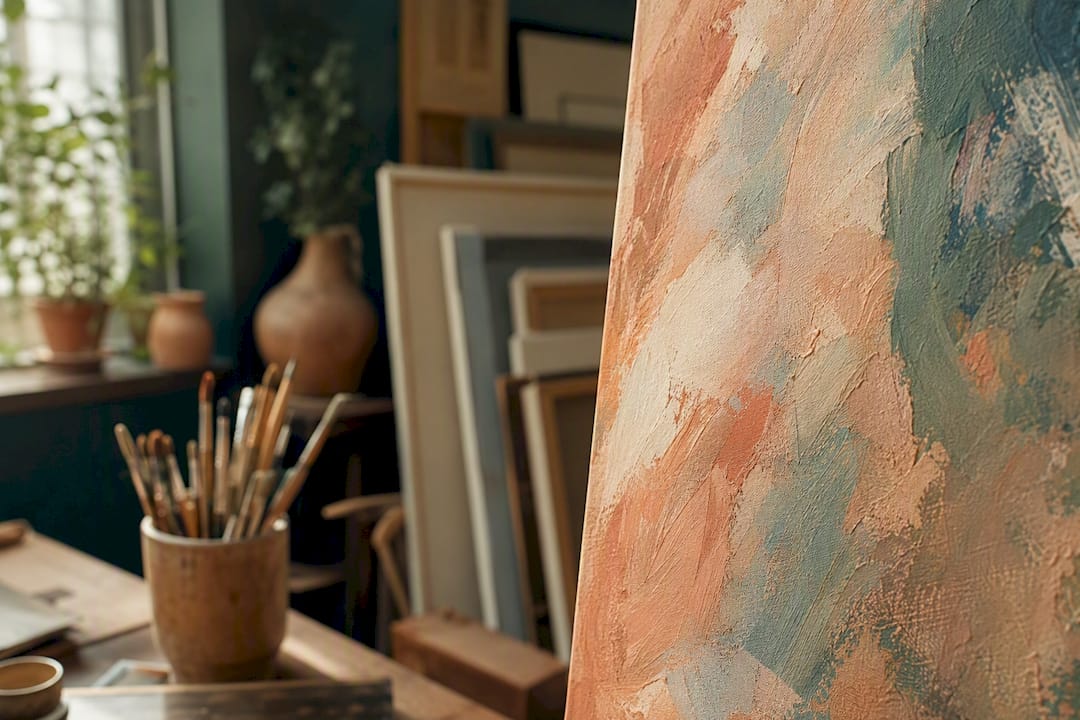
Hand-painted acrylic on stretched canvas tends to outperform digital print for large-format work, both in colour depth and long-term durability. Acrylic doesn’t yellow the way some inks do under UV exposure, and a properly stretched canvas resists the sagging that thinner substrates develop over years on the wall.
For commissions, ask what varnish is being used. A UV-protective varnish makes a meaningful difference in rooms with strong natural light, slowing fade without dulling the surface. Stretcher bar depth matters more than most buyers realise too. Anything under 38mm can bow slightly on canvases over five feet wide, so heavier-gauge bars are worth specifying for genuinely oversized work.
If durability against humidity matters, particularly in older properties or coastal locations, ask whether the canvas has been primed on both sides. This reduces the risk of warping that untreated cotton duck can develop over time.
How should you actually hang something this size?
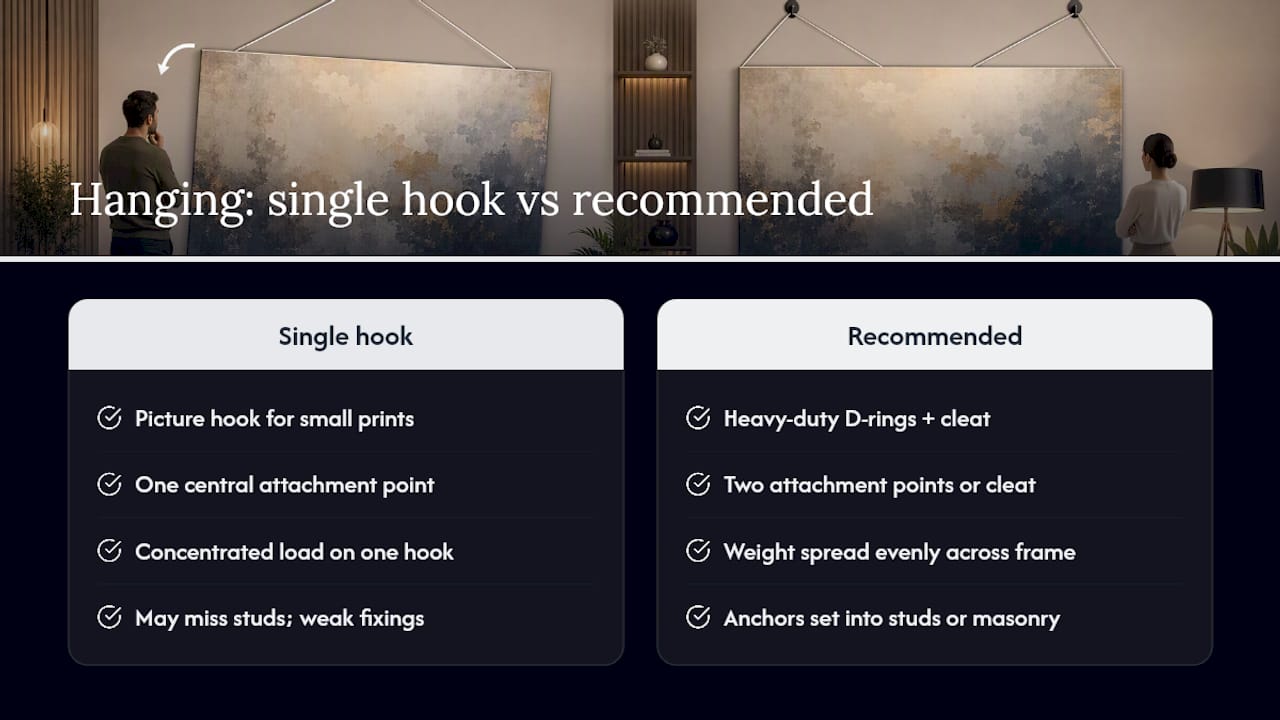
Hanging hardware for a large canvas needs to match its real weight, not its apparent size. A 6ft canvas on standard stretcher bars can weigh considerably more than expected once the frame is included, and picture hooks rated for small prints simply aren’t built for it.
Heavy-duty D-rings fixed into the stretcher bar frame, paired with a museum-grade wall cleat or French cleat system, distribute weight far more evenly than a single central hook. For very large or heavy pieces, two wall anchors set into studs (or appropriate masonry fixings on solid walls) spread the load and reduce the risk of the canvas shifting over time.
Get a second person for the actual hang. Large canvases are awkward rather than simply heavy, and a single installer trying to level a six-foot piece alone is the most common cause of crooked hangs and wall damage.
Leave the final positioning until after your mock-up stage confirms the height and placement. Eye-level guidance generally puts the centre of the piece around 145 to 150cm from the floor, though this shifts depending on ceiling height and whether furniture sits below it.
How do you keep a large canvas looking its best?
Direct sunlight is the biggest long-term threat to any canvas, hand-painted or printed. UV exposure fades pigment gradually, often before it’s visually obvious, so positioning matters as much as material choice.
Dust with a soft, dry brush or a microfibre cloth rather than a damp cloth, which can push moisture into the canvas weave and cause staining. Avoid household cleaning sprays entirely. Most contain solvents that will damage both paint and varnish.
Humidity swings, common in older UK homes without consistent heating, can cause canvas to expand and contract slightly over seasons. This is normal and rarely a problem unless the piece hangs near a radiator or a bathroom with poor ventilation, where repeated damp cycles can eventually loosen the canvas on its stretcher bars.
If a canvas does slacken over time, a professional can re-tension it on the original stretcher bars rather than requiring a full reframe, a far cheaper fix than most owners assume.
What goes wrong when hanging large canvases, and how do you fix it?
The most common issue isn’t damage, it’s misjudged wall space. A canvas that looked right on a tape measure sometimes looks wrong once it’s actually on the wall, usually because the surrounding furniture or door swing wasn’t accounted for. This is exactly why the mock-up stage matters more than the measuring stage.
Uneven walls, especially in older properties, can make a large canvas appear tilted even when it’s hung level. A small spirit level check against the actual wall surface, not just the frame, catches this before it becomes a visible problem.
Doorways and staircases present a genuine transport challenge for anything over roughly five feet in one dimension. This is where modular panels earn their keep again: a triptych can travel through a standard doorway in three manageable pieces where a single canvas would need to go in through a window.
Finally, lighting changes after installation catch people out more than any structural problem. A canvas that looked perfectly lit in the shop or studio can sit in shadow or glare once it’s on your actual wall. Testing the mock-up at different times of day, as covered earlier, remains the cheapest way to avoid this.
The commission-first mindset most guides get backwards
Most advice on large-scale wall art treats commissioning as the exotic, expensive option and ready-made as the sensible default. That gets the priority the wrong way round for a lot of walls. If your space has any awkwardness at all, an odd dimension, a specific palette already locked in by flooring or fabric, a ceiling height that standard stock sizes don’t anticipate, a commission usually solves the problem faster than searching stock collections hoping something fits by luck.
The conventional advice undersells how manageable commission timelines actually are. Six to ten weeks for a mid-size piece isn’t a long wait when set against the alternative: buying something that’s almost right and living with the compromise for years. Where readers should focus first isn’t cost, it’s fit. Get the wall’s real dimensions and light conditions sorted before worrying about price, because a well-briefed commission at a mid-range budget beats an expensive ready-made piece that was never quite right for the space.
Ready to put a large canvas on your wall?
Whichever route your wall points to, Frametheworld covers both without forcing a compromise. If your space is a standard size and you want something on the wall this month, browse the Wabi Sabi collection of hand-painted abstract textures built for exactly this kind of statement hang, or the bolder Pop Art collection if your room needs more energy than tone. Pieces like the Mariner’s Canvas abstract textured painting show what ready-made can look like at scale, no waiting, no guesswork about the final result.
If your wall is the awkward kind, an unusual height, a palette that has to match existing furniture exactly, get in touch to start a commission brief. Send your dimensions, room photos and mood direction, and Frametheworld will return a proposal covering price, materials and a realistic delivery date before any work begins.
Frequently asked questions
What size counts as a “large canvas”? Most designers treat anything from around 40 inches on its longest side as large enough to function as a single statement piece rather than part of a grouped display.
How long does a commissioned large canvas take? Expect 3 to 14 weeks depending on size and complexity, with most mid-size commissions landing around 6 to 10 weeks. Add extra time for framing and shipping.
Is commissioning more expensive than buying ready-made? Not always. Commission pricing often follows a sliding scale where large pieces cost less per square inch than small ones, though the final price still depends on materials and complexity. Ready-made remains faster and has a fixed, visible price from the outset.
What should I send an artist to start a commission? Wall dimensions, ceiling height, photos taken from the actual viewing angle, fabric or paint swatches, and a description of the mood you’re after. The more context you provide upfront, the fewer revision rounds you’ll need.
Do commissions come with any guarantees or documentation? Bespoke commissions typically include a Certificate of Authenticity and arrive via insured, crated delivery, standard trade practice for one-of-a-kind pieces.
Sources
- Oversized art buying and hanging tips — Apartment Therapy
- Commissioning a large-scale original: what the process is really like — Angela Simeone
- How to commission original artwork for interior design projects — Madhav Fine Art


Laat een reactie achter
Deze site wordt beschermd door hCaptcha en het privacybeleid en de servicevoorwaarden van hCaptcha zijn van toepassing.